ANIMATION
SUBMITTED BY: VEDANT SINGH
SUBMITTED TO: Mr. AMRITANSH MISHRA
BCA-1-B
BC2017110
CONTENTS
• Animation
• Types Of Animation
• Computer Animation Process
• Some Animation Software
• Animation Schools in India
• References
ANIMATION
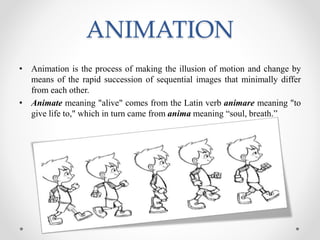
• Animation is the process of making the illusion of motion and change by
means of the rapid succession of sequential images that minimally differ
from each other.
• Animate meaning "alive" comes from the Latin verb animare meaning "to
give life to," which in turn came from anima meaning “soul, breath.”
TYPES OF ANIMATION
• 2-D animation
• 3-D animation
• Stop motion
• Claymation
• Cel animation
• Paint on glass animation
2-D ANIMATION
• Computer-assisted animation is typically two-dimensional (2-D), like
cartoons.
• Objects and characters are drawn either by hand or with a computer by an
animator.
• Next comes the process of key framing.
• Then, comes the process of tweening.
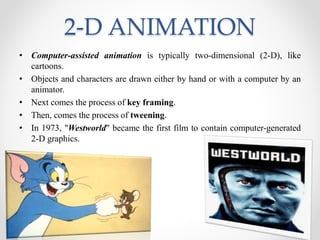
• In 1973, "Westworld" became the first film to contain computer-generated
2-D graphics.
3-D ANIMATION
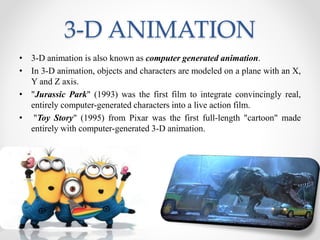
• 3-D animation is also known as computer generated animation.
• In 3-D animation, objects and characters are modeled on a plane with an X,
Y and Z axis.
• "Jurassic Park" (1993) was the first film to integrate convincingly real,
entirely computer-generated characters into a live action film.
• "Toy Story" (1995) from Pixar was the first full-length "cartoon" made
entirely with computer-generated 3-D animation.
STOP MOTION
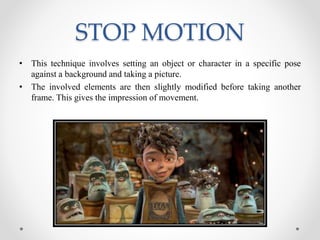
• This technique involves setting an object or character in a specific pose
against a background and taking a picture.
• The involved elements are then slightly modified before taking another
frame. This gives the impression of movement.
CLAYMATION
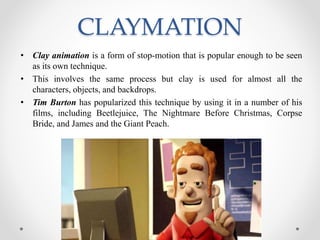
• Clay animation is a form of stop-motion that is popular enough to be seen
as its own technique.
• This involves the same process but clay is used for almost all the
characters, objects, and backdrops.
• Tim Burton has popularized this technique by using it in a number of his
films, including Beetlejuice, The Nightmare Before Christmas, Corpse
Bride, and James and the Giant Peach.
CEL ANIMATION
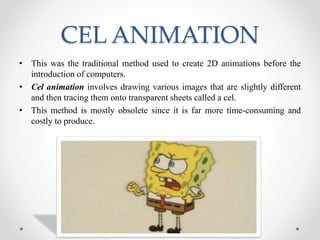
• This was the traditional method used to create 2D animations before the
introduction of computers.
• Cel animation involves drawing various images that are slightly different
and then tracing them onto transparent sheets called a cel.
• This method is mostly obsolete since it is far more time-consuming and
costly to produce.
PAINT ON GLASS
ANIMATION
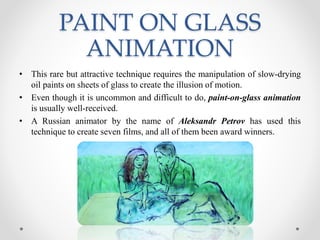
• This rare but attractive technique requires the manipulation of slow-drying
oil paints on sheets of glass to create the illusion of motion.
• Even though it is uncommon and difficult to do, paint-on-glass animation
is usually well-received.
• A Russian animator by the name of Aleksandr Petrov has used this
technique to create seven films, and all of them been award winners.
COMPUTER
ANIMATION PROCESS
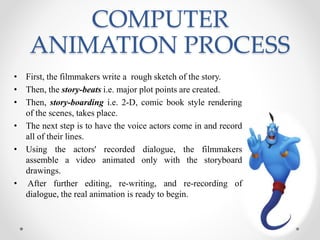
• First, the filmmakers write a rough sketch of the story.
• Then, the story-beats i.e. major plot points are created.
• Then, story-boarding i.e. 2-D, comic book style rendering
of the scenes, takes place.
• The next step is to have the voice actors come in and record
all of their lines.
• Using the actors' recorded dialogue, the filmmakers
assemble a video animated only with the storyboard
drawings.
• After further editing, re-writing, and re-recording of
dialogue, the real animation is ready to begin.
• The art department now designs all the characters, major set locations,
props and color palettes for the film in 3-D.
• Then comes the process called blocking. The director and lead animators
block the key character positions and camera angles for each and every
shot of the movie.
• Now teams of animators are each assigned short snippets of scenes. They
take the blocking instructions and create their own more detailed key
frames.
• Then begins the tweening process. The computer handles a lot of
the interpolation - calculating the best way to tween two key frames - but
the artist often has to tweak the results so they look even more lifelike.
• High-quality animated films are produced at a frame rate of 24 frames
per second (fps). For a 90 minute film, that's nearly 130,000 frames of
animation.
• Now the characters and props are given surface texture and color. Then
it's time to light the scenes, using ambient, omnidirectional and spotlights
to create depth, shadows and moods.
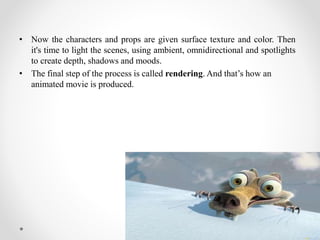
• The final step of the process is called rendering. And that’s how an
animated movie is produced.
SOME ANIMATION
SOFTWARES
2-D SOFTWARES:
 Pencil
 Creatoon
 Synfig Studio
 Stykz
3-D SOFTWARES:
 Blender
 DAZ Studio
 Aurora 3D Animation Maker
 Bryce
ANIMATION SCHOOLS
IN INDIA
 Arena Multimedia
 Maya Academy of Advanced Cinematic (MAAC)
 Zee Institute of Creative Arts (ZICA)
 Global School of Animation
 Whistling Woods International Institute
REFERENCES
• www.bloopanimation.com
• www.tutorialspoint.com
• www.howstuffworks.com
• Wikipedia
• www.careerindia.com

Animation- Vedant Singh

  • 1.
    ANIMATION SUBMITTED BY: VEDANTSINGH SUBMITTED TO: Mr. AMRITANSH MISHRA BCA-1-B BC2017110
  • 2.
    CONTENTS • Animation • TypesOf Animation • Computer Animation Process • Some Animation Software • Animation Schools in India • References
  • 3.
    ANIMATION • Animation isthe process of making the illusion of motion and change by means of the rapid succession of sequential images that minimally differ from each other. • Animate meaning "alive" comes from the Latin verb animare meaning "to give life to," which in turn came from anima meaning “soul, breath.”
  • 4.
    TYPES OF ANIMATION •2-D animation • 3-D animation • Stop motion • Claymation • Cel animation • Paint on glass animation
  • 5.
    2-D ANIMATION • Computer-assistedanimation is typically two-dimensional (2-D), like cartoons. • Objects and characters are drawn either by hand or with a computer by an animator. • Next comes the process of key framing. • Then, comes the process of tweening. • In 1973, "Westworld" became the first film to contain computer-generated 2-D graphics.
  • 6.
    3-D ANIMATION • 3-Danimation is also known as computer generated animation. • In 3-D animation, objects and characters are modeled on a plane with an X, Y and Z axis. • "Jurassic Park" (1993) was the first film to integrate convincingly real, entirely computer-generated characters into a live action film. • "Toy Story" (1995) from Pixar was the first full-length "cartoon" made entirely with computer-generated 3-D animation.
  • 7.
    STOP MOTION • Thistechnique involves setting an object or character in a specific pose against a background and taking a picture. • The involved elements are then slightly modified before taking another frame. This gives the impression of movement.
  • 8.
    CLAYMATION • Clay animationis a form of stop-motion that is popular enough to be seen as its own technique. • This involves the same process but clay is used for almost all the characters, objects, and backdrops. • Tim Burton has popularized this technique by using it in a number of his films, including Beetlejuice, The Nightmare Before Christmas, Corpse Bride, and James and the Giant Peach.
  • 9.
    CEL ANIMATION • Thiswas the traditional method used to create 2D animations before the introduction of computers. • Cel animation involves drawing various images that are slightly different and then tracing them onto transparent sheets called a cel. • This method is mostly obsolete since it is far more time-consuming and costly to produce.
  • 10.
    PAINT ON GLASS ANIMATION •This rare but attractive technique requires the manipulation of slow-drying oil paints on sheets of glass to create the illusion of motion. • Even though it is uncommon and difficult to do, paint-on-glass animation is usually well-received. • A Russian animator by the name of Aleksandr Petrov has used this technique to create seven films, and all of them been award winners.
  • 11.
    COMPUTER ANIMATION PROCESS • First,the filmmakers write a rough sketch of the story. • Then, the story-beats i.e. major plot points are created. • Then, story-boarding i.e. 2-D, comic book style rendering of the scenes, takes place. • The next step is to have the voice actors come in and record all of their lines. • Using the actors' recorded dialogue, the filmmakers assemble a video animated only with the storyboard drawings. • After further editing, re-writing, and re-recording of dialogue, the real animation is ready to begin.
  • 12.
    • The artdepartment now designs all the characters, major set locations, props and color palettes for the film in 3-D. • Then comes the process called blocking. The director and lead animators block the key character positions and camera angles for each and every shot of the movie. • Now teams of animators are each assigned short snippets of scenes. They take the blocking instructions and create their own more detailed key frames. • Then begins the tweening process. The computer handles a lot of the interpolation - calculating the best way to tween two key frames - but the artist often has to tweak the results so they look even more lifelike. • High-quality animated films are produced at a frame rate of 24 frames per second (fps). For a 90 minute film, that's nearly 130,000 frames of animation.
  • 13.
    • Now thecharacters and props are given surface texture and color. Then it's time to light the scenes, using ambient, omnidirectional and spotlights to create depth, shadows and moods. • The final step of the process is called rendering. And that’s how an animated movie is produced.
  • 14.
    SOME ANIMATION SOFTWARES 2-D SOFTWARES: Pencil  Creatoon  Synfig Studio  Stykz 3-D SOFTWARES:  Blender  DAZ Studio  Aurora 3D Animation Maker  Bryce
  • 15.
    ANIMATION SCHOOLS IN INDIA Arena Multimedia  Maya Academy of Advanced Cinematic (MAAC)  Zee Institute of Creative Arts (ZICA)  Global School of Animation  Whistling Woods International Institute
  • 16.
    REFERENCES • www.bloopanimation.com • www.tutorialspoint.com •www.howstuffworks.com • Wikipedia • www.careerindia.com