YEAR 4
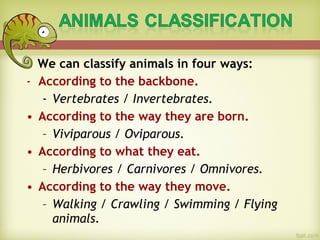
We can classify animals in four ways:
- According to the backbone.
- Vertebrates / Invertebrates.
• According to the way they are born.
– Viviparous / Oviparous.
• According to what they eat.
– Herbivores / Carnivores / Omnivores.
• According to the way they move.
– Walking / Crawling / Swimming / Flying
animals.
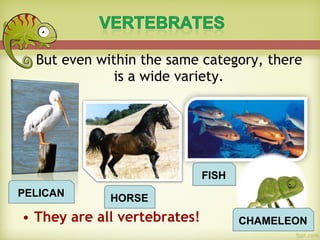
But even within the same category, there
is a wide variety.
• They are all vertebrates!
PELICAN HORSE
FISH
CHAMELEON
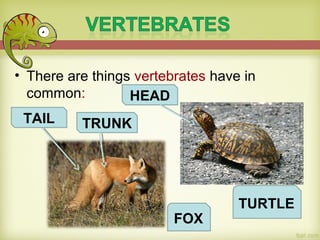
• There are things vertebrates have in
common:
TAIL
HEAD
TRUNK
FOX
TURTLE
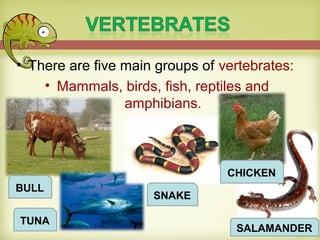
• There are five main groups of vertebrates:
• Mammals, birds, fish, reptiles and
amphibians.
BULL
TUNA
SNAKE
CHICKEN
SALAMANDER
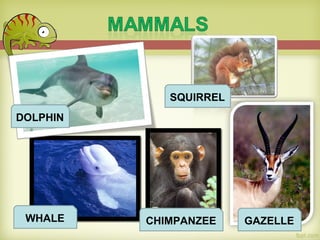
• Mammals are vertebrates and viviparous.
• Most of them have hair in their bodies.
• Most of them walk – others can swim, too,
and bats can fly.
• They are warm-blooded.
BAT GOAT
DOLPHIN
WHALE
SQUIRREL
CHIMPANZEE GAZELLE
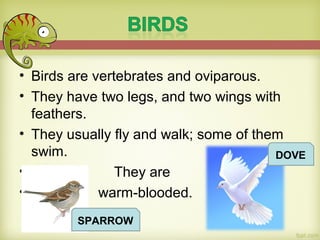
• Birds are vertebrates and oviparous.
• They have two legs, and two wings with
feathers.
• They usually fly and walk; some of them
swim.
• They are
• warm-blooded.
SPARROW
DOVE
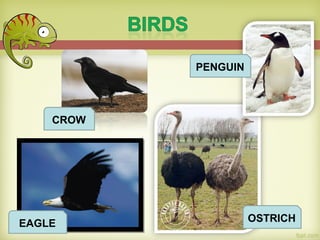
CROW
EAGLE
PENGUIN
OSTRICH
• Fish are vertebrates and oviparous.
• They have scales and fins.
• All of them swim.
• They are cold-blooded.
SHARK
CLOWN
FISH
SARDINE
TROUT
SALMON
SEAHORSE CATFISH
• Reptiles are vertebrate and mostly
oviparous.
• They have scales, and four or no legs.
• They can walk or crawl. Turtles swim.
• They are cold-blooded.
GECKO
IGUANA
FRILLED
LIZARD
COBRA
PYTHON
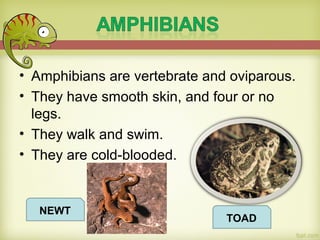
• Amphibians are vertebrate and oviparous.
• They have smooth skin, and four or no
legs.
• They walk and swim.
• They are cold-blooded.
NEWT
TOAD
AXOLOTL
SIREN
FROG

Animals classif2

  • 1.
  • 2.
    We can classifyanimals in four ways: - According to the backbone. - Vertebrates / Invertebrates. • According to the way they are born. – Viviparous / Oviparous. • According to what they eat. – Herbivores / Carnivores / Omnivores. • According to the way they move. – Walking / Crawling / Swimming / Flying animals.
  • 3.
    But even withinthe same category, there is a wide variety. • They are all vertebrates! PELICAN HORSE FISH CHAMELEON
  • 4.
    • There arethings vertebrates have in common: TAIL HEAD TRUNK FOX TURTLE
  • 5.
    • There arefive main groups of vertebrates: • Mammals, birds, fish, reptiles and amphibians. BULL TUNA SNAKE CHICKEN SALAMANDER
  • 6.
    • Mammals arevertebrates and viviparous. • Most of them have hair in their bodies. • Most of them walk – others can swim, too, and bats can fly. • They are warm-blooded. BAT GOAT
  • 7.
  • 8.
    • Birds arevertebrates and oviparous. • They have two legs, and two wings with feathers. • They usually fly and walk; some of them swim. • They are • warm-blooded. SPARROW DOVE
  • 9.
  • 10.
    • Fish arevertebrates and oviparous. • They have scales and fins. • All of them swim. • They are cold-blooded. SHARK CLOWN FISH
  • 11.
  • 12.
    • Reptiles arevertebrate and mostly oviparous. • They have scales, and four or no legs. • They can walk or crawl. Turtles swim. • They are cold-blooded. GECKO IGUANA
  • 13.
  • 14.
    • Amphibians arevertebrate and oviparous. • They have smooth skin, and four or no legs. • They walk and swim. • They are cold-blooded. NEWT TOAD
  • 15.