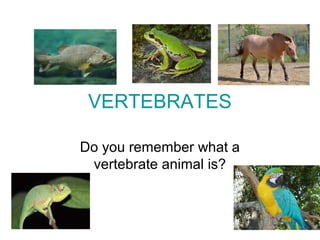
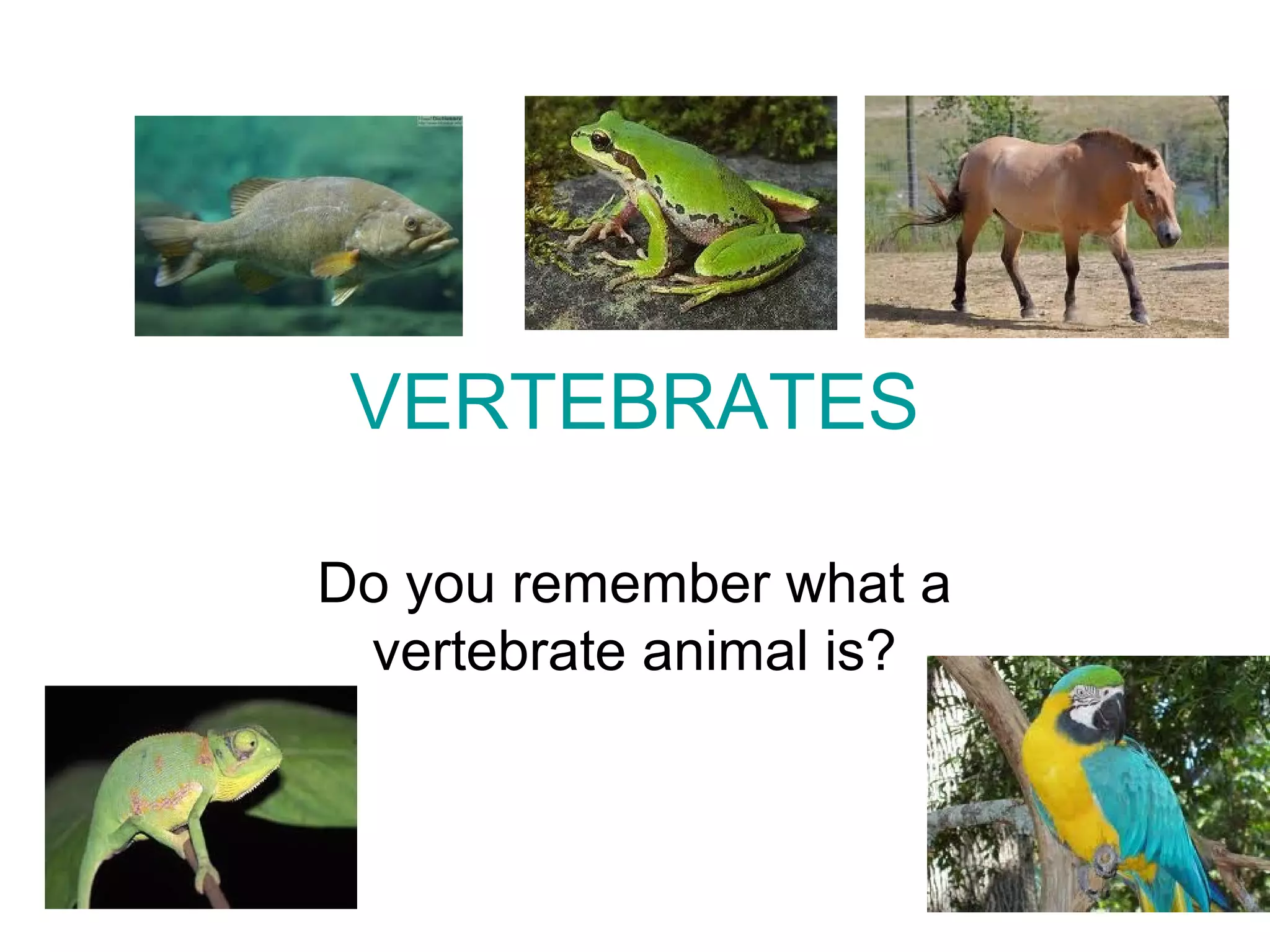
VERTEBRATES
Do you remember what a
vertebrate animal is?
• Vertebrates are animals with a
BACKBONE.
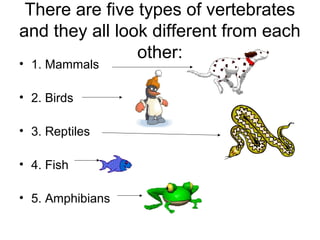
There are five types of vertebrates
and they all look different from each
other:
• 1. Mammals
• 2. Birds
• 3. Reptiles
• 4. Fish
• 5. Amphibians
1. MAMMALS
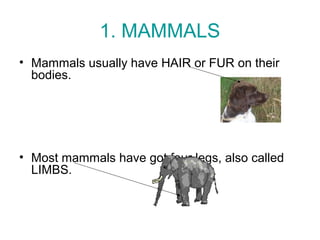
• Mammals usually have HAIR or FUR on their
bodies.
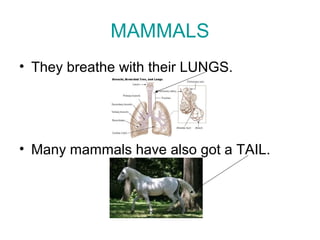
• Most mammals have got four legs, also called
LIMBS.
MAMMALS
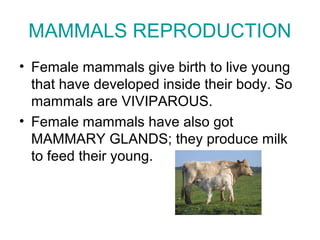
• They breathe with their LUNGS.
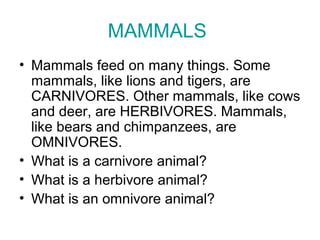
• Many mammals have also got a TAIL.
MAMMALS REPRODUCTION
• Female mammals give birth to live young
that have developed inside their body. So
mammals are VIVIPAROUS.
• Female mammals have also got
MAMMARY GLANDS; they produce milk
to feed their young.
MAMMALS
• Mammals feed on many things. Some
mammals, like lions and tigers, are
CARNIVORES. Other mammals, like cows
and deer, are HERBIVORES. Mammals,
like bears and chimpanzees, are
OMNIVORES.
• What is a carnivore animal?
• What is a herbivore animal?
• What is an omnivore animal?
MAMMALS
• Now, can you think of some examples of
mammals in English?
• Don’t forget that WHALES, DOLPHINS,
SEALS and BATS are also MAMMALS.
2. BIRDS
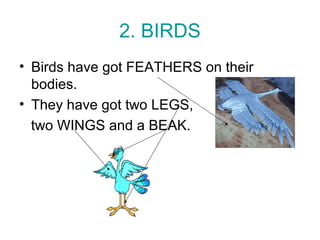
• Birds have got FEATHERS on their
bodies.
• They have got two LEGS,
two WINGS and a BEAK.
BIRDS
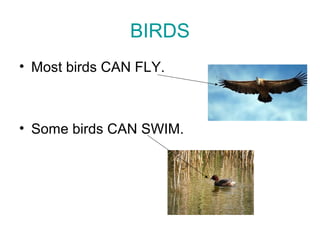
• Most birds CAN FLY.
• Some birds CAN SWIM.
BIRDS
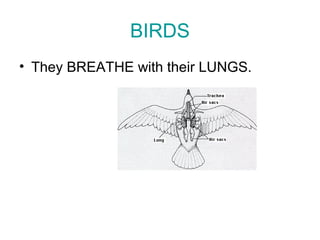
• They BREATHE with their LUNGS.
BIRDS
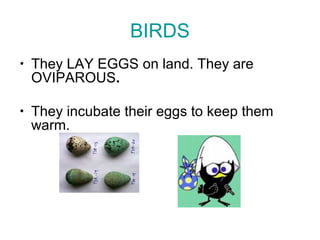
• They LAY EGGS on land. They are
OVIPAROUS.
• They incubate their eggs to keep them
warm.
BIRDS
• Now, can you think of some examples of
birds in English?
3. REPTILES
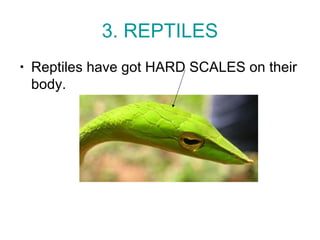
• Reptiles have got HARD SCALES on their
body.
REPTILES
• They’ve got lungs to breathe air.
• Most reptiles have four legs.
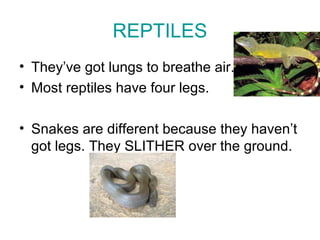
• Snakes are different because they haven’t
got legs. They SLITHER over the ground.
REPTILES
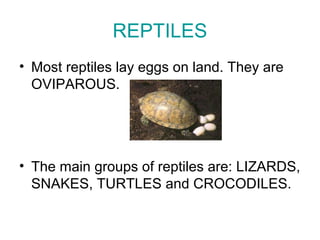
• Most reptiles lay eggs on land. They are
OVIPAROUS.
• The main groups of reptiles are: LIZARDS,
SNAKES, TURTLES and CROCODILES.
4. FISH
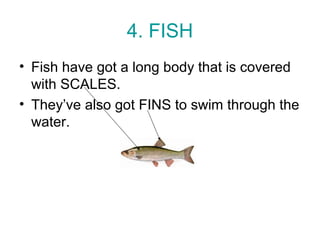
• Fish have got a long body that is covered
with SCALES.
• They’ve also got FINS to swim through the
water.
FISH
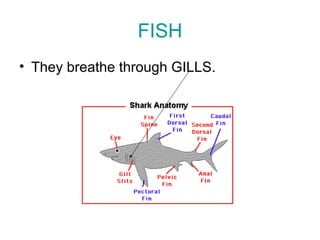
• They breathe through GILLS.
FISH
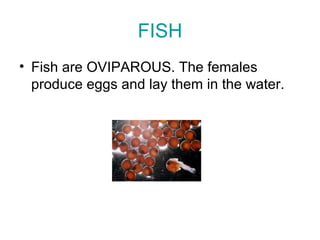
• Fish are OVIPAROUS. The females
produce eggs and lay them in the water.
5. AMPHIBIANS
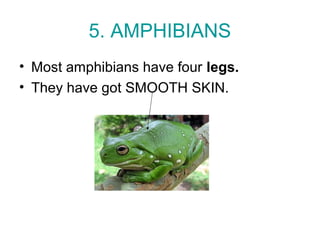
• Most amphibians have four legs.
• They have got SMOOTH SKIN.
AMPHIBIANS
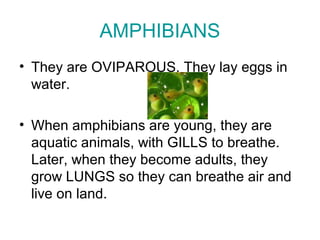
• They are OVIPAROUS. They lay eggs in
water.
• When amphibians are young, they are
aquatic animals, with GILLS to breathe.
Later, when they become adults, they
grow LUNGS so they can breathe air and
live on land.
AMPHIBIANS
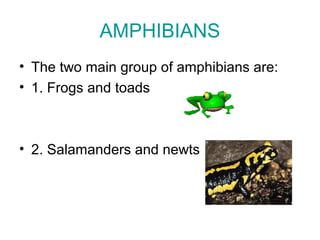
• The two main group of amphibians are:
• 1. Frogs and toads
• 2. Salamanders and newts
VERTEBRATES REVISION
• Can you answer the following questions?
1. What are VERTEBRATES?
2. Which groups of vertebrates are there?
3. What can you say about each group of
vertebrates?
4. Which group of animals do human beings
belong to?

Vertebrates 120706032503-phpapp02

  • 1.
    VERTEBRATES Do you rememberwhat a vertebrate animal is?
  • 2.
    • Vertebrates areanimals with a BACKBONE.
  • 3.
    There are fivetypes of vertebrates and they all look different from each other: • 1. Mammals • 2. Birds • 3. Reptiles • 4. Fish • 5. Amphibians
  • 4.
    1. MAMMALS • Mammalsusually have HAIR or FUR on their bodies. • Most mammals have got four legs, also called LIMBS.
  • 5.
    MAMMALS • They breathewith their LUNGS. • Many mammals have also got a TAIL.
  • 6.
    MAMMALS REPRODUCTION • Femalemammals give birth to live young that have developed inside their body. So mammals are VIVIPAROUS. • Female mammals have also got MAMMARY GLANDS; they produce milk to feed their young.
  • 7.
    MAMMALS • Mammals feedon many things. Some mammals, like lions and tigers, are CARNIVORES. Other mammals, like cows and deer, are HERBIVORES. Mammals, like bears and chimpanzees, are OMNIVORES. • What is a carnivore animal? • What is a herbivore animal? • What is an omnivore animal?
  • 8.
    MAMMALS • Now, canyou think of some examples of mammals in English? • Don’t forget that WHALES, DOLPHINS, SEALS and BATS are also MAMMALS.
  • 9.
    2. BIRDS • Birdshave got FEATHERS on their bodies. • They have got two LEGS, two WINGS and a BEAK.
  • 10.
    BIRDS • Most birdsCAN FLY. • Some birds CAN SWIM.
  • 11.
    BIRDS • They BREATHEwith their LUNGS.
  • 12.
    BIRDS • They LAYEGGS on land. They are OVIPAROUS. • They incubate their eggs to keep them warm.
  • 13.
    BIRDS • Now, canyou think of some examples of birds in English?
  • 14.
    3. REPTILES • Reptileshave got HARD SCALES on their body.
  • 15.
    REPTILES • They’ve gotlungs to breathe air. • Most reptiles have four legs. • Snakes are different because they haven’t got legs. They SLITHER over the ground.
  • 16.
    REPTILES • Most reptileslay eggs on land. They are OVIPAROUS. • The main groups of reptiles are: LIZARDS, SNAKES, TURTLES and CROCODILES.
  • 17.
    4. FISH • Fishhave got a long body that is covered with SCALES. • They’ve also got FINS to swim through the water.
  • 18.
    FISH • They breathethrough GILLS.
  • 19.
    FISH • Fish areOVIPAROUS. The females produce eggs and lay them in the water.
  • 20.
    5. AMPHIBIANS • Mostamphibians have four legs. • They have got SMOOTH SKIN.
  • 21.
    AMPHIBIANS • They areOVIPAROUS. They lay eggs in water. • When amphibians are young, they are aquatic animals, with GILLS to breathe. Later, when they become adults, they grow LUNGS so they can breathe air and live on land.
  • 22.
    AMPHIBIANS • The twomain group of amphibians are: • 1. Frogs and toads • 2. Salamanders and newts
  • 23.
    VERTEBRATES REVISION • Canyou answer the following questions? 1. What are VERTEBRATES? 2. Which groups of vertebrates are there? 3. What can you say about each group of vertebrates? 4. Which group of animals do human beings belong to?