things
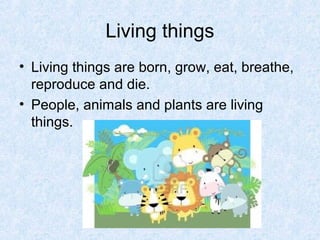
Living things
• Living things are born, grow, eat, breathe,
  reproduce and die.
• People, animals and plants are living
  things.
Non-living things
• Non-living things do not eat or grow.
• The Sun and rocks are non-living things.
• Cars, tables, or books are non-living
  things.
Animals and plants
• Plants cannot move from one place to
  another.
• They are fixed to the ground
   by the roots.
• Plants make their own
  food using water,
  minerals and sunlight.
Animals
• Animals can move from one place to
  another.
• They need to eat plants
  and other animals
  to live.
Classification of animals
We can classify animals using different
   criteria:
• The skeleton:
 - Vertebrates have
     a skeleton
  - Invertebrates
    do not have a
    skeleton
Classification of animals
The way animals are born:
• Viviparous animals are
  born from their
  mother’s womb.
• Oviparous animals
  are born from eggs.
Classification of animals
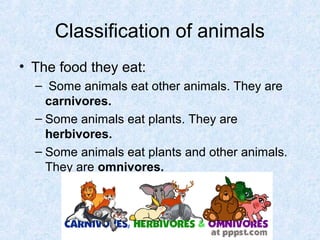
• The food they eat:
  – Some animals eat other animals. They are
    carnivores.
  – Some animals eat plants. They are
    herbivores.
  – Some animals eat plants and other animals.
    They are omnivores.
Vertebrates
• Vertebrates have a skeleton made up of bones
  and a spinal column.
• Vertebrates’ bodies have several parts:
  - head
  - trunk
  - limbs (arms, legs,
    wings or fins)
  - tail (a extension of
    the spinal column)
Classification of vertebrates
• Mammals
 - They are viviparous. They drink mother’s
         milk when they are babies.
 - They breath with lungs.
 - Most of then can walk,
   but others like dolphins
   or whales can swim.
 - Bats can fly.
Classification of vertebrates
• Birds
 – They are oviparous.
 – They breath with lungs.
 – They have two wings. Most of then
  can fly.
Classification of vertebrates
• Amphibians
 – They are oviparous.
 – When they are babies
   they live in water.
   They breath with gills
   and they can swim.
 – When they are adults they live on land.
   They breath with lungs and they can walk.
Classification of vertebrates
• Reptiles

 - They are oviparous.
 - They breath with lungs.
 - Snakes have no legs
   and they can crawl.
Classification of vertebrates
• Fish
 –   They live in water.
 –   They are oviparous.
 –   They breath with gills.
 –   They have fins and they can swim.

Livingthings.3 cm

  • 1.
  • 2.
    Living things • Livingthings are born, grow, eat, breathe, reproduce and die. • People, animals and plants are living things.
  • 3.
    Non-living things • Non-livingthings do not eat or grow. • The Sun and rocks are non-living things. • Cars, tables, or books are non-living things.
  • 4.
    Animals and plants •Plants cannot move from one place to another. • They are fixed to the ground by the roots. • Plants make their own food using water, minerals and sunlight.
  • 5.
    Animals • Animals canmove from one place to another. • They need to eat plants and other animals to live.
  • 6.
    Classification of animals Wecan classify animals using different criteria: • The skeleton: - Vertebrates have a skeleton - Invertebrates do not have a skeleton
  • 7.
    Classification of animals Theway animals are born: • Viviparous animals are born from their mother’s womb. • Oviparous animals are born from eggs.
  • 8.
    Classification of animals •The food they eat: – Some animals eat other animals. They are carnivores. – Some animals eat plants. They are herbivores. – Some animals eat plants and other animals. They are omnivores.
  • 9.
    Vertebrates • Vertebrates havea skeleton made up of bones and a spinal column. • Vertebrates’ bodies have several parts: - head - trunk - limbs (arms, legs, wings or fins) - tail (a extension of the spinal column)
  • 10.
    Classification of vertebrates •Mammals - They are viviparous. They drink mother’s milk when they are babies. - They breath with lungs. - Most of then can walk, but others like dolphins or whales can swim. - Bats can fly.
  • 11.
    Classification of vertebrates •Birds – They are oviparous. – They breath with lungs. – They have two wings. Most of then can fly.
  • 12.
    Classification of vertebrates •Amphibians – They are oviparous. – When they are babies they live in water. They breath with gills and they can swim. – When they are adults they live on land. They breath with lungs and they can walk.
  • 13.
    Classification of vertebrates •Reptiles - They are oviparous. - They breath with lungs. - Snakes have no legs and they can crawl.
  • 14.
    Classification of vertebrates •Fish – They live in water. – They are oviparous. – They breath with gills. – They have fins and they can swim.