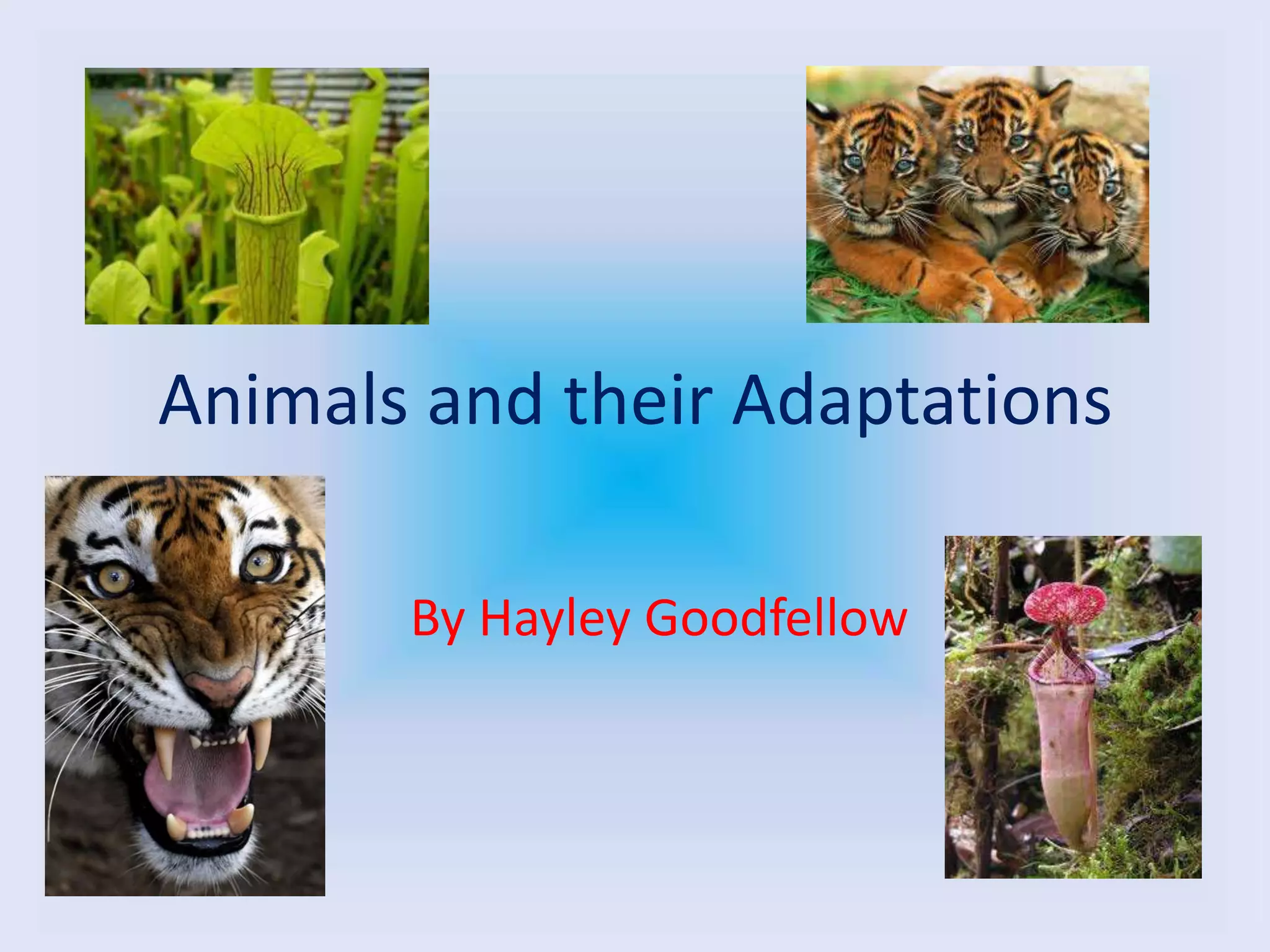
Animals and their Adaptations

       By Hayley Goodfellow
Tiger
Type of Adaptation: Structural Adaptation:
What the Adaptation is: Striped Coat
How does the adaptation help it to survive: The tiger's striped coat helps
them blend in well with the sunlight that comes through the trees to the
jungle floor. The tiger's camouflage to their surroundings is greater because
the striping also helps break up their body shape, making them difficult to
detect from their prey.

Type of Adaptation: Behavioural
What is the Adaptation: Very strong sense of hearing
How does the adaptation help it to survive: The tiger's sense of hearing is so
sharp that they are capable of hearing sound waves below the range of
normally audible sound. Tigers use infrasound to communicate over long
distances such as dense forest vegetation because the sound is capable of
passing through trees and mountains. Their strong sense of hearing can be
used to hear incoming enemies or prey.
Cobra Lily/ Pitcher Plant
Type of Adaptation: Structural Adaptation
What the Adaption is: Flower growth
How does it help the plant to survive: Flowers growing on a plant is usually a
welcoming and growing peaceful plant meaning that insects can stop to rest on this
carnivorous plant in which the plant would drown the insects which is the way that
the flower digests its food. It adapted to finding its nitrogen requirements through
carnivory, which helps to make up for the lack of available nitrogen in some habitats.

Type of Adaptation:
What the Adaption is: Survive Ragging Temperatures
How does it help the plant to survive: The cobra lily is able to survive fire by
regenerating from its roots, but despite this important role the roots are very delicate.
While the temperatures in much of the species range can exceed 25 °C. The plant
roots die after exposure to temperatures not much higher than 10 °C. Temperature
plays a large part in the functioning of all plants, but it is very rare for individual organs
to have such different temperature characteristics.

Animals and their adaptations

  • 1.
    Animals and theirAdaptations By Hayley Goodfellow
  • 2.
    Tiger Type of Adaptation:Structural Adaptation: What the Adaptation is: Striped Coat How does the adaptation help it to survive: The tiger's striped coat helps them blend in well with the sunlight that comes through the trees to the jungle floor. The tiger's camouflage to their surroundings is greater because the striping also helps break up their body shape, making them difficult to detect from their prey. Type of Adaptation: Behavioural What is the Adaptation: Very strong sense of hearing How does the adaptation help it to survive: The tiger's sense of hearing is so sharp that they are capable of hearing sound waves below the range of normally audible sound. Tigers use infrasound to communicate over long distances such as dense forest vegetation because the sound is capable of passing through trees and mountains. Their strong sense of hearing can be used to hear incoming enemies or prey.
  • 3.
    Cobra Lily/ PitcherPlant Type of Adaptation: Structural Adaptation What the Adaption is: Flower growth How does it help the plant to survive: Flowers growing on a plant is usually a welcoming and growing peaceful plant meaning that insects can stop to rest on this carnivorous plant in which the plant would drown the insects which is the way that the flower digests its food. It adapted to finding its nitrogen requirements through carnivory, which helps to make up for the lack of available nitrogen in some habitats. Type of Adaptation: What the Adaption is: Survive Ragging Temperatures How does it help the plant to survive: The cobra lily is able to survive fire by regenerating from its roots, but despite this important role the roots are very delicate. While the temperatures in much of the species range can exceed 25 °C. The plant roots die after exposure to temperatures not much higher than 10 °C. Temperature plays a large part in the functioning of all plants, but it is very rare for individual organs to have such different temperature characteristics.