Animal
Tissue
.
What makes TISSUES
interesting?
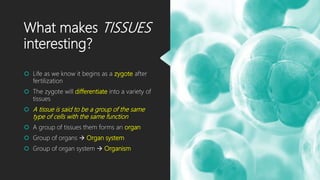
 Life as we know it begins as a zygote after
fertilization
 The zygote will differentiate into a variety of
tissues
 A tissue is said to be a group of the same
type of cells with the same function
 A group of tissues them forms an organ
 Group of organs  Organ system
 Group of organ system  Organism
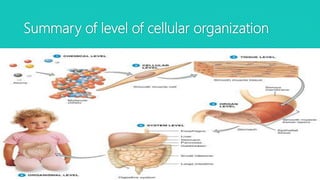
Summary of level of cellular organization
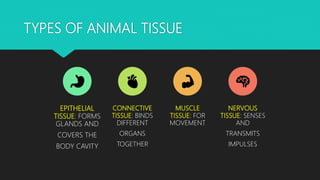
TYPES OF ANIMAL TISSUE
EPITHELIAL
TISSUE: FORMS
GLANDS AND
COVERS THE
BODY CAVITY
CONNECTIVE
TISSUE: BINDS
DIFFERENT
ORGANS
TOGETHER
MUSCLE
TISSUE: FOR
MOVEMENT
NERVOUS
TISSUE: SENSES
AND
TRANSMITS
IMPULSES
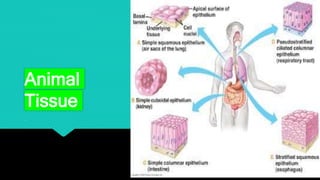
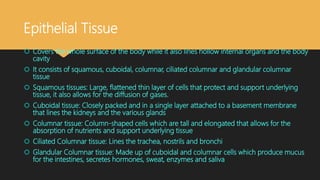
Epithelial Tissue
 Covers the whole surface of the body while it also lines hollow internal organs and the body
cavity
 It consists of squamous, cuboidal, columnar, ciliated columnar and glandular columnar
tissue
 Squamous tissues: Large, flattened thin layer of cells that protect and support underlying
tissue, it also allows for the diffusion of gases.
 Cuboidal tissue: Closely packed and in a single layer attached to a basement membrane
that lines the kidneys and the various glands
 Columnar tissue: Column-shaped cells which are tall and elongated that allows for the
absorption of nutrients and support underlying tissue
 Ciliated Columnar tissue: Lines the trachea, nostrils and bronchi
 Glandular Columnar tissue: Made up of cuboidal and columnar cells which produce mucus
for the intestines, secretes hormones, sweat, enzymes and saliva
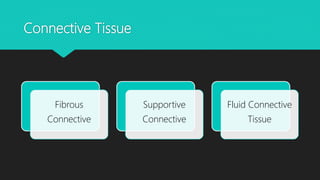
Connective Tissue
Fibrous
Connective
Supportive
Connective
Fluid Connective
Tissue
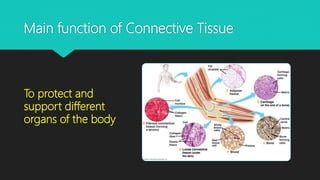
Main function of Connective Tissue
To protect and
support different
organs of the body
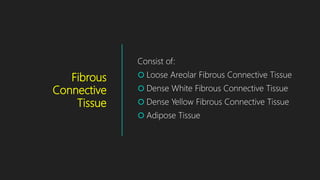
Fibrous
Connective
Tissue
Consist of:
 Loose Areolar Fibrous Connective Tissue
 Dense White Fibrous Connective Tissue
 Dense Yellow Fibrous Connective Tissue
 Adipose Tissue
Supportive
Fibrous
Connective
Tissue
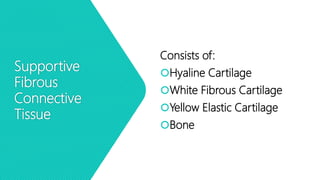
Consists of:
Hyaline Cartilage
White Fibrous Cartilage
Yellow Elastic Cartilage
Bone
Fluid
Connective
Tissue
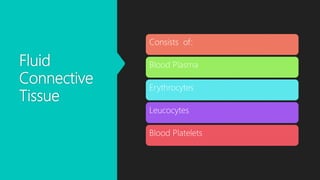
Consists of:
Blood Plasma
Erythrocytes
Leucocytes
Blood Platelets
Blood Plasma
 They mainly consists of water along other nutrients, organic waste, plasma proteins, hormones,
dissolved gasses and inorganic salts
 Found in a matrix that contains blood cells and are said to be straw colour fluid
 They transport hormones, cellular waste, digested food and they also regulate the temperature
of the body
Red Blood Cells
(Erythrocytes)
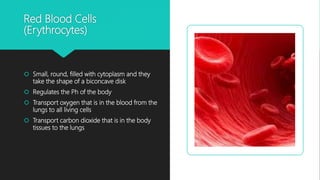
 Small, round, filled with cytoplasm and they
take the shape of a biconcave disk
 Regulates the Ph of the body
 Transport oxygen that is in the blood from the
lungs to all living cells
 Transport carbon dioxide that is in the body
tissues to the lungs
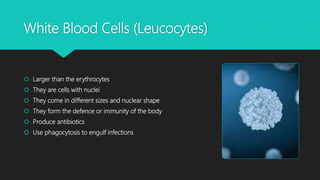
White Blood Cells (Leucocytes)
 Larger than the erythrocytes
 They are cells with nuclei
 They come in different sizes and nuclear shape
 They form the defence or immunity of the body
 Produce antibiotics
 Use phagocytosis to engulf infections
Blood Platelets
 Present in the bone marrow
 Giant cells with small discs having no nuclei
 Seal damaged blood vessels by releasing molecules that help with the clotting of the blood
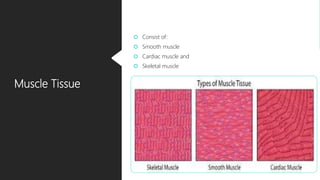
Muscle Tissue
 Consist of:
 Smooth muscle
 Cardiac muscle and
 Skeletal muscle
Smooth muscles
 Widespread in the body
 Walls of blood vessels, digestive tract, respiratory duct, urinary duct and reproductive duct
 Responsible for involuntary movements of organs
 Control the movement of substances moving in internal passages such blood in blood vessels
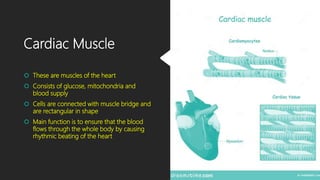
Cardiac Muscle
 These are muscles of the heart
 Consists of glucose, mitochondria and
blood supply
 Cells are connected with muscle bridge and
are rectangular in shape
 Main function is to ensure that the blood
flows through the whole body by causing
rhythmic beating of the heart
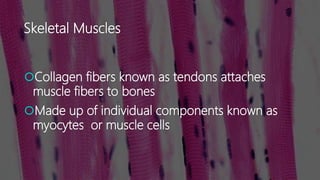
Skeletal Muscles
Collagen fibers known as tendons attaches
muscle fibers to bones
Made up of individual components known as
myocytes or muscle cells
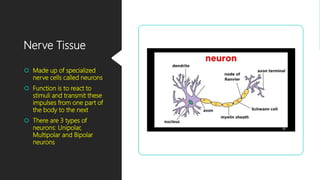
Nerve Tissue
 Made up of specialized
nerve cells called neurons
 Function is to react to
stimuli and transmit these
impulses from one part of
the body to the next
 There are 3 types of
neurons: Unipolar,
Multipolar and Bipolar
neurons
References
Dhital, M., 2019. Slideshare: Animal Tissue Notes. [Online]
Available at: https://www.slideshare.net/ManojDhital2/animal-tissue-notes?qid=4a11fc37-e168-472c-b092-f10724c731ae&v=&b=&from_search=1
[Accessed 14 August 2020].
Majumder, B., 2014. Slideshare: Animal Tissues. [Online]
Available at: https://www.slideshare.net/BiswarupMajumder/animal-tissues-100417056?qid=4a11fc37-e168-472c-b092-f10724c731ae&v=&b=&from_search=19
[Accessed 16 August 2020].
Motsoko, E., 2018. Slideshare. [Online]
Available at: https://www.slideshare.net/MOYAHABOMOTSOKO/unit-4-animal-tissue-111742232?qid=4a11fc37-e168-472c-b092-f10724c731ae&v=&b=&from_search=7
[Accessed 16 August 2020].
Piston, V. J., 2013. Animal Tissue. [Online]
Available at: https://www.slideshare.net/vieljoypiston/animal-tissue-by-viel-joy-piston?qid=4a11fc37-e168-472c-b092-f10724c731ae&v=&b=&from_search=5
[Accessed 17 July 2020].
Rana, J., 2015. Slideshare: Animal Tissue PPT by Jasveer Rana. [Online]
Available at: https://www.slideshare.net/jasveerrana79/animal-tissue-ppt-by-jasveer-rana?qid=4a11fc37-e168-472c-b092-f10724c731ae&v=&b=&from_search=10
[Accessed 16 August 2020].

Animal tissue

  • 1.
  • 2.
    What makes TISSUES interesting? Life as we know it begins as a zygote after fertilization  The zygote will differentiate into a variety of tissues  A tissue is said to be a group of the same type of cells with the same function  A group of tissues them forms an organ  Group of organs  Organ system  Group of organ system  Organism
  • 3.
    Summary of levelof cellular organization
  • 4.
    TYPES OF ANIMALTISSUE EPITHELIAL TISSUE: FORMS GLANDS AND COVERS THE BODY CAVITY CONNECTIVE TISSUE: BINDS DIFFERENT ORGANS TOGETHER MUSCLE TISSUE: FOR MOVEMENT NERVOUS TISSUE: SENSES AND TRANSMITS IMPULSES
  • 5.
    Epithelial Tissue  Coversthe whole surface of the body while it also lines hollow internal organs and the body cavity  It consists of squamous, cuboidal, columnar, ciliated columnar and glandular columnar tissue  Squamous tissues: Large, flattened thin layer of cells that protect and support underlying tissue, it also allows for the diffusion of gases.  Cuboidal tissue: Closely packed and in a single layer attached to a basement membrane that lines the kidneys and the various glands  Columnar tissue: Column-shaped cells which are tall and elongated that allows for the absorption of nutrients and support underlying tissue  Ciliated Columnar tissue: Lines the trachea, nostrils and bronchi  Glandular Columnar tissue: Made up of cuboidal and columnar cells which produce mucus for the intestines, secretes hormones, sweat, enzymes and saliva
  • 6.
  • 7.
    Main function ofConnective Tissue To protect and support different organs of the body
  • 8.
    Fibrous Connective Tissue Consist of:  LooseAreolar Fibrous Connective Tissue  Dense White Fibrous Connective Tissue  Dense Yellow Fibrous Connective Tissue  Adipose Tissue
  • 9.
    Supportive Fibrous Connective Tissue Consists of: Hyaline Cartilage WhiteFibrous Cartilage Yellow Elastic Cartilage Bone
  • 10.
  • 11.
    Blood Plasma  Theymainly consists of water along other nutrients, organic waste, plasma proteins, hormones, dissolved gasses and inorganic salts  Found in a matrix that contains blood cells and are said to be straw colour fluid  They transport hormones, cellular waste, digested food and they also regulate the temperature of the body
  • 12.
    Red Blood Cells (Erythrocytes) Small, round, filled with cytoplasm and they take the shape of a biconcave disk  Regulates the Ph of the body  Transport oxygen that is in the blood from the lungs to all living cells  Transport carbon dioxide that is in the body tissues to the lungs
  • 13.
    White Blood Cells(Leucocytes)  Larger than the erythrocytes  They are cells with nuclei  They come in different sizes and nuclear shape  They form the defence or immunity of the body  Produce antibiotics  Use phagocytosis to engulf infections
  • 14.
    Blood Platelets  Presentin the bone marrow  Giant cells with small discs having no nuclei  Seal damaged blood vessels by releasing molecules that help with the clotting of the blood
  • 15.
    Muscle Tissue  Consistof:  Smooth muscle  Cardiac muscle and  Skeletal muscle
  • 16.
    Smooth muscles  Widespreadin the body  Walls of blood vessels, digestive tract, respiratory duct, urinary duct and reproductive duct  Responsible for involuntary movements of organs  Control the movement of substances moving in internal passages such blood in blood vessels
  • 17.
    Cardiac Muscle  Theseare muscles of the heart  Consists of glucose, mitochondria and blood supply  Cells are connected with muscle bridge and are rectangular in shape  Main function is to ensure that the blood flows through the whole body by causing rhythmic beating of the heart
  • 18.
    Skeletal Muscles Collagen fibersknown as tendons attaches muscle fibers to bones Made up of individual components known as myocytes or muscle cells
  • 19.
    Nerve Tissue  Madeup of specialized nerve cells called neurons  Function is to react to stimuli and transmit these impulses from one part of the body to the next  There are 3 types of neurons: Unipolar, Multipolar and Bipolar neurons
  • 20.
    References Dhital, M., 2019.Slideshare: Animal Tissue Notes. [Online] Available at: https://www.slideshare.net/ManojDhital2/animal-tissue-notes?qid=4a11fc37-e168-472c-b092-f10724c731ae&v=&b=&from_search=1 [Accessed 14 August 2020]. Majumder, B., 2014. Slideshare: Animal Tissues. [Online] Available at: https://www.slideshare.net/BiswarupMajumder/animal-tissues-100417056?qid=4a11fc37-e168-472c-b092-f10724c731ae&v=&b=&from_search=19 [Accessed 16 August 2020]. Motsoko, E., 2018. Slideshare. [Online] Available at: https://www.slideshare.net/MOYAHABOMOTSOKO/unit-4-animal-tissue-111742232?qid=4a11fc37-e168-472c-b092-f10724c731ae&v=&b=&from_search=7 [Accessed 16 August 2020]. Piston, V. J., 2013. Animal Tissue. [Online] Available at: https://www.slideshare.net/vieljoypiston/animal-tissue-by-viel-joy-piston?qid=4a11fc37-e168-472c-b092-f10724c731ae&v=&b=&from_search=5 [Accessed 17 July 2020]. Rana, J., 2015. Slideshare: Animal Tissue PPT by Jasveer Rana. [Online] Available at: https://www.slideshare.net/jasveerrana79/animal-tissue-ppt-by-jasveer-rana?qid=4a11fc37-e168-472c-b092-f10724c731ae&v=&b=&from_search=10 [Accessed 16 August 2020].