STUDY OF COMMONLY USED
EXPERIMENTAL ANIMALS.
BHAGYASHREE SAHOO
M.PHARMA (PHARMACOLOGY)
DADHICHI COLLEGE OF PHARMACY
CONTENT
INTRODUCTION.
EXPERIMENTAL PHARMACOLOGY AND ITS AIM.
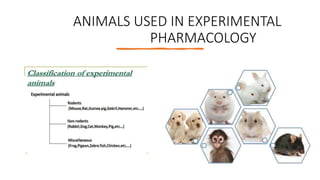
ANIMALS USED IN EXPERIMENTAL PHARMACOLOGY.
HANDLING OF ANIMALS.
INTRODUCTION
• Physiologically and anatomically, there is a
similarity between the humans and animals at
organ and organ system , which functions in a
similar manner.
• This similarity makes animals ideal model for the
study and development of products and technique
for humans.
• It was the use of animals in the laboratory that
lead to the discovery of the diptheria and polio
vaccines , insulin for the treatment of diabetes
mellitus , heart valve replacement , antibiotic
therapy, manic-depressive drugs and the list goes
on and on.
EXPERIMENTAL PHARMACOLOGY AND ITS AIM.
• EXPERIMENTAL PHARMACOLOGY :-
Experimental pharmacology is a study through experimental design in controlled
situations which involves testing of pharmacologically unknown substance and
pharmaceutical products in animals.
AIM OF EXPERIMENTAL PHARMACOLOGY
• Find out the therapeutic agent suitable for human use.
• Study the efficacy and toxicity of the drug .
• Study the mechanisms and site of action of the drug.
ANIMALS USED IN EXPERIMENTAL
PHARMACOLOGY
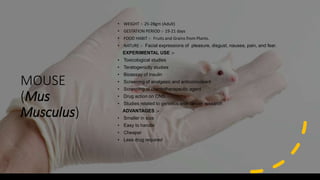
MOUSE
(Mus
Musculus)
• WEIGHT :- 25-28gm (Adult)
• GESTATION PERIOD :- 19-21 days
• FOOD HABIT :- Fruits and Grains from Plants.
• NATURE :- Facial expressions of pleasure, disgust, nausea, pain, and fear.
EXPERIMENTAL USE :-
• Toxicological studies
• Teratogenicity studies
• Bioassay of insulin
• Screening of analgesic and anticonvulsant
• Screening of chemotherapeutic agent
• Drug action on CNS.
• Studies related to genetics and cancer research
ADVANTAGES :-
• Smaller in size
• Easy to handle
• Cheaper
• Less drug required
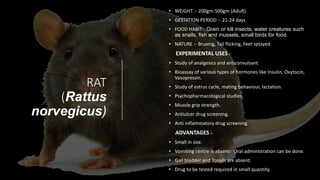
RAT
(Rattus
norvegicus)
• WEIGHT :- 200gm-500gm (Adult)
• GESTATION PERIOD :- 21-24 days
• FOOD HABIT :-Grain or kill insects, water creatures such
as snails, fish and mussels, small birds for food.
• NATURE :- Bruxing, Tail flicking, Feet splayed.
EXPERIMENTAL USES :-
• Study of analgesics and anticonvulsant.
• Bioassay of various types of hormones like Insulin, Oxytocin,
Vasopressin.
• Study of estrus cycle, mating behaviour, lactation.
• Psychopharmacological studies.
• Muscle grip strength.
• Antiulcer drug screening.
• Anti inflammatory drug screening.
ADVANTAGES :-
• Small in size.
• Vomiting centre is absent- Oral administration can be done.
• Gall bladder and Tonsils are absent.
• Drug to be tested required in small quantity.
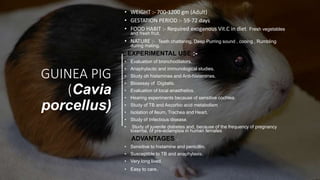
GUINEA PIG
(Cavia
porcellus)
• WEIGHT :- 700-1200 gm (Adult)
• GESTATION PERIOD :- 59-72 days
• FOOD HABIT :- Required exogenous Vit.C in diet. Fresh vegetables
and fresh fruit.
• NATURE :- Teeth chattering, Deep Purring sound , cooing , Rumbling
during mating.
EXPERIMENTAL USE :-
• Evaluation of bronchodilators.
• Anaphylactic and immunological studies.
• Study oh histamines and Anti-histamines.
• Bioassay of Digitalis.
• Evaluation of local anasthetics.
• Hearing experiments because of sensitive cochlea.
• Study of TB and Ascorbic acid metabolism
• Isolation of lleum, Trachea and Heart.
• Study of Infectious disease.
• Study of juvenile diabetes and, because of the frequency of pregnancy
toxemia, of pre-eclampsia in human females.
ADVANTAGES :-
• Sensitive to histamine and penicillin.
• Susceptible to TB and anaphylaxis.
• Very long lived.
• Easy to care.
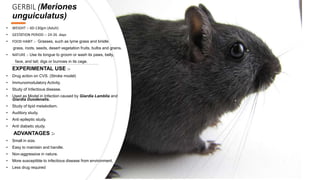
GERBIL (Meriones
unguiculatus)
• WEIGHT :- 60-130gm (Adult)
• GESTATION PERIOD :- 24-26 days
• FOOD HABIT :- Grasses, such as lyme grass and bristle
grass, roots, seeds, desert vegetation fruits, bulbs and grains.
• NATURE :- Use its tongue to groom or wash its paws, belly,
face, and tail; digs or burrows in its cage.
EXPERIMENTAL USE :-
• Drug action on CVS. (Stroke model)
• Immunomodulatory Activity.
• Study of Infectious disease.
• Used as Model in Infection caused by Giardia Lamblia and
Giardia Duodenalis.
• Study of lipid metabolism.
• Auditory study.
• Anti epileptic study.
• Anti diabetic study.
ADVANTAGES :-
• Small in size.
• Easy to maintain and handle.
• Non-aggressive in nature.
• More susceptible to infectious disease from environment.
• Less drug required
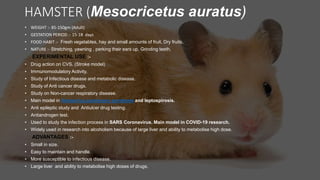
HAMSTER (Mesocricetus auratus)
• WEIGHT :- 85-150gm (Adult)
• GESTATION PERIOD :- 15-18 days
• FOOD HABIT :- Fresh vegetables, hay and small amounts of fruit, Dry fruits.
• NATURE :- Stretching, yawning , perking their ears up, Grinding teeth.
EXPERIMENTAL USE :-
• Drug action on CVS. (Stroke model)
• Immunomodulatory Activity.
• Study of Infectious disease and metabolic disease.
• Study of Anti cancer drugs.
• Study on Non-cancer respiratory disease.
• Main model in Hantavirus pulmonary syndrome and leptospirosis.
• Anti epileptic study and Antiulcer drug testing.
• Antiandrogen test.
• Used to study the infection process in SARS Coronavirus. Main model in COVID-19 research.
• Widely used in research into alcoholism because of large liver and ability to metabolise high dose.
ADVANTAGES :-
• Small in size.
• Easy to maintain and handle.
• More susceptible to infectious disease.
• Large liver and ability to metabolise high doses of drugs.
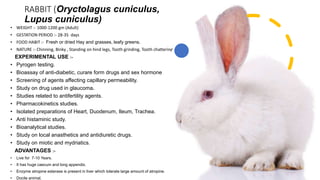
RABBIT (Oryctolagus cuniculus,
Lupus cuniculus)
• WEIGHT :- 1000-1200 gm (Adult)
• GESTATION PERIOD :- 28-35 days
• FOOD HABIT :- Fresh or dried Hay and grasses, leafy greens.
• NATURE :- Chinning, Binky , Standing on hind legs, Tooth grinding, Tooth chattering.
EXPERIMENTAL USE :-
• Pyrogen testing.
• Bioassay of anti-diabetic, curare form drugs and sex hormones.
• Screening of agents affecting capillary permeability.
• Study on drug used in glaucoma.
• Studies related to antifertility agents.
• Pharmacokinetics studies.
• Isolated preparations of Heart, Duodenum, Ileum, Trachea.
• Anti histaminic study.
• Bioanalytical studies.
• Study on local anasthetics and antidiuretic drugs.
• Study on miotic and mydriatics.
ADVANTAGES :-
• Live for 7-10 Years.
• It has huge caecum and long appendix.
• Enzyme atropine esterase is present in liver which tolerate large amount of atropine.
• Docile animal.
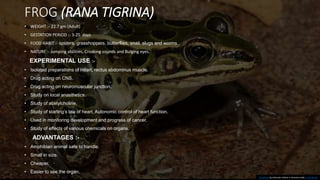
FROG (RANA TIGRINA)
• WEIGHT :- 22.7 gm (Adult)
• GESTATION PERIOD :- 3-25 days
• FOOD HABIT :- spiders, grasshoppers, butterflies, snail, slugs and worms.
• NATURE :- Jumping abilities, Croaking sounds and Bulging eyes.
EXPERIMENTAL USE :-
• Isolated preparations of Heart, rectus abdominus muscle.
• Drug acting on CNS.
• Drug acting on neuromuscular junction.
• Study on local anasthetics.
• Study of acetylcholine.
• Study of starling’s law of heart, Autonomic control of heart function.
• Used in monitoring development and progress of cancer.
• Study of effects of various chemicals on organs.
ADVANTAGES :-
• Amphibian animal safe to handle.
• Small in size.
• Cheaper.
• Easier to see the organ.
This Photo by Unknown Author is licensed under CC BY-SA-NC
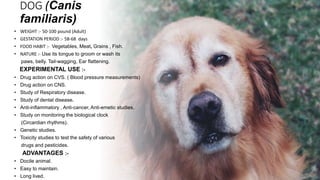
DOG (Canis
familiaris)
• WEIGHT :- 50-100 pound (Adult)
• GESTATION PERIOD :- 58-68 days
• FOOD HABIT :- Vegetables, Meat, Grains , Fish.
• NATURE :- Use its tongue to groom or wash its
paws, belly. Tail-wagging, Ear flattening.
EXPERIMENTAL USE :-
• Drug action on CVS. ( Blood pressure measurements)
• Drug action on CNS.
• Study of Respiratory disease.
• Study of dental disease.
• Anti-inflammatory , Anti-cancer, Anti-emetic studies.
• Study on monitoring the biological clock
(Circardian rhythms).
• Genetic studies.
• Toxicity studies to test the safety of various
drugs and pesticides.
ADVANTAGES :-
• Docile animal.
• Easy to maintain.
• Long lived.
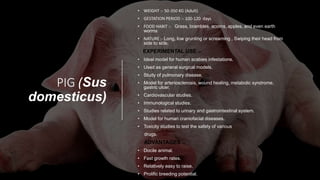
PIG (Sus
domesticus)
• WEIGHT :- 50-350 KG (Adult)
• GESTATION PERIOD :- 100-120 days
• FOOD HABIT :- Grass, brambles, acorns, apples, and even earth
worms
• NATURE :- Long, low grunting or screaming , Swiping their head from
side to side.
EXPERIMENTAL USE :-
• Ideal model for human scabies infestations.
• Used as general surgical models.
• Study of pulmonary disease.
• Model for arteriosclerosis, wound healing, metabolic syndrome,
gastric ulcer.
• Cardiovascular studies.
• Immunological studies.
• Studies related to urinary and gastrointestinal system.
• Model for human craniofacial diseases.
• Toxicity studies to test the safety of various
drugs.
ADVANTAGES :-
• Docile animal.
• Fast growth rates.
• Relatively easy to raise.
• Prolific breeding potential.
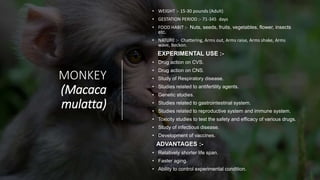
MONKEY
(Macaca
mulatta)
• WEIGHT :- 15-30 pounds (Adult)
• GESTATION PERIOD :- 71-345 days
• FOOD HABIT :- Nuts, seeds, fruits, vegetables, flower, insects
etc.
• NATURE :- Chattering, Arms out, Arms raise, Arms shake, Arms
wave, Beckon.
EXPERIMENTAL USE :-
• Drug action on CVS.
• Drug action on CNS.
• Study of Respiratory disease.
• Studies related to antifertility agents.
• Genetic studies.
• Studies related to gastrointestinal system.
• Studies related to reproductive system and immune system.
• Toxicity studies to test the safety and efficacy of various drugs.
• Study of infectious disease.
• Development of vaccines.
ADVANTAGES :-
• Relatively shorter life span.
• Faster aging.
• Ability to control experimental condition.
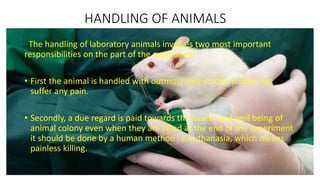
HANDLING OF ANIMALS
The handling of laboratory animals involves two most important
responsibilities on the part of the experiment.
• First the animal is handled with outmost care so that it does not
suffer any pain.
• Secondly, a due regard is paid towards the health and well being of
animal colony even when they are killed at the end of the experiment
it should be done by a human method i.e euthanasia, which means
painless killing.

Commonly used experimental animals

  • 1.
    STUDY OF COMMONLYUSED EXPERIMENTAL ANIMALS. BHAGYASHREE SAHOO M.PHARMA (PHARMACOLOGY) DADHICHI COLLEGE OF PHARMACY
  • 2.
    CONTENT INTRODUCTION. EXPERIMENTAL PHARMACOLOGY ANDITS AIM. ANIMALS USED IN EXPERIMENTAL PHARMACOLOGY. HANDLING OF ANIMALS.
  • 3.
    INTRODUCTION • Physiologically andanatomically, there is a similarity between the humans and animals at organ and organ system , which functions in a similar manner. • This similarity makes animals ideal model for the study and development of products and technique for humans. • It was the use of animals in the laboratory that lead to the discovery of the diptheria and polio vaccines , insulin for the treatment of diabetes mellitus , heart valve replacement , antibiotic therapy, manic-depressive drugs and the list goes on and on.
  • 4.
    EXPERIMENTAL PHARMACOLOGY ANDITS AIM. • EXPERIMENTAL PHARMACOLOGY :- Experimental pharmacology is a study through experimental design in controlled situations which involves testing of pharmacologically unknown substance and pharmaceutical products in animals. AIM OF EXPERIMENTAL PHARMACOLOGY • Find out the therapeutic agent suitable for human use. • Study the efficacy and toxicity of the drug . • Study the mechanisms and site of action of the drug.
  • 5.
    ANIMALS USED INEXPERIMENTAL PHARMACOLOGY
  • 6.
    MOUSE (Mus Musculus) • WEIGHT :-25-28gm (Adult) • GESTATION PERIOD :- 19-21 days • FOOD HABIT :- Fruits and Grains from Plants. • NATURE :- Facial expressions of pleasure, disgust, nausea, pain, and fear. EXPERIMENTAL USE :- • Toxicological studies • Teratogenicity studies • Bioassay of insulin • Screening of analgesic and anticonvulsant • Screening of chemotherapeutic agent • Drug action on CNS. • Studies related to genetics and cancer research ADVANTAGES :- • Smaller in size • Easy to handle • Cheaper • Less drug required
  • 7.
    RAT (Rattus norvegicus) • WEIGHT :-200gm-500gm (Adult) • GESTATION PERIOD :- 21-24 days • FOOD HABIT :-Grain or kill insects, water creatures such as snails, fish and mussels, small birds for food. • NATURE :- Bruxing, Tail flicking, Feet splayed. EXPERIMENTAL USES :- • Study of analgesics and anticonvulsant. • Bioassay of various types of hormones like Insulin, Oxytocin, Vasopressin. • Study of estrus cycle, mating behaviour, lactation. • Psychopharmacological studies. • Muscle grip strength. • Antiulcer drug screening. • Anti inflammatory drug screening. ADVANTAGES :- • Small in size. • Vomiting centre is absent- Oral administration can be done. • Gall bladder and Tonsils are absent. • Drug to be tested required in small quantity.
  • 8.
    GUINEA PIG (Cavia porcellus) • WEIGHT:- 700-1200 gm (Adult) • GESTATION PERIOD :- 59-72 days • FOOD HABIT :- Required exogenous Vit.C in diet. Fresh vegetables and fresh fruit. • NATURE :- Teeth chattering, Deep Purring sound , cooing , Rumbling during mating. EXPERIMENTAL USE :- • Evaluation of bronchodilators. • Anaphylactic and immunological studies. • Study oh histamines and Anti-histamines. • Bioassay of Digitalis. • Evaluation of local anasthetics. • Hearing experiments because of sensitive cochlea. • Study of TB and Ascorbic acid metabolism • Isolation of lleum, Trachea and Heart. • Study of Infectious disease. • Study of juvenile diabetes and, because of the frequency of pregnancy toxemia, of pre-eclampsia in human females. ADVANTAGES :- • Sensitive to histamine and penicillin. • Susceptible to TB and anaphylaxis. • Very long lived. • Easy to care.
  • 9.
    GERBIL (Meriones unguiculatus) • WEIGHT:- 60-130gm (Adult) • GESTATION PERIOD :- 24-26 days • FOOD HABIT :- Grasses, such as lyme grass and bristle grass, roots, seeds, desert vegetation fruits, bulbs and grains. • NATURE :- Use its tongue to groom or wash its paws, belly, face, and tail; digs or burrows in its cage. EXPERIMENTAL USE :- • Drug action on CVS. (Stroke model) • Immunomodulatory Activity. • Study of Infectious disease. • Used as Model in Infection caused by Giardia Lamblia and Giardia Duodenalis. • Study of lipid metabolism. • Auditory study. • Anti epileptic study. • Anti diabetic study. ADVANTAGES :- • Small in size. • Easy to maintain and handle. • Non-aggressive in nature. • More susceptible to infectious disease from environment. • Less drug required
  • 10.
    HAMSTER (Mesocricetus auratus) •WEIGHT :- 85-150gm (Adult) • GESTATION PERIOD :- 15-18 days • FOOD HABIT :- Fresh vegetables, hay and small amounts of fruit, Dry fruits. • NATURE :- Stretching, yawning , perking their ears up, Grinding teeth. EXPERIMENTAL USE :- • Drug action on CVS. (Stroke model) • Immunomodulatory Activity. • Study of Infectious disease and metabolic disease. • Study of Anti cancer drugs. • Study on Non-cancer respiratory disease. • Main model in Hantavirus pulmonary syndrome and leptospirosis. • Anti epileptic study and Antiulcer drug testing. • Antiandrogen test. • Used to study the infection process in SARS Coronavirus. Main model in COVID-19 research. • Widely used in research into alcoholism because of large liver and ability to metabolise high dose. ADVANTAGES :- • Small in size. • Easy to maintain and handle. • More susceptible to infectious disease. • Large liver and ability to metabolise high doses of drugs.
  • 11.
    RABBIT (Oryctolagus cuniculus, Lupuscuniculus) • WEIGHT :- 1000-1200 gm (Adult) • GESTATION PERIOD :- 28-35 days • FOOD HABIT :- Fresh or dried Hay and grasses, leafy greens. • NATURE :- Chinning, Binky , Standing on hind legs, Tooth grinding, Tooth chattering. EXPERIMENTAL USE :- • Pyrogen testing. • Bioassay of anti-diabetic, curare form drugs and sex hormones. • Screening of agents affecting capillary permeability. • Study on drug used in glaucoma. • Studies related to antifertility agents. • Pharmacokinetics studies. • Isolated preparations of Heart, Duodenum, Ileum, Trachea. • Anti histaminic study. • Bioanalytical studies. • Study on local anasthetics and antidiuretic drugs. • Study on miotic and mydriatics. ADVANTAGES :- • Live for 7-10 Years. • It has huge caecum and long appendix. • Enzyme atropine esterase is present in liver which tolerate large amount of atropine. • Docile animal.
  • 12.
    FROG (RANA TIGRINA) •WEIGHT :- 22.7 gm (Adult) • GESTATION PERIOD :- 3-25 days • FOOD HABIT :- spiders, grasshoppers, butterflies, snail, slugs and worms. • NATURE :- Jumping abilities, Croaking sounds and Bulging eyes. EXPERIMENTAL USE :- • Isolated preparations of Heart, rectus abdominus muscle. • Drug acting on CNS. • Drug acting on neuromuscular junction. • Study on local anasthetics. • Study of acetylcholine. • Study of starling’s law of heart, Autonomic control of heart function. • Used in monitoring development and progress of cancer. • Study of effects of various chemicals on organs. ADVANTAGES :- • Amphibian animal safe to handle. • Small in size. • Cheaper. • Easier to see the organ. This Photo by Unknown Author is licensed under CC BY-SA-NC
  • 13.
    DOG (Canis familiaris) • WEIGHT:- 50-100 pound (Adult) • GESTATION PERIOD :- 58-68 days • FOOD HABIT :- Vegetables, Meat, Grains , Fish. • NATURE :- Use its tongue to groom or wash its paws, belly. Tail-wagging, Ear flattening. EXPERIMENTAL USE :- • Drug action on CVS. ( Blood pressure measurements) • Drug action on CNS. • Study of Respiratory disease. • Study of dental disease. • Anti-inflammatory , Anti-cancer, Anti-emetic studies. • Study on monitoring the biological clock (Circardian rhythms). • Genetic studies. • Toxicity studies to test the safety of various drugs and pesticides. ADVANTAGES :- • Docile animal. • Easy to maintain. • Long lived.
  • 14.
    PIG (Sus domesticus) • WEIGHT:- 50-350 KG (Adult) • GESTATION PERIOD :- 100-120 days • FOOD HABIT :- Grass, brambles, acorns, apples, and even earth worms • NATURE :- Long, low grunting or screaming , Swiping their head from side to side. EXPERIMENTAL USE :- • Ideal model for human scabies infestations. • Used as general surgical models. • Study of pulmonary disease. • Model for arteriosclerosis, wound healing, metabolic syndrome, gastric ulcer. • Cardiovascular studies. • Immunological studies. • Studies related to urinary and gastrointestinal system. • Model for human craniofacial diseases. • Toxicity studies to test the safety of various drugs. ADVANTAGES :- • Docile animal. • Fast growth rates. • Relatively easy to raise. • Prolific breeding potential.
  • 15.
    MONKEY (Macaca mulatta) • WEIGHT :-15-30 pounds (Adult) • GESTATION PERIOD :- 71-345 days • FOOD HABIT :- Nuts, seeds, fruits, vegetables, flower, insects etc. • NATURE :- Chattering, Arms out, Arms raise, Arms shake, Arms wave, Beckon. EXPERIMENTAL USE :- • Drug action on CVS. • Drug action on CNS. • Study of Respiratory disease. • Studies related to antifertility agents. • Genetic studies. • Studies related to gastrointestinal system. • Studies related to reproductive system and immune system. • Toxicity studies to test the safety and efficacy of various drugs. • Study of infectious disease. • Development of vaccines. ADVANTAGES :- • Relatively shorter life span. • Faster aging. • Ability to control experimental condition.
  • 16.
    HANDLING OF ANIMALS Thehandling of laboratory animals involves two most important responsibilities on the part of the experiment. • First the animal is handled with outmost care so that it does not suffer any pain. • Secondly, a due regard is paid towards the health and well being of animal colony even when they are killed at the end of the experiment it should be done by a human method i.e euthanasia, which means painless killing.