The Human Body Interactive PowerPoint 5 th  Grade Science Menu
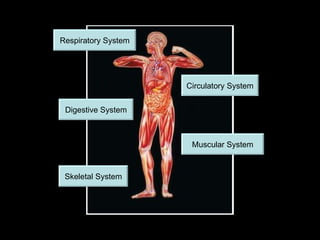
Digestive System Respiratory System Circulatory System Muscular System Skeletal System
Digestive System Menu Facts
Respiratory System Menu Facts
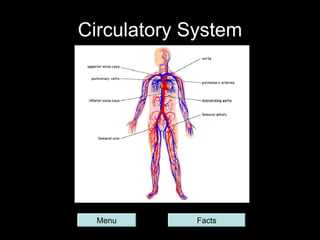
Circulatory System Menu Facts
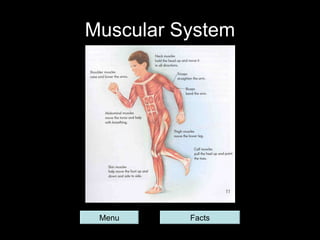
Muscular System Menu Facts
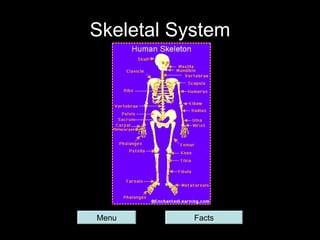
Skeletal System Menu Facts
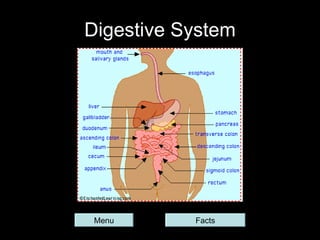
Digestive System Facts It is the process of breaking down food into smaller substances that your body can use. Digestion begins when a person chews their food and the smaller pieces are moistened by saliva. After the chewing process, the food then travels down the esophagus into the stomach. While in the stomach, the food will mix with digestive juices and be passed into the small intestines. Once in the small intestines, the villi (small fingerlike projections that line the wall) will absorb the digested food and the blood will transport the nutrients to every part of the body. The water from the undigested food will absorb into the large intestines. Menu
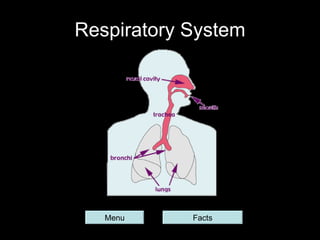
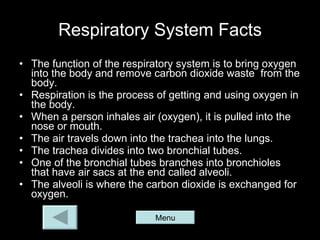
Respiratory System Facts The function of the respiratory system is to bring oxygen into the body and remove carbon dioxide waste  from the body. Respiration is the process of getting and using oxygen in the body. When a person inhales air (oxygen), it is pulled into the nose or mouth. The air travels down into the trachea into the lungs. The trachea divides into two bronchial tubes. One of the bronchial tubes branches into bronchioles that have air sacs at the end called alveoli. The alveoli is where the carbon dioxide is exchanged for oxygen. Menu
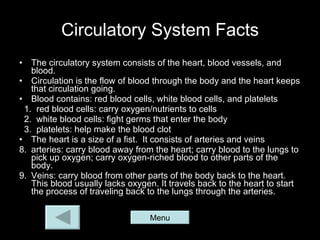
Circulatory System Facts The circulatory system consists of the heart, blood vessels, and blood. Circulation is the flow of blood through the body and the heart keeps that circulation going. Blood contains: red blood cells, white blood cells, and platelets 1.  red blood cells: carry oxygen/nutrients to cells 2.  white blood cells: fight germs that enter the body 3.  platelets: help make the blood clot The heart is a size of a fist.  It consists of arteries and veins arteries: carry blood away from the heart; carry blood to the lungs to pick up oxygen; carry oxygen-riched blood to other parts of the body. Veins: carry blood from other parts of the body back to the heart. This blood usually lacks oxygen. It travels back to the heart to start the process of traveling back to the lungs through the arteries. Menu
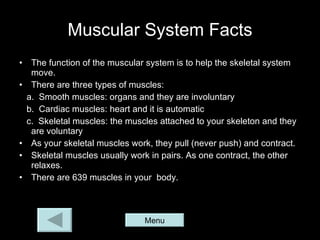
Muscular System Facts The function of the muscular system is to help the skeletal system move. There are three types of muscles: a.  Smooth muscles: organs and they are involuntary b.  Cardiac muscles: heart and it is automatic c.  Skeletal muscles: the muscles attached to your skeleton and they are voluntary As your skeletal muscles work, they pull (never push) and contract. Skeletal muscles usually work in pairs. As one contract, the other relaxes. There are 639 muscles in your  body. Menu
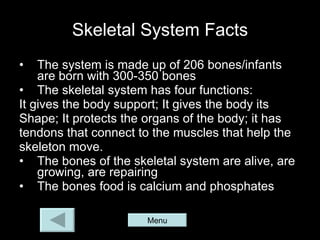
Skeletal System Facts The system is made up of 206 bones/infants are born with 300-350 bones The skeletal system has four functions: It gives the body support; It gives the body its Shape; It protects the organs of the body; it has tendons that connect to the muscles that help the skeleton move.  The bones of the skeletal system are alive, are growing, are repairing The bones food is calcium and phosphates  Menu

Interactivepowerpoint

  • 1.
    The Human BodyInteractive PowerPoint 5 th Grade Science Menu
  • 2.
    Digestive System RespiratorySystem Circulatory System Muscular System Skeletal System
  • 3.
  • 4.
  • 5.
  • 6.
  • 7.
  • 8.
    Digestive System FactsIt is the process of breaking down food into smaller substances that your body can use. Digestion begins when a person chews their food and the smaller pieces are moistened by saliva. After the chewing process, the food then travels down the esophagus into the stomach. While in the stomach, the food will mix with digestive juices and be passed into the small intestines. Once in the small intestines, the villi (small fingerlike projections that line the wall) will absorb the digested food and the blood will transport the nutrients to every part of the body. The water from the undigested food will absorb into the large intestines. Menu
  • 9.
    Respiratory System FactsThe function of the respiratory system is to bring oxygen into the body and remove carbon dioxide waste from the body. Respiration is the process of getting and using oxygen in the body. When a person inhales air (oxygen), it is pulled into the nose or mouth. The air travels down into the trachea into the lungs. The trachea divides into two bronchial tubes. One of the bronchial tubes branches into bronchioles that have air sacs at the end called alveoli. The alveoli is where the carbon dioxide is exchanged for oxygen. Menu
  • 10.
    Circulatory System FactsThe circulatory system consists of the heart, blood vessels, and blood. Circulation is the flow of blood through the body and the heart keeps that circulation going. Blood contains: red blood cells, white blood cells, and platelets 1. red blood cells: carry oxygen/nutrients to cells 2. white blood cells: fight germs that enter the body 3. platelets: help make the blood clot The heart is a size of a fist. It consists of arteries and veins arteries: carry blood away from the heart; carry blood to the lungs to pick up oxygen; carry oxygen-riched blood to other parts of the body. Veins: carry blood from other parts of the body back to the heart. This blood usually lacks oxygen. It travels back to the heart to start the process of traveling back to the lungs through the arteries. Menu
  • 11.
    Muscular System FactsThe function of the muscular system is to help the skeletal system move. There are three types of muscles: a. Smooth muscles: organs and they are involuntary b. Cardiac muscles: heart and it is automatic c. Skeletal muscles: the muscles attached to your skeleton and they are voluntary As your skeletal muscles work, they pull (never push) and contract. Skeletal muscles usually work in pairs. As one contract, the other relaxes. There are 639 muscles in your body. Menu
  • 12.
    Skeletal System FactsThe system is made up of 206 bones/infants are born with 300-350 bones The skeletal system has four functions: It gives the body support; It gives the body its Shape; It protects the organs of the body; it has tendons that connect to the muscles that help the skeleton move. The bones of the skeletal system are alive, are growing, are repairing The bones food is calcium and phosphates Menu