Methods for producing transgenic animals- retroviral, microinjection,
engineered stem cell. Targeted gene transfer. Transgene integration and
identification methods
Submitted By: Sweta Nayak
Roll no. 221253
Submitted to:
Dr. Ram Gopal Nitharwal
Course : Animal Biotechnology
Course Code : SIAS BT 1 3 01 DCEC 3003
INTRODUCTION
• Nowadays, breakthroughs in molecular biology are happening at an
unprecedented rate. One of them is the ability to engineer transgenic
animals.
• The transgenesis technique involves the introduction of foreign DNA
sequences into the genome of transfected cells and ensuring that the
DNA sequences are integrated and transmitted to the offspring.
• The foreign-interested genes that will be used in animal transgenic
techniques are prepared using a variety of methods & the produced gene
of interest is placed into a variety of vectors, including YAC, bacterial
plasmids, and cosmids.
• Several techniques, including heat shock, electroporation, viruses, the
gene gun, microinjection, and liposomes, are used to deliver the created
vector, which includes the interesting gene, into the host cell.
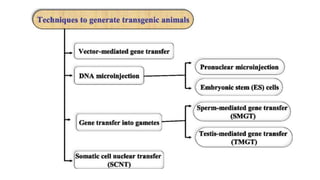
• Transgenesis can be carried out in the gonads, sperm, fertilized eggs, and
embryos through DNA microinjection, retroviruses, stem cells, and cloning.
• The most effective transgenic marker at the moment is fluorescent protein.
• Transgenesis success is confirmed by the integration of an antibiotic
resistance gene, western and southern blots, PCR, and ELISA.
• Greater prolificacy and reproductive performance, improved feed utilization
and growth rate, improved carcass composition, improved milk production
and/or compositions, and increased disease resistance are some of the
practical applications of transgenesis in animal production.
Retroviral Method
• For the past two decades retroviruses have been harnessed as vehicles for
transferring genes into eukaryotic cells, a process known as transduction.
• During this time, the technology has moved from being a scientific laboratory tool to a
potential clinical molecular medicine to be used in gene therapy.
• Retroviral vectors stably integrate into the dividing target cell genome so that the
introduced gene is passed on and expressed in all daughter cells.
• The retrovirus consists of two copies of a single stranded RNA genome with
sequences known as gag, pol, and env, which encode viral structural and catalytic
proteins surrounded by glycoprotein envelope.
• They can carry up to 7 to 8 kb from foreign genes, but at the same time, this may not
be enough for long genes or structures that require extensive regulatory sequences
for transcription
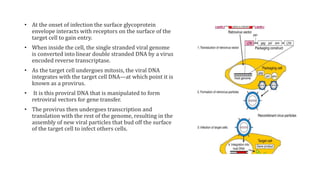
• At the onset of infection the surface glycoprotein
envelope interacts with receptors on the surface of the
target cell to gain entry.
• When inside the cell, the single stranded viral genome
is converted into linear double stranded DNA by a virus
encoded reverse transcriptase.
• As the target cell undergoes mitosis, the viral DNA
integrates with the target cell DNA—at which point it is
known as a provirus.
• It is this proviral DNA that is manipulated to form
retroviral vectors for gene transfer.
• The provirus then undergoes transcription and
translation with the rest of the genome, resulting in the
assembly of new viral particles that bud off the surface
of the target cell to infect others cells.
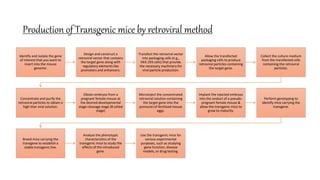
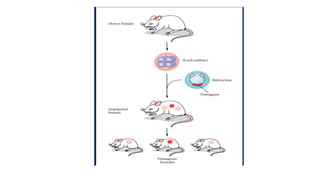
Production of Transgenic mice by retroviral method
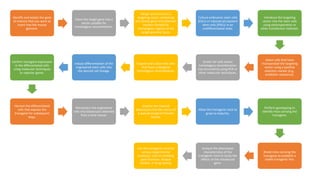
Identify and isolate the gene
of interest that you want to
insert into the mouse
genome.
Design and construct a
retroviral vector that contains
the target gene along with
regulatory elements like
promoters and enhancers.
Transfect the retroviral vector
into packaging cells (e.g.,
HEK-293 cells) that provide
the necessary machinery for
viral particle production.
Allow the transfected
packaging cells to produce
retroviral particles containing
the target gene.
Collect the culture medium
from the transfected cells
containing the retroviral
particles.
Concentrate and purify the
retroviral particles to obtain a
high-titer viral solution.
Obtain embryos from a
pregnant female mouse at
the desired developmental
stage cleavage stage (8 celled
stage)
Microinject the concentrated
retroviral solution containing
the target gene into the
pronuclei of fertilized mouse
eggs.
Implant the injected embryos
into the oviduct of a pseudo-
pregnant female mouse &
allow the transgenic mice to
grow to maturity.
Perform genotyping to
identify mice carrying the
transgene.
Breed mice carrying the
transgene to establish a
stable transgenic line.
Analyze the phenotypic
characteristics of the
transgenic mice to study the
effects of the introduced
gene.
Use the transgenic mice for
various experimental
purposes, such as studying
gene function, disease
models, or drug testing.
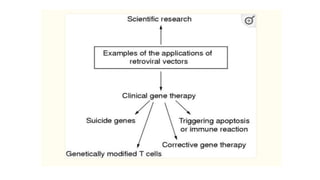
Applications
• The retroviral approach has been used to express genes in embryonic tissues to
allow the investigation of their developmental function. These experiments, which
have been carried out extensively in avian species, involve injecting viral vectors
into embryos and assessing their development.
• Retroviruses can be used to manipulate the germline to express genes in
transgenic animals. This is achieved by infecting pre-implantation embryos or
embryonic stem cells in culture.
• Retroviral vectors have been used to introduce a drug susceptibility or “suicide”
gene, such as herpes simplex thymidine kinase (TK), to target cells.
• When the patient is treated with a particular drug, such as gancyclovir, the target
cells containing TK are killed selectively.
Microinjection
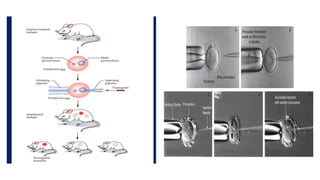
• A variety of approaches can be used to make transgenic animals. The
most common method used to date is the microinjection of genes into
the pronuclei of zygotes.
• In the 1980s, this method was first used on rabbits, pigs, and sheep and
thereafter on goats and cows.
• The principle of microinjection is based on the direct delivery of
genetic material into individual cells using a fine glass needle called a
micropipette, a positioning device known as a micromanipulator, and
a microinjector. The process is performed under a powerful
microscope.
• The genetic material is delivered into the cell by applying hydrostatic
pressure to release a fluid containing the DNA through the
micropipette.
• The small tip diameter of the micropipette and the precise
movements enabled by the micromanipulator allows the precise
delivery of desired materials.
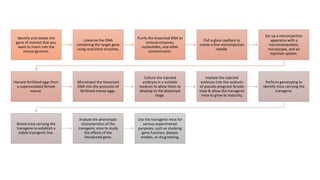
Identify and isolate the
gene of interest that you
want to insert into the
mouse genome.
Linearize the DNA
containing the target gene
using restriction enzymes.
Purify the linearized DNA to
remove enzymes,
nucleotides, and other
contaminants.
Pull a glass capillary to
create a fine microinjection
needle.
Set up a microinjection
apparatus with a
micromanipulator,
microscope, and an
injection system.
Harvest fertilized eggs from
a superovulated female
mouse.
Microinject the linearized
DNA into the pronuclei of
fertilized mouse eggs.
Culture the injected
embryos in a suitable
medium to allow them to
develop to the blastocyst
stage.
Implant the injected
embryos into the oviducts
of pseudo-pregnant female
mice & allow the transgenic
mice to grow to maturity.
Perform genotyping to
identify mice carrying the
transgene.
Breed mice carrying the
transgene to establish a
stable transgenic line.
Analyze the phenotypic
characteristics of the
transgenic mice to study
the effects of the
introduced gene.
Use the transgenic mice for
various experimental
purposes, such as studying
gene function, disease
models, or drug testing.
DRAWBACKS
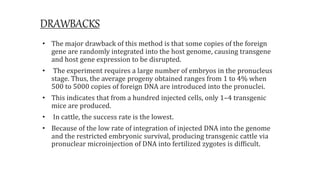
• The major drawback of this method is that some copies of the foreign
gene are randomly integrated into the host genome, causing transgene
and host gene expression to be disrupted.
• The experiment requires a large number of embryos in the pronucleus
stage. Thus, the average progeny obtained ranges from 1 to 4% when
500 to 5000 copies of foreign DNA are introduced into the pronuclei.
• This indicates that from a hundred injected cells, only 1–4 transgenic
mice are produced.
• In cattle, the success rate is the lowest.
• Because of the low rate of integration of injected DNA into the genome
and the restricted embryonic survival, producing transgenic cattle via
pronuclear microinjection of DNA into fertilized zygotes is difficult.
Engineered Stem Cell
• The properties of stem cells are undifferentiated cells which have
the ability to develop into any type of cell (including somatic and
germ cells), leading to the production of a full organism.
• Embryonic stem cells have been developed in vitro for a long
period of time .
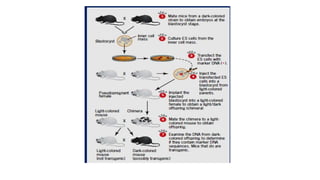
• The appropriate DNA sequence is inserted into an in vitro culture
of embryonic stem (ES) cells using homologous recombination.
• Foreign DNA can be introduced into ES cells, and utilizing a
selection gene, clones carrying the foreign gene can be generated.
• These cells can be used to make transgenic chimeric mice
Identify and isolate the gene
of interest that you want to
insert into the mouse
genome.
Clone the target gene into a
vector suitable for
homologous recombination.
Design and construct a
targeting vector containing
the cloned gene and selection
markers flanked by
homologous regions to the
target genomic locus.
Culture embryonic stem cells
(ESCs) or induced pluripotent
stem cells (iPSCs) in an
undifferentiated state.
Introduce the targeting
vector into the stem cells
using electroporation or
other transfection methods.
Select cells that have
incorporated the targeting
vector using a positive
selection marker (e.g.,
antibiotic resistance).
Screen for cells where
homologous recombination
has occurred by using PCR or
other molecular techniques.
Expand and culture the cells
that have undergone
homologous recombination.
Induce differentiation of the
engineered stem cells into
the desired cell lineage.
Confirm transgene expression
in the differentiated cells
using molecular techniques
or reporter genes.
Harvest the differentiated
cells that express the
transgene for subsequent
steps.
Microinject the engineered
cells into blastocysts obtained
from a host mouse.
Implant the injected
blastocysts into the uterus of
a pseudo-pregnant female
mouse.
Allow the transgenic mice to
grow to maturity.
Perform genotyping to
identify mice carrying the
transgene.
Breed mice carrying the
transgene to establish a
stable transgenic line.
Analyze the phenotypic
characteristics of the
transgenic mice to study the
effects of the introduced
gene.
Use the transgenic mice for
various experimental
purposes, such as studying
gene function, disease
models, or drug testing.
TRANSGENE INTEGRATION & IDENTIFICATION METHODS
• Transgene delivery systems, particularly those involving retroviruses, often result in the integration of
multiple copies of the transgene throughout the host genome.
• Since site-specific silencing of trangenes can occur, it becomes important to identify the number and
chromosomal location of the multiple copies of the transgenes in order to correlate inheritance of the
transgene at a particular chromosomal site with a specific and robust phenotype.
• Using a technique that combines restriction endonuclease digest and several rounds of PCR
amplification followed by nucleotide sequencing, it is possible to identify multiple chromosomal
integration sites in transgenic founder animals.
• By designing genotyping assays to detect each individual integration site in the offspring of these
founders, the inheritance of transgenes integrated at specific chromosomal locations can be followed
efficiently as the transgenes randomly segregate in subsequent generations.
Dot Blot Technique
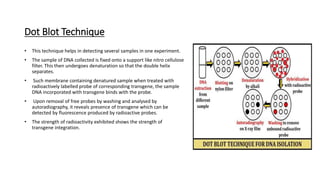
• This technique helps in detecting several samples in one experiment.
• The sample of DNA collected is fixed onto a support like nitro cellulose
filter. This then undergoes denaturation so that the double helix
separates.
• Such membrane containing denatured sample when treated with
radioactively labelled probe of corresponding transgene, the sample
DNA incorporated with transgene binds with the probe.
• Upon removal of free probes by washing and analysed by
autoradiography, it reveals presence of transgene which can be
detected by fluorescence produced by radioactive probes.
• The strength of radioactivity exhibited shows the strength of
transgene integration.
PCR technique:
This is the most important and widespread used technology to identify the transgenic successful animals. The primers
corresponding to the integrated transgene is used to amplify the test DNA sequences isolated from the transgenic animals. This
results in the amplification of the transgene. The amplified DNA when blotted and hybridized, the presence of transgene is
confirmed. But the techniques adopted for identification of transgenic animals does not reveal the actual level and site of
integration. For achieving these further steps has to be adopted like:
Analysis of transgene integration:
In order to analyse the transgene integrated, the isolated gene samples which are detected with transgene integration,
undergo restriction digestion with known restriction endonucleases. The fragments are separated by agarose gel
electrophoresis and these fragments are analysed by southern blotting procedure. The fragments on the gel are
transferred to a nitrocellulose filter membrane and denatured and probed with radioactive probe to reveal the actual
site of transgenic integration. The integration of transgene can be confirmed by choosing the appropriate restriction
enzyme. The presence of single or multiple integration of transgene is indicated by southern blotting.
Analysis of mRNA production:
The mRNA produced from a transgene can be detected as it is different from the native mRNA of the organisms. These can be purified and
hybridized with a radioactive probe to detect mRNA production.
Analysis of protein expression:
The final aim of transgenic integration is to produce proteins coded by the transgene and its efficient expression.
Therefore the detection of transgene integration is possible by protein expression of the transgene. The analysis of
transgenic proteins can be done by two methods: by identifying specific antibodies produced by transgenic
proteins and by studying the enzymatic properties of the concerned proteins. In the case of antibody
identification, various immunologic assays can be used. ELISA test is a classic example of the same. In this case, the
antibody specific to the antigenic protein is added and allowed to react. Following the first reaction, this is further
reacted with an antibody specific to the former antibody results in formation of a complex. This when treated with
the substrate of corresponding enzyme, it produces colour proportional to the strength of the antibody indicating
the amount of corresponding transgenic protein expressed. The other assays included are immunoblotting,
radioimmunoprecipitation, immunohistochemical staining etc.
REFERENCES
• https://www.biotechnologyforums.com/thread-1856.html
• https://www.future-
science.com/doi/10.2144/000112289#:~:text=In%20transgenic%20animals%20created%20by,different%2
0in%20each%20founder%20animal.
• https://www.mayo.edu/research/core-resources/transgenic-knockout-core/services/embryonic-stem-cell-
based-gene-targeted-mice
• https://www.ncbi.nlm.nih.gov/pmc/articles/PMC4095860/
• https://www.sciencedirect.com/topics/biochemistry-genetics-and-molecular-biology/transgenic-animal
• https://www.creative-biolabs.com/drug-discovery/therapeutics/dna-microinjection.htm
animal biotech transgene integration methods

animal biotech transgene integration methods

  • 1.
    Methods for producingtransgenic animals- retroviral, microinjection, engineered stem cell. Targeted gene transfer. Transgene integration and identification methods Submitted By: Sweta Nayak Roll no. 221253 Submitted to: Dr. Ram Gopal Nitharwal Course : Animal Biotechnology Course Code : SIAS BT 1 3 01 DCEC 3003
  • 2.
    INTRODUCTION • Nowadays, breakthroughsin molecular biology are happening at an unprecedented rate. One of them is the ability to engineer transgenic animals. • The transgenesis technique involves the introduction of foreign DNA sequences into the genome of transfected cells and ensuring that the DNA sequences are integrated and transmitted to the offspring. • The foreign-interested genes that will be used in animal transgenic techniques are prepared using a variety of methods & the produced gene of interest is placed into a variety of vectors, including YAC, bacterial plasmids, and cosmids. • Several techniques, including heat shock, electroporation, viruses, the gene gun, microinjection, and liposomes, are used to deliver the created vector, which includes the interesting gene, into the host cell.
  • 3.
    • Transgenesis canbe carried out in the gonads, sperm, fertilized eggs, and embryos through DNA microinjection, retroviruses, stem cells, and cloning. • The most effective transgenic marker at the moment is fluorescent protein. • Transgenesis success is confirmed by the integration of an antibiotic resistance gene, western and southern blots, PCR, and ELISA. • Greater prolificacy and reproductive performance, improved feed utilization and growth rate, improved carcass composition, improved milk production and/or compositions, and increased disease resistance are some of the practical applications of transgenesis in animal production.
  • 5.
    Retroviral Method • Forthe past two decades retroviruses have been harnessed as vehicles for transferring genes into eukaryotic cells, a process known as transduction. • During this time, the technology has moved from being a scientific laboratory tool to a potential clinical molecular medicine to be used in gene therapy. • Retroviral vectors stably integrate into the dividing target cell genome so that the introduced gene is passed on and expressed in all daughter cells. • The retrovirus consists of two copies of a single stranded RNA genome with sequences known as gag, pol, and env, which encode viral structural and catalytic proteins surrounded by glycoprotein envelope. • They can carry up to 7 to 8 kb from foreign genes, but at the same time, this may not be enough for long genes or structures that require extensive regulatory sequences for transcription
  • 6.
    • At theonset of infection the surface glycoprotein envelope interacts with receptors on the surface of the target cell to gain entry. • When inside the cell, the single stranded viral genome is converted into linear double stranded DNA by a virus encoded reverse transcriptase. • As the target cell undergoes mitosis, the viral DNA integrates with the target cell DNA—at which point it is known as a provirus. • It is this proviral DNA that is manipulated to form retroviral vectors for gene transfer. • The provirus then undergoes transcription and translation with the rest of the genome, resulting in the assembly of new viral particles that bud off the surface of the target cell to infect others cells.
  • 7.
    Production of Transgenicmice by retroviral method Identify and isolate the gene of interest that you want to insert into the mouse genome. Design and construct a retroviral vector that contains the target gene along with regulatory elements like promoters and enhancers. Transfect the retroviral vector into packaging cells (e.g., HEK-293 cells) that provide the necessary machinery for viral particle production. Allow the transfected packaging cells to produce retroviral particles containing the target gene. Collect the culture medium from the transfected cells containing the retroviral particles. Concentrate and purify the retroviral particles to obtain a high-titer viral solution. Obtain embryos from a pregnant female mouse at the desired developmental stage cleavage stage (8 celled stage) Microinject the concentrated retroviral solution containing the target gene into the pronuclei of fertilized mouse eggs. Implant the injected embryos into the oviduct of a pseudo- pregnant female mouse & allow the transgenic mice to grow to maturity. Perform genotyping to identify mice carrying the transgene. Breed mice carrying the transgene to establish a stable transgenic line. Analyze the phenotypic characteristics of the transgenic mice to study the effects of the introduced gene. Use the transgenic mice for various experimental purposes, such as studying gene function, disease models, or drug testing.
  • 10.
    Applications • The retroviralapproach has been used to express genes in embryonic tissues to allow the investigation of their developmental function. These experiments, which have been carried out extensively in avian species, involve injecting viral vectors into embryos and assessing their development. • Retroviruses can be used to manipulate the germline to express genes in transgenic animals. This is achieved by infecting pre-implantation embryos or embryonic stem cells in culture. • Retroviral vectors have been used to introduce a drug susceptibility or “suicide” gene, such as herpes simplex thymidine kinase (TK), to target cells. • When the patient is treated with a particular drug, such as gancyclovir, the target cells containing TK are killed selectively.
  • 11.
    Microinjection • A varietyof approaches can be used to make transgenic animals. The most common method used to date is the microinjection of genes into the pronuclei of zygotes. • In the 1980s, this method was first used on rabbits, pigs, and sheep and thereafter on goats and cows. • The principle of microinjection is based on the direct delivery of genetic material into individual cells using a fine glass needle called a micropipette, a positioning device known as a micromanipulator, and a microinjector. The process is performed under a powerful microscope. • The genetic material is delivered into the cell by applying hydrostatic pressure to release a fluid containing the DNA through the micropipette. • The small tip diameter of the micropipette and the precise movements enabled by the micromanipulator allows the precise delivery of desired materials.
  • 12.
    Identify and isolatethe gene of interest that you want to insert into the mouse genome. Linearize the DNA containing the target gene using restriction enzymes. Purify the linearized DNA to remove enzymes, nucleotides, and other contaminants. Pull a glass capillary to create a fine microinjection needle. Set up a microinjection apparatus with a micromanipulator, microscope, and an injection system. Harvest fertilized eggs from a superovulated female mouse. Microinject the linearized DNA into the pronuclei of fertilized mouse eggs. Culture the injected embryos in a suitable medium to allow them to develop to the blastocyst stage. Implant the injected embryos into the oviducts of pseudo-pregnant female mice & allow the transgenic mice to grow to maturity. Perform genotyping to identify mice carrying the transgene. Breed mice carrying the transgene to establish a stable transgenic line. Analyze the phenotypic characteristics of the transgenic mice to study the effects of the introduced gene. Use the transgenic mice for various experimental purposes, such as studying gene function, disease models, or drug testing.
  • 14.
    DRAWBACKS • The majordrawback of this method is that some copies of the foreign gene are randomly integrated into the host genome, causing transgene and host gene expression to be disrupted. • The experiment requires a large number of embryos in the pronucleus stage. Thus, the average progeny obtained ranges from 1 to 4% when 500 to 5000 copies of foreign DNA are introduced into the pronuclei. • This indicates that from a hundred injected cells, only 1–4 transgenic mice are produced. • In cattle, the success rate is the lowest. • Because of the low rate of integration of injected DNA into the genome and the restricted embryonic survival, producing transgenic cattle via pronuclear microinjection of DNA into fertilized zygotes is difficult.
  • 15.
    Engineered Stem Cell •The properties of stem cells are undifferentiated cells which have the ability to develop into any type of cell (including somatic and germ cells), leading to the production of a full organism. • Embryonic stem cells have been developed in vitro for a long period of time . • The appropriate DNA sequence is inserted into an in vitro culture of embryonic stem (ES) cells using homologous recombination. • Foreign DNA can be introduced into ES cells, and utilizing a selection gene, clones carrying the foreign gene can be generated. • These cells can be used to make transgenic chimeric mice
  • 16.
    Identify and isolatethe gene of interest that you want to insert into the mouse genome. Clone the target gene into a vector suitable for homologous recombination. Design and construct a targeting vector containing the cloned gene and selection markers flanked by homologous regions to the target genomic locus. Culture embryonic stem cells (ESCs) or induced pluripotent stem cells (iPSCs) in an undifferentiated state. Introduce the targeting vector into the stem cells using electroporation or other transfection methods. Select cells that have incorporated the targeting vector using a positive selection marker (e.g., antibiotic resistance). Screen for cells where homologous recombination has occurred by using PCR or other molecular techniques. Expand and culture the cells that have undergone homologous recombination. Induce differentiation of the engineered stem cells into the desired cell lineage. Confirm transgene expression in the differentiated cells using molecular techniques or reporter genes. Harvest the differentiated cells that express the transgene for subsequent steps. Microinject the engineered cells into blastocysts obtained from a host mouse. Implant the injected blastocysts into the uterus of a pseudo-pregnant female mouse. Allow the transgenic mice to grow to maturity. Perform genotyping to identify mice carrying the transgene. Breed mice carrying the transgene to establish a stable transgenic line. Analyze the phenotypic characteristics of the transgenic mice to study the effects of the introduced gene. Use the transgenic mice for various experimental purposes, such as studying gene function, disease models, or drug testing.
  • 18.
    TRANSGENE INTEGRATION &IDENTIFICATION METHODS • Transgene delivery systems, particularly those involving retroviruses, often result in the integration of multiple copies of the transgene throughout the host genome. • Since site-specific silencing of trangenes can occur, it becomes important to identify the number and chromosomal location of the multiple copies of the transgenes in order to correlate inheritance of the transgene at a particular chromosomal site with a specific and robust phenotype. • Using a technique that combines restriction endonuclease digest and several rounds of PCR amplification followed by nucleotide sequencing, it is possible to identify multiple chromosomal integration sites in transgenic founder animals. • By designing genotyping assays to detect each individual integration site in the offspring of these founders, the inheritance of transgenes integrated at specific chromosomal locations can be followed efficiently as the transgenes randomly segregate in subsequent generations.
  • 19.
    Dot Blot Technique •This technique helps in detecting several samples in one experiment. • The sample of DNA collected is fixed onto a support like nitro cellulose filter. This then undergoes denaturation so that the double helix separates. • Such membrane containing denatured sample when treated with radioactively labelled probe of corresponding transgene, the sample DNA incorporated with transgene binds with the probe. • Upon removal of free probes by washing and analysed by autoradiography, it reveals presence of transgene which can be detected by fluorescence produced by radioactive probes. • The strength of radioactivity exhibited shows the strength of transgene integration.
  • 20.
    PCR technique: This isthe most important and widespread used technology to identify the transgenic successful animals. The primers corresponding to the integrated transgene is used to amplify the test DNA sequences isolated from the transgenic animals. This results in the amplification of the transgene. The amplified DNA when blotted and hybridized, the presence of transgene is confirmed. But the techniques adopted for identification of transgenic animals does not reveal the actual level and site of integration. For achieving these further steps has to be adopted like: Analysis of transgene integration: In order to analyse the transgene integrated, the isolated gene samples which are detected with transgene integration, undergo restriction digestion with known restriction endonucleases. The fragments are separated by agarose gel electrophoresis and these fragments are analysed by southern blotting procedure. The fragments on the gel are transferred to a nitrocellulose filter membrane and denatured and probed with radioactive probe to reveal the actual site of transgenic integration. The integration of transgene can be confirmed by choosing the appropriate restriction enzyme. The presence of single or multiple integration of transgene is indicated by southern blotting.
  • 21.
    Analysis of mRNAproduction: The mRNA produced from a transgene can be detected as it is different from the native mRNA of the organisms. These can be purified and hybridized with a radioactive probe to detect mRNA production. Analysis of protein expression: The final aim of transgenic integration is to produce proteins coded by the transgene and its efficient expression. Therefore the detection of transgene integration is possible by protein expression of the transgene. The analysis of transgenic proteins can be done by two methods: by identifying specific antibodies produced by transgenic proteins and by studying the enzymatic properties of the concerned proteins. In the case of antibody identification, various immunologic assays can be used. ELISA test is a classic example of the same. In this case, the antibody specific to the antigenic protein is added and allowed to react. Following the first reaction, this is further reacted with an antibody specific to the former antibody results in formation of a complex. This when treated with the substrate of corresponding enzyme, it produces colour proportional to the strength of the antibody indicating the amount of corresponding transgenic protein expressed. The other assays included are immunoblotting, radioimmunoprecipitation, immunohistochemical staining etc.
  • 22.
    REFERENCES • https://www.biotechnologyforums.com/thread-1856.html • https://www.future- science.com/doi/10.2144/000112289#:~:text=In%20transgenic%20animals%20created%20by,different%2 0in%20each%20founder%20animal. •https://www.mayo.edu/research/core-resources/transgenic-knockout-core/services/embryonic-stem-cell- based-gene-targeted-mice • https://www.ncbi.nlm.nih.gov/pmc/articles/PMC4095860/ • https://www.sciencedirect.com/topics/biochemistry-genetics-and-molecular-biology/transgenic-animal • https://www.creative-biolabs.com/drug-discovery/therapeutics/dna-microinjection.htm

Editor's Notes

  • #11  An alternative approach is to introduce a biologically neutral gene as a marker of the descendants of target cells in cell lineage studiesfor instance, the marker gene may be a certain colour, such as blue Lac Z. These studies use small numbers of virions so that individual cells are infected and the subsequent clone of cells can be followed.