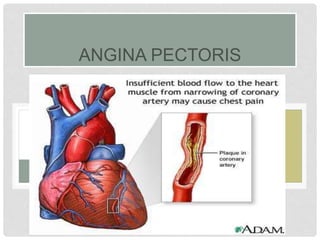
ANGINA PECTORIS
INTRODUCTION
• It is commonly known as angina is the sensation of chest
pain, pressure, or squeezing, often due to not enough
blood flow to the heart muscle as a result
of obstruction or spasm of the coronary arteries.
• The term derives from the Latin angere ("to strangle")
and pectus ("chest"), and can therefore be translated as
"a strangling feeling in the chest".
• angina pectoris can occur due to anemia, abnormal
heart rhythms and heart failure, its main cause
is coronary artery disease, an atherosclerotic process
affecting the arteries feeding the heart
CLASSIFICATION
• Stable angina(effort angina)
• Unstable angina(crescendo angina)
• it occurs at rest (or with minimal exertion), usually lasting
more than 10 minutes
• it is severe and of new onset (i.e., within the prior 4–6
weeks)
• it occurs with a crescendo pattern (i.e., distinctly more
severe, prolonged, or frequent than before)
• Cardiac syndrome X(microvascular angina)
SIGNS AND SYMPTOMS
• Chest discomfort
• Pain in epigastrum
• Nausea
• Vomiting
• Pallor(pale color of skin)
RISK FACTORS
• Age
• Smoking
• Diabetes mellitus
• Dyslipidemia
• hypertension
• Medications
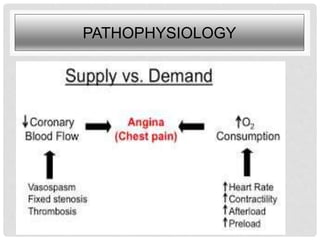
PATHOPHYSIOLOGY
DIAGNOSIS
• CBC
• CARDIAC BIOMARKERS
• ECG
• CORONARY ANGIOGRAM
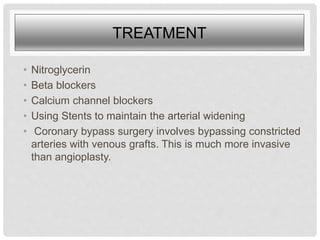
TREATMENT
• Nitroglycerin
• Beta blockers
• Calcium channel blockers
• Using Stents to maintain the arterial widening
• Coronary bypass surgery involves bypassing constricted
arteries with venous grafts. This is much more invasive
than angioplasty.
ICD-10-CM GUIDELINES
• Unstable angina-i20.0
• Angina pectoris with documented spasm-i20.1
• Other forms of angina pectoris-i20.8
• Angina pectoris,unspecified-i20.9
• https://www.medesunglobal.com
THANK YOU

Angina pectoris-ICD-10-CM-2017

  • 1.
  • 2.
    INTRODUCTION • It iscommonly known as angina is the sensation of chest pain, pressure, or squeezing, often due to not enough blood flow to the heart muscle as a result of obstruction or spasm of the coronary arteries.
  • 3.
    • The termderives from the Latin angere ("to strangle") and pectus ("chest"), and can therefore be translated as "a strangling feeling in the chest". • angina pectoris can occur due to anemia, abnormal heart rhythms and heart failure, its main cause is coronary artery disease, an atherosclerotic process affecting the arteries feeding the heart
  • 4.
    CLASSIFICATION • Stable angina(effortangina) • Unstable angina(crescendo angina) • it occurs at rest (or with minimal exertion), usually lasting more than 10 minutes • it is severe and of new onset (i.e., within the prior 4–6 weeks) • it occurs with a crescendo pattern (i.e., distinctly more severe, prolonged, or frequent than before) • Cardiac syndrome X(microvascular angina)
  • 5.
    SIGNS AND SYMPTOMS •Chest discomfort • Pain in epigastrum • Nausea • Vomiting • Pallor(pale color of skin)
  • 6.
    RISK FACTORS • Age •Smoking • Diabetes mellitus • Dyslipidemia • hypertension • Medications
  • 7.
  • 8.
    DIAGNOSIS • CBC • CARDIACBIOMARKERS • ECG • CORONARY ANGIOGRAM
  • 9.
    TREATMENT • Nitroglycerin • Betablockers • Calcium channel blockers • Using Stents to maintain the arterial widening • Coronary bypass surgery involves bypassing constricted arteries with venous grafts. This is much more invasive than angioplasty.
  • 10.
    ICD-10-CM GUIDELINES • Unstableangina-i20.0 • Angina pectoris with documented spasm-i20.1 • Other forms of angina pectoris-i20.8 • Angina pectoris,unspecified-i20.9 • https://www.medesunglobal.com
  • 11.