Ischemic Heart Disease
Logman Mohammed Alshaikh
9/13/2020 logman 1
Ischemic heart disease
• Ischemic heart disease (IHD) is a condition
in which there is anadequate supply of
blood and oxygen to a portion of
myocardium. It tipically occurs when there
is an imbalance between myocardial
oxygen supply and demand.
• The most common cause is atherosclerotic
disease of an epicardial coronary artery.
9/13/2020 logman 2
Etiology
• 1.decresed coronary blood flow by
obstruction(atheroma,spasm,thrombosis,e
mbolus,arteritis,congenital abnormalities)
• 2.increased myocardial oxygen demand
• 3.decresed flow of oxygenated blood to
the myocardium
• 4.cardiac syndrome X(angina in patient
with normal CA (micro vascular angina)
9/13/2020 logman 3
Risk factors
• Fixed
• Age
• Male sex
• Positive family history
• Race
9/13/2020 logman 4
cont
• modifiable
• Hyperlipidaemia
• Cigarette smoking
• Hypertension
• Diabetes mellitus
• Lack of exercise
• Homocysteinaemia
cont
• Personality
• Obesity
• Contraceptive pill
• Heavy alcohol consumption
9/13/2020 logman 6
Pathophysiology of myocardial
ischemia
• Myocardial oxigen supply is decreased
– Narrowed coronary arteries (sclerosis, thrombus,
spasmus, coronary embolism, vasculitis)
– Hypotension
– Severe anemia
– Methemoglobinemia, increased carboxyhemoglobin
• Myocardial oxigen demand is increased
– Left ventricle hypertrophy
– Fever
– Hyperthyroidism
– Tachycardy
9/13/2020 logman 7
Coronary atherosclerosis
• Segmental atherosclerotic narrowing of coronary
arteries is caused most commonly by formation of
plaque.
• When a stenosis reduces the diameter of coronary artery
– by 50%, there is a limitation on the ability to
increase flow,to meet increased myocardial
demand
– by 80%, blood flow at rest may be reduced
9/13/2020 logman 8
The clinical manifestations of
ischemic heart disease
• Ischemic heart disease without clinical
symptoms.OR Sudden death can be the
presenting manifestation.
• Cardiomegaly and heart failure that may have
caused no symptoms prior the development of
heart failure – ischemic cardiomyopathy.
• Angina pectoris. Stable angina pectoris.
• Unstable angina/Non ST-elevation myocardial
infarction (NSTEMI)/STEMI = acut coronary
syndromes
9/13/2020 logman 9
Angina pectoris
• Angina pectoris (Latin, angere = press or grip,
pectus = chest) or stenocardia (Greek, stenos =
narrow, cardia = heart) means chest pain
because of episodic myocardial ischemia
• Angina pectoris is the most common
manifestation of the ischemic heart disease.
*Woodwell DA. National ambulatory medical care survey:1998 summary. Adv. Data 2000;19:1-26.
9/13/2020 logman 10
Pathophysiology of
stable/unstable angina &MI
• Stable angina: coronary perfusion
impaired by fixed or stable atheroma of CA
• i-e patient has fixed capacity of exertion
after that he starts feeling chest pain
• Unstable angina :pain on minimal
exertion or at rest . The culiprit lesion is
usually complex ulcerated or fissured
atheroma with adherent PLTT –rich
thrombus and local CA spasm.
9/13/2020 logman 11
cont
• Unstable angina=ulcerated atheroma +
thrombus formation → abrupt reduction of
coronary blood flow caused by thrombus
formation → angina at rest.
• MI: same to unstable angina but there is
total obstruction of coronary artery.
9/13/2020 logman 12
Types of angina Pectoris
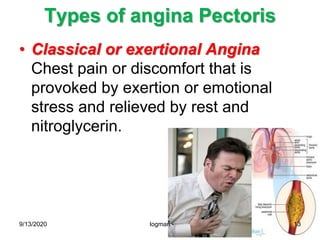
• Classical or exertional Angina
Chest pain or discomfort that is
provoked by exertion or emotional
stress and relieved by rest and
nitroglycerin.
9/13/2020 logman 13
Variant (Prinzmetal’s) angina
• Rare, usually occurs at rest—
midnight to early morning hours.
• Pain possibly severe
• Electrocardiogram (ECG) changes
due to coronary artery spasm.
• There is no increased myocardial
demand.
9/13/2020 logman 14
Unstable Angina Pectoris (Pre
infarction)
• Chest pain occurring at rest.
• No increase in oxygen demand is
placed on the heart, but an acute lack
of blood flow to the heart occurs
because of coronary artery spasm or
the presence of an enlarged plaque
or hemorrhage ulceration of a
complicated lesion.
9/13/2020 logman 15
• A change in frequency, duration, and
intensity of stable angina symptoms is
indicative of progression to unstable
angina.
• Unstable angina pain lasts longer than
10 minutes, is unrelieved by rest or
sublingual nitroglycerin, and mimics
signs and symptoms of impending MI.
• Unstable angina can cause sudden
death or result in MI.9/13/2020 logman 16
Decubitus angina
• Occurs when patient lies down.its is
usually occurs in assosciation with
impaired left ventricle function
• Patient usually has sever coronary artey
disease
9/13/2020 logman 17
Nocturnal angina
• This is the angina that awakes the patient
sleep.it may be provoked by vivid dreams
• It may be occurs due to critical coronary
artery obstruction or coronary spasm.
9/13/2020 logman 18
Cardiac syndrome X
patient present with angina and positive
ETT (Exercise Tolerance Test), or
ambulatory (Holter) ECG monitoring.and
angiographically normal CA .it may be
due to functional abnormalities of
coronary microcirculation(no dilatation of
arterioles at the time of stress
9/13/2020 logman 19
clinical features if stable angina
• symptoms
• Chest pain
• Dyspnea
• Associated symptoms
9/13/2020 logman 20
1. Characters of pain
• Sub sternal chest pain, pressure, heaviness,
squeezing, burning, strangling, or cramping
pain.
• a. Pain may be mild or severe and typically
presents with a gradual buildup of discomfort.
• b. May produce numbness or weakness in
arms, wrists, or hands.
• Associated symptoms include
Diaphoresis, nausea, indigestion, dyspnea,
tachycardia, and increase in blood pressure.
9/13/2020 logman 21
2. Location
behind middle or upper third of
sternum; the patient will make a
fist over the site of the pain
3. Radiation
• Usually radiates to neck, jaw,
shoulders, arms, hands, and
posterior interscapular area.
• Pain occurs more commonly
on the left side than the right.
9/13/2020 logman 22
4. Duration
Usually lasts 2 to 15 minutes after stopping activity
nitroglycerin relieves pain within 1 minute.
5. precipitating factors
• Exposure to weather extremes
• Eating a heavy meal
• Stress
all increase the workload of the heart, thus
increasing oxygen demand.
• Relieving factors:Rest and nitrate as in stable
angina
9/13/2020 logman 23
Diagnostic Evaluation
• 1. Characteristic chest pain and clinical history.
• 2. Nitroglycerin test—relief of pain with
nitroglycerin.
• 3. Blood tests.
• Hemoglobin to rule out anemia, which may reduce
myocardial oxygen supply.
• HbA1C and fasting lipid panel to rule out modifiable
risk factors for CAD.
• Coagulation studies, CRP (determines inflammation
)
• Cardiac markers, (creatinine kinase CK-MB, and
troponin-I)
9/13/2020 logman 24
ECG
• During pain ST- segment depression with
or without T wave depression that reverse
after ischemia disappears
• ST- segment elevation in prinzmetal
angina
• Resting ECG may be normal between
attacks or may show LVH, ST-T wave
changes, arrhythmias, and Q waves.
9/13/2020 logman 25
ETT (Exercise Tollerance Test)
indications
• To confirm diagnosis of
angina
• To assess prognosis in
CAD pts
• To evaluate response to
therapy
Contra indications
• Acute MI(2days)
• High risk UA
• Decompensated HF
• Arrhythmias
• Acute Myo/pericaditis
• Uncontrolled HTN
• Sever aortic stenosis
• Exercise intolerance
• Severe hypertrophic
cardiomyopathy9/13/2020 logman 26
ETT cont
ETT is immediately terminated when there is:
1. Significant chest pain
2. Drop inSBP of >10mmHg of baseline
3. Arrhythmias
4. Severe dyspnea
5. Dizziness,ataxia,fatigue,pallor,or cyanosis
6. ST-depession of >3-4mm
7. ST-segment elevation >1mm
9/13/2020 logman 27
ECG stress testing Ambulatory (Holter) ECG .
9/13/2020 logman 28
• Cardiac catheterization
Coronary angiography performed during the procedure
determines the presence, location, and extent of coronary
lesions.
• Isotpe scanning
• ECHO
9/13/2020 logman 29
Management
Drug Therapy include :
• Nitrates
• Beta -adrenergic blockers
• Calcium channel blockers.
• Asprin
9/13/2020 logman 30
Nitrates
• Action : cause generalized vasodilation
throughout the body.
• Nitrates can be administered orally, sublingually,
trans dermally I.V.
• may provide short- or long-acting effects.
• a. Short-acting nitrates (sublingual) provide
immediate relief of acute anginal attacks
• b. Long-acting nitrates prevent anginal episodes
and/or reduce severity and frequency of attacks.
• s/e ; headache,hypotension,dizzines,tolerance.
9/13/2020 logman 31
• 5. Ant lipid agents—reduce total
cholesterol and triglyceride levels and
have been shown to assist in the
stabilization of plaque.
• 6. Antiplatelet agents—decrease
platelet aggregation to inhibit
thrombus formation. Aspirin are
common used.
9/13/2020 logman 32
Percutaneous Coronary
Interventions
1. Percutaneous trans
luminal angioplasty
• a. A balloon-tipped
catheter is placed in a
coronary vessel narrowed
by plaque.
• b. The balloon is inflated
and deflated to stretch the
vessel wall and flatten the
plaque
9/13/2020 logman 33
2. Intracoronary atherectomy
• A blade-tipped
catheter is guided into
a coronary vessel to
the site of the plaque.
• Depending on the
type of blade, the
plaque is either cut,
shaved, or pulverized,
and then removed.
9/13/2020 logman 34
3. Intracoronary stent
A diamond mesh
tubular device is
placed in the coronary
vessel to Prevents
restenosis by
providing a “skeletal”
support.
9/13/2020 logman 35
Other Interventional Strategies
Coronary artery bypass
graft (CABG) surgery
A graft is surgically
attached to the aorta,
and the other end of the
graft is attached to a
distal portion of a
coronary vessel to
returns adequate blood
flow to the heart muscle
supplied by the artery.
9/13/2020 logman 36
Secondary Prevention
• Cessation of smoking
• Control of high blood pressure
• Diet low in saturated fat cholesterol(300
mg/day)
• Low-dose aspirin daily for those at high risk
• Physical exercise .
• Weight control
• Control of diabetes mellitus
• Control of blood lipids
9/13/2020 logman 37
Complications
1. Sudden death due to dysrhythmias
2. Heart failure
3. Myocardial infraction
cont...
9/13/2020 logman 38

Ihd

  • 1.
    Ischemic Heart Disease LogmanMohammed Alshaikh 9/13/2020 logman 1
  • 2.
    Ischemic heart disease •Ischemic heart disease (IHD) is a condition in which there is anadequate supply of blood and oxygen to a portion of myocardium. It tipically occurs when there is an imbalance between myocardial oxygen supply and demand. • The most common cause is atherosclerotic disease of an epicardial coronary artery. 9/13/2020 logman 2
  • 3.
    Etiology • 1.decresed coronaryblood flow by obstruction(atheroma,spasm,thrombosis,e mbolus,arteritis,congenital abnormalities) • 2.increased myocardial oxygen demand • 3.decresed flow of oxygenated blood to the myocardium • 4.cardiac syndrome X(angina in patient with normal CA (micro vascular angina) 9/13/2020 logman 3
  • 4.
    Risk factors • Fixed •Age • Male sex • Positive family history • Race 9/13/2020 logman 4
  • 5.
    cont • modifiable • Hyperlipidaemia •Cigarette smoking • Hypertension • Diabetes mellitus • Lack of exercise • Homocysteinaemia
  • 6.
    cont • Personality • Obesity •Contraceptive pill • Heavy alcohol consumption 9/13/2020 logman 6
  • 7.
    Pathophysiology of myocardial ischemia •Myocardial oxigen supply is decreased – Narrowed coronary arteries (sclerosis, thrombus, spasmus, coronary embolism, vasculitis) – Hypotension – Severe anemia – Methemoglobinemia, increased carboxyhemoglobin • Myocardial oxigen demand is increased – Left ventricle hypertrophy – Fever – Hyperthyroidism – Tachycardy 9/13/2020 logman 7
  • 8.
    Coronary atherosclerosis • Segmentalatherosclerotic narrowing of coronary arteries is caused most commonly by formation of plaque. • When a stenosis reduces the diameter of coronary artery – by 50%, there is a limitation on the ability to increase flow,to meet increased myocardial demand – by 80%, blood flow at rest may be reduced 9/13/2020 logman 8
  • 9.
    The clinical manifestationsof ischemic heart disease • Ischemic heart disease without clinical symptoms.OR Sudden death can be the presenting manifestation. • Cardiomegaly and heart failure that may have caused no symptoms prior the development of heart failure – ischemic cardiomyopathy. • Angina pectoris. Stable angina pectoris. • Unstable angina/Non ST-elevation myocardial infarction (NSTEMI)/STEMI = acut coronary syndromes 9/13/2020 logman 9
  • 10.
    Angina pectoris • Anginapectoris (Latin, angere = press or grip, pectus = chest) or stenocardia (Greek, stenos = narrow, cardia = heart) means chest pain because of episodic myocardial ischemia • Angina pectoris is the most common manifestation of the ischemic heart disease. *Woodwell DA. National ambulatory medical care survey:1998 summary. Adv. Data 2000;19:1-26. 9/13/2020 logman 10
  • 11.
    Pathophysiology of stable/unstable angina&MI • Stable angina: coronary perfusion impaired by fixed or stable atheroma of CA • i-e patient has fixed capacity of exertion after that he starts feeling chest pain • Unstable angina :pain on minimal exertion or at rest . The culiprit lesion is usually complex ulcerated or fissured atheroma with adherent PLTT –rich thrombus and local CA spasm. 9/13/2020 logman 11
  • 12.
    cont • Unstable angina=ulceratedatheroma + thrombus formation → abrupt reduction of coronary blood flow caused by thrombus formation → angina at rest. • MI: same to unstable angina but there is total obstruction of coronary artery. 9/13/2020 logman 12
  • 13.
    Types of anginaPectoris • Classical or exertional Angina Chest pain or discomfort that is provoked by exertion or emotional stress and relieved by rest and nitroglycerin. 9/13/2020 logman 13
  • 14.
    Variant (Prinzmetal’s) angina •Rare, usually occurs at rest— midnight to early morning hours. • Pain possibly severe • Electrocardiogram (ECG) changes due to coronary artery spasm. • There is no increased myocardial demand. 9/13/2020 logman 14
  • 15.
    Unstable Angina Pectoris(Pre infarction) • Chest pain occurring at rest. • No increase in oxygen demand is placed on the heart, but an acute lack of blood flow to the heart occurs because of coronary artery spasm or the presence of an enlarged plaque or hemorrhage ulceration of a complicated lesion. 9/13/2020 logman 15
  • 16.
    • A changein frequency, duration, and intensity of stable angina symptoms is indicative of progression to unstable angina. • Unstable angina pain lasts longer than 10 minutes, is unrelieved by rest or sublingual nitroglycerin, and mimics signs and symptoms of impending MI. • Unstable angina can cause sudden death or result in MI.9/13/2020 logman 16
  • 17.
    Decubitus angina • Occurswhen patient lies down.its is usually occurs in assosciation with impaired left ventricle function • Patient usually has sever coronary artey disease 9/13/2020 logman 17
  • 18.
    Nocturnal angina • Thisis the angina that awakes the patient sleep.it may be provoked by vivid dreams • It may be occurs due to critical coronary artery obstruction or coronary spasm. 9/13/2020 logman 18
  • 19.
    Cardiac syndrome X patientpresent with angina and positive ETT (Exercise Tolerance Test), or ambulatory (Holter) ECG monitoring.and angiographically normal CA .it may be due to functional abnormalities of coronary microcirculation(no dilatation of arterioles at the time of stress 9/13/2020 logman 19
  • 20.
    clinical features ifstable angina • symptoms • Chest pain • Dyspnea • Associated symptoms 9/13/2020 logman 20
  • 21.
    1. Characters ofpain • Sub sternal chest pain, pressure, heaviness, squeezing, burning, strangling, or cramping pain. • a. Pain may be mild or severe and typically presents with a gradual buildup of discomfort. • b. May produce numbness or weakness in arms, wrists, or hands. • Associated symptoms include Diaphoresis, nausea, indigestion, dyspnea, tachycardia, and increase in blood pressure. 9/13/2020 logman 21
  • 22.
    2. Location behind middleor upper third of sternum; the patient will make a fist over the site of the pain 3. Radiation • Usually radiates to neck, jaw, shoulders, arms, hands, and posterior interscapular area. • Pain occurs more commonly on the left side than the right. 9/13/2020 logman 22
  • 23.
    4. Duration Usually lasts2 to 15 minutes after stopping activity nitroglycerin relieves pain within 1 minute. 5. precipitating factors • Exposure to weather extremes • Eating a heavy meal • Stress all increase the workload of the heart, thus increasing oxygen demand. • Relieving factors:Rest and nitrate as in stable angina 9/13/2020 logman 23
  • 24.
    Diagnostic Evaluation • 1.Characteristic chest pain and clinical history. • 2. Nitroglycerin test—relief of pain with nitroglycerin. • 3. Blood tests. • Hemoglobin to rule out anemia, which may reduce myocardial oxygen supply. • HbA1C and fasting lipid panel to rule out modifiable risk factors for CAD. • Coagulation studies, CRP (determines inflammation ) • Cardiac markers, (creatinine kinase CK-MB, and troponin-I) 9/13/2020 logman 24
  • 25.
    ECG • During painST- segment depression with or without T wave depression that reverse after ischemia disappears • ST- segment elevation in prinzmetal angina • Resting ECG may be normal between attacks or may show LVH, ST-T wave changes, arrhythmias, and Q waves. 9/13/2020 logman 25
  • 26.
    ETT (Exercise TolleranceTest) indications • To confirm diagnosis of angina • To assess prognosis in CAD pts • To evaluate response to therapy Contra indications • Acute MI(2days) • High risk UA • Decompensated HF • Arrhythmias • Acute Myo/pericaditis • Uncontrolled HTN • Sever aortic stenosis • Exercise intolerance • Severe hypertrophic cardiomyopathy9/13/2020 logman 26
  • 27.
    ETT cont ETT isimmediately terminated when there is: 1. Significant chest pain 2. Drop inSBP of >10mmHg of baseline 3. Arrhythmias 4. Severe dyspnea 5. Dizziness,ataxia,fatigue,pallor,or cyanosis 6. ST-depession of >3-4mm 7. ST-segment elevation >1mm 9/13/2020 logman 27
  • 28.
    ECG stress testingAmbulatory (Holter) ECG . 9/13/2020 logman 28
  • 29.
    • Cardiac catheterization Coronaryangiography performed during the procedure determines the presence, location, and extent of coronary lesions. • Isotpe scanning • ECHO 9/13/2020 logman 29
  • 30.
    Management Drug Therapy include: • Nitrates • Beta -adrenergic blockers • Calcium channel blockers. • Asprin 9/13/2020 logman 30
  • 31.
    Nitrates • Action :cause generalized vasodilation throughout the body. • Nitrates can be administered orally, sublingually, trans dermally I.V. • may provide short- or long-acting effects. • a. Short-acting nitrates (sublingual) provide immediate relief of acute anginal attacks • b. Long-acting nitrates prevent anginal episodes and/or reduce severity and frequency of attacks. • s/e ; headache,hypotension,dizzines,tolerance. 9/13/2020 logman 31
  • 32.
    • 5. Antlipid agents—reduce total cholesterol and triglyceride levels and have been shown to assist in the stabilization of plaque. • 6. Antiplatelet agents—decrease platelet aggregation to inhibit thrombus formation. Aspirin are common used. 9/13/2020 logman 32
  • 33.
    Percutaneous Coronary Interventions 1. Percutaneoustrans luminal angioplasty • a. A balloon-tipped catheter is placed in a coronary vessel narrowed by plaque. • b. The balloon is inflated and deflated to stretch the vessel wall and flatten the plaque 9/13/2020 logman 33
  • 34.
    2. Intracoronary atherectomy •A blade-tipped catheter is guided into a coronary vessel to the site of the plaque. • Depending on the type of blade, the plaque is either cut, shaved, or pulverized, and then removed. 9/13/2020 logman 34
  • 35.
    3. Intracoronary stent Adiamond mesh tubular device is placed in the coronary vessel to Prevents restenosis by providing a “skeletal” support. 9/13/2020 logman 35
  • 36.
    Other Interventional Strategies Coronaryartery bypass graft (CABG) surgery A graft is surgically attached to the aorta, and the other end of the graft is attached to a distal portion of a coronary vessel to returns adequate blood flow to the heart muscle supplied by the artery. 9/13/2020 logman 36
  • 37.
    Secondary Prevention • Cessationof smoking • Control of high blood pressure • Diet low in saturated fat cholesterol(300 mg/day) • Low-dose aspirin daily for those at high risk • Physical exercise . • Weight control • Control of diabetes mellitus • Control of blood lipids 9/13/2020 logman 37
  • 38.
    Complications 1. Sudden deathdue to dysrhythmias 2. Heart failure 3. Myocardial infraction cont... 9/13/2020 logman 38