Overview of
Android
Platform
Android Training
By
Khaled Anaqwa
What is Android?







Android is a Linux-based operating system
designed for smartphones (open source)
developed by Android, Inc., which Google
bought in 2005.
Open Handset Alliance: a consortium of
hardware, software, and telecommunication
companies devoted to advancing open
standards for mobile devices.
The first Android-powered phone was sold in
October 2008.
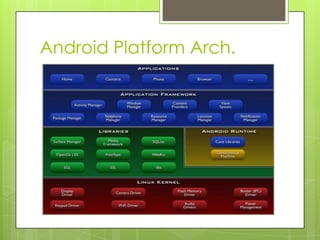
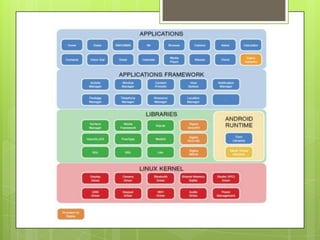
Android Platform Arch.
Android Platform






Linux for device drivers, memory
management, process management,
networking
Next level up is the android native libs, written
in c/c++ internally. Call from java interfaces.
Dalvik VM. Dalvik runs dex files, converted
from standard class file at compile time.
Application Framework, for developers
More about Dalvik




It is optimized for low memory requirements,
and is designed to allow multiple VM
instances to run at once, relying on the
underlying OS for process isolation, MM and
thread support.
one app 16m memory
Dev Environment



Java
Android SDKs + source code






libs,
dev tools: dx, aapt, adb, ddms, ant scripts
Emulators, docs, sample codes

Eclipse (IDE) + ADT
Application Fundamentals






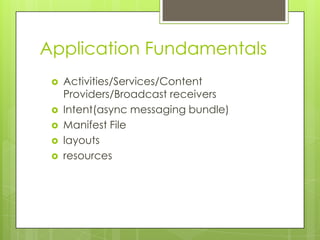
Activities/Services/Content
Providers/Broadcast receivers
Intent(async messaging bundle)
Manifest File
layouts
resources
Activity





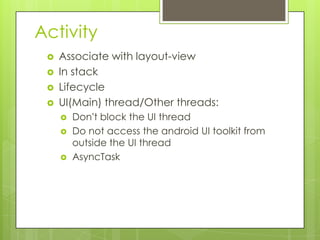
Associate with layout-view
In stack
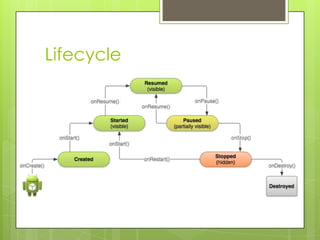
Lifecycle
UI(Main) thread/Other threads:




Don’t block the UI thread
Do not access the android UI toolkit from
outside the UI thread
AsyncTask
Lifecycle

Android Training (Intro)