Chep-1
McaNotes.com
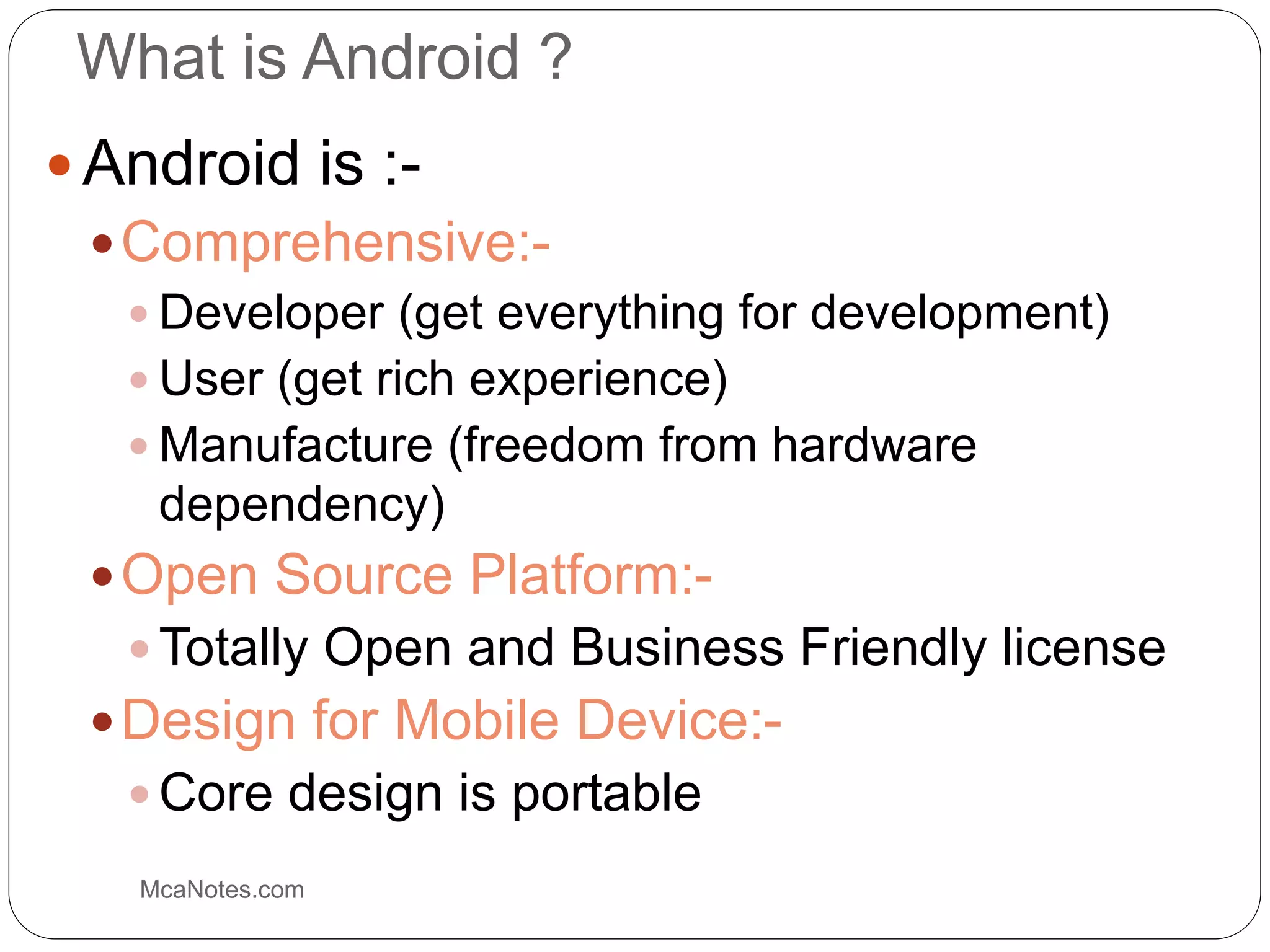
What is Android ?
 Android is :-
Comprehensive:-
 Developer (get everything for development)
 User (get rich experience)
 Manufacture (freedom from hardware
dependency)
Open Source Platform:-
 Totally Open and Business Friendly license
Design for Mobile Device:-
 Core design is portable
McaNotes.com
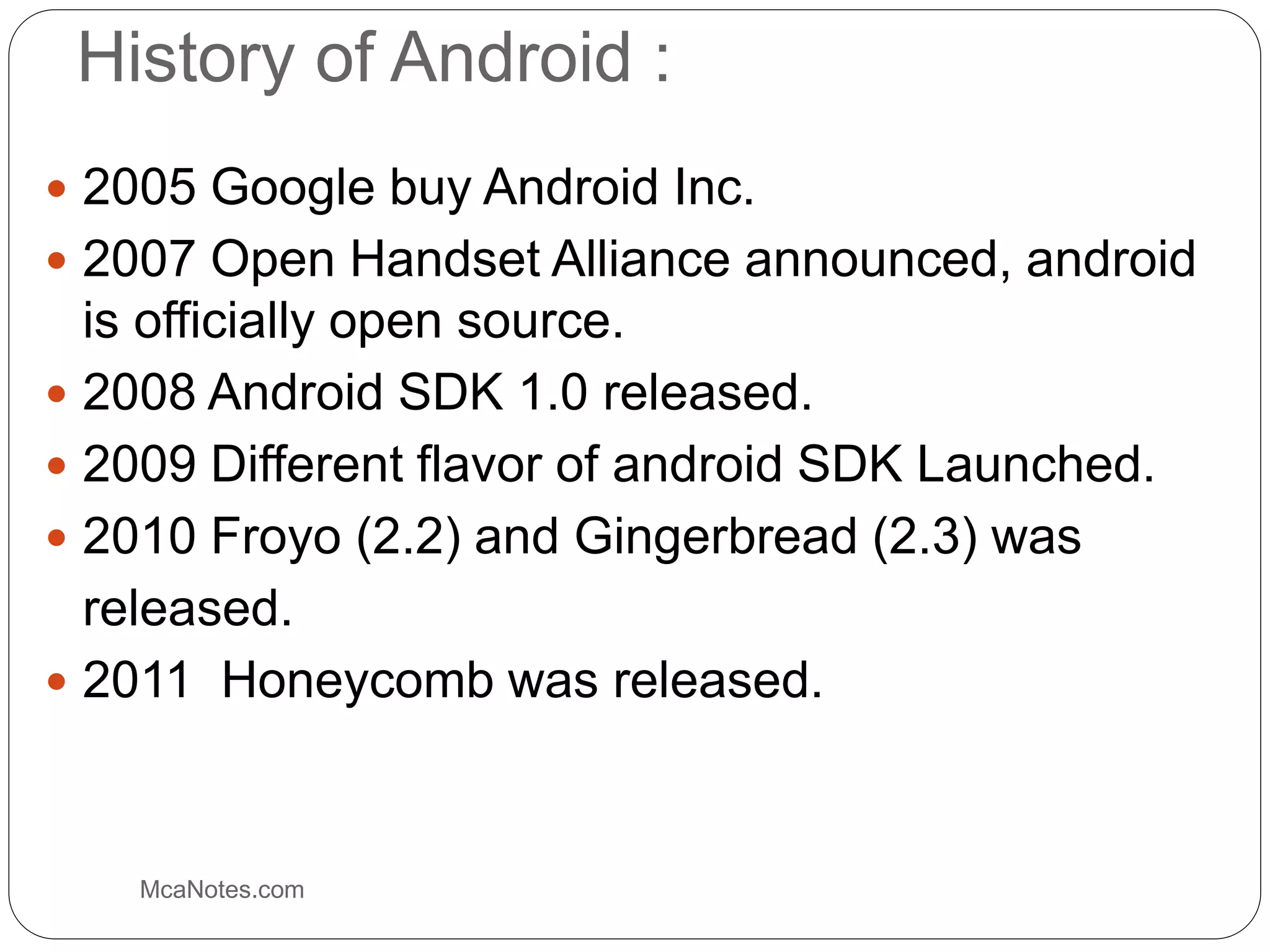
History of Android :
 2005 Google buy Android Inc.
 2007 Open Handset Alliance announced, android
is officially open source.
 2008 Android SDK 1.0 released.
 2009 Different flavor of android SDK Launched.
 2010 Froyo (2.2) and Gingerbread (2.3) was
released.
 2011 Honeycomb was released.
McaNotes.com
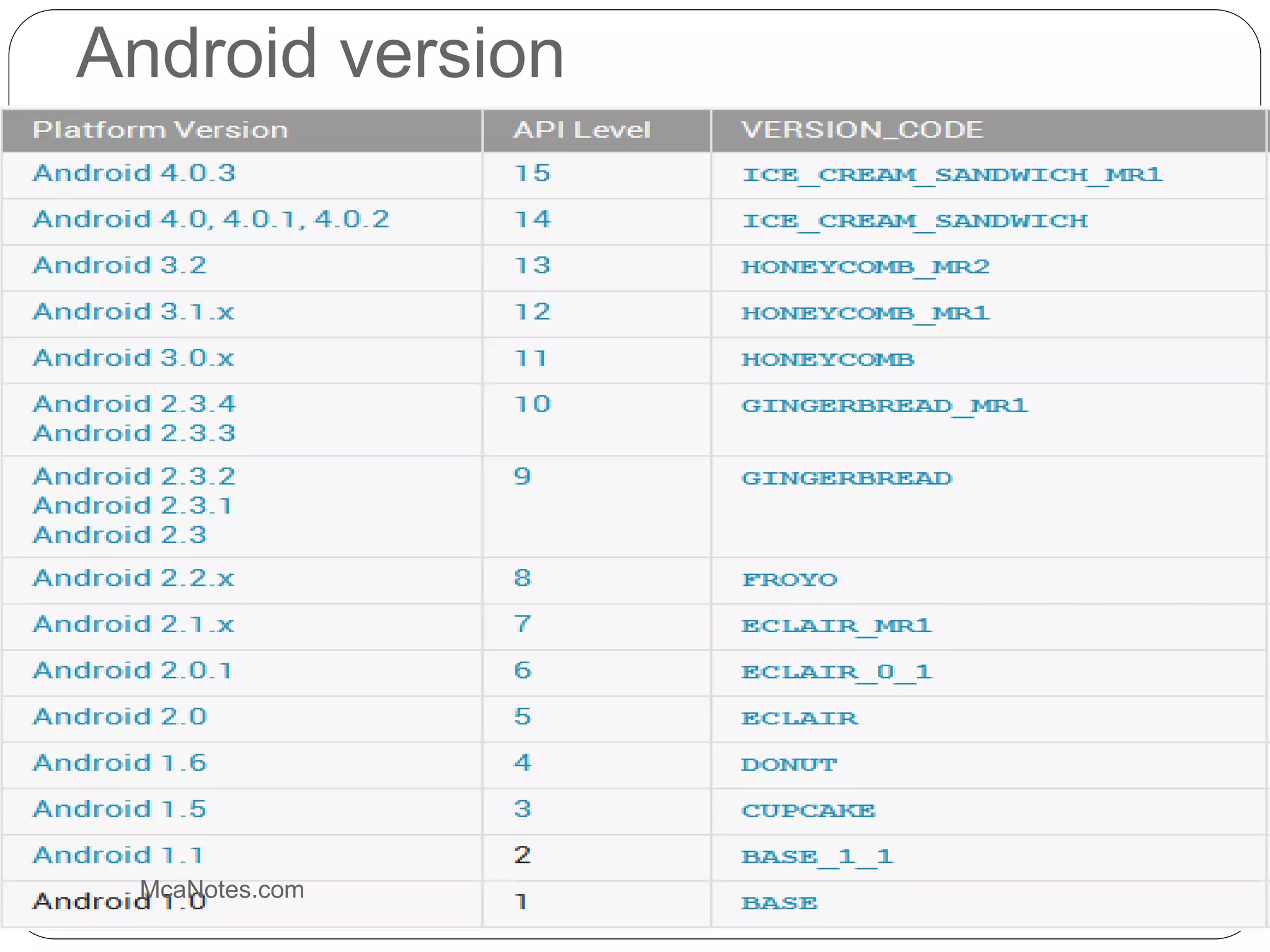
Android version
McaNotes.com
Open Handset Alliance
McaNotes.com
Birth of Open Handset Alliance
 Google was not satisfied with it’s success.
 Google lead the movement to turn closed system
to open.
 November 2007, Open Handset Alliance formed.
 Google acquired android in 2005.
 Many well known company join OHA.
 OHA started to create open resources .
McaNotes.com
Every one is getting Advantage
 Manufactures
 More than half member of OHA are handset
 manufacture like Samsung, Motorola, LG, HTC, Intel …
 Mobile Operator From
 North, South and Center America
 Europe, Asia, India, Australia, Africa ,Middle East …
Content Provider
 Everyone is developing killer apps for android
 More than 80,000 apps in Android Market
McaNotes.com
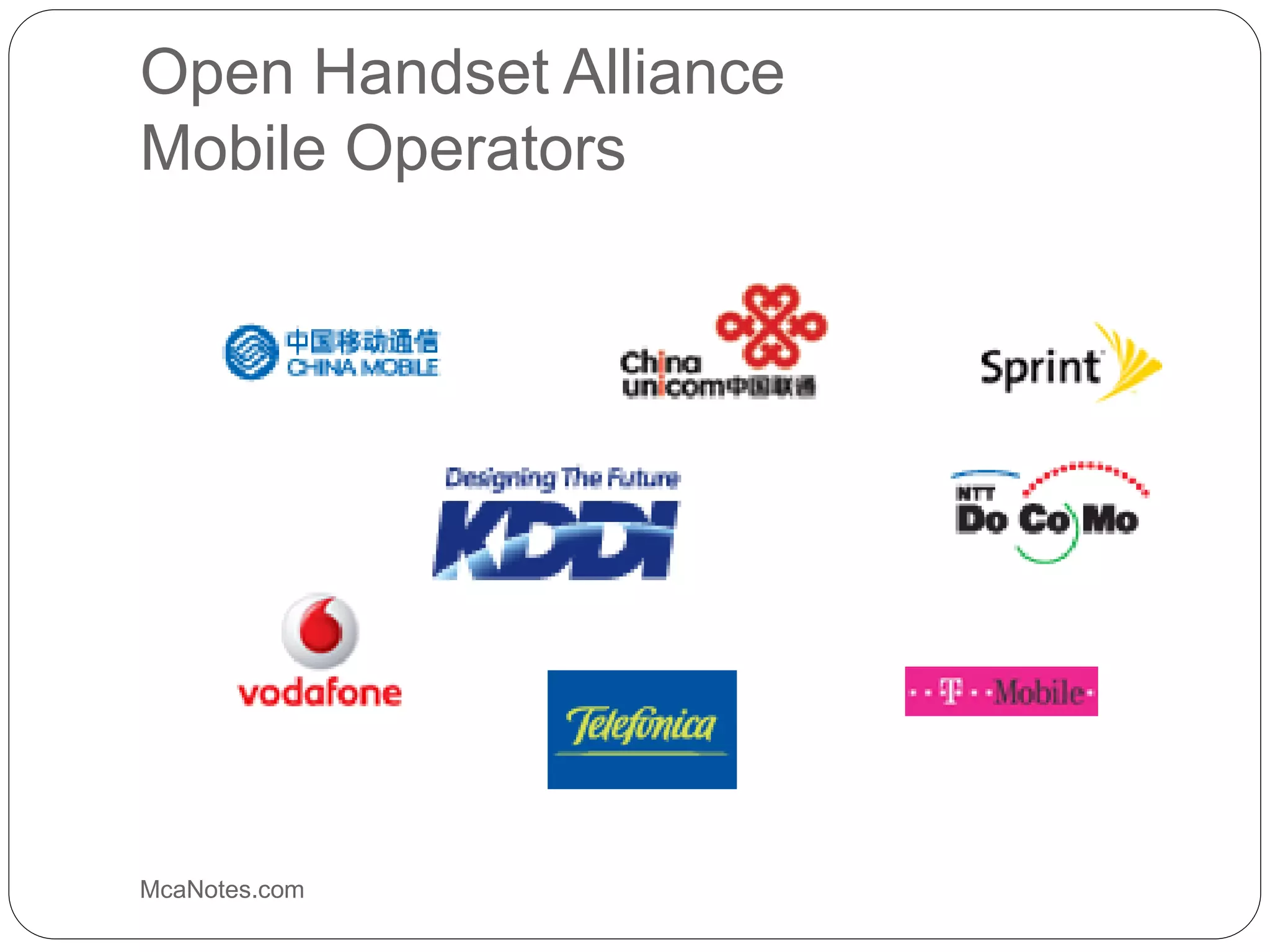
Open Handset Alliance
Mobile Operators
McaNotes.com
Open Handset Alliance
Handset Manufacturers
McaNotes.com
Open Handset Alliance
Semiconductor Companies
McaNotes.com
Open Handset Alliance
Software Companies
McaNotes.com
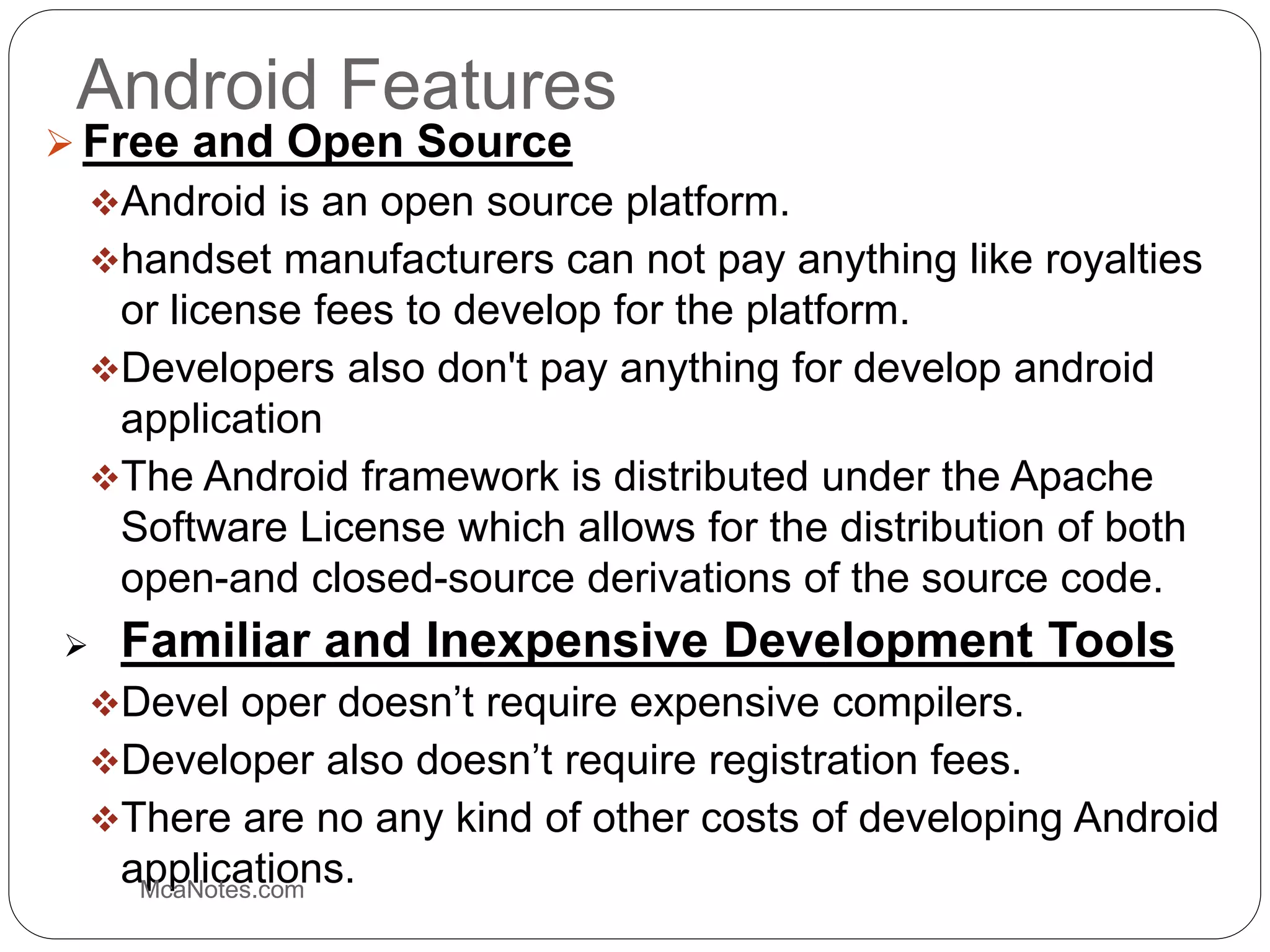
Android Features
 Free and Open Source
Android is an open source platform.
handset manufacturers can not pay anything like royalties
or license fees to develop for the platform.
Developers also don't pay anything for develop android
application
The Android framework is distributed under the Apache
Software License which allows for the distribution of both
open-and closed-source derivations of the source code.
 Familiar and Inexpensive Development Tools
Devel oper doesn’t require expensive compilers.
Developer also doesn’t require registration fees.
There are no any kind of other costs of developing Android
applications.McaNotes.com
Android Features
 Freely Available Software Development Kit
The Android SDK and tools are freely available.
Developers can download the Android SDK from the
Android website.
 Familiar Language, Familiar Development
Environments.
Eclipse is the most popular IDE for Android development,
and there is an Android plug-in available for facilitating
Android development.
Android applications can be developed on the xp , mac ,
linux…..etc operating systems:
McaNotes.com
Android Features
Enabling Development of Powerful applications
The manufacturer would grant the developer Privileged
All Android applications use the same libraries.
Applications can be extended or replaced altogether .
 A “Free Market” for Applications.
Android developers are free to choose any kind of revenue
model they want.
Developer can develop
 freeware
 shareware
 trial-ware applications
 ad-driven
 paid applications.
McaNotes.com
Android Features
 Rich, Secure Application Integration.
 A New and Growing Platform
McaNotes.com
Android Architecture
McaNotes.com
Android Architecture
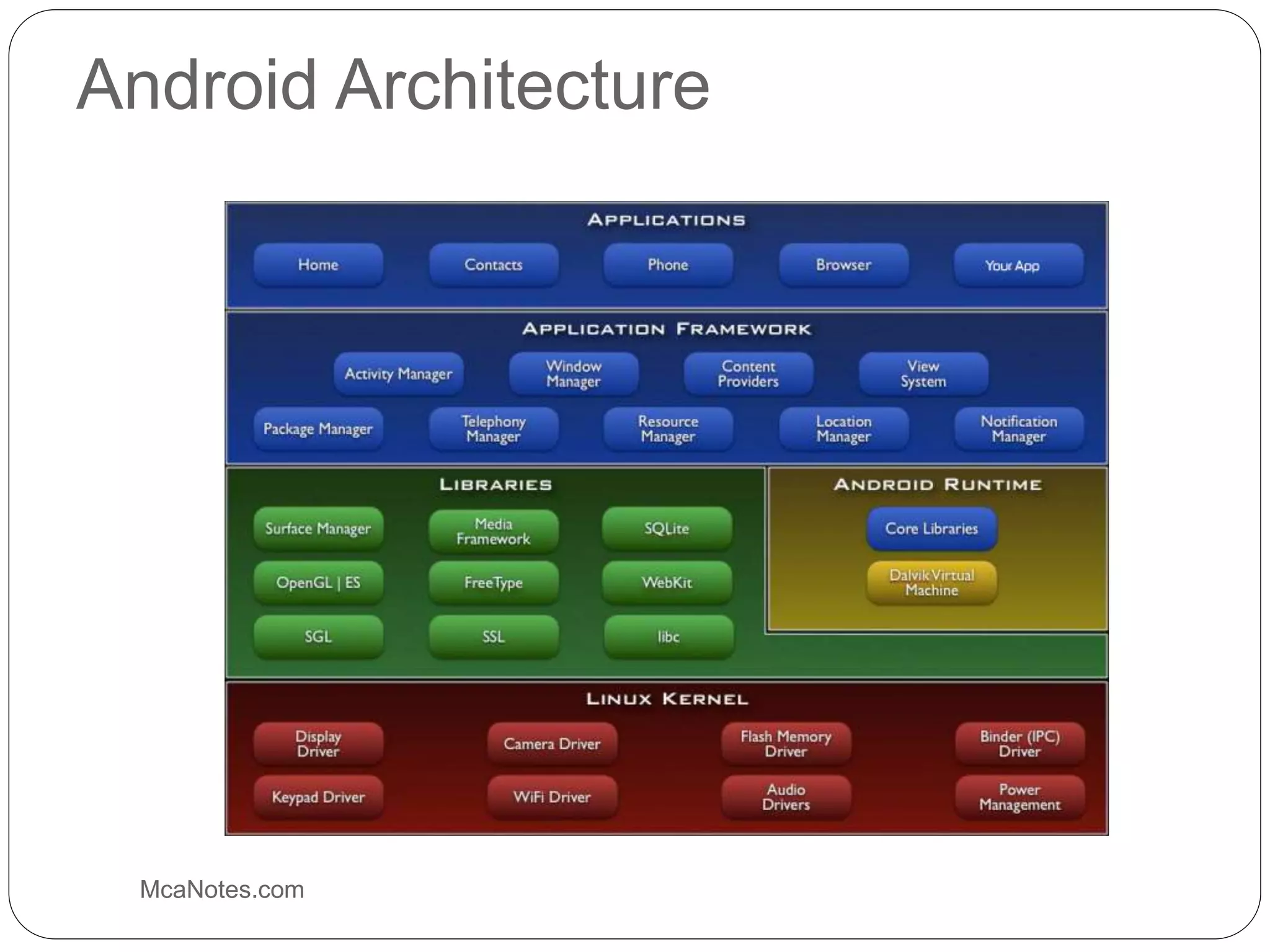
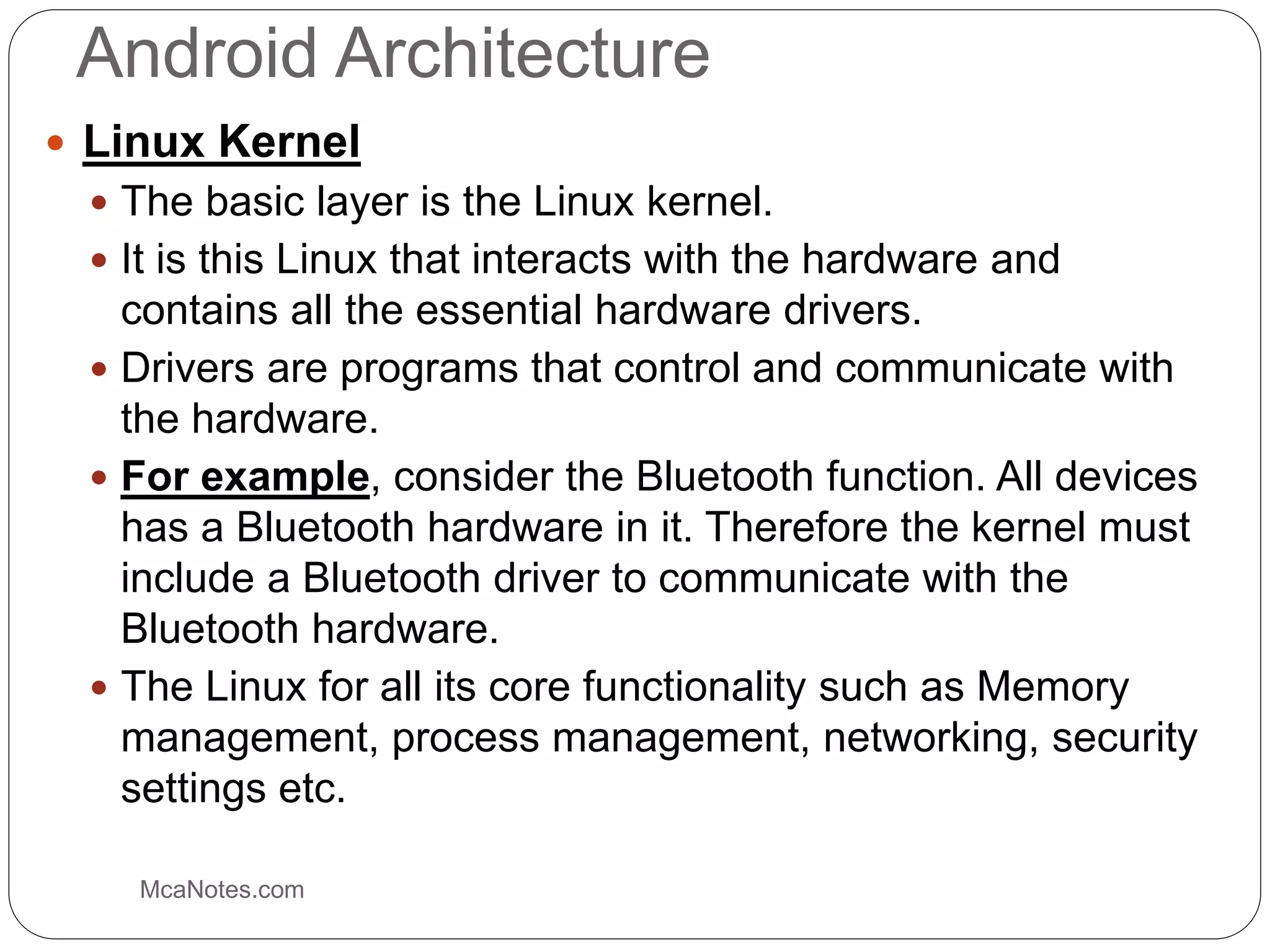
 Linux Kernel
 The basic layer is the Linux kernel.
 It is this Linux that interacts with the hardware and
contains all the essential hardware drivers.
 Drivers are programs that control and communicate with
the hardware.
 For example, consider the Bluetooth function. All devices
has a Bluetooth hardware in it. Therefore the kernel must
include a Bluetooth driver to communicate with the
Bluetooth hardware.
 The Linux for all its core functionality such as Memory
management, process management, networking, security
settings etc.
McaNotes.com
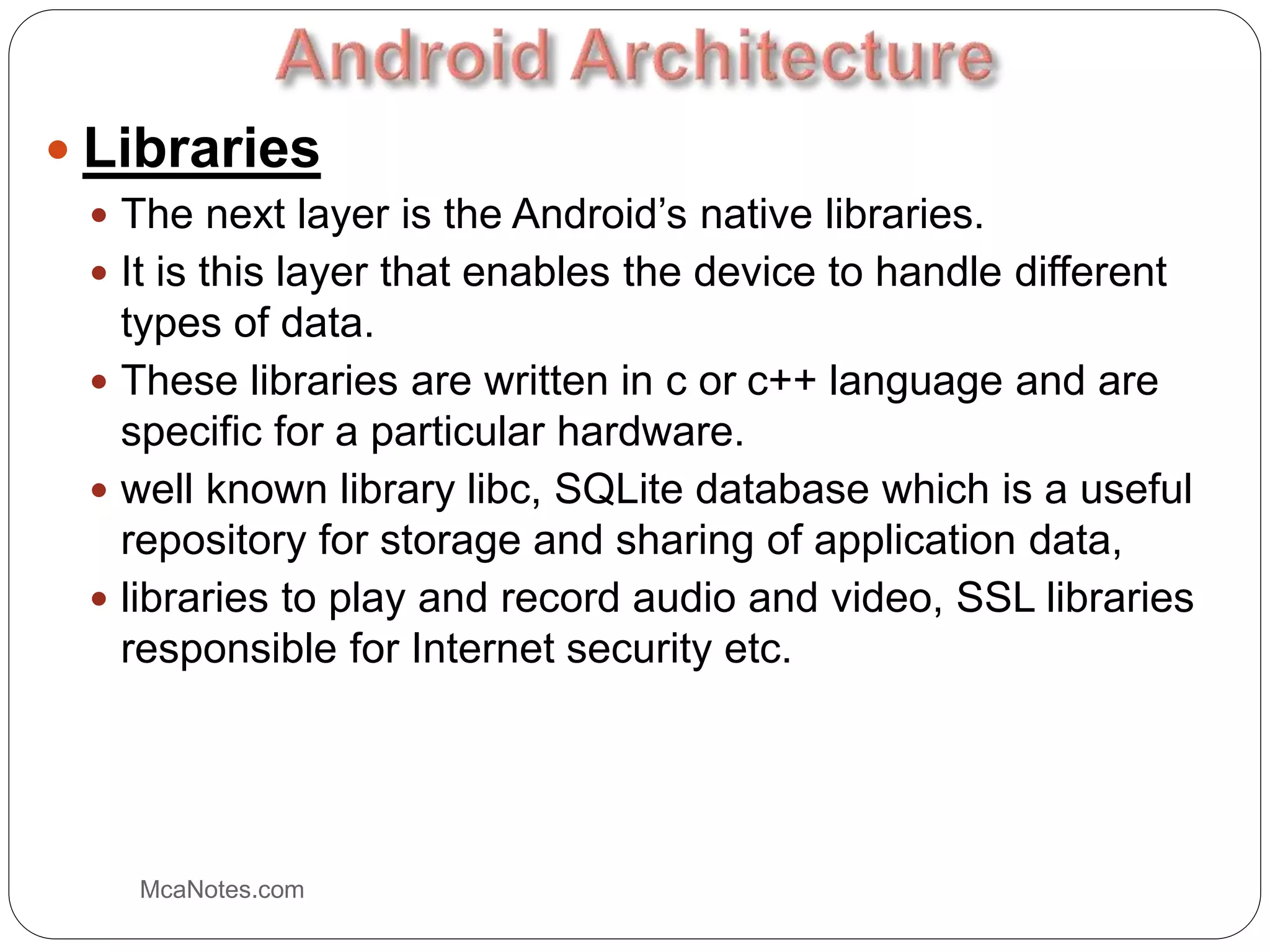
 Libraries
 The next layer is the Android’s native libraries.
 It is this layer that enables the device to handle different
types of data.
 These libraries are written in c or c++ language and are
specific for a particular hardware.
 well known library libc, SQLite database which is a useful
repository for storage and sharing of application data,
 libraries to play and record audio and video, SSL libraries
responsible for Internet security etc.
McaNotes.com
Android Architecture
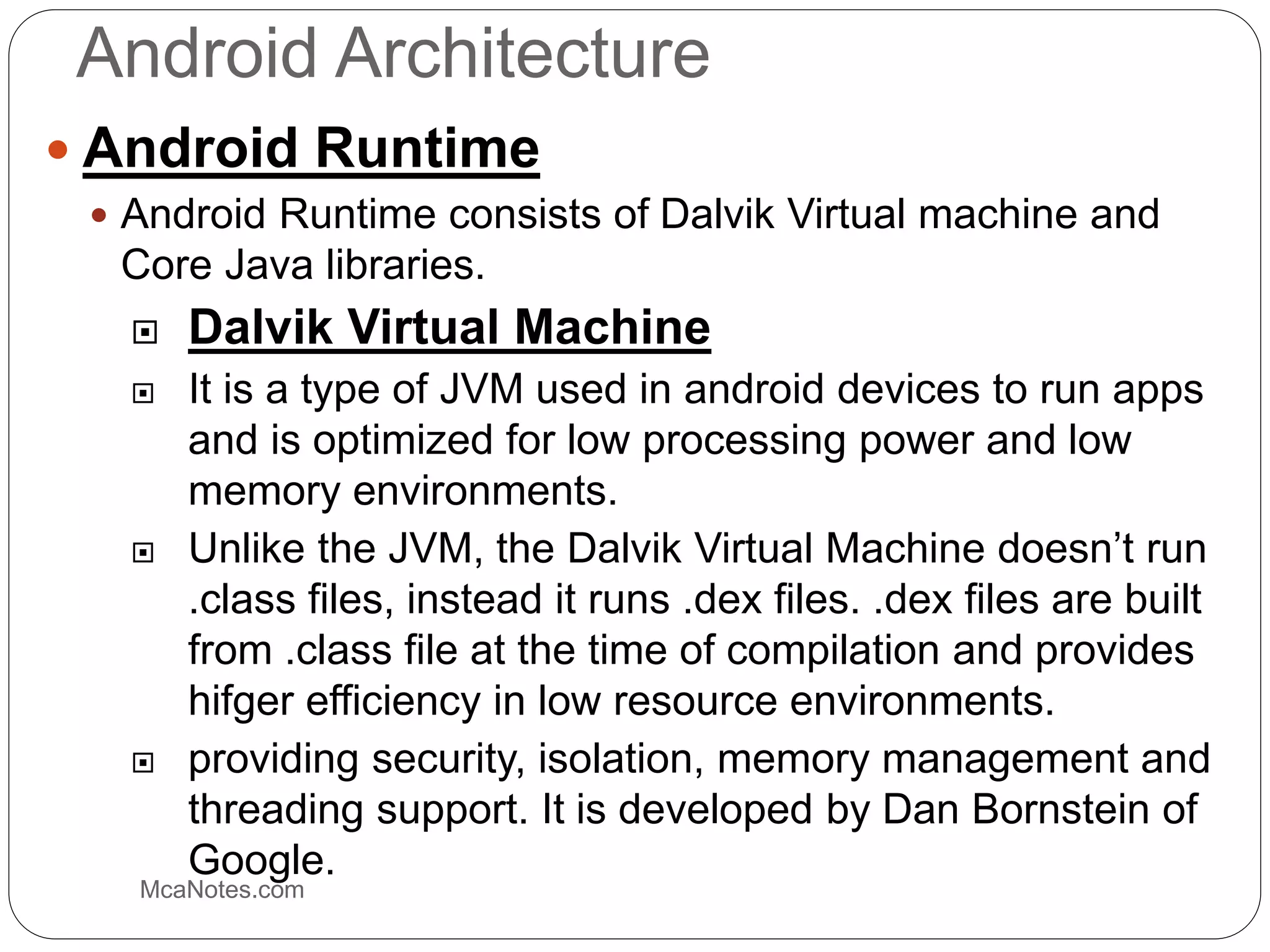
 Android Runtime
 Android Runtime consists of Dalvik Virtual machine and
Core Java libraries.
 Dalvik Virtual Machine
 It is a type of JVM used in android devices to run apps
and is optimized for low processing power and low
memory environments.
 Unlike the JVM, the Dalvik Virtual Machine doesn’t run
.class files, instead it runs .dex files. .dex files are built
from .class file at the time of compilation and provides
hifger efficiency in low resource environments.
 providing security, isolation, memory management and
threading support. It is developed by Dan Bornstein of
Google.
McaNotes.com
Android Architecture
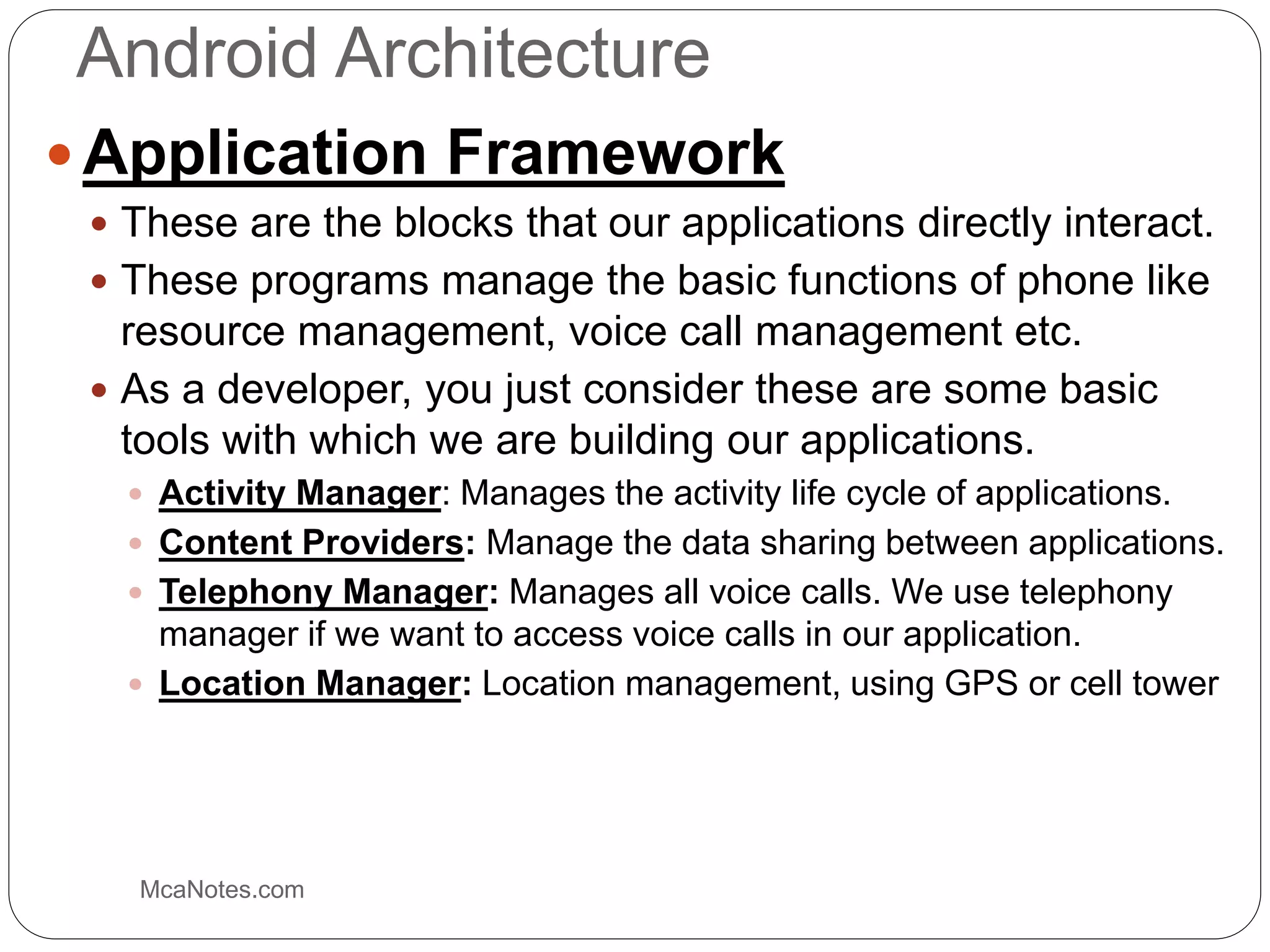
 Application Framework
 These are the blocks that our applications directly interact.
 These programs manage the basic functions of phone like
resource management, voice call management etc.
 As a developer, you just consider these are some basic
tools with which we are building our applications.
 Activity Manager: Manages the activity life cycle of applications.
 Content Providers: Manage the data sharing between applications.
 Telephony Manager: Manages all voice calls. We use telephony
manager if we want to access voice calls in our application.
 Location Manager: Location management, using GPS or cell tower
McaNotes.com
Android Architecture
 Applications
 Applications are the top layer in the Android architecture
and this is where our applications are gonna fit. Several
standard applications comes pre-installed with every
device, such as:
 SMS client app
 Dialer
 Web browser
 Contact manager
 As a developer we are able to write an app which replace
any existing system app.
 That is, you are not limited in accessing any particular
feature.
McaNotes.com

Android introduction

  • 1.
  • 2.
    What is Android?  Android is :- Comprehensive:-  Developer (get everything for development)  User (get rich experience)  Manufacture (freedom from hardware dependency) Open Source Platform:-  Totally Open and Business Friendly license Design for Mobile Device:-  Core design is portable McaNotes.com
  • 3.
    History of Android:  2005 Google buy Android Inc.  2007 Open Handset Alliance announced, android is officially open source.  2008 Android SDK 1.0 released.  2009 Different flavor of android SDK Launched.  2010 Froyo (2.2) and Gingerbread (2.3) was released.  2011 Honeycomb was released. McaNotes.com
  • 4.
  • 5.
  • 6.
    Birth of OpenHandset Alliance  Google was not satisfied with it’s success.  Google lead the movement to turn closed system to open.  November 2007, Open Handset Alliance formed.  Google acquired android in 2005.  Many well known company join OHA.  OHA started to create open resources . McaNotes.com
  • 7.
    Every one isgetting Advantage  Manufactures  More than half member of OHA are handset  manufacture like Samsung, Motorola, LG, HTC, Intel …  Mobile Operator From  North, South and Center America  Europe, Asia, India, Australia, Africa ,Middle East … Content Provider  Everyone is developing killer apps for android  More than 80,000 apps in Android Market McaNotes.com
  • 8.
    Open Handset Alliance MobileOperators McaNotes.com
  • 9.
    Open Handset Alliance HandsetManufacturers McaNotes.com
  • 10.
  • 11.
    Open Handset Alliance SoftwareCompanies McaNotes.com
  • 12.
    Android Features  Freeand Open Source Android is an open source platform. handset manufacturers can not pay anything like royalties or license fees to develop for the platform. Developers also don't pay anything for develop android application The Android framework is distributed under the Apache Software License which allows for the distribution of both open-and closed-source derivations of the source code.  Familiar and Inexpensive Development Tools Devel oper doesn’t require expensive compilers. Developer also doesn’t require registration fees. There are no any kind of other costs of developing Android applications.McaNotes.com
  • 13.
    Android Features  FreelyAvailable Software Development Kit The Android SDK and tools are freely available. Developers can download the Android SDK from the Android website.  Familiar Language, Familiar Development Environments. Eclipse is the most popular IDE for Android development, and there is an Android plug-in available for facilitating Android development. Android applications can be developed on the xp , mac , linux…..etc operating systems: McaNotes.com
  • 14.
    Android Features Enabling Developmentof Powerful applications The manufacturer would grant the developer Privileged All Android applications use the same libraries. Applications can be extended or replaced altogether .  A “Free Market” for Applications. Android developers are free to choose any kind of revenue model they want. Developer can develop  freeware  shareware  trial-ware applications  ad-driven  paid applications. McaNotes.com
  • 15.
    Android Features  Rich,Secure Application Integration.  A New and Growing Platform McaNotes.com
  • 16.
  • 17.
    Android Architecture  LinuxKernel  The basic layer is the Linux kernel.  It is this Linux that interacts with the hardware and contains all the essential hardware drivers.  Drivers are programs that control and communicate with the hardware.  For example, consider the Bluetooth function. All devices has a Bluetooth hardware in it. Therefore the kernel must include a Bluetooth driver to communicate with the Bluetooth hardware.  The Linux for all its core functionality such as Memory management, process management, networking, security settings etc. McaNotes.com
  • 18.
     Libraries  Thenext layer is the Android’s native libraries.  It is this layer that enables the device to handle different types of data.  These libraries are written in c or c++ language and are specific for a particular hardware.  well known library libc, SQLite database which is a useful repository for storage and sharing of application data,  libraries to play and record audio and video, SSL libraries responsible for Internet security etc. McaNotes.com
  • 19.
    Android Architecture  AndroidRuntime  Android Runtime consists of Dalvik Virtual machine and Core Java libraries.  Dalvik Virtual Machine  It is a type of JVM used in android devices to run apps and is optimized for low processing power and low memory environments.  Unlike the JVM, the Dalvik Virtual Machine doesn’t run .class files, instead it runs .dex files. .dex files are built from .class file at the time of compilation and provides hifger efficiency in low resource environments.  providing security, isolation, memory management and threading support. It is developed by Dan Bornstein of Google. McaNotes.com
  • 20.
    Android Architecture  ApplicationFramework  These are the blocks that our applications directly interact.  These programs manage the basic functions of phone like resource management, voice call management etc.  As a developer, you just consider these are some basic tools with which we are building our applications.  Activity Manager: Manages the activity life cycle of applications.  Content Providers: Manage the data sharing between applications.  Telephony Manager: Manages all voice calls. We use telephony manager if we want to access voice calls in our application.  Location Manager: Location management, using GPS or cell tower McaNotes.com
  • 21.
    Android Architecture  Applications Applications are the top layer in the Android architecture and this is where our applications are gonna fit. Several standard applications comes pre-installed with every device, such as:  SMS client app  Dialer  Web browser  Contact manager  As a developer we are able to write an app which replace any existing system app.  That is, you are not limited in accessing any particular feature. McaNotes.com