http://code.google.com/android Android is a software platform for mobile devices based on the Linux operating system and developed by Google and the Open Handset Alliance. OS: Linux kernel - version 2.6  Emulator: on Mac, Windows, Linux  Hardware support: GSM Telephony Bluetooth, 3G, and WiFi Camera, GPS, compass, and accelerometer
 
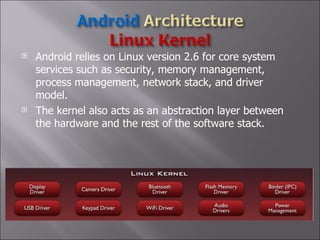
Android relies on Linux version 2.6 for core system services such as security, memory management, process management, network stack, and driver model.  The kernel also acts as an abstraction layer between the hardware and the rest of the software stack.
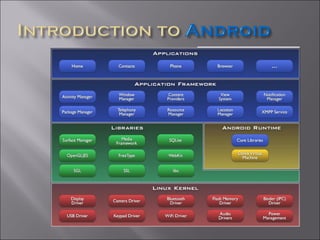
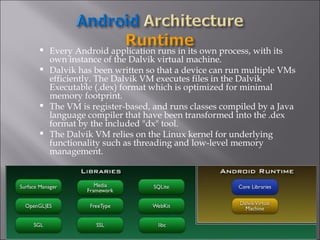
Every Android application runs in its own process, with its own instance of the Dalvik virtual machine.  Dalvik has been written so that a device can run multiple VMs efficiently. The Dalvik VM executes files in the Dalvik Executable (.dex) format which is optimized for minimal memory footprint.  The VM is register-based, and runs classes compiled by a Java language compiler that have been transformed into the .dex format by the included "dx" tool. The Dalvik VM relies on the Linux kernel for underlying functionality such as threading and low-level memory management.
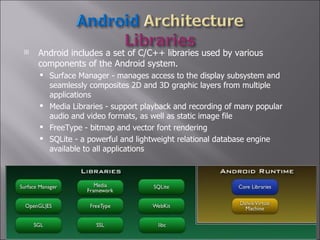
Android includes a set of C/C++ libraries used by various components of the Android system.  Surface Manager - manages access to the display subsystem and seamlessly composites 2D and 3D graphic layers from multiple applications Media Libraries - support playback and recording of many popular audio and video formats, as well as static image file FreeType - bitmap and vector font rendering SQLite - a powerful and lightweight relational database engine available to all applications
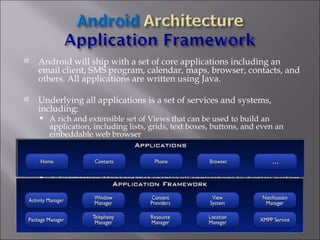
Android will ship with a set of core applications including an email client, SMS program, calendar, maps, browser, contacts, and others. All applications are written using Java. Underlying all applications is a set of services and systems, including: A rich and extensible set of Views that can be used to build an application, including lists, grids, text boxes, buttons, and even an embeddable web browser Content Providers that enable applications to access data from other applications (such as Contacts), or to share their own data A Resource Manager, providing access to non-code resources such as localized strings, graphics, and layout files A Notification Manager that enables all applications to display custom alerts in the status bar An Activity Manager that manages the life cycle of applications and provides a common navigation backstack

Android Architecture

  • 1.
    http://code.google.com/android Android isa software platform for mobile devices based on the Linux operating system and developed by Google and the Open Handset Alliance. OS: Linux kernel - version 2.6 Emulator: on Mac, Windows, Linux Hardware support: GSM Telephony Bluetooth, 3G, and WiFi Camera, GPS, compass, and accelerometer
  • 2.
  • 3.
    Android relies onLinux version 2.6 for core system services such as security, memory management, process management, network stack, and driver model. The kernel also acts as an abstraction layer between the hardware and the rest of the software stack.
  • 4.
    Every Android applicationruns in its own process, with its own instance of the Dalvik virtual machine. Dalvik has been written so that a device can run multiple VMs efficiently. The Dalvik VM executes files in the Dalvik Executable (.dex) format which is optimized for minimal memory footprint. The VM is register-based, and runs classes compiled by a Java language compiler that have been transformed into the .dex format by the included "dx" tool. The Dalvik VM relies on the Linux kernel for underlying functionality such as threading and low-level memory management.
  • 5.
    Android includes aset of C/C++ libraries used by various components of the Android system. Surface Manager - manages access to the display subsystem and seamlessly composites 2D and 3D graphic layers from multiple applications Media Libraries - support playback and recording of many popular audio and video formats, as well as static image file FreeType - bitmap and vector font rendering SQLite - a powerful and lightweight relational database engine available to all applications
  • 6.
    Android will shipwith a set of core applications including an email client, SMS program, calendar, maps, browser, contacts, and others. All applications are written using Java. Underlying all applications is a set of services and systems, including: A rich and extensible set of Views that can be used to build an application, including lists, grids, text boxes, buttons, and even an embeddable web browser Content Providers that enable applications to access data from other applications (such as Contacts), or to share their own data A Resource Manager, providing access to non-code resources such as localized strings, graphics, and layout files A Notification Manager that enables all applications to display custom alerts in the status bar An Activity Manager that manages the life cycle of applications and provides a common navigation backstack