ANDROID
ARCHITECTURE
Saurabh Kukreja
It’s Me
 I am Saurabh Kukreja, Working as Mobile
Application Consultant from more than 3 years
.
 I am also working as a co-founder of a startup
named as 4Edges, which is a service oriented
company, delivery various Software solutions
to our clients
Agenda
 Evolution Of Mobile Phones
 History Of Android
 Architecture of android
 Features
 Application Component
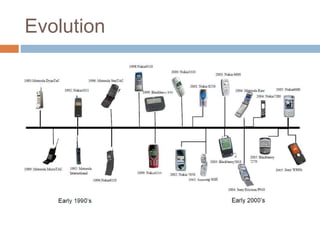
Evolution
 A robot with a human appearance
 An open-source operating system used for
smartphones and tablets.
Android
History
 Android Inc. was founded by:
 Andy Rubin
 Rich Miner
 Chris White
 Nick Sears
 They thought of Developing an advanced OS for camera
but later switched to Mobile Operating Systems
 Google acquired Android Inc. in August 2005.
 OHA- Open Handset Alliance
 The first commercially available smartphone
running Android was the HTC Dream released on
October 22, 2008.
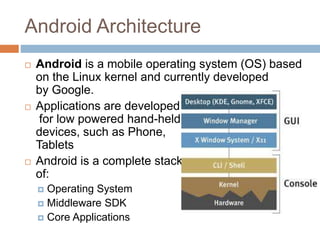
Android Architecture
 Android is a mobile operating system (OS) based
on the Linux kernel and currently developed
by Google.
 Applications are developed
for low powered hand-held
devices, such as Phone,
Tablets
 Android is a complete stack
of:
 Operating System
 Middleware SDK
 Core Applications
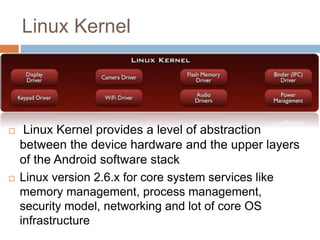
 Linux Kernel provides a level of abstraction
between the device hardware and the upper layers
of the Android software stack
 Linux version 2.6.x for core system services like
memory management, process management,
security model, networking and lot of core OS
infrastructure
Linux Kernel
 All These libraries are written in C/C++
 Libc: c standard library
 SSL: Secure Socket Layer
 Surface Manager: Responsible for composing different drawing surfaces
onto the
screen.
 Open GL and SGL are graphic Libraries
 OpenGL|ES : 3D Image Engine
 SGL : 2D image Engine.
 Hence we can combine 3D and 2D graphics in the same application.
 Media Framework : Core part of the android multimedia.
 MPEG4,MP3,…
 FreeType: To render the fonts.
 WebKit:Open source browser engine. Helps to work well on small screen.
 SQLite: Embedded Database
Libraries
Android Runtime
 Android runtime meet the needs of Android
running in an embedded environment
,i.e., where is limited battery, limited Memory and limited CPU.
 Android Runtime consists of Dalvik Virtual machine and Core Java
libraries.
 CORE LIBRARIES:
 Java Programming Language contains all the collection classes, utilities,
IO..all these utilities which you come across and expected to use.
 DALVIK VIRTUAL MACHINE
 application code must be transformed from standard Java class files to the Dalvik
executable (.dex) format, which has a 50% smaller memory footprint than
standard Java bytecode
 Each Android application simply runs as a process directly on the Linux kernel,
each application running on an Android device does so within its own instance of
the Dalvik virtual machine (VM).
 applications are essentially sandboxed
 enforced level of abstraction makes applications platform neutral in that they are
never tied to any specific hardware.
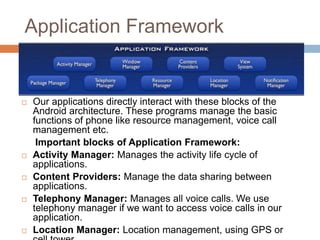
Application Framework
 Our applications directly interact with these blocks of the
Android architecture. These programs manage the basic
functions of phone like resource management, voice call
management etc.
Important blocks of Application Framework:
 Activity Manager: Manages the activity life cycle of
applications.
 Content Providers: Manage the data sharing between
applications.
 Telephony Manager: Manages all voice calls. We use
telephony manager if we want to access voice calls in our
application.
 Location Manager: Location management, using GPS or
Applicatios
Application Component
 Activities
 They dictate the UI and handle the user interaction to
the smartphone screen
 Services
 They handle background processing associated with
an application.
 Intent Receivers/Broadcast Receivers
 Respond to notification or status changes. Can wake
up your process
 Content Providers
 They handle data and database management issues.
Features
 Beautiful UI
 Android OS basic screen provides a beautiful and
intuitive user interface.
 Connectivity
 GSM/EDGE, Bluetooth, Wi-Fi, NFC.
 Storage SQLite
 A lightweight relational database, is used for data
storage purposes.
 Media support
 MPEG-4, MP3, MIDI, WAV, JPEG, PNG, GIF, and
BMP
 Messaging
 SMS and MMS
 Web browser
 Based on the open-source WebKit layout engine, coupled with Chrome's
V8 JavaScript engine supporting HTML5 and CSS3.
 Multi-touch
 Android has native support for multi-touch which was initially made
available in handsets such as the HTC Hero.
 Multi-tasking
 User can jump from one task to another and same time various
application can run simultaneously.
 Resizable widgets
 Widgets are resizable, so users can expand them to show more content
or shrink them to save space
 GCM
 Google Cloud Messaging (GCM) is a service that lets developers send
short message data to their users on Android devices, without needing a
proprietary sync solution.
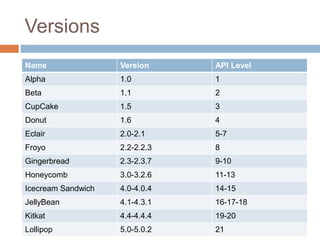
Versions
Name Version API Level
Alpha 1.0 1
Beta 1.1 2
CupCake 1.5 3
Donut 1.6 4
Eclair 2.0-2.1 5-7
Froyo 2.2-2.2.3 8
Gingerbread 2.3-2.3.7 9-10
Honeycomb 3.0-3.2.6 11-13
Icecream Sandwich 4.0-4.0.4 14-15
JellyBean 4.1-4.3.1 16-17-18
Kitkat 4.4-4.4.4 19-20
Lollipop 5.0-5.0.2 21
Evolving Trends
 Android Wear
 Android Wear extends the Android platform to a
new generation of devices
 Small, powerful devices, worn on the body.
 Useful information when you need it most.
 Intelligent answers to spoken questions. Tools to
help reach fitness goals.
 Android TV
 Bring your apps, games, and content to the
biggest screen in the house.
 Running the Android 5.0 ("Lollipop") operating
system
 Users will have access to theGoogle Play Store to
download Android apps
 Android Auto
 To be operated in automobiles through
the dashboard's head unit.
 The standard will offer drivers control over
 GPS mapping/navigation
 music playback
 SMS
 Telephony
 web search
THANK YOU
Reach me at :
Saurabhkukreja@live.com

Android architecture

  • 1.
  • 2.
    It’s Me  Iam Saurabh Kukreja, Working as Mobile Application Consultant from more than 3 years .  I am also working as a co-founder of a startup named as 4Edges, which is a service oriented company, delivery various Software solutions to our clients
  • 3.
    Agenda  Evolution OfMobile Phones  History Of Android  Architecture of android  Features  Application Component
  • 4.
  • 5.
     A robotwith a human appearance  An open-source operating system used for smartphones and tablets. Android
  • 6.
    History  Android Inc.was founded by:  Andy Rubin  Rich Miner  Chris White  Nick Sears  They thought of Developing an advanced OS for camera but later switched to Mobile Operating Systems  Google acquired Android Inc. in August 2005.  OHA- Open Handset Alliance  The first commercially available smartphone running Android was the HTC Dream released on October 22, 2008.
  • 7.
    Android Architecture  Androidis a mobile operating system (OS) based on the Linux kernel and currently developed by Google.  Applications are developed for low powered hand-held devices, such as Phone, Tablets  Android is a complete stack of:  Operating System  Middleware SDK  Core Applications
  • 9.
     Linux Kernelprovides a level of abstraction between the device hardware and the upper layers of the Android software stack  Linux version 2.6.x for core system services like memory management, process management, security model, networking and lot of core OS infrastructure Linux Kernel
  • 11.
     All Theselibraries are written in C/C++  Libc: c standard library  SSL: Secure Socket Layer  Surface Manager: Responsible for composing different drawing surfaces onto the screen.  Open GL and SGL are graphic Libraries  OpenGL|ES : 3D Image Engine  SGL : 2D image Engine.  Hence we can combine 3D and 2D graphics in the same application.  Media Framework : Core part of the android multimedia.  MPEG4,MP3,…  FreeType: To render the fonts.  WebKit:Open source browser engine. Helps to work well on small screen.  SQLite: Embedded Database Libraries
  • 13.
    Android Runtime  Androidruntime meet the needs of Android running in an embedded environment ,i.e., where is limited battery, limited Memory and limited CPU.  Android Runtime consists of Dalvik Virtual machine and Core Java libraries.  CORE LIBRARIES:  Java Programming Language contains all the collection classes, utilities, IO..all these utilities which you come across and expected to use.  DALVIK VIRTUAL MACHINE  application code must be transformed from standard Java class files to the Dalvik executable (.dex) format, which has a 50% smaller memory footprint than standard Java bytecode  Each Android application simply runs as a process directly on the Linux kernel, each application running on an Android device does so within its own instance of the Dalvik virtual machine (VM).  applications are essentially sandboxed  enforced level of abstraction makes applications platform neutral in that they are never tied to any specific hardware.
  • 15.
    Application Framework  Ourapplications directly interact with these blocks of the Android architecture. These programs manage the basic functions of phone like resource management, voice call management etc. Important blocks of Application Framework:  Activity Manager: Manages the activity life cycle of applications.  Content Providers: Manage the data sharing between applications.  Telephony Manager: Manages all voice calls. We use telephony manager if we want to access voice calls in our application.  Location Manager: Location management, using GPS or
  • 16.
  • 17.
    Application Component  Activities They dictate the UI and handle the user interaction to the smartphone screen  Services  They handle background processing associated with an application.  Intent Receivers/Broadcast Receivers  Respond to notification or status changes. Can wake up your process  Content Providers  They handle data and database management issues.
  • 18.
    Features  Beautiful UI Android OS basic screen provides a beautiful and intuitive user interface.  Connectivity  GSM/EDGE, Bluetooth, Wi-Fi, NFC.  Storage SQLite  A lightweight relational database, is used for data storage purposes.  Media support  MPEG-4, MP3, MIDI, WAV, JPEG, PNG, GIF, and BMP  Messaging  SMS and MMS
  • 19.
     Web browser Based on the open-source WebKit layout engine, coupled with Chrome's V8 JavaScript engine supporting HTML5 and CSS3.  Multi-touch  Android has native support for multi-touch which was initially made available in handsets such as the HTC Hero.  Multi-tasking  User can jump from one task to another and same time various application can run simultaneously.  Resizable widgets  Widgets are resizable, so users can expand them to show more content or shrink them to save space  GCM  Google Cloud Messaging (GCM) is a service that lets developers send short message data to their users on Android devices, without needing a proprietary sync solution.
  • 20.
    Versions Name Version APILevel Alpha 1.0 1 Beta 1.1 2 CupCake 1.5 3 Donut 1.6 4 Eclair 2.0-2.1 5-7 Froyo 2.2-2.2.3 8 Gingerbread 2.3-2.3.7 9-10 Honeycomb 3.0-3.2.6 11-13 Icecream Sandwich 4.0-4.0.4 14-15 JellyBean 4.1-4.3.1 16-17-18 Kitkat 4.4-4.4.4 19-20 Lollipop 5.0-5.0.2 21
  • 21.
    Evolving Trends  AndroidWear  Android Wear extends the Android platform to a new generation of devices  Small, powerful devices, worn on the body.  Useful information when you need it most.  Intelligent answers to spoken questions. Tools to help reach fitness goals.
  • 22.
     Android TV Bring your apps, games, and content to the biggest screen in the house.  Running the Android 5.0 ("Lollipop") operating system  Users will have access to theGoogle Play Store to download Android apps
  • 23.
     Android Auto To be operated in automobiles through the dashboard's head unit.  The standard will offer drivers control over  GPS mapping/navigation  music playback  SMS  Telephony  web search
  • 24.
    THANK YOU Reach meat : Saurabhkukreja@live.com