Android
M o b i l e O S P U R V I K 1239
What is Android?
 A software platform and operating system for mobile
devices
 Based on the Linux kernel
 Developed by Google and later the Open Handset Alliance
(OHA)
 Allows writing managed code in the Java language
 Unveiling of the Android platform was announced on 5
November 2007
P U R V I K 1239
Android
“ It is a software stack for mobile devices that includes an
operating system, middleware and key applications “
 Released under the open-source Apache License
 Offers a unified approach to application development
 Need to develop only for Android
 Application can run on numerous devices
P U R V I K 1239
Features of Android
 Storage - SQLite, a lightweight relational database for data
storage
 Connectivity – GSM/EDGE, CDMA, UMTS, WiFi, WiMAX
 Media Support
 Hardware Support – Accelerometer Sensor, Digital Compass,
Proximity Sensor and GPS
 Multi-touch and Multi-tasking
 Flash Support – Android 2.3 (Flash 10.1)
 Tethering – sharing of Internet connection as a wired/wireless
hotspot
P U R V I K 1239
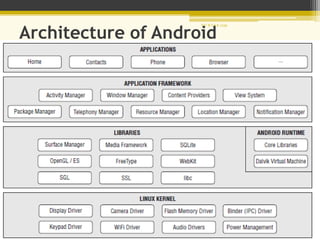
Architecture of Android
P U R V I K 1239
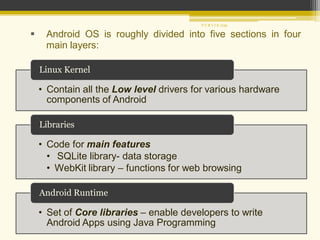
 Android OS is roughly divided into five sections in four
main layers:
• Contain all the Low level drivers for various hardware
components of Android
Linux Kernel
• Code for main features
• SQLite library- data storage
• WebKit library – functions for web browsing
Libraries
• Set of Core libraries – enable developers to write
Android Apps using Java Programming
Android Runtime
P U R V I K 1239
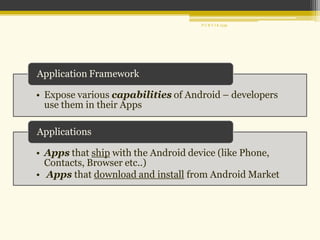
• Expose various capabilities of Android – developers
use them in their Apps
Application Framework
• Apps that ship with the Android device (like Phone,
Contacts, Browser etc..)
• Apps that download and install from Android Market
Applications
P U R V I K 1239
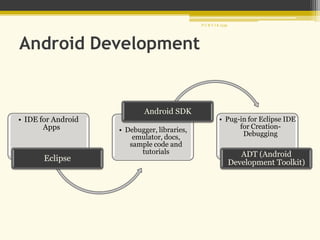
Android Development
• IDE for Android
Apps
Eclipse
• Debugger, libraries,
emulator, docs,
sample code and
tutorials
Android SDK
• Pug-in for Eclipse IDE
for Creation-
Debugging
ADT (Android
Development Toolkit)
P U R V I K 1239
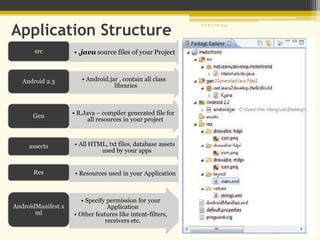
• .java source files of your Projectsrc
• Android.jar , contain all class
libraries
Android 2.3
• R.Java – compiler generated file for
all resources in your project
Gen
• All HTML, txt files, database assets
used by your apps
assects
• Resources used in your ApplicationRes
• Specify permission for your
Application
• Other features like intent-filters,
receivers etc.
AndroidManifest.x
ml
Application Structure
P U R V I K 1239
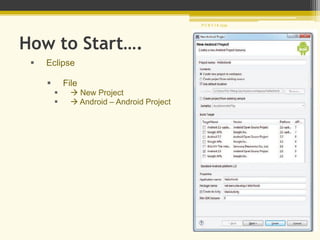
How to Start….
 Eclipse
 File
  New Project
  Android – Android Project
P U R V I K 1239
P U R V I K 1239
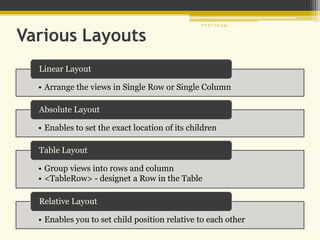
Various Layouts
• Arrange the views in Single Row or Single Column
Linear Layout
• Enables to set the exact location of its children
Absolute Layout
• Group views into rows and column
• <TableRow> - designet a Row in the Table
Table Layout
• Enables you to set child position relative to each other
Relative Layout
P U R V I K 1239

Andriod_Intro

  • 1.
    Android M o bi l e O S P U R V I K 1239
  • 2.
    What is Android? A software platform and operating system for mobile devices  Based on the Linux kernel  Developed by Google and later the Open Handset Alliance (OHA)  Allows writing managed code in the Java language  Unveiling of the Android platform was announced on 5 November 2007 P U R V I K 1239
  • 3.
    Android “ It isa software stack for mobile devices that includes an operating system, middleware and key applications “  Released under the open-source Apache License  Offers a unified approach to application development  Need to develop only for Android  Application can run on numerous devices P U R V I K 1239
  • 4.
    Features of Android Storage - SQLite, a lightweight relational database for data storage  Connectivity – GSM/EDGE, CDMA, UMTS, WiFi, WiMAX  Media Support  Hardware Support – Accelerometer Sensor, Digital Compass, Proximity Sensor and GPS  Multi-touch and Multi-tasking  Flash Support – Android 2.3 (Flash 10.1)  Tethering – sharing of Internet connection as a wired/wireless hotspot P U R V I K 1239
  • 5.
  • 6.
     Android OSis roughly divided into five sections in four main layers: • Contain all the Low level drivers for various hardware components of Android Linux Kernel • Code for main features • SQLite library- data storage • WebKit library – functions for web browsing Libraries • Set of Core libraries – enable developers to write Android Apps using Java Programming Android Runtime P U R V I K 1239
  • 7.
    • Expose variouscapabilities of Android – developers use them in their Apps Application Framework • Apps that ship with the Android device (like Phone, Contacts, Browser etc..) • Apps that download and install from Android Market Applications P U R V I K 1239
  • 8.
    Android Development • IDEfor Android Apps Eclipse • Debugger, libraries, emulator, docs, sample code and tutorials Android SDK • Pug-in for Eclipse IDE for Creation- Debugging ADT (Android Development Toolkit) P U R V I K 1239
  • 9.
    • .java sourcefiles of your Projectsrc • Android.jar , contain all class libraries Android 2.3 • R.Java – compiler generated file for all resources in your project Gen • All HTML, txt files, database assets used by your apps assects • Resources used in your ApplicationRes • Specify permission for your Application • Other features like intent-filters, receivers etc. AndroidManifest.x ml Application Structure P U R V I K 1239
  • 10.
    How to Start…. Eclipse  File   New Project   Android – Android Project P U R V I K 1239
  • 11.
    P U RV I K 1239
  • 12.
    Various Layouts • Arrangethe views in Single Row or Single Column Linear Layout • Enables to set the exact location of its children Absolute Layout • Group views into rows and column • <TableRow> - designet a Row in the Table Table Layout • Enables you to set child position relative to each other Relative Layout P U R V I K 1239