Android Malware
Survey
1
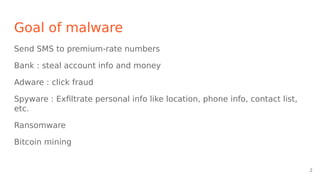
Goal of malware
Send SMS to premium-rate numbers
Bank : steal account info and money
Adware : click fraud
Spyware : Exfiltrate personal info like location, phone info, contact list,
etc.
Ransomware
Bitcoin mining
2
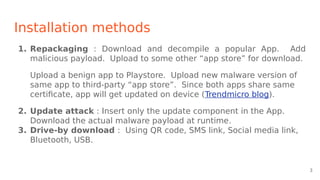
Installation methods
1. Repackaging : Download and decompile a popular App. Add
malicious payload. Upload to some other ā€œapp storeā€ for download.
Upload a benign app to Playstore. Upload new malware version of
same app to third-party ā€œapp storeā€. Since both apps share same
certificate, app will get updated on device (Trendmicro blog).
2. Update attack : Insert only the update component in the App.
Download the actual malware payload at runtime.
3. Drive-by download : Using QR code, SMS link, Social media link,
Bluetooth, USB.
3
Malicious install of an APK
1. Root exploit
2. Misuse Android Accessibility services
3. Create confusion through popups and look-alikes
4. Prevent removal by storing in system partition
Grabos (McAfee)
https://securingtomorrow.mcafee.com/mcafee-labs/android-malware-grabo
s-exposed-millions-to-pay-per-install-scam-on-google-play/
4
PC to mobile infection
Android.Claco: Runs on the Mobile device. Downloads Windows
executable and places it in the root directory of the SD card. When the
mobile device is connected to a PC, and if the AutoRun feature is
enabled, Windows will automatically execute the malicious file.
Trojan.Droidpak: Runs on Windows as system service. Downloads
malware APK and even ā€œadbā€. Attempts to install the APK on the
connected Mobile (if USB debugging Mode is On).
5
Loopholes in Google Playstore
Innovation by Android.dvmap
ā€œTo bypass Google Play Store security checks, the malware creators
used a very interesting method: they uploaded a clean app to the store
at the end of March, 2017, and would then update it with a malicious
version for short period of time. Usually they would upload a clean
version back on Google Play the very same day. They did this at least 5
times between 18 April and 15 May. ā€œ
https://securelist.com/dvmap-the-first-android-malware-with-code-inject
ion/78648/
6
Activation methods
BOOT COMPLETED event to kick off background services
SMS RECEIVED broadcast
SCREEN TURNED OFF
7
Top permissions asked by Malware
Unless you have a root exploit, you require ā€œPermissionsā€ in the
Manifest.
1. Internet
2. Access_network_state
3. read/write external storage
4. Read phone state
5. Access wifi state
6. Access coarse/fine location
7. Read/write contacts
8
How to create overlay windows
Bank malware needs to overlay a window which resembles the bank
login website.
Ways to achieve this overlay:
1. Use permission SYSTEM_ALERT_WINDOW.
2. Seek permission to use ā€œAccessibility servicesā€ which allows access
to UI of other running apps, and create overlays. (Used by SvPeng)
3. Use ā€œTOASTā€ notification to create full-screen window (on pre-Oreo).
See ā€œToast overlay attackā€ in Sept 2017.
9
Botnets
Evolution of Command and Control (C&C) architecture
1. First generation had single C&C server
2. Semi-distributed
3. Peer-to-peer
To avoid hard-coded URLs, C&C URL is generated using domain name
generation (DGA) seeded by current date. Or the C&C is a twitter
account whose name is generated dynamically (e.g. twikabot). Bot
then decrypts and executes tweets.
Rapidly rotate the IP address of the C&C server : ā€œFast flux botnetā€.
10
Evade detection by anti-malware tools
1. All constant strings in APK are encrypted
2. Use of Base64 encoding
3. Network traffic is encrypted
4. Call via reflection; decrypt class and method names just before call
5. Decryption key is not hard-coded but derived at runtime
6. Hide payload inside images folder
7. Use Android Packers or Protectors
8. Alter behaviour when running inside Emulator
9. Modify the code at runtime to evade static signatures (metamorphic
malware).
11
Hide the payload inside an image
PNG file has many chunks, each with its header and length
If a chunk has an unknown header, the PNG reader will skip it
PNG with a legitimate image (app icon) can contain malware
(encrypted)
Load malware payload from chunk, decrypt and run using
DexClassLoader
Anomaly : Look for a small image having large size !
12
Axelle Apvrille. Hide Android Applications in Images. Blackhat Europe 2014
Packers and Protectors
Top packers : Bangcle, APKProtect.com, Baidu, Tencent
ā— Encrypts the APK and stores it in assets folder
ā— Replaces the APK Main Activity by their own
ā— Inserts it own decryption library (native C)
ā— During run, decrypts your APK in the RAM and runs it
Packers developed to protect vendor IP, but being misused to distribute
malware.
Packed APK cannot be detected by static or dynamic analysis.
13
14
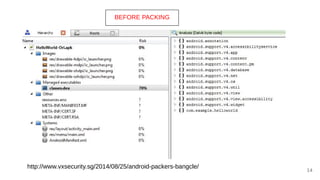
http://www.vxsecurity.sg/2014/08/25/android-packers-bangcle/
BEFORE PACKING
15
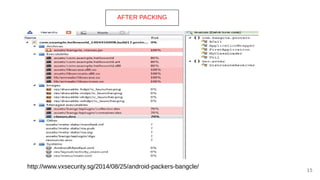
http://www.vxsecurity.sg/2014/08/25/android-packers-bangcle/
AFTER PACKING
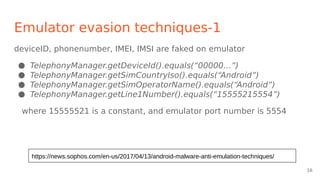
Emulator evasion techniques-1
deviceID, phonenumber, IMEI, IMSI are faked on emulator
ā— TelephonyManager.getDeviceId().equals(ā€œ00000ā€¦ā€)
ā— TelephonyManager.getSimCountryIso().equals(ā€œAndroidā€)
ā— TelephonyManager.getSimOperatorName().equals(ā€œAndroidā€)
ā— TelephonyManager.getLine1Number().equals(ā€œ15555215554ā€)
where 15555521 is a constant, and emulator port number is 5554
https://news.sophos.com/en-us/2017/04/13/android-malware-anti-emulation-techniques/
16
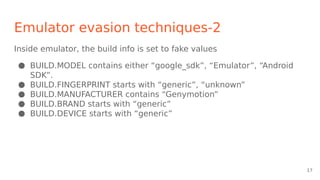
Emulator evasion techniques-2
Inside emulator, the build info is set to fake values
ā— BUILD.MODEL contains either ā€œgoogle_sdkā€, ā€œEmulatorā€, ā€œAndroid
SDKā€.
ā— BUILD.FINGERPRINT starts with ā€œgenericā€, ā€œunknownā€
ā— BUILD.MANUFACTURER contains ā€œGenymotionā€
ā— BUILD.BRAND starts with ā€œgenericā€
ā— BUILD.DEVICE starts with ā€œgenericā€
17
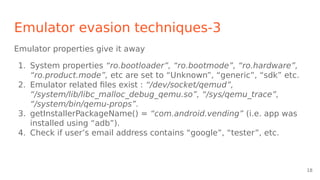
Emulator evasion techniques-3
Emulator properties give it away
1. System properties ā€œro.bootloaderā€, ā€œro.bootmodeā€, ā€œro.hardwareā€,
ā€œro.product.modeā€, etc are set to ā€œUnknownā€, ā€œgenericā€, ā€œsdkā€ etc.
2. Emulator related files exist : ā€œ/dev/socket/qemudā€,
ā€œ/system/lib/libc_malloc_debug_qemu.soā€, ā€œ/sys/qemu_traceā€,
ā€œ/system/bin/qemu-propsā€.
3. getInstallerPackageName() = ā€œcom.android.vendingā€ (i.e. app was
installed using ā€œadbā€).
4. Check if user’s email address contains ā€œgoogleā€, ā€œtesterā€, etc.
18
Detect if running in debugger
Check Debug.isDebuggerConnected(), Debug.waitingForDebugger()
Launch multiple threads and let one thread attach to another using
ptrace(), because a process can only be attached by one process.
[Packergrind paper]
19
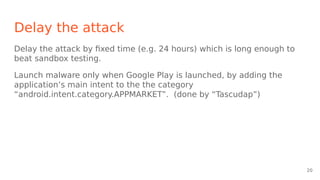
Delay the attack
Delay the attack by fixed time (e.g. 24 hours) which is long enough to
beat sandbox testing.
Launch malware only when Google Play is launched, by adding the
application’s main intent to the the category
ā€œandroid.intent.category.APPMARKETā€. (done by ā€œTascudapā€)
20
Polymorphic and metamorphic malware
Oligomorphic :
Polymorphic
ā— Use of encryption for strings, payloads; Data append/prepend
Metamorphic (hard to detect using file signatures)
1. Reorder instructions or data structures
2. Add Semantic NOPs
3. Register reassignment
21
https://reverseengineering.stackexchange.com/questions/1696/what-are-the-differences-between-
metamorphic-oligomorphic-and-polymorphic-malwa
Malware toolkits
Adware SDK : MDash, Xavier, lgexin
Botnet : Bilal Bot, GM Bot, KNL Bot
Rooting tools : https://github.com/android-rooting-tools (older Android
versions)
22
Malware databases
Android Malware Genome Database (outdated)
Contagio
Drebin
(Individual vendors collect their own databases)
23
Malware Detection Methods
24
ā— Static analysis (signature, ML)
ā— Dynamic analysis (sandbox)
ā— Opcode analysis (cusom, ML)
ā— Hybrid
Static analysis
Check
ā— Uses-feature in Manifest
ā— Permissions in Manifest
ā— Intents
ā— Use of DexClassLoader, NDK Loadlib
ā— Use of crypto API
ā— OS system calls
ā— Receiving broadcasts
25
Dynamic Analysis
Run APK in Sandbox - e.g. DroidBox, Andrubis
Record
1. API calls
2. OS system calls
3. Network traffic
4. Battery consumption
5. CPU usage
26
Network monitoring
Malware tends to use DNS, HTTP (OkHttp), IRC, and TOR !
1. DNS query may be used to locate C&C server.
2. Why OkHttp? It can contact multiple alternative HTTP servers, and
retries silently and periodically in case of failure.
3. IRC is popular because it supports redundancy (multi-master), has
builtin login protocol, and offers full 2-way communication.
4. TOR : Difficult to shutdown a botnet using TOR, as you cannot de-
anonymize the C&C server sitting inside TOR network.
5. App may not request Internet permissions but use other apps like
browser to send/recv data over network
27
Dynamic Analysis - Andrubis
Andrubis does ā€œStimulationā€ instead of passive wait or UI exploration.
1. Invoke all Activities (not just Main) found in the Manifest
2. Patch Android ActivityManager to start all background services
automatically.
3. Intercept calls to ā€œregisterReceiverā€ and use ActivityManager to
invoke them.
4. Broadcast common events such as SMS, WiFi+3G connectivity, GPS
lock, phone calls, phone state changes to trigger OS and App
behaviour.
Andrubis is now commercial - Lastline
[Weichselbaum, et al. Andrubis. Android Malware under the magnifying glass ]
28
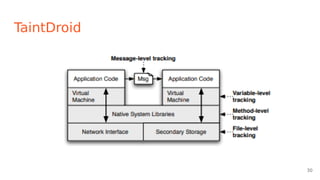
TaintDroid
Leverages Android virtualized env. Assumes no app is trusted.
It labels (taints) data from privacy-sensitive sources
Transitively applies labels as sensitive data propagates through program
variables, files, and interprocess messages.
When tainted data are transmitted over the network, or otherwise leave
the system, TaintDroid logs the data’s labels, the application responsible
for transmitting the data, and the data’s destination.
[Enck, et al. TaintDroid - OSDI 2010]
29
TaintDroid
30
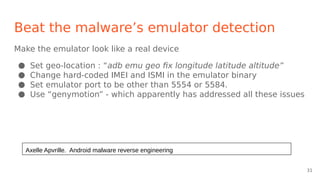
Beat the malware’s emulator detection
Make the emulator look like a real device
ā— Set geo-location : ā€œadb emu geo fix longitude latitude altitudeā€
ā— Change hard-coded IMEI and ISMI in the emulator binary
ā— Set emulator port to be other than 5554 or 5584.
ā— Use ā€œgenymotionā€ - which apparently has addressed all these issues
Axelle Apvrille. Android malware reverse engineering
31
How to beat the Packers
Some packers decrypt the original APK at known locations in RAM. Use
that to find and analyze the decrypted APK at runtime.
[ Strazzere talk at Defcon 14 https://github.com/strazzere/android-unpacker ]
DexHunter modified Dalvik runtime(ART/OAT) to trap ClassLoader.
[ Zhang, et al. DexHunter ESORICS 2015 https://github.com/zyq8709/DexHunter ]
PackerGrind
[ Xue, et al. Adaptive Unpacking of Android Apps ]
DaBID Debugger [Blackhat Asia 2015]
32
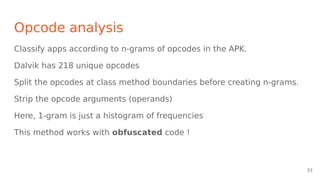
Opcode analysis
Classify apps according to n-grams of opcodes in the APK.
Dalvik has 218 unique opcodes
Split the opcodes at class method boundaries before creating n-grams.
Strip the opcode arguments (operands)
Here, 1-gram is just a histogram of frequencies
This method works with obfuscated code !
33
ML model over opcode sequences
ML : the holy grail !
Treat opcode sequence as text.
Formulate malware recognition as an NLP problem.
Feed the opcode sequence to a Neural Net.
System dynamically learns the length of the n-gram which is most
relevant.
[ McLaughlin et al. Deep Android Malware Detection. ODASPY 2017 ]
34
ML model over API or OS calls
These require first running the App in an emulator to capture dynamic
behaviour.
Malware may not exhibit all the malicious behaviour during test.
35
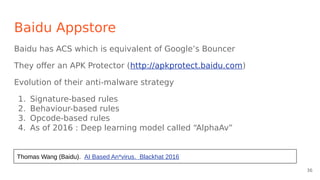
Baidu Appstore
Baidu has ACS which is equivalent of Google’s Bouncer
They offer an APK Protector (http://apkprotect.baidu.com)
Evolution of their anti-malware strategy
1. Signature-based rules
2. Behaviour-based rules
3. Opcode-based rules
4. As of 2016 : Deep learning model called ā€œAlphaAvā€
Thomas Wang (Baidu). AI Based An*virus. Blackhat 2016
36
Baidu Appstore
AlphaAv ML model extracts features from APK
1. Permissions in Manifest.
2. Number of picture files in /res
3. Number of fields of type ā€œbooleanā€
4. Number of methods with parameters > 20
5. Has executable file in /res ?
6. Has apk file in /assets ?
7. Registers for DEVICE_ADMIN_ENABLED broadcast and has
sendSMSmessage permission
37
Google Playstore
Components
1. Bouncer : test submitted apps in Google Cloud
2. Verify Apps : runs on device. Warn or block installation of harmful
apps; continuously scan apps running on device; kill malware apps
remotely.
3. SafetyNet : privacy preserving IDS.
4. SafetyNet Attestation : determine if the device is CTS compatible
5. Android Device Manager : locate a stolen or lost device
6. Android Update service : deliver updates to the device through web
or OTA.
38
Google Playstore
Vertical monitoring : Check if runtime behaviour differs from upload-
time (testing) behaviour ?
Lateral Monitoring : How does the same App work across all the
devices ? A device that fails to perform the periodic ā€œVerify Appsā€
check after an App install is flagged as DOI (Dead or Insecure)
The ā€œVerify Appsā€ service computes a DOI score of each App. All Apps
should have DOI score in same range.
https://android-developers.googleblog.com/2017/01/findingmalware.html
39
Malware detection tools
Urlvoid : check if a URL is blacklisted.
VirusTotal (owned by Alphabet) : collaborative platform. Your
submitted APK is checked against large number of malware engines -
McAfee, AVG, TrendMicro.
Koodous : another collaborative platform
40
Resources
1. Conferences : Blackhat, DefCon, RSA, IEEE Security & Privacy,
USENIX Security, ACM. Also see uploaded videos of past
conferences.
2. https://github.com/ashishb/android-security-awesome
41
Malware detection
Theoretical result by Fred Cohen
The ā€œvirus detectionā€ problem can be reduced to the ā€œhalting problemā€
- hence undecidable whether a program has a virus.
Therefore, Anti-virus algorithms are essentially probabilistic.
42

Android malware presentation

  • 1.
  • 2.
    Goal of malware SendSMS to premium-rate numbers Bank : steal account info and money Adware : click fraud Spyware : Exfiltrate personal info like location, phone info, contact list, etc. Ransomware Bitcoin mining 2
  • 3.
    Installation methods 1. Repackaging: Download and decompile a popular App. Add malicious payload. Upload to some other ā€œapp storeā€ for download. Upload a benign app to Playstore. Upload new malware version of same app to third-party ā€œapp storeā€. Since both apps share same certificate, app will get updated on device (Trendmicro blog). 2. Update attack : Insert only the update component in the App. Download the actual malware payload at runtime. 3. Drive-by download : Using QR code, SMS link, Social media link, Bluetooth, USB. 3
  • 4.
    Malicious install ofan APK 1. Root exploit 2. Misuse Android Accessibility services 3. Create confusion through popups and look-alikes 4. Prevent removal by storing in system partition Grabos (McAfee) https://securingtomorrow.mcafee.com/mcafee-labs/android-malware-grabo s-exposed-millions-to-pay-per-install-scam-on-google-play/ 4
  • 5.
    PC to mobileinfection Android.Claco: Runs on the Mobile device. Downloads Windows executable and places it in the root directory of the SD card. When the mobile device is connected to a PC, and if the AutoRun feature is enabled, Windows will automatically execute the malicious file. Trojan.Droidpak: Runs on Windows as system service. Downloads malware APK and even ā€œadbā€. Attempts to install the APK on the connected Mobile (if USB debugging Mode is On). 5
  • 6.
    Loopholes in GooglePlaystore Innovation by Android.dvmap ā€œTo bypass Google Play Store security checks, the malware creators used a very interesting method: they uploaded a clean app to the store at the end of March, 2017, and would then update it with a malicious version for short period of time. Usually they would upload a clean version back on Google Play the very same day. They did this at least 5 times between 18 April and 15 May. ā€œ https://securelist.com/dvmap-the-first-android-malware-with-code-inject ion/78648/ 6
  • 7.
    Activation methods BOOT COMPLETEDevent to kick off background services SMS RECEIVED broadcast SCREEN TURNED OFF 7
  • 8.
    Top permissions askedby Malware Unless you have a root exploit, you require ā€œPermissionsā€ in the Manifest. 1. Internet 2. Access_network_state 3. read/write external storage 4. Read phone state 5. Access wifi state 6. Access coarse/fine location 7. Read/write contacts 8
  • 9.
    How to createoverlay windows Bank malware needs to overlay a window which resembles the bank login website. Ways to achieve this overlay: 1. Use permission SYSTEM_ALERT_WINDOW. 2. Seek permission to use ā€œAccessibility servicesā€ which allows access to UI of other running apps, and create overlays. (Used by SvPeng) 3. Use ā€œTOASTā€ notification to create full-screen window (on pre-Oreo). See ā€œToast overlay attackā€ in Sept 2017. 9
  • 10.
    Botnets Evolution of Commandand Control (C&C) architecture 1. First generation had single C&C server 2. Semi-distributed 3. Peer-to-peer To avoid hard-coded URLs, C&C URL is generated using domain name generation (DGA) seeded by current date. Or the C&C is a twitter account whose name is generated dynamically (e.g. twikabot). Bot then decrypts and executes tweets. Rapidly rotate the IP address of the C&C server : ā€œFast flux botnetā€. 10
  • 11.
    Evade detection byanti-malware tools 1. All constant strings in APK are encrypted 2. Use of Base64 encoding 3. Network traffic is encrypted 4. Call via reflection; decrypt class and method names just before call 5. Decryption key is not hard-coded but derived at runtime 6. Hide payload inside images folder 7. Use Android Packers or Protectors 8. Alter behaviour when running inside Emulator 9. Modify the code at runtime to evade static signatures (metamorphic malware). 11
  • 12.
    Hide the payloadinside an image PNG file has many chunks, each with its header and length If a chunk has an unknown header, the PNG reader will skip it PNG with a legitimate image (app icon) can contain malware (encrypted) Load malware payload from chunk, decrypt and run using DexClassLoader Anomaly : Look for a small image having large size ! 12 Axelle Apvrille. Hide Android Applications in Images. Blackhat Europe 2014
  • 13.
    Packers and Protectors Toppackers : Bangcle, APKProtect.com, Baidu, Tencent ā— Encrypts the APK and stores it in assets folder ā— Replaces the APK Main Activity by their own ā— Inserts it own decryption library (native C) ā— During run, decrypts your APK in the RAM and runs it Packers developed to protect vendor IP, but being misused to distribute malware. Packed APK cannot be detected by static or dynamic analysis. 13
  • 14.
  • 15.
  • 16.
    Emulator evasion techniques-1 deviceID,phonenumber, IMEI, IMSI are faked on emulator ā— TelephonyManager.getDeviceId().equals(ā€œ00000ā€¦ā€) ā— TelephonyManager.getSimCountryIso().equals(ā€œAndroidā€) ā— TelephonyManager.getSimOperatorName().equals(ā€œAndroidā€) ā— TelephonyManager.getLine1Number().equals(ā€œ15555215554ā€) where 15555521 is a constant, and emulator port number is 5554 https://news.sophos.com/en-us/2017/04/13/android-malware-anti-emulation-techniques/ 16
  • 17.
    Emulator evasion techniques-2 Insideemulator, the build info is set to fake values ā— BUILD.MODEL contains either ā€œgoogle_sdkā€, ā€œEmulatorā€, ā€œAndroid SDKā€. ā— BUILD.FINGERPRINT starts with ā€œgenericā€, ā€œunknownā€ ā— BUILD.MANUFACTURER contains ā€œGenymotionā€ ā— BUILD.BRAND starts with ā€œgenericā€ ā— BUILD.DEVICE starts with ā€œgenericā€ 17
  • 18.
    Emulator evasion techniques-3 Emulatorproperties give it away 1. System properties ā€œro.bootloaderā€, ā€œro.bootmodeā€, ā€œro.hardwareā€, ā€œro.product.modeā€, etc are set to ā€œUnknownā€, ā€œgenericā€, ā€œsdkā€ etc. 2. Emulator related files exist : ā€œ/dev/socket/qemudā€, ā€œ/system/lib/libc_malloc_debug_qemu.soā€, ā€œ/sys/qemu_traceā€, ā€œ/system/bin/qemu-propsā€. 3. getInstallerPackageName() = ā€œcom.android.vendingā€ (i.e. app was installed using ā€œadbā€). 4. Check if user’s email address contains ā€œgoogleā€, ā€œtesterā€, etc. 18
  • 19.
    Detect if runningin debugger Check Debug.isDebuggerConnected(), Debug.waitingForDebugger() Launch multiple threads and let one thread attach to another using ptrace(), because a process can only be attached by one process. [Packergrind paper] 19
  • 20.
    Delay the attack Delaythe attack by fixed time (e.g. 24 hours) which is long enough to beat sandbox testing. Launch malware only when Google Play is launched, by adding the application’s main intent to the the category ā€œandroid.intent.category.APPMARKETā€. (done by ā€œTascudapā€) 20
  • 21.
    Polymorphic and metamorphicmalware Oligomorphic : Polymorphic ā— Use of encryption for strings, payloads; Data append/prepend Metamorphic (hard to detect using file signatures) 1. Reorder instructions or data structures 2. Add Semantic NOPs 3. Register reassignment 21 https://reverseengineering.stackexchange.com/questions/1696/what-are-the-differences-between- metamorphic-oligomorphic-and-polymorphic-malwa
  • 22.
    Malware toolkits Adware SDK: MDash, Xavier, lgexin Botnet : Bilal Bot, GM Bot, KNL Bot Rooting tools : https://github.com/android-rooting-tools (older Android versions) 22
  • 23.
    Malware databases Android MalwareGenome Database (outdated) Contagio Drebin (Individual vendors collect their own databases) 23
  • 24.
    Malware Detection Methods 24 ā—Static analysis (signature, ML) ā— Dynamic analysis (sandbox) ā— Opcode analysis (cusom, ML) ā— Hybrid
  • 25.
    Static analysis Check ā— Uses-featurein Manifest ā— Permissions in Manifest ā— Intents ā— Use of DexClassLoader, NDK Loadlib ā— Use of crypto API ā— OS system calls ā— Receiving broadcasts 25
  • 26.
    Dynamic Analysis Run APKin Sandbox - e.g. DroidBox, Andrubis Record 1. API calls 2. OS system calls 3. Network traffic 4. Battery consumption 5. CPU usage 26
  • 27.
    Network monitoring Malware tendsto use DNS, HTTP (OkHttp), IRC, and TOR ! 1. DNS query may be used to locate C&C server. 2. Why OkHttp? It can contact multiple alternative HTTP servers, and retries silently and periodically in case of failure. 3. IRC is popular because it supports redundancy (multi-master), has builtin login protocol, and offers full 2-way communication. 4. TOR : Difficult to shutdown a botnet using TOR, as you cannot de- anonymize the C&C server sitting inside TOR network. 5. App may not request Internet permissions but use other apps like browser to send/recv data over network 27
  • 28.
    Dynamic Analysis -Andrubis Andrubis does ā€œStimulationā€ instead of passive wait or UI exploration. 1. Invoke all Activities (not just Main) found in the Manifest 2. Patch Android ActivityManager to start all background services automatically. 3. Intercept calls to ā€œregisterReceiverā€ and use ActivityManager to invoke them. 4. Broadcast common events such as SMS, WiFi+3G connectivity, GPS lock, phone calls, phone state changes to trigger OS and App behaviour. Andrubis is now commercial - Lastline [Weichselbaum, et al. Andrubis. Android Malware under the magnifying glass ] 28
  • 29.
    TaintDroid Leverages Android virtualizedenv. Assumes no app is trusted. It labels (taints) data from privacy-sensitive sources Transitively applies labels as sensitive data propagates through program variables, files, and interprocess messages. When tainted data are transmitted over the network, or otherwise leave the system, TaintDroid logs the data’s labels, the application responsible for transmitting the data, and the data’s destination. [Enck, et al. TaintDroid - OSDI 2010] 29
  • 30.
  • 31.
    Beat the malware’semulator detection Make the emulator look like a real device ā— Set geo-location : ā€œadb emu geo fix longitude latitude altitudeā€ ā— Change hard-coded IMEI and ISMI in the emulator binary ā— Set emulator port to be other than 5554 or 5584. ā— Use ā€œgenymotionā€ - which apparently has addressed all these issues Axelle Apvrille. Android malware reverse engineering 31
  • 32.
    How to beatthe Packers Some packers decrypt the original APK at known locations in RAM. Use that to find and analyze the decrypted APK at runtime. [ Strazzere talk at Defcon 14 https://github.com/strazzere/android-unpacker ] DexHunter modified Dalvik runtime(ART/OAT) to trap ClassLoader. [ Zhang, et al. DexHunter ESORICS 2015 https://github.com/zyq8709/DexHunter ] PackerGrind [ Xue, et al. Adaptive Unpacking of Android Apps ] DaBID Debugger [Blackhat Asia 2015] 32
  • 33.
    Opcode analysis Classify appsaccording to n-grams of opcodes in the APK. Dalvik has 218 unique opcodes Split the opcodes at class method boundaries before creating n-grams. Strip the opcode arguments (operands) Here, 1-gram is just a histogram of frequencies This method works with obfuscated code ! 33
  • 34.
    ML model overopcode sequences ML : the holy grail ! Treat opcode sequence as text. Formulate malware recognition as an NLP problem. Feed the opcode sequence to a Neural Net. System dynamically learns the length of the n-gram which is most relevant. [ McLaughlin et al. Deep Android Malware Detection. ODASPY 2017 ] 34
  • 35.
    ML model overAPI or OS calls These require first running the App in an emulator to capture dynamic behaviour. Malware may not exhibit all the malicious behaviour during test. 35
  • 36.
    Baidu Appstore Baidu hasACS which is equivalent of Google’s Bouncer They offer an APK Protector (http://apkprotect.baidu.com) Evolution of their anti-malware strategy 1. Signature-based rules 2. Behaviour-based rules 3. Opcode-based rules 4. As of 2016 : Deep learning model called ā€œAlphaAvā€ Thomas Wang (Baidu). AI Based An*virus. Blackhat 2016 36
  • 37.
    Baidu Appstore AlphaAv MLmodel extracts features from APK 1. Permissions in Manifest. 2. Number of picture files in /res 3. Number of fields of type ā€œbooleanā€ 4. Number of methods with parameters > 20 5. Has executable file in /res ? 6. Has apk file in /assets ? 7. Registers for DEVICE_ADMIN_ENABLED broadcast and has sendSMSmessage permission 37
  • 38.
    Google Playstore Components 1. Bouncer: test submitted apps in Google Cloud 2. Verify Apps : runs on device. Warn or block installation of harmful apps; continuously scan apps running on device; kill malware apps remotely. 3. SafetyNet : privacy preserving IDS. 4. SafetyNet Attestation : determine if the device is CTS compatible 5. Android Device Manager : locate a stolen or lost device 6. Android Update service : deliver updates to the device through web or OTA. 38
  • 39.
    Google Playstore Vertical monitoring: Check if runtime behaviour differs from upload- time (testing) behaviour ? Lateral Monitoring : How does the same App work across all the devices ? A device that fails to perform the periodic ā€œVerify Appsā€ check after an App install is flagged as DOI (Dead or Insecure) The ā€œVerify Appsā€ service computes a DOI score of each App. All Apps should have DOI score in same range. https://android-developers.googleblog.com/2017/01/findingmalware.html 39
  • 40.
    Malware detection tools Urlvoid: check if a URL is blacklisted. VirusTotal (owned by Alphabet) : collaborative platform. Your submitted APK is checked against large number of malware engines - McAfee, AVG, TrendMicro. Koodous : another collaborative platform 40
  • 41.
    Resources 1. Conferences :Blackhat, DefCon, RSA, IEEE Security & Privacy, USENIX Security, ACM. Also see uploaded videos of past conferences. 2. https://github.com/ashishb/android-security-awesome 41
  • 42.
    Malware detection Theoretical resultby Fred Cohen The ā€œvirus detectionā€ problem can be reduced to the ā€œhalting problemā€ - hence undecidable whether a program has a virus. Therefore, Anti-virus algorithms are essentially probabilistic. 42