Android Security
Developing Secure App
Secure Coding Guidelines
•Such guidelines even exists?
•Who cares! No one's gonna hack my app.
•Lets finish this project anyhow!!!
Secure Coding Guidelines
• Computer Emergency ResponseTeam (CERT)
• Expert groups that handle Computer/IT security incidents.
• Issued Android Secure Coding Guidelines.
• Mission: We reduce the number of vulnerabilities to a level
that can be fully mitigated in operational environments.
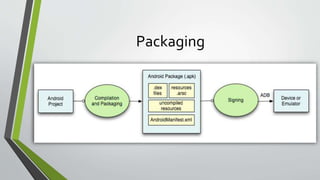
Packaging
AttackVectors
in Android
AttackVectors
AttackVectors
• Mounting SD Card in PC
• Malicious App
• Network Attack
• Malicious File Attack
• User’s Unawareness
• USB Debugging
• Root permissions!! (Can do anything)
Security Policy
in Android
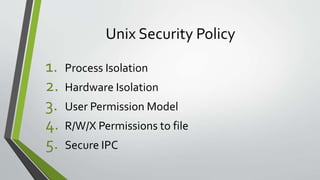
Unix Security Policy
1. Process Isolation
2. Hardware Isolation
3. User Permission Model
4. R/W/X Permissions to file
5. Secure IPC
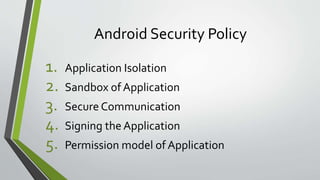
Android Security Policy
1. Application Isolation
2. Sandbox of Application
3. Secure Communication
4. Signing the Application
5. Permission model of Application
To Do's
To Secure Apps
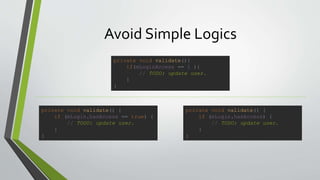
Avoid Simple Logics
private void validate(){
if(mLoginAccess == 1 ){
// TODO: update user.
}
}
private void validate() {
if (mLogin.hasAccess == true) {
// TODO: update user.
}
}
private void validate() {
if (mLogin.hasAccess) {
// TODO: update user.
}
}
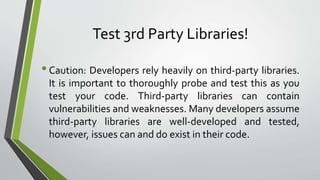
Test 3rd Party Libraries!
•Caution: Developers rely heavily on third-party libraries.
It is important to thoroughly probe and test this as you
test your code. Third-party libraries can contain
vulnerabilities and weaknesses. Many developers assume
third-party libraries are well-developed and tested,
however, issues can and do exist in their code.
Use Encryption
•Caution: External storage can become unavailable if the
user mounts the external storage on a computer or
removes the media, and there's no security enforced
upon files you save to the external storage. All
applications can read and write files placed on the
external storage and the user can remove them.
http://developer.android.com/guide/topics/data/data-
storage.html
But How to Encrypt?
To Secure Apps
How to Encrypt or Encode?
1. Encode Shared Preferences
2.Encrypt SQLite: SQLCipher
3. Encrypt Network:TLS
4.Data Encryption: Facebook’s Conceal Library
5.MD5, SHA Sensitive Data
To be Secured
1. Secure Intents
2.SecureWebView
3. Secure Logs
4.Secure Intent Leaks
Code Obfuscation
1. Proguard
2.Don't include unused Classes and Libraries
3. Difficult to protect from Smali Decompilation
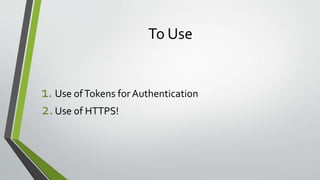
To Use
1. Use ofTokens for Authentication
2.Use of HTTPS!
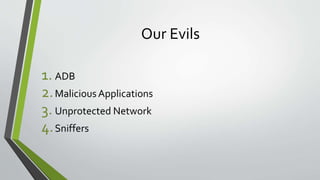
Our Evils
1. ADB
2.MaliciousApplications
3. Unprotected Network
4.Sniffers
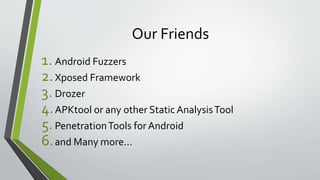
Our Friends
1. Android Fuzzers
2.Xposed Framework
3. Drozer
4.APKtool or any other StaticAnalysisTool
5.PenetrationTools for Android
6.and Many more...
Thank you!
@DearDhruv

Android security

  • 1.
  • 2.
    Secure Coding Guidelines •Suchguidelines even exists? •Who cares! No one's gonna hack my app. •Lets finish this project anyhow!!!
  • 3.
    Secure Coding Guidelines •Computer Emergency ResponseTeam (CERT) • Expert groups that handle Computer/IT security incidents. • Issued Android Secure Coding Guidelines. • Mission: We reduce the number of vulnerabilities to a level that can be fully mitigated in operational environments.
  • 4.
  • 5.
  • 6.
  • 7.
    AttackVectors • Mounting SDCard in PC • Malicious App • Network Attack • Malicious File Attack • User’s Unawareness • USB Debugging • Root permissions!! (Can do anything)
  • 8.
  • 9.
    Unix Security Policy 1.Process Isolation 2. Hardware Isolation 3. User Permission Model 4. R/W/X Permissions to file 5. Secure IPC
  • 10.
    Android Security Policy 1.Application Isolation 2. Sandbox of Application 3. Secure Communication 4. Signing the Application 5. Permission model of Application
  • 11.
  • 12.
    Avoid Simple Logics privatevoid validate(){ if(mLoginAccess == 1 ){ // TODO: update user. } } private void validate() { if (mLogin.hasAccess == true) { // TODO: update user. } } private void validate() { if (mLogin.hasAccess) { // TODO: update user. } }
  • 13.
    Test 3rd PartyLibraries! •Caution: Developers rely heavily on third-party libraries. It is important to thoroughly probe and test this as you test your code. Third-party libraries can contain vulnerabilities and weaknesses. Many developers assume third-party libraries are well-developed and tested, however, issues can and do exist in their code.
  • 14.
    Use Encryption •Caution: Externalstorage can become unavailable if the user mounts the external storage on a computer or removes the media, and there's no security enforced upon files you save to the external storage. All applications can read and write files placed on the external storage and the user can remove them. http://developer.android.com/guide/topics/data/data- storage.html
  • 15.
    But How toEncrypt? To Secure Apps
  • 16.
    How to Encryptor Encode? 1. Encode Shared Preferences 2.Encrypt SQLite: SQLCipher 3. Encrypt Network:TLS 4.Data Encryption: Facebook’s Conceal Library 5.MD5, SHA Sensitive Data
  • 17.
    To be Secured 1.Secure Intents 2.SecureWebView 3. Secure Logs 4.Secure Intent Leaks
  • 18.
    Code Obfuscation 1. Proguard 2.Don'tinclude unused Classes and Libraries 3. Difficult to protect from Smali Decompilation
  • 19.
    To Use 1. UseofTokens for Authentication 2.Use of HTTPS!
  • 20.
    Our Evils 1. ADB 2.MaliciousApplications 3.Unprotected Network 4.Sniffers
  • 21.
    Our Friends 1. AndroidFuzzers 2.Xposed Framework 3. Drozer 4.APKtool or any other StaticAnalysisTool 5.PenetrationTools for Android 6.and Many more...
  • 22.