Let’s go in…
Som Ranjan
Introduction
What is Android?
• A software platform and operating system for mobile devices

• Based on the Linux kernel

• Developed by Google and later the Open Handset Alliance (OHA)

• Allows writing managed code in the Java language

• Possibility to write applications in other languages and compiling it to
  ARM native code (support of Google? No)

• Unveiling of the Android platform was announced on 5 November 2007
  with the founding of OHA
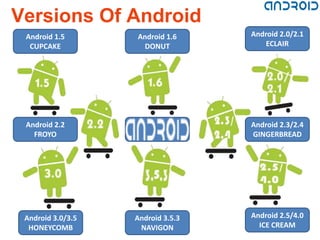
Versions Of Android
 Android 1.5       Android 1.6     Android 2.0/2.1
  CUPCAKE           DONUT             ECLAIR


 Android 2.2                       Android 2.3/2.4
   FROYO                           GINGERBREAD


 Android 3.0/3.5   Android 3.5.3   Android 2.5/4.0
  HONEYCOMB         NAVIGON          ICE CREAM
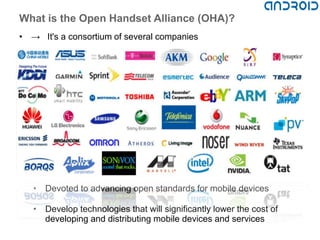
What is the Open Handset Alliance (OHA)?
• → It's a consortium of several companies


   • Devoted to advancing open standards for mobile devices

   • Develop technologies that will significantly lower the cost of
     developing and distributing mobile devices and services
Features
• Application framework enabling reuse and replacement of
  components
• Dalvik virtual machine optimized for mobile devices
• Integrated browser based on the open source WebKit engine
• Optimized graphics powered by a custom 2D graphics library;
  3D graphics based on the OpenGL ES 1.0 specification
  (hardware acceleration optional)
• SQLite for structured data storage
• Media support for common audio, video, and image
   formats (MPEG4, H.264, MP3, AMR, JPG, PNG, GIF)
• GSM Telephony (hardware dependent)
• Bluetooth, EDGE, 3G, and WiFi (hardware dependent)
• Camera, GPS, compass, and accelerometer (hardware
  dependent)
• Rich development environment including a device
  emulator, tools for debugging, memory and performance
  profiling, and a plugin for the Eclipse IDE
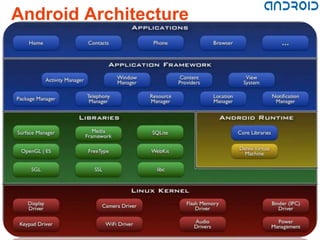
Android Architecture
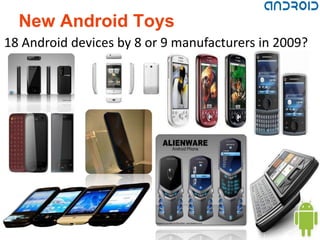
New Android Toys
18 Android devices by 8 or 9 manufacturers in 2009?
Platform
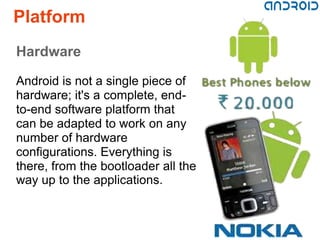
Hardware

Android is not a single piece of
hardware; it's a complete, end-
to-end software platform that
can be adapted to work on any
number of hardware
configurations. Everything is
there, from the bootloader all the
way up to the applications.
Platform
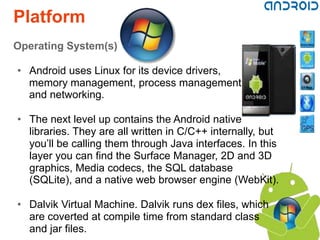
Operating System(s)

• Android uses Linux for its device drivers,
  memory management, process management,
  and networking.

• The next level up contains the Android native
  libraries. They are all written in C/C++ internally, but
  you’ll be calling them through Java interfaces. In this
  layer you can find the Surface Manager, 2D and 3D
  graphics, Media codecs, the SQL database
  (SQLite), and a native web browser engine (WebKit).

• Dalvik Virtual Machine. Dalvik runs dex files, which
  are coverted at compile time from standard class
  and jar files.
Platform

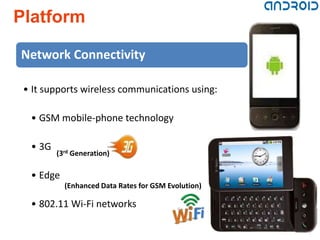
Network Connectivity

 • It supports wireless communications using:

  • GSM mobile-phone technology

  • 3G
         (3rd Generation)

  • Edge
           (Enhanced Data Rates for GSM Evolution)

  • 802.11 Wi-Fi networks
Platform
Security

Android is a multi-process system, in which each
application (and parts of the system) runs in its own
process. Most security between applications and the
system is enforced at the process level through
standard Linux facilities, such as user and group IDs
that are assigned to applications.

Additional finer-grained security features are
provided through a "permission" mechanism that
enforces restrictions on the specific operations that a
particular process can perform, and per-URI
permissions for granting ad-hoc access to specific
pieces of data.
Platform
Performance
Platform

Future possibilities

• Google Android Sales to Overtake iPhone in 2012
• The OHA is committed to make their vision a reality: to deploy
  the Android platform for every mobile operator, handset
  manufacturers and developers to build innovative devices
• Intel doesn’t want to lose ownership of the netbook market, so
  they need to prepare for anything, including Android
• More Android devices are coming and some will push the
  envelope even further
Software development

Development requirements

• Java

• Android SDK

• Eclipse IDE (optional)
Software development
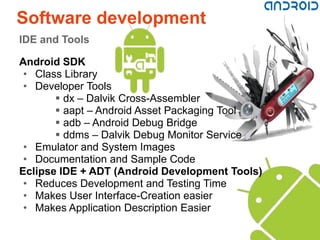
IDE and Tools

Android SDK
 • Class Library
 • Developer Tools
        dx – Dalvik Cross-Assembler
        aapt – Android Asset Packaging Tool
        adb – Android Debug Bridge
        ddms – Dalvik Debug Monitor Service
 • Emulator and System Images
 • Documentation and Sample Code
Eclipse IDE + ADT (Android Development Tools)
 • Reduces Development and Testing Time
 • Makes User Interface-Creation easier
 • Makes Application Description Easier
Software development

Programming Language(s)

• Java – officially supported

• C/C++ – also possible but not supported
Advantages
• The ability for anyone to customize the Google Android platform
• The consumer will benefit from having a wide range of mobile
  applications to choose, because Google Android provides more
  than 2,00,000 online applications on Android market.
• Men will be able to customize a mobile phones using Google
  Android platform like never before
• Features like weather details, opening screen, live RSS feeds and
  even the icons on the opening screen will be able to be
  customized
• As a result of many mobile phones carrying Google
  Android, companies will come up with such innovative products
• In addition the entertainment functionalities will be taken a notch
  higher by Google Android being able to offer online real time
  multiplayer games
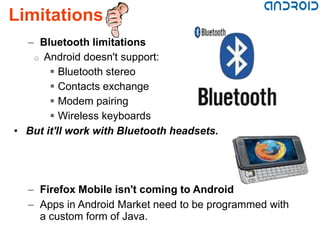
Limitations
  – Bluetooth limitations
   o Android doesn't support:
        Bluetooth stereo
        Contacts exchange
        Modem pairing
        Wireless keyboards
• But it'll work with Bluetooth headsets.


  – Firefox Mobile isn't coming to Android
  – Apps in Android Market need to be programmed with
    a custom form of Java.
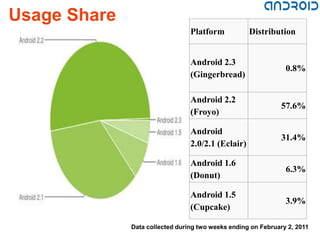
Usage Share
                                 Platform           Distribution


                                 Android 2.3
                                                                0.8%
                                 (Gingerbread)

                                 Android 2.2
                                                               57.6%
                                 (Froyo)

                                 Android
                                                               31.4%
                                 2.0/2.1 (Eclair)

                                 Android 1.6
                                                                6.3%
                                 (Donut)

                                 Android 1.5
                                                                3.9%
                                 (Cupcake)

              Data collected during two weeks ending on February 2, 2011
Prepared By:Somaranjan

ANDROID

  • 1.
  • 2.
  • 3.
    Introduction What is Android? •A software platform and operating system for mobile devices • Based on the Linux kernel • Developed by Google and later the Open Handset Alliance (OHA) • Allows writing managed code in the Java language • Possibility to write applications in other languages and compiling it to ARM native code (support of Google? No) • Unveiling of the Android platform was announced on 5 November 2007 with the founding of OHA
  • 4.
    Versions Of Android Android 1.5 Android 1.6 Android 2.0/2.1 CUPCAKE DONUT ECLAIR Android 2.2 Android 2.3/2.4 FROYO GINGERBREAD Android 3.0/3.5 Android 3.5.3 Android 2.5/4.0 HONEYCOMB NAVIGON ICE CREAM
  • 5.
    What is theOpen Handset Alliance (OHA)? • → It's a consortium of several companies • Devoted to advancing open standards for mobile devices • Develop technologies that will significantly lower the cost of developing and distributing mobile devices and services
  • 6.
    Features • Application frameworkenabling reuse and replacement of components • Dalvik virtual machine optimized for mobile devices • Integrated browser based on the open source WebKit engine • Optimized graphics powered by a custom 2D graphics library; 3D graphics based on the OpenGL ES 1.0 specification (hardware acceleration optional) • SQLite for structured data storage • Media support for common audio, video, and image formats (MPEG4, H.264, MP3, AMR, JPG, PNG, GIF) • GSM Telephony (hardware dependent) • Bluetooth, EDGE, 3G, and WiFi (hardware dependent) • Camera, GPS, compass, and accelerometer (hardware dependent) • Rich development environment including a device emulator, tools for debugging, memory and performance profiling, and a plugin for the Eclipse IDE
  • 7.
  • 8.
    New Android Toys 18Android devices by 8 or 9 manufacturers in 2009?
  • 9.
    Platform Hardware Android is nota single piece of hardware; it's a complete, end- to-end software platform that can be adapted to work on any number of hardware configurations. Everything is there, from the bootloader all the way up to the applications.
  • 10.
    Platform Operating System(s) • Androiduses Linux for its device drivers, memory management, process management, and networking. • The next level up contains the Android native libraries. They are all written in C/C++ internally, but you’ll be calling them through Java interfaces. In this layer you can find the Surface Manager, 2D and 3D graphics, Media codecs, the SQL database (SQLite), and a native web browser engine (WebKit). • Dalvik Virtual Machine. Dalvik runs dex files, which are coverted at compile time from standard class and jar files.
  • 11.
    Platform Network Connectivity •It supports wireless communications using: • GSM mobile-phone technology • 3G (3rd Generation) • Edge (Enhanced Data Rates for GSM Evolution) • 802.11 Wi-Fi networks
  • 12.
    Platform Security Android is amulti-process system, in which each application (and parts of the system) runs in its own process. Most security between applications and the system is enforced at the process level through standard Linux facilities, such as user and group IDs that are assigned to applications. Additional finer-grained security features are provided through a "permission" mechanism that enforces restrictions on the specific operations that a particular process can perform, and per-URI permissions for granting ad-hoc access to specific pieces of data.
  • 13.
  • 14.
    Platform Future possibilities • GoogleAndroid Sales to Overtake iPhone in 2012 • The OHA is committed to make their vision a reality: to deploy the Android platform for every mobile operator, handset manufacturers and developers to build innovative devices • Intel doesn’t want to lose ownership of the netbook market, so they need to prepare for anything, including Android • More Android devices are coming and some will push the envelope even further
  • 15.
    Software development Development requirements •Java • Android SDK • Eclipse IDE (optional)
  • 16.
    Software development IDE andTools Android SDK • Class Library • Developer Tools  dx – Dalvik Cross-Assembler  aapt – Android Asset Packaging Tool  adb – Android Debug Bridge  ddms – Dalvik Debug Monitor Service • Emulator and System Images • Documentation and Sample Code Eclipse IDE + ADT (Android Development Tools) • Reduces Development and Testing Time • Makes User Interface-Creation easier • Makes Application Description Easier
  • 17.
    Software development Programming Language(s) •Java – officially supported • C/C++ – also possible but not supported
  • 18.
    Advantages • The abilityfor anyone to customize the Google Android platform • The consumer will benefit from having a wide range of mobile applications to choose, because Google Android provides more than 2,00,000 online applications on Android market. • Men will be able to customize a mobile phones using Google Android platform like never before • Features like weather details, opening screen, live RSS feeds and even the icons on the opening screen will be able to be customized • As a result of many mobile phones carrying Google Android, companies will come up with such innovative products • In addition the entertainment functionalities will be taken a notch higher by Google Android being able to offer online real time multiplayer games
  • 19.
    Limitations –Bluetooth limitations o Android doesn't support:  Bluetooth stereo  Contacts exchange  Modem pairing  Wireless keyboards • But it'll work with Bluetooth headsets. – Firefox Mobile isn't coming to Android – Apps in Android Market need to be programmed with a custom form of Java.
  • 20.
    Usage Share Platform Distribution Android 2.3 0.8% (Gingerbread) Android 2.2 57.6% (Froyo) Android 31.4% 2.0/2.1 (Eclair) Android 1.6 6.3% (Donut) Android 1.5 3.9% (Cupcake) Data collected during two weeks ending on February 2, 2011
  • 21.