Android
Android is an open source and Linux-based operating system for
mobile devices such as smartphones and tablet computers.
Android was developed by the Open Handset Alliance, led by
Google, and other companies.
What is Android?
• Android is an open source and Linux-based Operating
System for mobile devices such as smartphones and tablet
computers. Android was developed by the Open Handset
Alliance, led by Google, and other companies.
• Android offers a unified approach to application development
for mobile devices which means developers need only develop
for Android, and their applications should be able to run on
different devices powered by Android.
• The source code for Android is available under free and open
source software licenses. Google publishes most of the code
under the Apache License version 2.0 and the rest, Linux
kernel changes, under the GNU General Public License version
2.
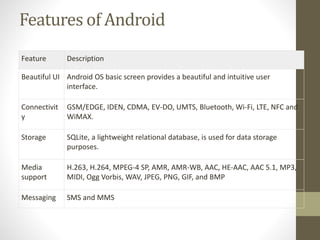
Features of Android
Feature Description
Beautiful UI Android OS basic screen provides a beautiful and intuitive user
interface.
Connectivit
y
GSM/EDGE, IDEN, CDMA, EV-DO, UMTS, Bluetooth, Wi-Fi, LTE, NFC and
WiMAX.
Storage SQLite, a lightweight relational database, is used for data storage
purposes.
Media
support
H.263, H.264, MPEG-4 SP, AMR, AMR-WB, AAC, HE-AAC, AAC 5.1, MP3,
MIDI, Ogg Vorbis, WAV, JPEG, PNG, GIF, and BMP
Messaging SMS and MMS
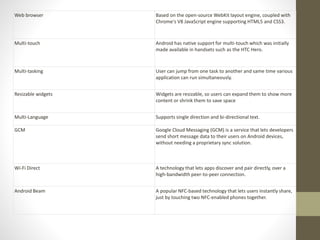
Web browser Based on the open-source WebKit layout engine, coupled with
Chrome's V8 JavaScript engine supporting HTML5 and CSS3.
Multi-touch Android has native support for multi-touch which was initially
made available in handsets such as the HTC Hero.
Multi-tasking User can jump from one task to another and same time various
application can run simultaneously.
Resizable widgets Widgets are resizable, so users can expand them to show more
content or shrink them to save space
Multi-Language Supports single direction and bi-directional text.
GCM Google Cloud Messaging (GCM) is a service that lets developers
send short message data to their users on Android devices,
without needing a proprietary sync solution.
Wi-Fi Direct A technology that lets apps discover and pair directly, over a
high-bandwidth peer-to-peer connection.
Android Beam A popular NFC-based technology that lets users instantly share,
just by touching two NFC-enabled phones together.
Android Applications
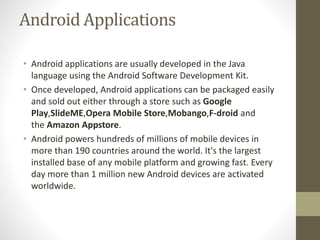
• Android applications are usually developed in the Java
language using the Android Software Development Kit.
• Once developed, Android applications can be packaged easily
and sold out either through a store such as Google
Play,SlideME,Opera Mobile Store,Mobango,F-droid and
the Amazon Appstore.
• Android powers hundreds of millions of mobile devices in
more than 190 countries around the world. It's the largest
installed base of any mobile platform and growing fast. Every
day more than 1 million new Android devices are activated
worldwide.
History of Android
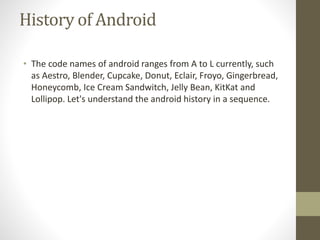
• The code names of android ranges from A to L currently, such
as Aestro, Blender, Cupcake, Donut, Eclair, Froyo, Gingerbread,
Honeycomb, Ice Cream Sandwitch, Jelly Bean, KitKat and
Lollipop. Let's understand the android history in a sequence.
Linux kernel
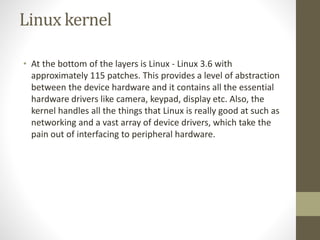
• At the bottom of the layers is Linux - Linux 3.6 with
approximately 115 patches. This provides a level of abstraction
between the device hardware and it contains all the essential
hardware drivers like camera, keypad, display etc. Also, the
kernel handles all the things that Linux is really good at such as
networking and a vast array of device drivers, which take the
pain out of interfacing to peripheral hardware.
Libraries
• On top of Linux kernel there is a set of libraries including
open-source Web browser engine WebKit, well known library
libc, SQLite database which is a useful repository for storage
and sharing of application data, libraries to play and record
audio and video, SSL libraries responsible for Internet security
etc
Android Libraries
• This category encompasses those Java-based libraries that are
specific to Android development. Examples of libraries in this
category include the application framework libraries in
addition to those that facilitate user interface building,
graphics drawing and database access.
• android.app − Provides access to the application model and is
the cornerstone of all Android applications.
• android.content − Facilitates content access, publishing and
messaging between applications and application components.
• android.database − Used to access data published by content
providers and includes SQLite database management classes.
• android.opengl − A Java interface to the OpenGL ES 3D
graphics rendering API.
• android.os − Provides applications with access to standard
operating system services including messages, system services
and inter-process communication.
• android.text − Used to render and manipulate text on a device
display.
• android.view − The fundamental building blocks of application
user interfaces.
• android.widget − A rich collection of pre-built user interface
components such as buttons, labels, list views, layout
managers, radio buttons etc.
• android.webkit − A set of classes intended to allow web-
browsing capabilities to be built into applications.
Android Runtime
• This is the third section of the architecture and available on
the second layer from the bottom. This section provides a key
component called Dalvik Virtual Machine which is a kind of
Java Virtual Machine specially designed and optimized for
Android.
• The Dalvik VM makes use of Linux core features like memory
management and multi-threading, which is intrinsic in the Java
language. The Dalvik VM enables every Android application to
run in its own process, with its own instance of the Dalvik
virtual machine.

Android

  • 1.
    Android Android is anopen source and Linux-based operating system for mobile devices such as smartphones and tablet computers. Android was developed by the Open Handset Alliance, led by Google, and other companies.
  • 2.
    What is Android? •Android is an open source and Linux-based Operating System for mobile devices such as smartphones and tablet computers. Android was developed by the Open Handset Alliance, led by Google, and other companies. • Android offers a unified approach to application development for mobile devices which means developers need only develop for Android, and their applications should be able to run on different devices powered by Android.
  • 3.
    • The sourcecode for Android is available under free and open source software licenses. Google publishes most of the code under the Apache License version 2.0 and the rest, Linux kernel changes, under the GNU General Public License version 2.
  • 4.
    Features of Android FeatureDescription Beautiful UI Android OS basic screen provides a beautiful and intuitive user interface. Connectivit y GSM/EDGE, IDEN, CDMA, EV-DO, UMTS, Bluetooth, Wi-Fi, LTE, NFC and WiMAX. Storage SQLite, a lightweight relational database, is used for data storage purposes. Media support H.263, H.264, MPEG-4 SP, AMR, AMR-WB, AAC, HE-AAC, AAC 5.1, MP3, MIDI, Ogg Vorbis, WAV, JPEG, PNG, GIF, and BMP Messaging SMS and MMS
  • 5.
    Web browser Basedon the open-source WebKit layout engine, coupled with Chrome's V8 JavaScript engine supporting HTML5 and CSS3. Multi-touch Android has native support for multi-touch which was initially made available in handsets such as the HTC Hero. Multi-tasking User can jump from one task to another and same time various application can run simultaneously. Resizable widgets Widgets are resizable, so users can expand them to show more content or shrink them to save space Multi-Language Supports single direction and bi-directional text. GCM Google Cloud Messaging (GCM) is a service that lets developers send short message data to their users on Android devices, without needing a proprietary sync solution. Wi-Fi Direct A technology that lets apps discover and pair directly, over a high-bandwidth peer-to-peer connection. Android Beam A popular NFC-based technology that lets users instantly share, just by touching two NFC-enabled phones together.
  • 6.
    Android Applications • Androidapplications are usually developed in the Java language using the Android Software Development Kit. • Once developed, Android applications can be packaged easily and sold out either through a store such as Google Play,SlideME,Opera Mobile Store,Mobango,F-droid and the Amazon Appstore. • Android powers hundreds of millions of mobile devices in more than 190 countries around the world. It's the largest installed base of any mobile platform and growing fast. Every day more than 1 million new Android devices are activated worldwide.
  • 7.
    History of Android •The code names of android ranges from A to L currently, such as Aestro, Blender, Cupcake, Donut, Eclair, Froyo, Gingerbread, Honeycomb, Ice Cream Sandwitch, Jelly Bean, KitKat and Lollipop. Let's understand the android history in a sequence.
  • 8.
    Linux kernel • Atthe bottom of the layers is Linux - Linux 3.6 with approximately 115 patches. This provides a level of abstraction between the device hardware and it contains all the essential hardware drivers like camera, keypad, display etc. Also, the kernel handles all the things that Linux is really good at such as networking and a vast array of device drivers, which take the pain out of interfacing to peripheral hardware.
  • 9.
    Libraries • On topof Linux kernel there is a set of libraries including open-source Web browser engine WebKit, well known library libc, SQLite database which is a useful repository for storage and sharing of application data, libraries to play and record audio and video, SSL libraries responsible for Internet security etc
  • 10.
    Android Libraries • Thiscategory encompasses those Java-based libraries that are specific to Android development. Examples of libraries in this category include the application framework libraries in addition to those that facilitate user interface building, graphics drawing and database access.
  • 11.
    • android.app −Provides access to the application model and is the cornerstone of all Android applications. • android.content − Facilitates content access, publishing and messaging between applications and application components. • android.database − Used to access data published by content providers and includes SQLite database management classes. • android.opengl − A Java interface to the OpenGL ES 3D graphics rendering API. • android.os − Provides applications with access to standard operating system services including messages, system services and inter-process communication.
  • 12.
    • android.text −Used to render and manipulate text on a device display. • android.view − The fundamental building blocks of application user interfaces. • android.widget − A rich collection of pre-built user interface components such as buttons, labels, list views, layout managers, radio buttons etc. • android.webkit − A set of classes intended to allow web- browsing capabilities to be built into applications.
  • 13.
    Android Runtime • Thisis the third section of the architecture and available on the second layer from the bottom. This section provides a key component called Dalvik Virtual Machine which is a kind of Java Virtual Machine specially designed and optimized for Android. • The Dalvik VM makes use of Linux core features like memory management and multi-threading, which is intrinsic in the Java language. The Dalvik VM enables every Android application to run in its own process, with its own instance of the Dalvik virtual machine.