


How to Test and Optimize Your Lead
Nurturing Strategy
Practical Tips and Examples with Marketo and SmartBear
Software
Heidi Bullock, VP Demand Generation @ Marketo
Val Armstrong, Marketing Operations Manager @ SmartBear
Rick DeCosta, Marketing Production Manager @ SmartBear
Gary DeAsi, Senior Marketing Manager @ SmartBear
http://www.marketo.com/DG2LN
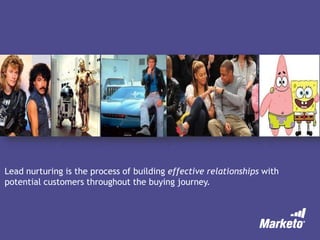
Lead nurturing is the process of building effective relationships with
potential customers throughout the buying journey.
Why Is Nurturing So Important?
Page 5Marketo Proprietary and Confidential | © Marketo, Inc. 4/9/2015
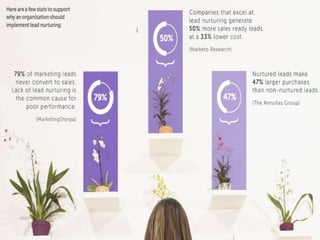
Buyers are Self-Directing Journeys
66% to 90% of a Buyer’s Journey Today is Self-Directed (Forrester, 2014)
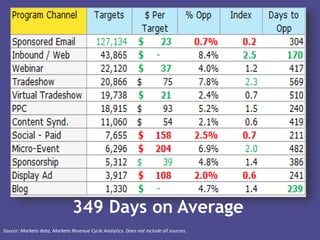
Source: Marketo data, Marketo Revenue Cycle Analytics. Does not include all sources.
349 Days on Average
10 Tips for Engaging Lead
Nurturing
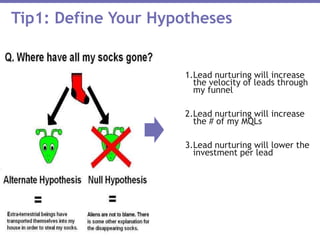
1.Lead nurturing will increase
the velocity of leads through
my funnel
2.Lead nurturing will increase
the # of my MQLs
3.Lead nurturing will lower the
investment per lead
Tip1: Define Your Hypotheses
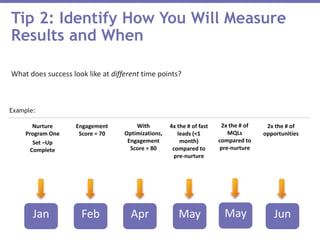
What does success look like at different time points?
Tip 2: Identify How You Will Measure
Results and When
Nurture
Program One
Set –Up
Complete
Jan Feb Apr May Jun
Engagement
Score = 70
4x the # of fast
leads (<1
month)
compared to
pre-nurture
2x the # of
opportunities
With
Optimizations,
Engagement
Score = 80
May
2x the # of
MQLs
compared to
pre-nurture
Example:
Tip 3: Create Your Team Structure
Nurture Content Manager
Nurture Operations Manager
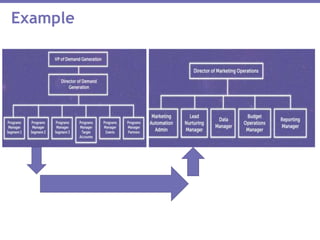
Example
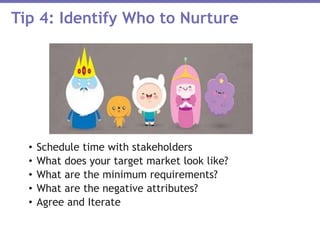
• Schedule time with stakeholders
• What does your target market look like?
• What are the minimum requirements?
• What are the negative attributes?
• Agree and Iterate
Tip 4: Identify Who to Nurture
Page 14Marketo | © Marketo, Inc. 4/9/2015
2 3
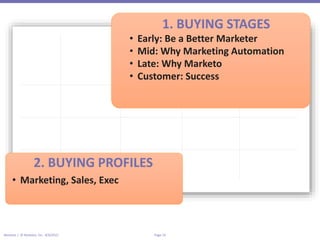
1. BUYING STAGES
• Early: Be a Better Marketer
• Mid: Why Marketing Automation
• Late: Why Marketo
• Customer: Success
2. BUYING PROFILES
• Marketing, Sales, Exec
Page 15Marketo Proprietary and Confidential | © Marketo, Inc. 4/9/2015
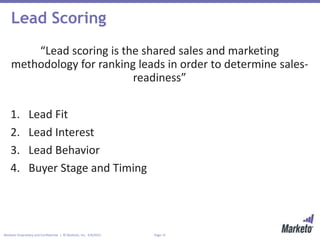
Lead Scoring
“Lead scoring is the shared sales and marketing
methodology for ranking leads in order to determine sales-
readiness”
1. Lead Fit
2. Lead Interest
3. Lead Behavior
4. Buyer Stage and Timing
Page 16Marketo Proprietary and Confidential | © Marketo, Inc. 4/9/2015
Database Health
Database Health
- Removing Duplicates
- Remove Inactive
- Eliminate Junk
- Uniformity of Values
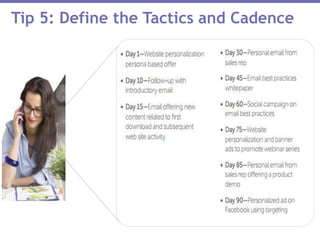
Tip 5: Define the Tactics and Cadence
Page 18Marketo | © Marketo, Inc. 4/9/2015
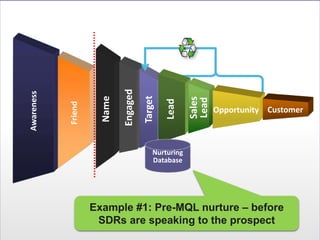
Name
Awareness
Friend
Engaged
Target
Opportunity Customer
Lead
Sales
Lead
Nurturing
Database
Example #1: Pre-MQL nurture – before
SDRs are speaking to the prospect
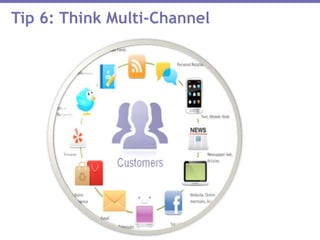
Tip 6: Think Multi-Channel
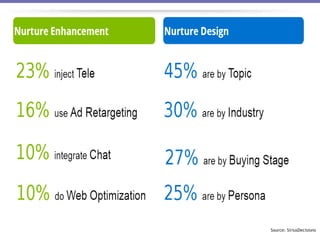
Source: SiriusDecisions
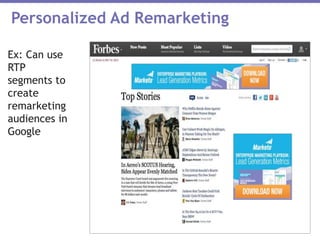
Personalized Ad Remarketing
Ex: Can use
RTP
segments to
create
remarketing
audiences in
Google
Page 22Marketo Proprietary and Confidential | © Marketo, Inc. 4/9/2015
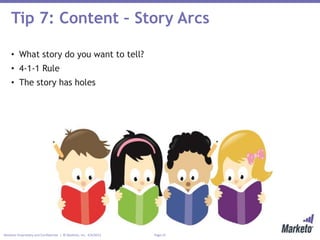
Tip 7: Content – Story Arcs
• What story do you want to tell?
• 4-1-1 Rule
• The story has holes
Page 23Marketo Proprietary and Confidential | © Marketo, Inc. 4/9/2015
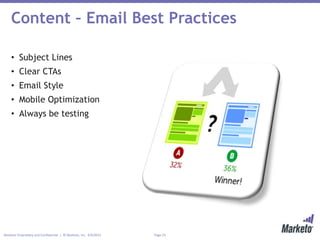
Content – Email Best Practices
• Subject Lines
• Clear CTAs
• Email Style
• Mobile Optimization
• Always be testing
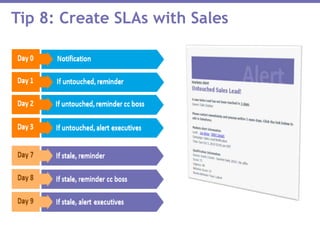
Tip 8: Create SLAs with Sales
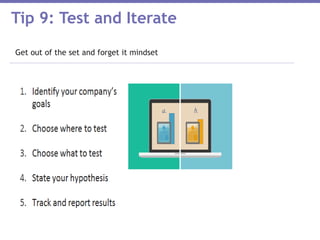
Tip 9: Test and Iterate
Get out of the set and forget it mindset
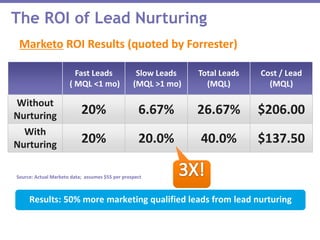
Fast Leads
( MQL <1 mo)
Slow Leads
(MQL >1 mo)
Total Leads
(MQL)
Cost / Lead
(MQL)
Without
Nurturing 20% 6.67% 26.67% $206.00
With
Nurturing 20% 20.0% 40.0% $137.50
The ROI of Lead Nurturing
Source: Actual Marketo data; assumes $55 per prospect
Marketo ROI Results (quoted by Forrester)
Results: 50% more marketing qualified leads from lead nurturing
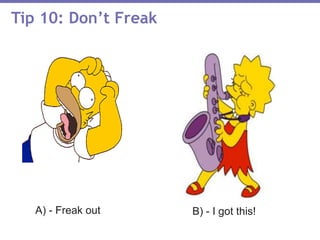
B) - I got this!A) - Freak out
Tip 10: Don’t Freak
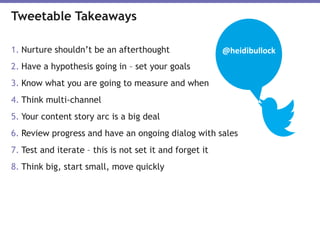
1. Nurture shouldn’t be an afterthought
2. Have a hypothesis going in – set your goals
3. Know what you are going to measure and when
4. Think multi-channel
5. Your content story arc is a big deal
6. Review progress and have an ongoing dialog with sales
7. Test and iterate – this is not set it and forget it
8. Think big, start small, move quickly
Tweetable Takeaways
@heidibullock
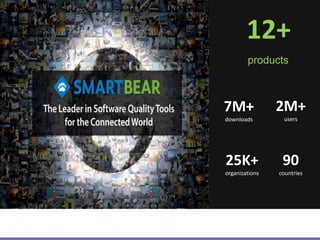
7M+
downloads
2M+
users
25K+
organizations
90
countries
12+
products
3 5
Gary DeAsi
Senior Manager,
Corporate & Digital Marketing
Val Armstrong
Marketing Operations Manager
Rick Decosta
Marketing Production Manager
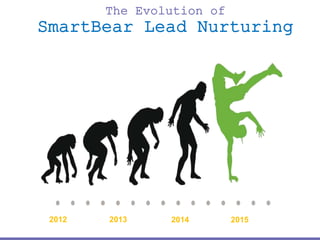
The Evolution of
SmartBear Lead Nurturing
20132012 2014 2015
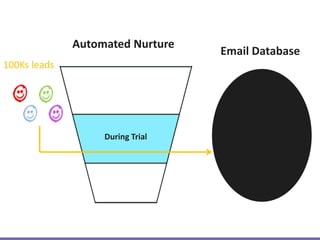
100Ks leads
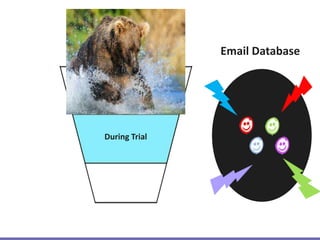
Automated Nurture
Email Database
During Trial
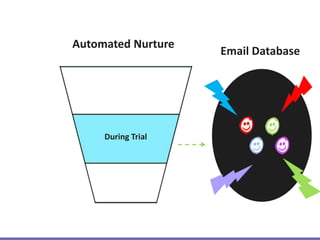
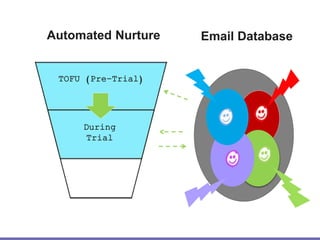
Automated Nurture
Email Database
During Trial
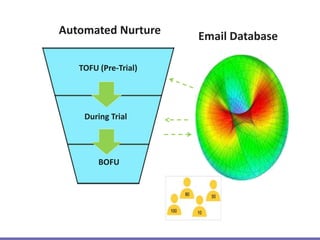
Automated Nurture
During Trial
Email Database
Automated Nurture Email Database
During
Trial
TOFU (Pre-Trial)
Automated Nurture Email Database
During Trial
BOFU
TOFU (Pre-Trial)
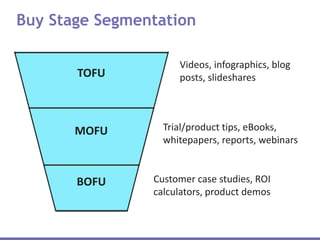
Buy Stage Segmentation
Videos, infographics, blog
posts, slideshares
Trial/product tips, eBooks,
whitepapers, reports, webinars
Customer case studies, ROI
calculators, product demos
TOFU
MOFU
BOFU
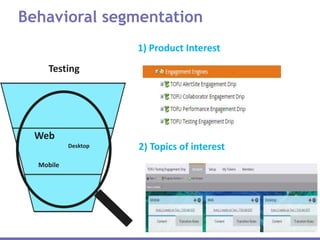
Behavioral segmentation
Testing
Mobile
Desktop
Web
2) Topics of interest
1) Product Interest
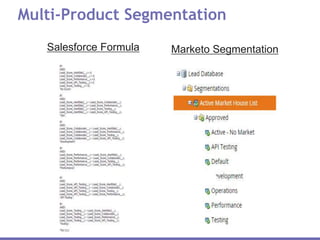
Multi-Product Segmentation
Salesforce Formula Marketo Segmentation
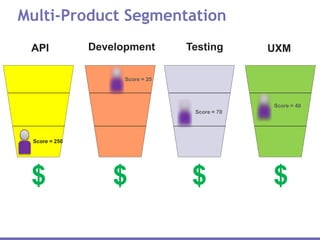
Multi-Product Segmentation
API Development Testing UXM
$ $$$
Score = 250
Score = 25
Score = 70
Score = 40
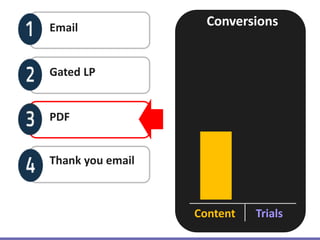
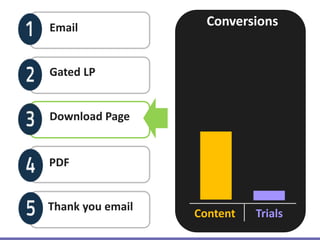
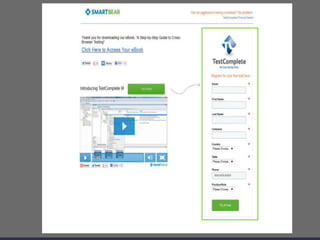
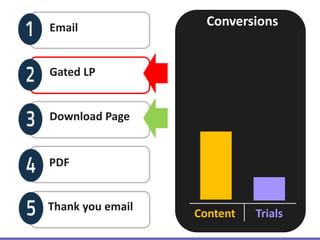
Email
Gated LP
PDF
Thank you email
Conversions
Content Trials
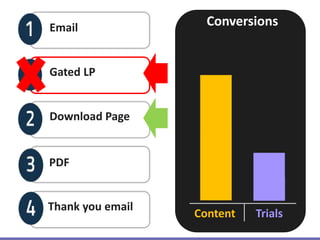
Email
Gated LP
PDF
Conversions
Content Trials
Thank you email
Download Page
Email
Gated LP
PDF
Conversions
Content Trials
Thank you email
Download Page
Email
Gated LP
PDF
Conversions
Content Trials
Thank you email
Download Page
Gated LP
Conversions
Content Trials
Download Page
Email
Thank you email
PDF
Conversions
Content TrialsContent Trials
Conversions
SmartBear Nurture Overview
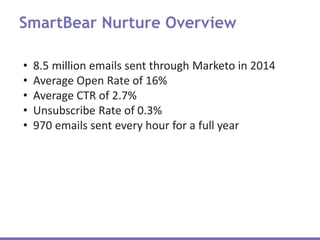
• 8.5 million emails sent through Marketo in 2014
• Average Open Rate of 16%
• Average CTR of 2.7%
• Unsubscribe Rate of 0.3%
• 970 emails sent every hour for a full year
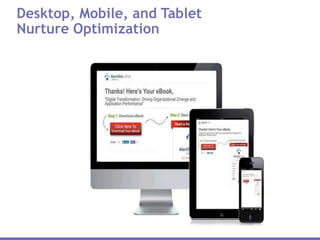
Desktop, Mobile, and Tablet
Nurture Optimization
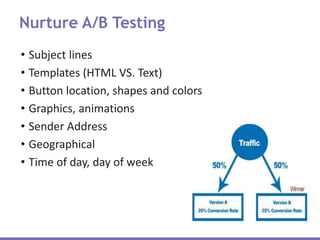
Nurture A/B Testing
• Subject lines
• Templates (HTML VS. Text)
• Button location, shapes and colors
• Graphics, animations
• Sender Address
• Geographical
• Time of day, day of week
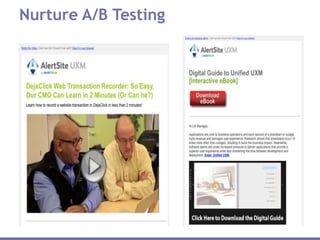
Nurture A/B Testing
Database Health
• Avoid list purchases
• Remove duplicates
• Active Vs. inactive leads
• Avoid SPAM traps
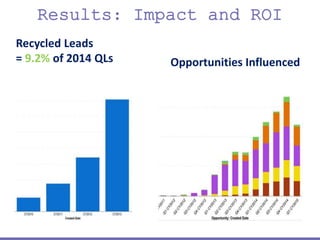
Opportunities Influenced
Recycled Leads
= 9.2% of 2014 QLs
Results: Impact and ROI
Tips for Success
• Start simple – “the Russian Doll Approach”
• Content fuels the engine
• You’re only as good as your data
• If you don’t have the data, create the data
• Always be testing
• Use your channels
• Funnel awareness at every stage
• Always keep end goal in sight
• It’s all about Scale
• Educate your sales team
Thank You!

How to Test and Optimize Your Lead Nurturing Strategy

Editor's Notes

  • #3 http://www.marketo.com/definitive-guides/lead-nurturing/
  • #4 Definition Lead nurturing is the process of building effective relationships with potential customers throughout the buying journey. Key on relationship No different from the relationships you have with those around you. When you have a good relationship, there is a higher level of trust, it’s easier to ask them for help when you need it.
  • #5 When marketers look into purchasing a MA platform, they often focus on a few core features, and one of those features is almost always LN. Why is that? Why is is so important? Well, the ability to build relationships is obviously important, but over the past 10 to 15 years, something else has changed that’s made LN really important. Deliver what sales has the capacity and desire to manage, and nurture the rest.
  • #6 (point here is to reiterate Jon’s intro)- the way people buy has changed – therefore as a marketer, you need to think about how you will cut through the noise and stand out. It is more critical than ever to ‘be found’ and attract people to your company/brand - >> if you don’t, your competitors will.
  • #8 And depending on what you’re selling, and how long the buying journey typically takes for your product or service, nurturing is something that is often required over a long period of time. In the case of Marketo, here you can see how long it takes leads to become opportunities across various channels, and the average is 327 days. That’s almost a year that a marketer needs to stay engaged with a potential buyer until an opportunity is identified. And that’s really just one stage of the relationship. Once the person becomes a customer, there’s more nurturing to do. Companies nurture existing companies for many reasons, from upsell or cross-sell, to advocacy, and more. So nurturing is really something that should be done over a long period of time if it’s to be done well.
  • #10 Goal setting Improve the percentage rate at which raw leads convert to qualified prospects by X% • Improve the percentage rate at which raw leads convert to closed deals by X% • Increase the number of sales ready leads per month to X • Reduce the number of leads rejected by sales to X% • Generate X incremental opportunities per month from the existing database • Faster sales cycle by X% • Better win rates by X% • Increase upsell / cross-sell with current customers by X%
  • #11 Success Secret # 2 – Set your goals upfront with key stake holders. It is very important before you even start on the event (signing the contract, etc.) to make sure that the team is aligned on objectives and outcomes. I have an example illustrated here for a tradeshow. I suggest setting up a meeting with key folks – may be your VP of Marketing, CEO, head of sales, head of product Review the reasons why you think the event has value and how you propose looking at success over time. The timing element is an important one because most likely you will not see closed won deals the day after the tradeshow. So here you can see there are pre-event goals, during event, and post event goals.
  • #12 Success Secret # 3 – Lead nurturing is a co-existence of two opposing variables: creativity and logic. It’s both an art and a science. Your nurture team needs to produce compelling content, but it also needs to perform complex marketing operations. On some marketing teams, all lead nurturing is managed by one person. In other organizations, it is divided amongst several people. Nurture content manager Nurture operations manager
  • #15 So how we segment at Marketo. Well, first of all, we do it across 2 primary dimensions on a regional basis. One dimension we use is the buying stage, which maps really well to our overall revenue model, both to the high level funnel stages, TOFU, MOFU and BOFU, and also happens to map to the way we segment our content, EARLY, MID, LATE and CUSTOMER. The other dimension is the buying profile, which we typically define by personas. And by the way, we’ve kept it to 2 because even moving to 3 adds an exponential level of complexity.
  • #16 Lead scoring is the shared sales and marketing methodology for ranking leads in order to determine sales-readiness In essence, lead scoring is helping you qualify and eliminate leads based on the agreed upon definition you defined for your organization. There are 4 dimensions of lead scoring that can help you determine the sales readiness of a lead. Lead fit is based on demographics like title, role, location. It’s based on firmographics or organizational characteristics like company size, revenue, industry. Lead fit is also based on BANT, which stands for budget, authority, need and time. Lead interest is based on scoring individual behaviour and tying an interest score to those behaviours. For example, if someone visits our social product page, we score them as interested in our social product. Lead behaviour is picking up on certain behaviours that qualify an individual. For example, if someone fills out a “Receive a quote” page. This indicative behaviour is something you should be scoring on for sales readiness. So how does this differ from lead interest, which also scores on individual behaviours. Lead interest is an aggregate of multiple behaviours that says someone is interested in someone. Lead behaviour is looking at a set of scores that you should be paying attention to. Last is buyer stage and time. What this in essence means is, which of your leads require a lot of nurturing, and which ones should be passed immediately to sales. If you score your leads on these four dimensions, you’ve created a great automated process for identifying and qualifying, who is within your target market.
  • #17 Lead scoring is useless if the health of your database is not clean. If the data you have is inaccurate then you could potentially be scoring people incorrectly. It’s like approaching someone you think has one name, and then realizing that their name is something completely different. It can be a very awkward experience, and lead nurturing is all about personalized communications at scale. Keeping your database healthy includes, identifying and removing duplicates from your system, removing inactive contacts, removing junk contacts, and having a uniformity of values - for example everyone in an Enterprise company should not have multiple values like ent or 2000+. They should all be uniform.
  • #19 There are typically three to think about : pre-MQL - Nurturing before a prospect is handed off to a teleprospecting, field or channel resource Recycled - Nurturing when a prospect is rejected by a sales resource for a pre-determined reason Passive recycled – Nurturing when a prospect has experienced no movement fora pre-determined period of time, but has not been rejected by sales
  • #20 For nurture to be effective, you have to think outside of just email. It is most effective when it is aligned to buyer behavior and their communication preferences. For this to be successful: -Synchronized experience across every touch point • Monitored, measured and agile • Rules-based content targeting • Supports named and anonymous prospects
  • #22 Marketo uses personalized retargeting ads to target visitors from the Enterprise industry who were on their website. These personalized ads generated 2x more leads compared to their standard remarketing campaigns We can our RTP segments to create remarketing audiences in Google Adwords – which allows us to target remarketing ads to a segment Lead gen example – anon or known - CAN PULL IN REVENUE STAGES
  • #23 Alright now you’ve got your team together, you’ve defined your target market, you’re able to properly identify and qualify them, its time to think of the story you want to tell them. The best way to do this is to determine how many emails you want to nurture a particular audience with. Let’s go with 10. The first 2-4 emails tend to be the most important because they either capture the attention of your audience, or they are the ones that people unsubscribe from. This is where you should place your best performing emails. Once a person has unsubscribed from your emails, there goes your ability to tell someone a holistic story about your company. At Marketo our philosophy is to always start with light and engaging content like infographics or videos, and then move on to meatier pieces of content like eBooks or definitive guides. Finally you can include some product promotions, but do them carefully, sparsely and intermittently. You don’t want people to feel sold to and unsubscribe from your content. Nurture is all about engaging with people over a long period of time. At Marketo we have a rule of thumb called the 4-11 rule. For every four entertainment pieces, we send 1 soft promotion like a research report and 1 hard promotion like attend a demo or visit a pricing page Also be conscious that even though you create a story arc of emails 1 through 10, doesn’t mean that a person will read and receive all of them
  • #24 Once you’ve determined the story you want to tell and the types of content you want to send. What should your email look like? There are different looks and feels to emails, but there are a couple of other things to take into consideration. For Example, does your subject line clearly summarize what is in the body of the email. You can always have a great subject line that gets a high open rate, but if people feel like the email itself does not match their expectation they could unsubscribe or they may no longer pay attention to your emails. It’s like the boy who cried wolf. If you want help with subject lines, there are 3 subject line techniques that work really well. The first is to ask questions in your subject line. Another technique is to Educate people with subject lines like “7 things marketers can learn from sales”. Another technique is to jump on a popular on trending topic. Another email best practice is to have a clear call to action. Whether it’s to download an eBook, or to set up a meeting with a rep, its important to answer some of these questions. Do you have buttons that call out these CTA’s, are you bolding the hyper links, are the CTAs clearly above fold, which just means is your CTA button above the first half of the email screen and not below where people have to scroll down. There are also multiple ways you can stylize your emails. There are emails that are highly branded, and are incredibly visual. Think of retail brand emails. Then there are also text based emails that come off more personalized and like they are coming from a sales person. Different email styles work better for different types of promotions, but all of them should be mobile responsive. Mobile responsive use to be optional. Now it should be a standard, because 41% of emails are opened on a mobile device. Emails require constant innovation and so its important to adjust to new screens, but also to be testing things like subject lines or CTA’s to help you improve the performance of your nurtures.
  • #27 What I want to focus on here is two models that you can use to calculate the ROI yourself. In the first, the key is to estimate