Comparative Study Of
Android
VS
Windows Phone
Submitted by:
 Areeba Jabeen
 Hafsa Habib
 Muniba Javaid
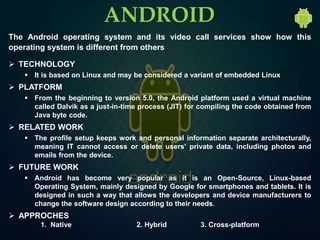
The Android operating system and its video call services show how this
operating system is different from others
 TECHNOLOGY
 It is based on Linux and may be considered a variant of embedded Linux
 PLATFORM
 From the beginning to version 5.0, the Android platform used a virtual machine
called Dalvik as a just-in-time process (JIT) for compiling the code obtained from
Java byte code.
 RELATED WORK
 The profile setup keeps work and personal information separate architecturally,
meaning IT cannot access or delete users' private data, including photos and
emails from the device.
 FUTURE WORK
 Android has become very popular as it is an Open-Source, Linux-based
Operating System, mainly designed by Google for smartphones and tablets. It is
designed in such a way that allows the developers and device manufacturers to
change the software design according to their needs.
 APPROCHES
1. Native 2. Hybrid 3. Cross-platform
ANDROID
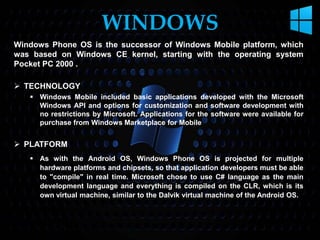
Windows Phone OS is the successor of Windows Mobile platform, which
was based on Windows CE kernel, starting with the operating system
Pocket PC 2000 .
 TECHNOLOGY
 Windows Mobile included basic applications developed with the Microsoft
Windows API and options for customization and software development with
no restrictions by Microsoft. Applications for the software were available for
purchase from Windows Marketplace for Mobile
 PLATFORM
 As with the Android OS, Windows Phone OS is projected for multiple
hardware platforms and chipsets, so that application developers must be able
to "compile" in real time. Microsoft chose to use C# language as the main
development language and everything is compiled on the CLR, which is its
own virtual machine, similar to the Dalvik virtual machine of the Android OS.
WINDOWS
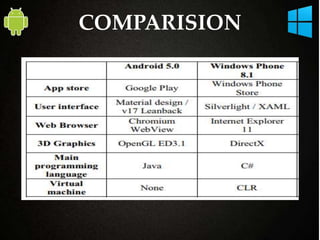
COMPARISION
 PLATFORM
 Android is developed by Google and later the Open Handset Alliance (OHA).
 Android is Linux based operating system for mobile devices.
 Android is an open source operating system.
 RELATED WORK
 Screen size increase since touch screen devices have become mainstream
 Smart phones are become small, more powerful and modern networking
capabilities so that people stay connected to the network.
 APPROACHES
 Android OS is architected in the form of different layers of stacked as software
that comprises android applications, an operating system, android run-time,
middleware, services and libraries.
 FUTURE WORK
 Improving runtime issues, such as CPU load, battery usage and network
performance.
 Improving security issues.
 TECHNOLOGY
 operating system based on the Linux kernel and facilitates developers to write
managed code in Java using Google developed Java libraries.
ANDROID
 TECHNOLOGY USED
 Windows is a closed source or proprietary operating system.
 Windows is programmed in C, C++ programming languages.
 PLATFORMS
 Programs for Windows Phone 7 are written in .NET managed code.
 Windows Phone 7 supports two popular programming platforms:
1. Silverlight : to create sophisticated user interfaces.
2. XNA, is Microsoft’s game platform. It supports both 2D and 3D graphics.
 Approaches
 Window phone framework is a rich application environment facilitating for
applications and databases to run locally on the mobile device.
 Future Work
 Due to low market-share, Microsoft will no longer sell or manufacture new
Windows 10 Mobile devices.
 Existing devices will receive bug fixes and security updates only.
WINDOWS
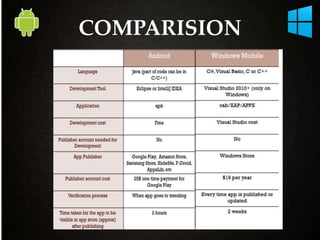
COMPARISION
ANDROID WINDOWS
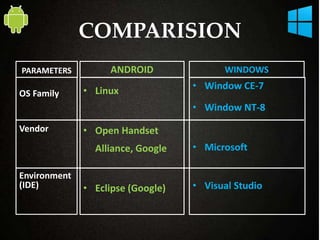
• Linux
• Open Handset
Alliance, Google
• Eclipse (Google)
• Window CE-7
• Window NT-8
• Microsoft
• Visual Studio
PARAMETERS
OS Family
Vendor
Environment
(IDE)
•
COMPARISION
ANDROID WINDOWS
• Open Source
• C, C++, Java
• Google Play
• Very High
• Closed Source
• C#, VB.NET, F#, C++,
JScript
• Windows Phone Store
• Medium
PARAMETERS
Source Model
Written In
Application
Store
Future Prospect
ANDROID VS WINDOW PHONES
INTRODUCTION
Android and windows both are operating
system
ANDROID
 Google developed Android OS.
 Specific phone and tablets
WINDOWS
 Microsoft developed.
 For computer ,PCs and Windows mobile.
Both smart phone has a High resolution touch
screen display, Wi-Fi connectivity, web
browsing capabilities and the ability to accept
the sophisticated applications
RELATED WORK
• As android usage are increasing day by
day, so android have emerged as an
outstanding area of research in recent
past.
• There are a considerable amount of
research contributions in the pervasive
application and mobile development
area.
o User interface design
o Context-awareness in mobile device
applications
o Security
PLATEFORM USE
Today, sophisticated features are available
and there are a large number of platforms
to develop new software on. Android &
Window phones
FUTURE WORK
Android in the future is easier access to
the power of AI on mobile
In future window version are updated
according to their application advancement
FEATURES
ANDROID
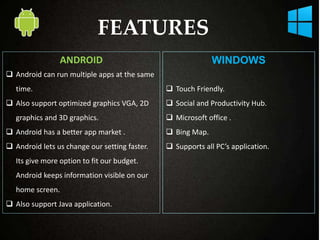
 Android can run multiple apps at the same
time.
 Also support optimized graphics VGA, 2D
graphics and 3D graphics.
 Android has a better app market .
 Android lets us change our setting faster.
Its give more option to fit our budget.
Android keeps information visible on our
home screen.
 Also support Java application.
WINDOWS
 Touch Friendly.
 Social and Productivity Hub.
 Microsoft office .
 Bing Map.
 Supports all PC’s application.
.
COMPARISION
THE END

Comparative Study Of Android VS Windows Phone

  • 1.
    Comparative Study Of Android VS WindowsPhone Submitted by:  Areeba Jabeen  Hafsa Habib  Muniba Javaid
  • 2.
    The Android operatingsystem and its video call services show how this operating system is different from others  TECHNOLOGY  It is based on Linux and may be considered a variant of embedded Linux  PLATFORM  From the beginning to version 5.0, the Android platform used a virtual machine called Dalvik as a just-in-time process (JIT) for compiling the code obtained from Java byte code.  RELATED WORK  The profile setup keeps work and personal information separate architecturally, meaning IT cannot access or delete users' private data, including photos and emails from the device.  FUTURE WORK  Android has become very popular as it is an Open-Source, Linux-based Operating System, mainly designed by Google for smartphones and tablets. It is designed in such a way that allows the developers and device manufacturers to change the software design according to their needs.  APPROCHES 1. Native 2. Hybrid 3. Cross-platform ANDROID
  • 3.
    Windows Phone OSis the successor of Windows Mobile platform, which was based on Windows CE kernel, starting with the operating system Pocket PC 2000 .  TECHNOLOGY  Windows Mobile included basic applications developed with the Microsoft Windows API and options for customization and software development with no restrictions by Microsoft. Applications for the software were available for purchase from Windows Marketplace for Mobile  PLATFORM  As with the Android OS, Windows Phone OS is projected for multiple hardware platforms and chipsets, so that application developers must be able to "compile" in real time. Microsoft chose to use C# language as the main development language and everything is compiled on the CLR, which is its own virtual machine, similar to the Dalvik virtual machine of the Android OS. WINDOWS
  • 4.
  • 5.
     PLATFORM  Androidis developed by Google and later the Open Handset Alliance (OHA).  Android is Linux based operating system for mobile devices.  Android is an open source operating system.  RELATED WORK  Screen size increase since touch screen devices have become mainstream  Smart phones are become small, more powerful and modern networking capabilities so that people stay connected to the network.  APPROACHES  Android OS is architected in the form of different layers of stacked as software that comprises android applications, an operating system, android run-time, middleware, services and libraries.  FUTURE WORK  Improving runtime issues, such as CPU load, battery usage and network performance.  Improving security issues.  TECHNOLOGY  operating system based on the Linux kernel and facilitates developers to write managed code in Java using Google developed Java libraries. ANDROID
  • 6.
     TECHNOLOGY USED Windows is a closed source or proprietary operating system.  Windows is programmed in C, C++ programming languages.  PLATFORMS  Programs for Windows Phone 7 are written in .NET managed code.  Windows Phone 7 supports two popular programming platforms: 1. Silverlight : to create sophisticated user interfaces. 2. XNA, is Microsoft’s game platform. It supports both 2D and 3D graphics.  Approaches  Window phone framework is a rich application environment facilitating for applications and databases to run locally on the mobile device.  Future Work  Due to low market-share, Microsoft will no longer sell or manufacture new Windows 10 Mobile devices.  Existing devices will receive bug fixes and security updates only. WINDOWS
  • 7.
    COMPARISION ANDROID WINDOWS • Linux •Open Handset Alliance, Google • Eclipse (Google) • Window CE-7 • Window NT-8 • Microsoft • Visual Studio PARAMETERS OS Family Vendor Environment (IDE) •
  • 8.
    COMPARISION ANDROID WINDOWS • OpenSource • C, C++, Java • Google Play • Very High • Closed Source • C#, VB.NET, F#, C++, JScript • Windows Phone Store • Medium PARAMETERS Source Model Written In Application Store Future Prospect
  • 9.
    ANDROID VS WINDOWPHONES INTRODUCTION Android and windows both are operating system ANDROID  Google developed Android OS.  Specific phone and tablets WINDOWS  Microsoft developed.  For computer ,PCs and Windows mobile. Both smart phone has a High resolution touch screen display, Wi-Fi connectivity, web browsing capabilities and the ability to accept the sophisticated applications RELATED WORK • As android usage are increasing day by day, so android have emerged as an outstanding area of research in recent past. • There are a considerable amount of research contributions in the pervasive application and mobile development area. o User interface design o Context-awareness in mobile device applications o Security PLATEFORM USE Today, sophisticated features are available and there are a large number of platforms to develop new software on. Android & Window phones FUTURE WORK Android in the future is easier access to the power of AI on mobile In future window version are updated according to their application advancement
  • 10.
    FEATURES ANDROID  Android canrun multiple apps at the same time.  Also support optimized graphics VGA, 2D graphics and 3D graphics.  Android has a better app market .  Android lets us change our setting faster. Its give more option to fit our budget. Android keeps information visible on our home screen.  Also support Java application. WINDOWS  Touch Friendly.  Social and Productivity Hub.  Microsoft office .  Bing Map.  Supports all PC’s application. .
  • 11.
  • 12.