WHAT IS ANDROID?
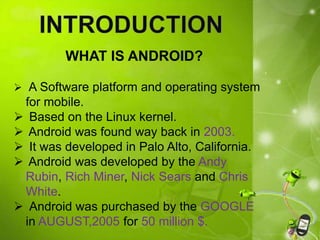
 A Software platform and operating system
for mobile.
 Based on the Linux kernel.
 Android was found way back in 2003.
 It was developed in Palo Alto, California.
 Android was developed by the Andy
Rubin, Rich Miner, Nick Sears and Chris
White.
 Android was purchased by the GOOGLE
in AUGUST,2005 for 50 million $.
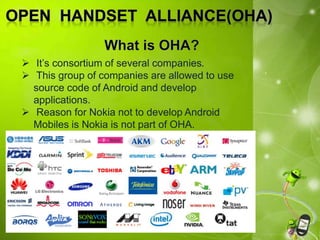
 It’s consortium of several companies.
 This group of companies are allowed to use
source code of Android and develop
applications.
 Reason for Nokia not to develop Android
Mobiles is Nokia is not part of OHA.
Android supports wireless communication
using:-
 Android is a multi-process system, in
which each application (and parts of
the system) runs in its own process.
 Security
 3G Networks
 4G Networks
 802.11 Wi-Fi Networks
 Bluetooth Connectivity
FEATURES OF ANDROID
Multi touch screen supported mobiles.
SQLite database
Open source and User gets millions of
applications that user can not get in any
other mobile operating system.
 Android supports advanced audio/video/still
media formats such as MPEG-4, H.264, MP3,
and AAC, AMR, JPEG, PNG, GIF.
 Developing an android application is not
tough using SDK(standard development
kit) and java emulator we can easily
develop applications that we want.
ANDROID ARCHITECTURE
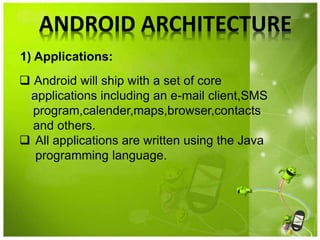
 Android will ship with a set of core
applications including an e-mail client,SMS
program,calender,maps,browser,contacts
and others.
 All applications are written using the Java
programming language.
1) Applications:
ANDROID ARCHITECTURE
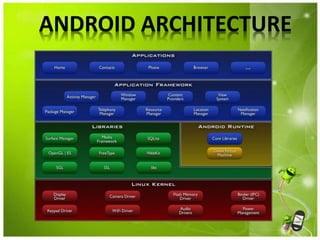
2) Application Framework :
This layer provides services at
runtime to your application. This layer contains a
set of Managers which are service providers to
your application. The following are the Managers
that exist in this layer.
1) Activity Manager
2) Window Manager
3) Location Manager
4) Resource Manager
5) Package Manager etc.
ANDROID ARCHITECTURE
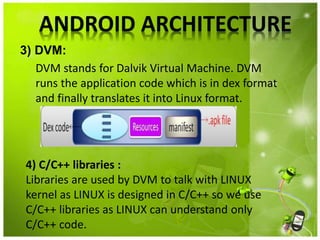
3) DVM:
DVM stands for Dalvik Virtual Machine. DVM
runs the application code which is in dex format
and finally translates it into Linux format.
4) C/C++ libraries :
Libraries are used by DVM to talk with LINUX
kernel as LINUX is designed in C/C++ so we use
C/C++ libraries as LINUX can understand only
C/C++ code.
ANDROID ARCHITECTURE
4) Java APIs :
These APIs are essential for the interpretation of
our Application by DVM. Here we have Core Java
libraries and also Android libraries that are
required for proper functioning of DVM.
 Web- android.webkit.WebView
 Multimedia- android.media.MediaPlayer
5) LINUX Kernel :
Kernel interacts with the Drivers by taking the
calls from DVM which in turn communicates with
the appropriate Hardware device.
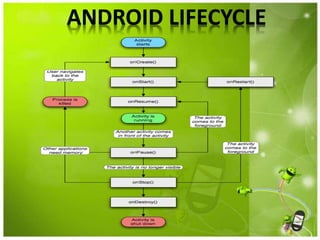
ANDROID LIFECYCLE
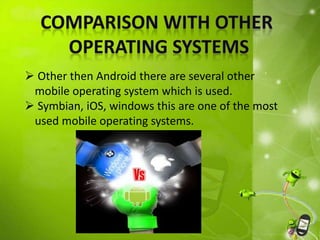
 Other then Android there are several other
mobile operating system which is used.
 Symbian, iOS, windows this are one of the most
used mobile operating systems.
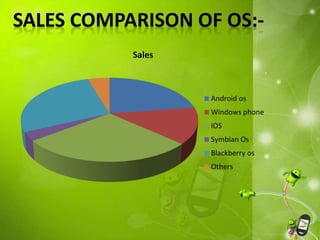
Sales
Android os
Windows phone
iOS
Symbian Os
Blackberry os
Others
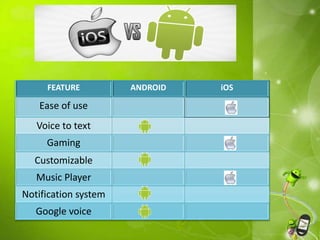
FEATURE ANDROID iOS
Ease of use
Voice to text
Gaming
Customizable
Music Player
Notification system
Google voice
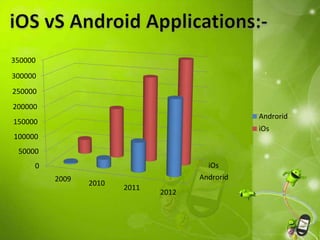
Androrid
iOs0
50000
100000
150000
200000
250000
300000
350000
2009
2010
2011
2012
Androrid
iOs
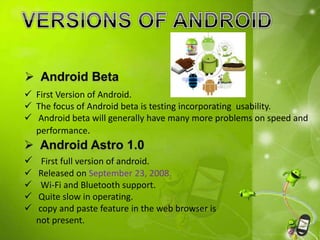
 First Version of Android.
 The focus of Android beta is testing incorporating usability.
 Android beta will generally have many more problems on speed and
performance.
 First full version of android.
 Released on September 23, 2008.
 Wi-Fi and Bluetooth support.
 Quite slow in operating.
 copy and paste feature in the web browser is
not present.
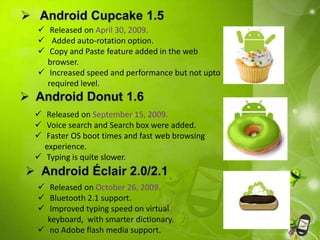
 Released on April 30, 2009.
 Added auto-rotation option.
 Copy and Paste feature added in the web
browser.
 Increased speed and performance but not upto
required level.
 Released on September 15, 2009.
 Voice search and Search box were added.
 Faster OS boot times and fast web browsing
experience.
 Typing is quite slower.
 Released on October 26, 2009.
 Bluetooth 2.1 support.
 Improved typing speed on virtual
keyboard, with smarter dictionary.
 no Adobe flash media support.
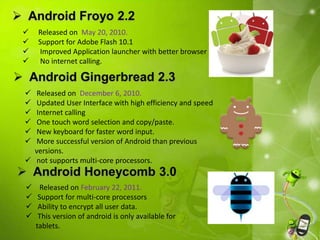
 Released on May 20, 2010.
 Support for Adobe Flash 10.1
 Improved Application launcher with better browser
 No internet calling.
 Released on December 6, 2010.
 Updated User Interface with high efficiency and speed
 Internet calling
 One touch word selection and copy/paste.
 New keyboard for faster word input.
 More successful version of Android than previous
versions.
 not supports multi-core processors.
 Released on February 22, 2011.
 Support for multi-core processors
 Ability to encrypt all user data.
 This version of android is only available for
tablets.
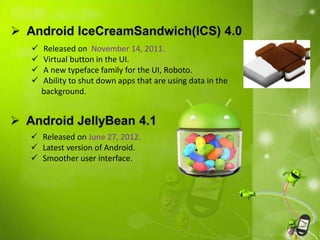
 Released on November 14, 2011.
 Virtual button in the UI.
 A new typeface family for the UI, Roboto.
 Ability to shut down apps that are using data in the
background.
 Released on June 27, 2012.
 Latest version of Android.
 Smoother user interface.
 Making source code available to everyone
inevitably invites the attention of hackers.
 Android operating system uses more
amount of battery as compared to normal
mobile phones.
 As there are so many user sometimes it
becomes difficult to connect all the users.
 As we call Android is world of applications
we continuously need to connected with
the internet which is not possible for all the
users.
 Android is now stepping up in next level of
mobile internet.
 There are chances of Android Mobile sales
becomes more then iPhone in next two
years.
 Google may launch another version of
android that starts K because Google is
launching all the android versions in the
alphabetical order.
 There are chances of Android may become
the widely used operating system in world.
Power Point Presentaton on Android Operating system

Power Point Presentaton on Android Operating system

  • 3.
    WHAT IS ANDROID? A Software platform and operating system for mobile.  Based on the Linux kernel.  Android was found way back in 2003.  It was developed in Palo Alto, California.  Android was developed by the Andy Rubin, Rich Miner, Nick Sears and Chris White.  Android was purchased by the GOOGLE in AUGUST,2005 for 50 million $.
  • 4.
     It’s consortiumof several companies.  This group of companies are allowed to use source code of Android and develop applications.  Reason for Nokia not to develop Android Mobiles is Nokia is not part of OHA.
  • 5.
    Android supports wirelesscommunication using:-  Android is a multi-process system, in which each application (and parts of the system) runs in its own process.  Security  3G Networks  4G Networks  802.11 Wi-Fi Networks  Bluetooth Connectivity
  • 6.
    FEATURES OF ANDROID Multitouch screen supported mobiles. SQLite database Open source and User gets millions of applications that user can not get in any other mobile operating system.  Android supports advanced audio/video/still media formats such as MPEG-4, H.264, MP3, and AAC, AMR, JPEG, PNG, GIF.  Developing an android application is not tough using SDK(standard development kit) and java emulator we can easily develop applications that we want.
  • 7.
  • 8.
    ANDROID ARCHITECTURE  Androidwill ship with a set of core applications including an e-mail client,SMS program,calender,maps,browser,contacts and others.  All applications are written using the Java programming language. 1) Applications:
  • 9.
    ANDROID ARCHITECTURE 2) ApplicationFramework : This layer provides services at runtime to your application. This layer contains a set of Managers which are service providers to your application. The following are the Managers that exist in this layer. 1) Activity Manager 2) Window Manager 3) Location Manager 4) Resource Manager 5) Package Manager etc.
  • 10.
    ANDROID ARCHITECTURE 3) DVM: DVMstands for Dalvik Virtual Machine. DVM runs the application code which is in dex format and finally translates it into Linux format. 4) C/C++ libraries : Libraries are used by DVM to talk with LINUX kernel as LINUX is designed in C/C++ so we use C/C++ libraries as LINUX can understand only C/C++ code.
  • 11.
    ANDROID ARCHITECTURE 4) JavaAPIs : These APIs are essential for the interpretation of our Application by DVM. Here we have Core Java libraries and also Android libraries that are required for proper functioning of DVM.  Web- android.webkit.WebView  Multimedia- android.media.MediaPlayer 5) LINUX Kernel : Kernel interacts with the Drivers by taking the calls from DVM which in turn communicates with the appropriate Hardware device.
  • 12.
  • 13.
     Other thenAndroid there are several other mobile operating system which is used.  Symbian, iOS, windows this are one of the most used mobile operating systems.
  • 14.
  • 15.
    FEATURE ANDROID iOS Easeof use Voice to text Gaming Customizable Music Player Notification system Google voice
  • 16.
  • 17.
     First Versionof Android.  The focus of Android beta is testing incorporating usability.  Android beta will generally have many more problems on speed and performance.  First full version of android.  Released on September 23, 2008.  Wi-Fi and Bluetooth support.  Quite slow in operating.  copy and paste feature in the web browser is not present.
  • 18.
     Released onApril 30, 2009.  Added auto-rotation option.  Copy and Paste feature added in the web browser.  Increased speed and performance but not upto required level.  Released on September 15, 2009.  Voice search and Search box were added.  Faster OS boot times and fast web browsing experience.  Typing is quite slower.  Released on October 26, 2009.  Bluetooth 2.1 support.  Improved typing speed on virtual keyboard, with smarter dictionary.  no Adobe flash media support.
  • 19.
     Released onMay 20, 2010.  Support for Adobe Flash 10.1  Improved Application launcher with better browser  No internet calling.  Released on December 6, 2010.  Updated User Interface with high efficiency and speed  Internet calling  One touch word selection and copy/paste.  New keyboard for faster word input.  More successful version of Android than previous versions.  not supports multi-core processors.  Released on February 22, 2011.  Support for multi-core processors  Ability to encrypt all user data.  This version of android is only available for tablets.
  • 20.
     Released onNovember 14, 2011.  Virtual button in the UI.  A new typeface family for the UI, Roboto.  Ability to shut down apps that are using data in the background.  Released on June 27, 2012.  Latest version of Android.  Smoother user interface.
  • 21.
     Making sourcecode available to everyone inevitably invites the attention of hackers.  Android operating system uses more amount of battery as compared to normal mobile phones.  As there are so many user sometimes it becomes difficult to connect all the users.  As we call Android is world of applications we continuously need to connected with the internet which is not possible for all the users.
  • 22.
     Android isnow stepping up in next level of mobile internet.  There are chances of Android Mobile sales becomes more then iPhone in next two years.  Google may launch another version of android that starts K because Google is launching all the android versions in the alphabetical order.  There are chances of Android may become the widely used operating system in world.