Multimedia Presentation
on
Android Technology
===================================
Group Member:
 Rajesh M. Gupta(SYIT-09)
 Anil Gupta(SYIT-08)

Submitted To,
Mr. Gokul D. Chudhary
INDEX
======














INTRODUCTION
FEATURES
MARKET SHARE
TABLETS
Memory management /Hardware requirements
Linux kernel
VERSIONS OF ANDROID
Platform usage
Android Usage on other dévies
Advantages
LIMITATIONS
CONCLUSION AND FUTURE SCOPE
Référence / Work Distribution
Introduction
----------------------What Is Android ?
•

Android is an Mobile operating system based on the Linux kernel
Programmed in C (coré), C++, Java .

•

It was developed in Palo Alto, California.

•

Android was developed by the Andy Rubin, Rich Miner, Nick Sears and
Chris White in 2003.

•

Android was purchased by the GOOGLE in AUGUST,2005 for 50 million $.

•

The first Android-powered phone was sold in October 2008.

•

As of September 3, 2013, 1 billion Android devices have been activated.

•

As of May 2013, 48 billion apps have been installed from the Google
Play store.

•

Android is the world's most widely used Smartphone platform, overtaking
Symbian in the fourth quarter of 2010.
•

Features
==========
User gets millions of applications that user can not get in any other mobile
operating system.

•

Android supports advanced audio/video/still media formats such
as MPEG-4, H.264, MP3, and AAC, AMR, JPEG, PNG, GIF.

•

Multi-touch, Multitasking, Screen capture, Video calling, Multiple language
(46 languages)support, Java support.

•

Third-party apps available on Google Play and other app stores
can extensively re-theme the homescreen, and even mimic the look
of other operating systems, such as Windows Phone.

•

Internal hardware such as accelerometers, gyroscopes and proximity
sensors are used by some applications to respond to additional user
actions.

•

Android supports wireless communication using:




3G Networks
4G Networks
802.11 Wi-Fi Networks
Bluetooth Connectivity
•

Market share
============== the
By the fourth quarter of 2010 this had grown to 33% of the market, becoming
top-selling Smartphone platform.

•

By the third quarter of 2012 Android had a 75% share
of the global Smartphone market according to the
research firm IDC.

•

In July 2011, Google said that 550,000 new Android
devices were being activated every day.

•

In September 2012, 500 million devices had been
activated with 1.3 million activations per day.
Tablets
========
•

initially Android tablet adoption was slow. One of the main causes
was the chicken or the egg situation where consumers
were hesitant to buy an Android tablet due to a lack of high
quality tablet apps.

•

Furthermore, several Android tablets such as the
Motorola Xoom were priced the same or higher than the iPad,
which hurt sales.

•

This began to change in 2012 with the release of the
affordable Nexus 7 and a push by Google for developers
to write better tablet apps .
Memory management
Hardware requirements
============================
•

Android devices are incorporating many optional hardware
components, including still or video cameras, GPS, hardware orientation
sensors,
dedicated gaming controls, accelerometers, gyroscopes, proximity
sensors, pressure sensors, thermometers and touch screens.

•

As of November 2013, current versions of Android require at least 512 MB
of RAM and a 32-bit ARMv7, MIPS or x86 architecture processor,
together with an OpenGL ES 2.0 compatible graphics processing unit (GPU).

•

In 2012 Intel processors began to appear on more mainstream Android
platforms, such as phones.

•

Android manages the apps stored in memory automatically:
when memory is low, the system will begin killing apps and processes
that have been inactive for a while, in reverse order since they were
last used (i.e. oldest first), Some third-party task killers are generally
regarded as doing more harm than good.
•

Linux kernel
==============

As of November 2013, current Android versions consist of a kernel based on the
Linux kernel version 3.x ,while Android versions older than 4.0 Ice Cream Sandwich
were based on the Linux kernel 2.6.x
VERSIONS OF ANDROID
==================

•
•
•

Android Beta
First Version of Android.
The focus of Android beta is testing incorporating usability.
Android beta will generally have many more problems on speed and
performance.
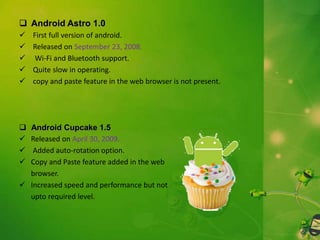
 Android Astro 1.0











First full version of android.
Released on September 23, 2008.
Wi-Fi and Bluetooth support.
Quite slow in operating.
copy and paste feature in the web browser is not present.

Android Cupcake 1.5
Released on April 30, 2009.
Added auto-rotation option.
Copy and Paste feature added in the web
browser.
 Increased speed and performance but not
upto required level.
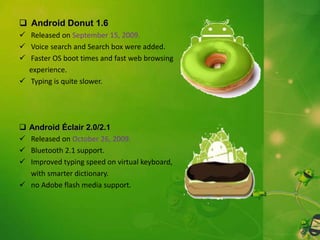
 Android Donut 1.6
 Released on September 15, 2009.
 Voice search and Search box were added.
 Faster OS boot times and fast web browsing
experience.
 Typing is quite slower.






Android Éclair 2.0/2.1
Released on October 26, 2009.
Bluetooth 2.1 support.
Improved typing speed on virtual keyboard,
with smarter dictionary.
 no Adobe flash media support.
 Android Froyo 2.2
 Released on May 20, 2010.
 Support for Adobe Flash 10.1
 Improved Application launcher with better browser
 No internet calling.

 Android Gingerbread 2.3
 Released on December 6, 2010.
 Updated User Interface with high
efficiency and speed
 Internet calling
 One touch word selection and copy/paste.
 New keyboard for faster word input.
 More successful version of Android than previous versions.
 not supports multi-core processors.
 Android Honeycomb 3.0





Released on February 22, 2011.
Support for multi-core processors
Ability to encrypt all user data.
This version of android is only available
for tablets.







Android Ice Cream Sandwich(ICS) 4.0
Released on November 14, 2011.
Virtual button in the UI.
A new typeface family for the UI, Roboto.
Ability to shut down apps that are using data in the background.





Android JellyBean 4.1
Released on June 27, 2012.
Latest version of Android.
Smoother user interface.

 Android KitKat 4.4
 Released on 14 oct, 2013.
 Latest version of Android.
 Smoother user interface.
 There Is new icons
 You can add more than 5 home screens.
 Faster than old versions of android.
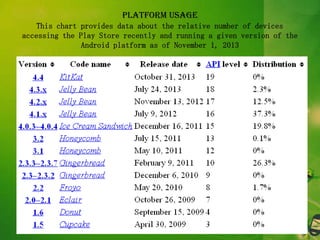
Platform usage
This chart provides data about the relative number of devices
accessing the Play Store recently and running a given version of the
Android platform as of November 1, 2013

•
Android Usage on other devices
=============================
•

The open and customizable nature of Android allows it to be used on other
electronics a side from smartphones and tablets, including laptops
and netbooks, smartbooks smart TVs (Google TV) and cameras (Nikon
Coolpix S800c and Galaxy Camera).

•

In addition, the Android operating system has seen applications on smart
glasses (Google Glass), wristwatches,headphones,car CD and DVD
players, mirrors.

•

Another variety of devices are those that, while not
running Android themselves, have been designed to
interface with and act as a companion to an
Android device, such as Sony's Smart Watch line or
Samsung's Galaxy Gear.

The Sony’s Android Smart Watch
Advantages
============
• Multitasking : User can perform multitask at time for ex- user can
browse a internet with listening song .
•

Ease of Notification: Any sms ,email or other information will be shown
on top notification bar , user can know all activity of phone .

•

Easy Access Thousand of Application: via Google Play store or other
application user can install thousands of App which is compare to
another OS is a very great feature.

•

Google Drive: user can store all information about their phone like
contact detail , data , and IMEI information .
LIMITATIONS
============
 Making source code available to everyone inevitably invites the
attention of hackers.
 Android operating system uses more amount of battery as
compared to normal mobile phones.
 Advertising- while downloading free application from Android
Playstore it display advertisement on the bottom of App Window .
 As we call Android is world of applications we continuously need
to connected with the internet which is not possible for all the
users.


Android is now stepping up in next level of mobile feature, internet.



There are chances of Android Mobile sales becomes more then
Another brands like iPhone ,windows etc.



Google may launch another version of android that starts L because
Google is launching all the android versions in the alphabetical
order.



Android is widely used operating system in world so there have lots
of opportunity in the various field like Marketing, Selling, software
development, manufacturing etc
•

Thank Yew 
 Web Sites
•
•
•
•
•

Reference :
===========

https://Wikipedia.org
https://Android.com
www.labnol.org
www.Visionmobile.com
www.Techblog.com

 Books Reference
•
•

Android Technology
Know Android

 Work Distribution

 Offline Works like info from books is Done By Anil and Online
works like info from web By Rajesh .
 Slide Background and other Images Edited by PHOTOSHOP.

Android technology and Information with Presentation Project.

  • 1.
    Multimedia Presentation on Android Technology =================================== GroupMember:  Rajesh M. Gupta(SYIT-09)  Anil Gupta(SYIT-08) Submitted To, Mr. Gokul D. Chudhary
  • 2.
    INDEX ======              INTRODUCTION FEATURES MARKET SHARE TABLETS Memory management/Hardware requirements Linux kernel VERSIONS OF ANDROID Platform usage Android Usage on other dévies Advantages LIMITATIONS CONCLUSION AND FUTURE SCOPE Référence / Work Distribution
  • 3.
    Introduction ----------------------What Is Android? • Android is an Mobile operating system based on the Linux kernel Programmed in C (coré), C++, Java . • It was developed in Palo Alto, California. • Android was developed by the Andy Rubin, Rich Miner, Nick Sears and Chris White in 2003. • Android was purchased by the GOOGLE in AUGUST,2005 for 50 million $. • The first Android-powered phone was sold in October 2008. • As of September 3, 2013, 1 billion Android devices have been activated. • As of May 2013, 48 billion apps have been installed from the Google Play store. • Android is the world's most widely used Smartphone platform, overtaking Symbian in the fourth quarter of 2010.
  • 4.
    • Features ========== User gets millionsof applications that user can not get in any other mobile operating system. • Android supports advanced audio/video/still media formats such as MPEG-4, H.264, MP3, and AAC, AMR, JPEG, PNG, GIF. • Multi-touch, Multitasking, Screen capture, Video calling, Multiple language (46 languages)support, Java support. • Third-party apps available on Google Play and other app stores can extensively re-theme the homescreen, and even mimic the look of other operating systems, such as Windows Phone. • Internal hardware such as accelerometers, gyroscopes and proximity sensors are used by some applications to respond to additional user actions. • Android supports wireless communication using:    3G Networks 4G Networks 802.11 Wi-Fi Networks Bluetooth Connectivity
  • 5.
    • Market share ============== the Bythe fourth quarter of 2010 this had grown to 33% of the market, becoming top-selling Smartphone platform. • By the third quarter of 2012 Android had a 75% share of the global Smartphone market according to the research firm IDC. • In July 2011, Google said that 550,000 new Android devices were being activated every day. • In September 2012, 500 million devices had been activated with 1.3 million activations per day.
  • 6.
    Tablets ======== • initially Android tabletadoption was slow. One of the main causes was the chicken or the egg situation where consumers were hesitant to buy an Android tablet due to a lack of high quality tablet apps. • Furthermore, several Android tablets such as the Motorola Xoom were priced the same or higher than the iPad, which hurt sales. • This began to change in 2012 with the release of the affordable Nexus 7 and a push by Google for developers to write better tablet apps .
  • 7.
    Memory management Hardware requirements ============================ • Androiddevices are incorporating many optional hardware components, including still or video cameras, GPS, hardware orientation sensors, dedicated gaming controls, accelerometers, gyroscopes, proximity sensors, pressure sensors, thermometers and touch screens. • As of November 2013, current versions of Android require at least 512 MB of RAM and a 32-bit ARMv7, MIPS or x86 architecture processor, together with an OpenGL ES 2.0 compatible graphics processing unit (GPU). • In 2012 Intel processors began to appear on more mainstream Android platforms, such as phones. • Android manages the apps stored in memory automatically: when memory is low, the system will begin killing apps and processes that have been inactive for a while, in reverse order since they were last used (i.e. oldest first), Some third-party task killers are generally regarded as doing more harm than good.
  • 8.
    • Linux kernel ============== As ofNovember 2013, current Android versions consist of a kernel based on the Linux kernel version 3.x ,while Android versions older than 4.0 Ice Cream Sandwich were based on the Linux kernel 2.6.x
  • 9.
    VERSIONS OF ANDROID ==================  • • • AndroidBeta First Version of Android. The focus of Android beta is testing incorporating usability. Android beta will generally have many more problems on speed and performance.
  • 10.
     Android Astro1.0          First full version of android. Released on September 23, 2008. Wi-Fi and Bluetooth support. Quite slow in operating. copy and paste feature in the web browser is not present. Android Cupcake 1.5 Released on April 30, 2009. Added auto-rotation option. Copy and Paste feature added in the web browser.  Increased speed and performance but not upto required level.
  • 11.
     Android Donut1.6  Released on September 15, 2009.  Voice search and Search box were added.  Faster OS boot times and fast web browsing experience.  Typing is quite slower.     Android Éclair 2.0/2.1 Released on October 26, 2009. Bluetooth 2.1 support. Improved typing speed on virtual keyboard, with smarter dictionary.  no Adobe flash media support.
  • 12.
     Android Froyo2.2  Released on May 20, 2010.  Support for Adobe Flash 10.1  Improved Application launcher with better browser  No internet calling.  Android Gingerbread 2.3  Released on December 6, 2010.  Updated User Interface with high efficiency and speed  Internet calling  One touch word selection and copy/paste.  New keyboard for faster word input.  More successful version of Android than previous versions.  not supports multi-core processors.
  • 13.
     Android Honeycomb3.0     Released on February 22, 2011. Support for multi-core processors Ability to encrypt all user data. This version of android is only available for tablets.      Android Ice Cream Sandwich(ICS) 4.0 Released on November 14, 2011. Virtual button in the UI. A new typeface family for the UI, Roboto. Ability to shut down apps that are using data in the background.
  • 14.
        Android JellyBean 4.1 Releasedon June 27, 2012. Latest version of Android. Smoother user interface.  Android KitKat 4.4  Released on 14 oct, 2013.  Latest version of Android.  Smoother user interface.  There Is new icons  You can add more than 5 home screens.  Faster than old versions of android.
  • 15.
    Platform usage This chartprovides data about the relative number of devices accessing the Play Store recently and running a given version of the Android platform as of November 1, 2013 •
  • 16.
    Android Usage onother devices ============================= • The open and customizable nature of Android allows it to be used on other electronics a side from smartphones and tablets, including laptops and netbooks, smartbooks smart TVs (Google TV) and cameras (Nikon Coolpix S800c and Galaxy Camera). • In addition, the Android operating system has seen applications on smart glasses (Google Glass), wristwatches,headphones,car CD and DVD players, mirrors. • Another variety of devices are those that, while not running Android themselves, have been designed to interface with and act as a companion to an Android device, such as Sony's Smart Watch line or Samsung's Galaxy Gear. The Sony’s Android Smart Watch
  • 17.
    Advantages ============ • Multitasking :User can perform multitask at time for ex- user can browse a internet with listening song . • Ease of Notification: Any sms ,email or other information will be shown on top notification bar , user can know all activity of phone . • Easy Access Thousand of Application: via Google Play store or other application user can install thousands of App which is compare to another OS is a very great feature. • Google Drive: user can store all information about their phone like contact detail , data , and IMEI information .
  • 18.
    LIMITATIONS ============  Making sourcecode available to everyone inevitably invites the attention of hackers.  Android operating system uses more amount of battery as compared to normal mobile phones.  Advertising- while downloading free application from Android Playstore it display advertisement on the bottom of App Window .  As we call Android is world of applications we continuously need to connected with the internet which is not possible for all the users.
  • 19.
     Android is nowstepping up in next level of mobile feature, internet.  There are chances of Android Mobile sales becomes more then Another brands like iPhone ,windows etc.  Google may launch another version of android that starts L because Google is launching all the android versions in the alphabetical order.  Android is widely used operating system in world so there have lots of opportunity in the various field like Marketing, Selling, software development, manufacturing etc
  • 20.
  • 21.
     Web Sites • • • • • Reference: =========== https://Wikipedia.org https://Android.com www.labnol.org www.Visionmobile.com www.Techblog.com  Books Reference • • Android Technology Know Android  Work Distribution  Offline Works like info from books is Done By Anil and Online works like info from web By Rajesh .  Slide Background and other Images Edited by PHOTOSHOP.