Androgenesis,
Gynogenesis-
Induction
Team members:
46- Anitta
47- Anuj Sharma
48- Ashitha
49- Asiya N
50- Bhagyaleshmi
Kerala University of Fisheries and Ocean Studies,
Kochi, Kerala, India
TABLE OF CONTENTS
01
Chromosome
manipulation
02 Gynogenesis
03 Androgenesis
04 Applications
Chromosome manipulation
The changes in the number of chromosome sets are brought
out by the destruction of one set, as in egg or sperm cells, or
by the disruption of the metaphase spindle during
karyokinesis in either somatic or germinal cells.
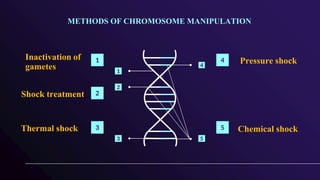
Inactivation of
gametes
Thermal shock
Pressure shock
Shock treatment
Chemical shock
1
2
3
4
5
1
2
3
4
5
METHODS OF CHROMOSOME MANIPULATION
Inactivation of gametes
1. Irradiation of spermatozoa with gamma
radiation, X-ray or U-V light or dimethyl sulphate
destroys the genetic material without inactivating
the spermatozoa.
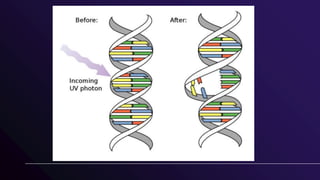
2. UV irradiation form pyrimidine dimers in DNA
leading to its genetic inactivation.
3. The optimum dose of UV varies with
spermatozoa concentration.
4. De-chromosomed spermatozoa activates the
egg followed by shock treatment (to prevent second
polar body release), and establishes XX condition.
Inactivation of gametes
5. To induce androgenesis, the maternal (egg)
genome is inactivated by irradiation and fertilized
with normal sperm.
6. Fish eggs - difficult to manipulate - large size.
Fish spermatozoa - easy to manipulate - small size.
7. Gynogenetic, androgenetic individuals -haploids
with low survival rate.
Diploidization by shock treatment improves the
survival rate.
Shock treatment
1. Ploidy induction - multiplication of the
chromosome set during embryonic development,
by insemination, release of polar body and first-cell
division.
2. Manipulation is done by application of thermal
or temperature (cold and heat), pressure or
chemical shock.
3. Shocking of inseminated fish egg causes
depolymerization of tubulin polymers that form
microtubules essential for formation of spindle
apparatus.
Shock treatment
4. Shock treatment results in the inhibition of
spindle formation and aster movement.
5. When heat shock is applied shortly before first
cleavage, cytokinesis is inhibited and cause
zygotes to undergo two genomic replications with
only one cytoplasmic division.
6. This is necessary for diploidizing gynogenetic
and androgenetic offspring and in inducing
triploidy and tetraploidy.
Thermal shock
1. Cold shocks for cold water species (salmonids) -
0C
2. Cold shocks for warm water species (Common
carp, Tilapia and Indian major carps), 8-12C.
3. Heat shock for cold water fishes around
26-28C.
4. Heat shock for warm water fishes 39-42C
Pressure shock
1. Simple to administer.
2. Pressure range varies between 7000 to 9000
pascals (Psi).
3. The hydrostatic pressure is applied by French
Cell Press designed by mechanical engineering
method.
4. Less side effect than the thermal shock.
Chemical shock
1. Colchicine and cytochalasin-B disrupt cell
division and induce ploidy induction.
2. Anaesthetics such as nitrous oxide and Freon 22
induce triploidy. But the results are inconsistent
and unsatisfactory.
ANDROGENESIS
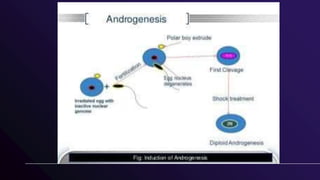
Results in all-paternal inheritance.
Involves genetic inactivation of the egg’s genome and
fertilization with haploid sperm (followed by diploidization)
or diploid sperm.
Method requires the suppression of the first mitotic cleavage.
Survival of the androgenotes is very low due to,
-irradiation damage suffered by eggs.
-the homozygous expression of the lethal gene.
-damage inflicted by thermal shock treatment to suppress
the first mitotic cleavage.
Induced in fish by fertilizing irradiated eggs (gamma or X-ray
or U-V ray) with normal spermatozoa.
U-V (254 nm) irradiation is easy, inexpensive, can be easily
set up under laboratory condition.
Diploid androgenetic individuals can then be produced by
various treatments (thermal, pressure or chemical shock) to
suppress the first cleavage division to yield a homozygous
diploid.
U-V (254 nm) irradiation is easy, inexpensive, can be easily
set up under laboratory condition.
Diploid androgenetic individuals can then be produced by
various treatments (thermal, pressure or chemical shock) to
suppress the first cleavage division to yield a homozygous
diploid.
It can be used to generate clonal lines.
It has the advantage of storing and regenerating lines from
cryopreserved sperm.
Androgenetic fishes were successfully produced only in about
a dozen economically important food fishes (e.g., common
carp, tilapia, rainbow trout and Siberian sturgeon).
Androgenetic tilapia can be useful for monosex fish culture.

GYNOGENESIS
It is a reproductive manipulation resulting in all-maternal
inheritance.
It involves egg activation by genetically inactivated
homologous or heterologous sperm and diploidization by
retention of second polar body (meiotic gynogenesis), or
suppression of the first mitotic cleavage (mitotic
gynogenesis).
The shocks destroy the aster formation or the microtubules of
the spindle and inhibit nuclear division. Thus, a diploid
embryo containing maternal genetic material alone can be
produced.
Gynogenesis is a natural form of reproduction in the
teleost, Mollienesia formosa.
Irradiation of spermatozoa
Gamma, UV radiation are used to inactivate sperm.
Gamma radiation has greater penetration and
helpful in the treatment of large quantities of sperm
at a time.
Residual chromosome fragments found in
gynogenetic offspring after fertilization with
gamma –irradiated sperm, reduce survival or cause
abnormalities therefore, in the gynogenetic
offspring, UV is a preferred method for sperm
chromosome inactivation.
Diploidization
The haploid embryo generated by gynogenesis dies
unless some special treatment is conducted, so
apparently, it is necessary for the embryo to
become diploid by doubling its chromosomes.
Polyploidization treatment can be performed by
inhibiting meiotic phase II after insemination with
sperm that has received a genetic inactivation
treatment.
Meiogynogenesis
Achieved by inhibiting the extrusion of the second
polar body.
The resulting offspring are homozygous at a locus
only if no recombination occurred.
Determination of the percentage of heterozygous
offspring helps to calculate the recombination
frequency.
Mitotic gynogenesis
Polyploidization can be caused by the inhibition of
cell division during the first cleavage.
The original haploid set of chromosomes during
meiotic phases I and II will be duplicated before
the first cleavage.
Pairs of chromosomes after the first cleavage
inhibition are homologous to each other
irrespective of crossing over.
Mitotic gynogenesis
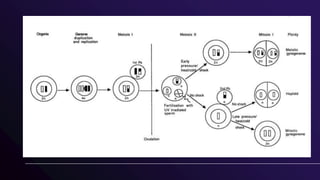
Mitotic gynogenesis results in fully homozygous
offspring since it is achieved by inhibiting the first
mitotic cleavage after duplication of the haploid
genome.
It has been achieved in zebra fish (Danio rerio),
medaka (Oryzias latipes), common carp (Cyprinus
carpio) Nile tilapia (Oreochromis niloticus) and
Indian catfish (Heteropneustes fossilis).
Application of gynogenesis
In female homogametic species, all-female
population is produced.
50 to 100% inbred individuals can be produced in a
single generation.
Inbred lines of fish can be crossed to produce
hybrid vigour or heterosis.
It has the ability to map genes relative to their
centromeres in fish after retention of the second
polar body.
Application of gynogenesis
Generates homozygous lines by applying a second
cycle of gynogenesis to the homozygous fish
produced initially by gynogenesis.
This is useful for the production of female or
monosex exotic species for release into the natural
environment without risk of reproduction.
Combining gynogenesis and sex reversal, it is
possible to produce males with female genotype.
THANK YOU

Androgenesis, Gynogenesis- Induction.pptx

  • 1.
  • 2.
    Team members: 46- Anitta 47-Anuj Sharma 48- Ashitha 49- Asiya N 50- Bhagyaleshmi Kerala University of Fisheries and Ocean Studies, Kochi, Kerala, India
  • 3.
    TABLE OF CONTENTS 01 Chromosome manipulation 02Gynogenesis 03 Androgenesis 04 Applications
  • 4.
    Chromosome manipulation The changesin the number of chromosome sets are brought out by the destruction of one set, as in egg or sperm cells, or by the disruption of the metaphase spindle during karyokinesis in either somatic or germinal cells.
  • 5.
    Inactivation of gametes Thermal shock Pressureshock Shock treatment Chemical shock 1 2 3 4 5 1 2 3 4 5 METHODS OF CHROMOSOME MANIPULATION
  • 6.
    Inactivation of gametes 1.Irradiation of spermatozoa with gamma radiation, X-ray or U-V light or dimethyl sulphate destroys the genetic material without inactivating the spermatozoa. 2. UV irradiation form pyrimidine dimers in DNA leading to its genetic inactivation. 3. The optimum dose of UV varies with spermatozoa concentration. 4. De-chromosomed spermatozoa activates the egg followed by shock treatment (to prevent second polar body release), and establishes XX condition.
  • 9.
    Inactivation of gametes 5.To induce androgenesis, the maternal (egg) genome is inactivated by irradiation and fertilized with normal sperm. 6. Fish eggs - difficult to manipulate - large size. Fish spermatozoa - easy to manipulate - small size. 7. Gynogenetic, androgenetic individuals -haploids with low survival rate. Diploidization by shock treatment improves the survival rate.
  • 10.
    Shock treatment 1. Ploidyinduction - multiplication of the chromosome set during embryonic development, by insemination, release of polar body and first-cell division. 2. Manipulation is done by application of thermal or temperature (cold and heat), pressure or chemical shock. 3. Shocking of inseminated fish egg causes depolymerization of tubulin polymers that form microtubules essential for formation of spindle apparatus.
  • 11.
    Shock treatment 4. Shocktreatment results in the inhibition of spindle formation and aster movement. 5. When heat shock is applied shortly before first cleavage, cytokinesis is inhibited and cause zygotes to undergo two genomic replications with only one cytoplasmic division. 6. This is necessary for diploidizing gynogenetic and androgenetic offspring and in inducing triploidy and tetraploidy.
  • 12.
    Thermal shock 1. Coldshocks for cold water species (salmonids) - 0C 2. Cold shocks for warm water species (Common carp, Tilapia and Indian major carps), 8-12C. 3. Heat shock for cold water fishes around 26-28C. 4. Heat shock for warm water fishes 39-42C
  • 13.
    Pressure shock 1. Simpleto administer. 2. Pressure range varies between 7000 to 9000 pascals (Psi). 3. The hydrostatic pressure is applied by French Cell Press designed by mechanical engineering method. 4. Less side effect than the thermal shock.
  • 14.
    Chemical shock 1. Colchicineand cytochalasin-B disrupt cell division and induce ploidy induction. 2. Anaesthetics such as nitrous oxide and Freon 22 induce triploidy. But the results are inconsistent and unsatisfactory.
  • 15.
  • 16.
    Results in all-paternalinheritance. Involves genetic inactivation of the egg’s genome and fertilization with haploid sperm (followed by diploidization) or diploid sperm. Method requires the suppression of the first mitotic cleavage.
  • 17.
    Survival of theandrogenotes is very low due to, -irradiation damage suffered by eggs. -the homozygous expression of the lethal gene. -damage inflicted by thermal shock treatment to suppress the first mitotic cleavage. Induced in fish by fertilizing irradiated eggs (gamma or X-ray or U-V ray) with normal spermatozoa. U-V (254 nm) irradiation is easy, inexpensive, can be easily set up under laboratory condition.
  • 18.
    Diploid androgenetic individualscan then be produced by various treatments (thermal, pressure or chemical shock) to suppress the first cleavage division to yield a homozygous diploid. U-V (254 nm) irradiation is easy, inexpensive, can be easily set up under laboratory condition. Diploid androgenetic individuals can then be produced by various treatments (thermal, pressure or chemical shock) to suppress the first cleavage division to yield a homozygous diploid.
  • 19.
    It can beused to generate clonal lines. It has the advantage of storing and regenerating lines from cryopreserved sperm. Androgenetic fishes were successfully produced only in about a dozen economically important food fishes (e.g., common carp, tilapia, rainbow trout and Siberian sturgeon). Androgenetic tilapia can be useful for monosex fish culture.
  • 21.
  • 22.
    It is areproductive manipulation resulting in all-maternal inheritance. It involves egg activation by genetically inactivated homologous or heterologous sperm and diploidization by retention of second polar body (meiotic gynogenesis), or suppression of the first mitotic cleavage (mitotic gynogenesis).
  • 23.
    The shocks destroythe aster formation or the microtubules of the spindle and inhibit nuclear division. Thus, a diploid embryo containing maternal genetic material alone can be produced. Gynogenesis is a natural form of reproduction in the teleost, Mollienesia formosa.
  • 24.
    Irradiation of spermatozoa Gamma,UV radiation are used to inactivate sperm. Gamma radiation has greater penetration and helpful in the treatment of large quantities of sperm at a time. Residual chromosome fragments found in gynogenetic offspring after fertilization with gamma –irradiated sperm, reduce survival or cause abnormalities therefore, in the gynogenetic offspring, UV is a preferred method for sperm chromosome inactivation.
  • 25.
    Diploidization The haploid embryogenerated by gynogenesis dies unless some special treatment is conducted, so apparently, it is necessary for the embryo to become diploid by doubling its chromosomes. Polyploidization treatment can be performed by inhibiting meiotic phase II after insemination with sperm that has received a genetic inactivation treatment.
  • 26.
    Meiogynogenesis Achieved by inhibitingthe extrusion of the second polar body. The resulting offspring are homozygous at a locus only if no recombination occurred. Determination of the percentage of heterozygous offspring helps to calculate the recombination frequency.
  • 27.
    Mitotic gynogenesis Polyploidization canbe caused by the inhibition of cell division during the first cleavage. The original haploid set of chromosomes during meiotic phases I and II will be duplicated before the first cleavage. Pairs of chromosomes after the first cleavage inhibition are homologous to each other irrespective of crossing over.
  • 28.
    Mitotic gynogenesis Mitotic gynogenesisresults in fully homozygous offspring since it is achieved by inhibiting the first mitotic cleavage after duplication of the haploid genome. It has been achieved in zebra fish (Danio rerio), medaka (Oryzias latipes), common carp (Cyprinus carpio) Nile tilapia (Oreochromis niloticus) and Indian catfish (Heteropneustes fossilis).
  • 30.
    Application of gynogenesis Infemale homogametic species, all-female population is produced. 50 to 100% inbred individuals can be produced in a single generation. Inbred lines of fish can be crossed to produce hybrid vigour or heterosis. It has the ability to map genes relative to their centromeres in fish after retention of the second polar body.
  • 31.
    Application of gynogenesis Generateshomozygous lines by applying a second cycle of gynogenesis to the homozygous fish produced initially by gynogenesis. This is useful for the production of female or monosex exotic species for release into the natural environment without risk of reproduction. Combining gynogenesis and sex reversal, it is possible to produce males with female genotype.
  • 32.