AQU2203
 Teknik Pembiakbakaan Ikan

              LECTURE 2
TYPES OF FISH BREEDING TECHNIQUES
         IN FISH PRODUCTION


 © Dr. Shahreza, FPAI, UMT
AQU2203 Teknik Pembiakbakaan Ikan                       2


                                    Lecture 1
  TYPES OF FISH BREEDING TECHNIQUES
          IN FISH PRODUCTION

       Objective :

       3)To expose students to the different types of
       breeding for stock improvement

       5)To develop understanding about fish breeding
       techniques in fish production.


      © Dr. Shahreza, FPAI, UMT
AQU2203 Teknik Pembiakbakaan Ikan   3


       Introduction
       Types of Breeding
       Crossbreeding
       Hybridization
       Monosex Culture
       Chromosome Manipulation


      © Dr. Shahreza, FPAI, UMT
AQU2203 Teknik Pembiakbakaan Ikan                               4


                                    Lecture 1
  TYPES OF FISH BREEDING TECHNIQUES
          IN FISH PRODUCTION

       Learning Outcome :

       At the end of lecture, students should be able to :

       Explain the breeding techniques in fish production

       Diferentiate the different breeding techniques in fish
       production

      © Dr. Shahreza, FPAI, UMT
AQU2203 Teknik Pembiakbakaan Ikan       5


 IMPROVEMENTS IN AQUACULTURE
• IMPROVEMENT IN REPRODUCTION
• IMPROVEMENT IN GROWTH AND NUTRITION
• IMPROVEMENT IN HEALTH
• IMPROVEMENT IN QUALITY AND VALUE
• CONSERVATION OF GENETIC RESOURCES
• IMPROVEMENT IN BIOMEDICINAL VALUE

               INCREASE
             PRODUCTIVITY
      © Dr. Shahreza, FPAI, UMT
AQU2203 Teknik Pembiakbakaan Ikan                                               6


                                       Increase
                                      Productivity

Environmental Manipulation                               Genetic Manipulation


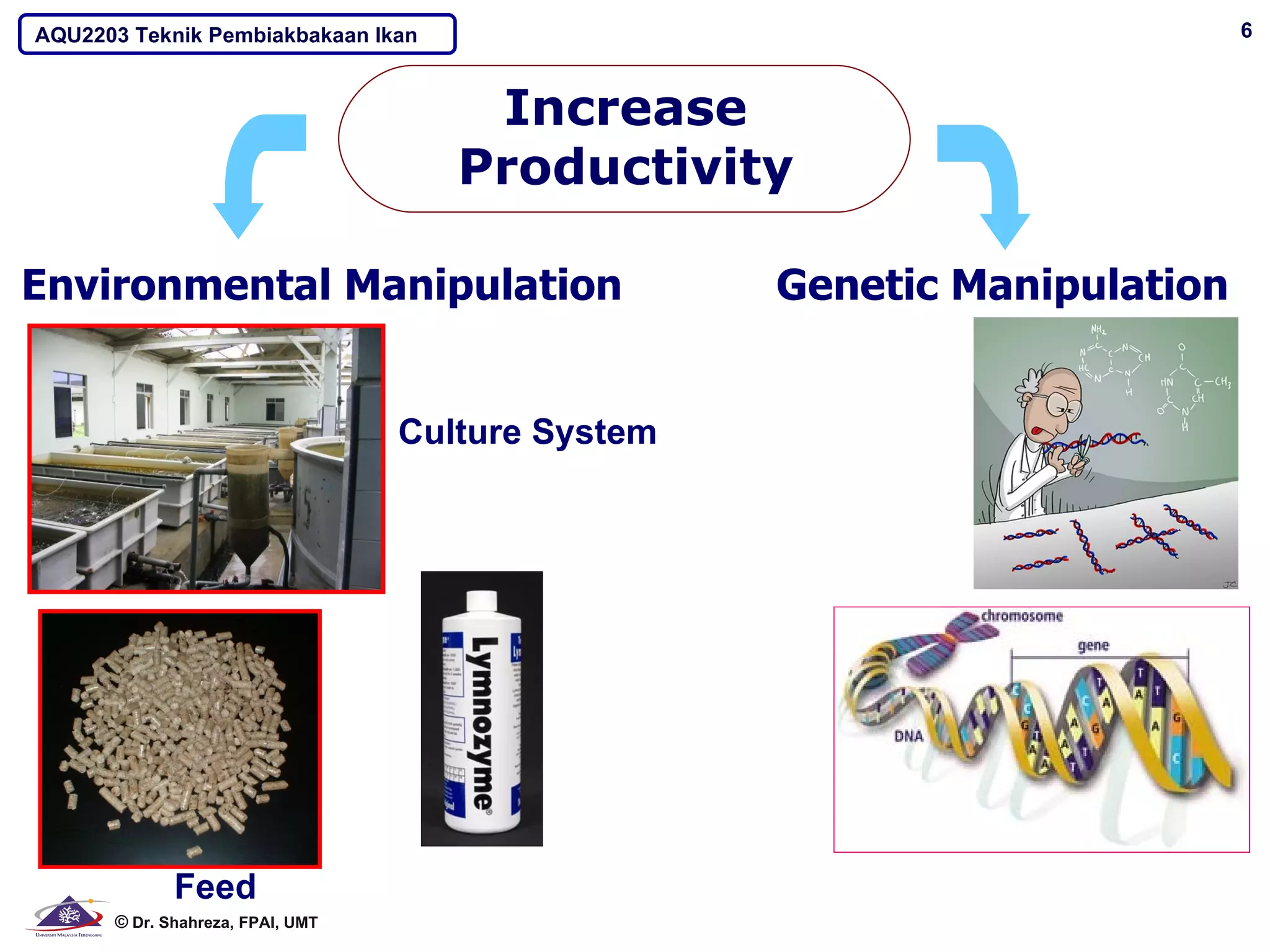
                                   Culture System


             Feed                 Additives – hormone,
      © Dr. Shahreza, FPAI, UMT   probiotic, chemicals
AQU2203 Teknik Pembiakbakaan Ikan                                 7


        GENETIC IMPROVEMENT
          IN FISH BREEDING
      A method to increase the quality or to obtain the desired
      traits using various selected breeding techniques


      Involves genetic manipulation in which the traits can be
      modified and inherit


      © Dr. Shahreza, FPAI, UMT
AQU2203 Teknik Pembiakbakaan Ikan                                  8


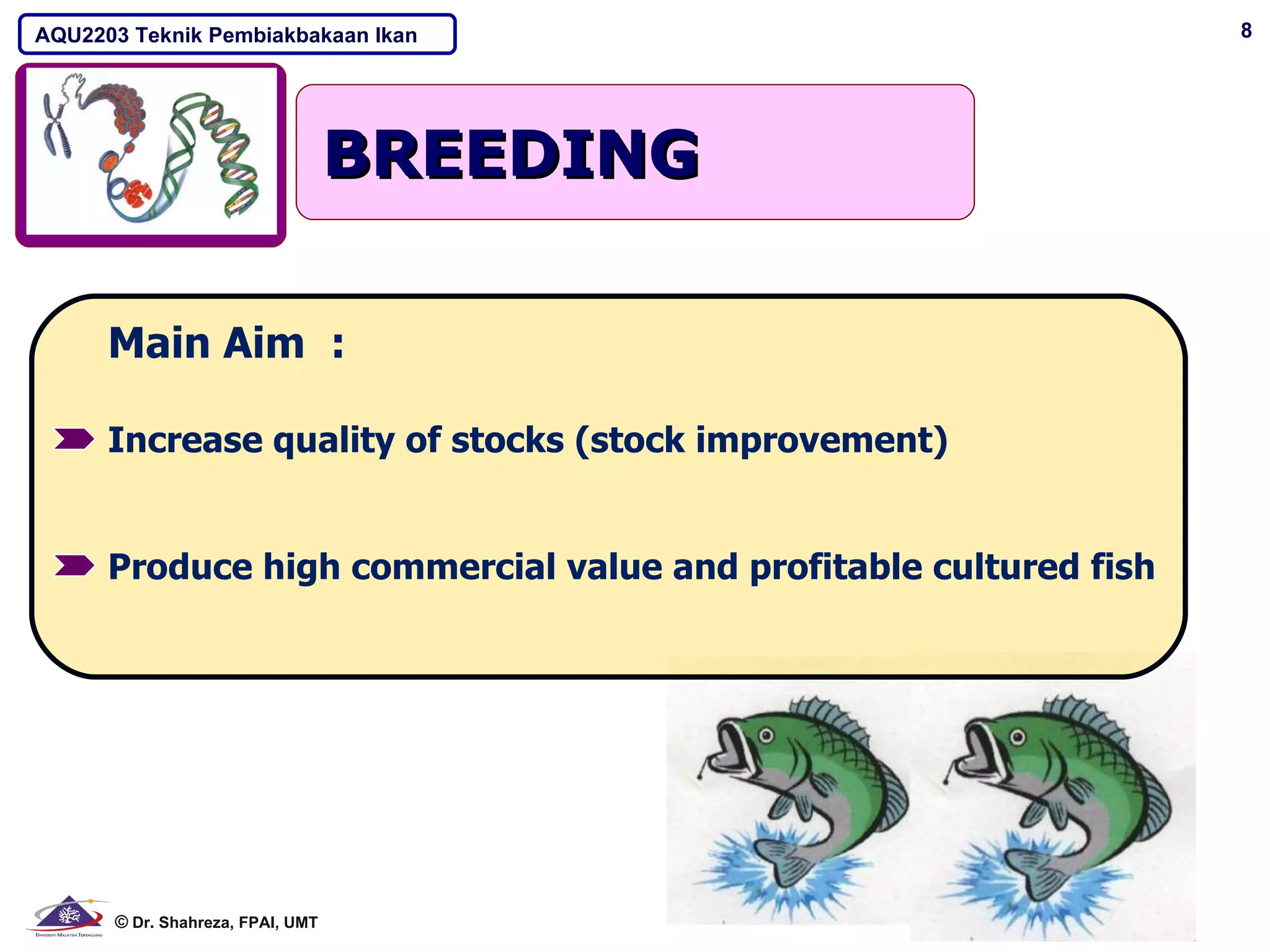
                                  BREEDING

      Main Aim :

      Increase quality of stocks (stock improvement)


      Produce high commercial value and profitable cultured fish


      © Dr. Shahreza, FPAI, UMT
AQU2203 Teknik Pembiakbakaan Ikan                                    9


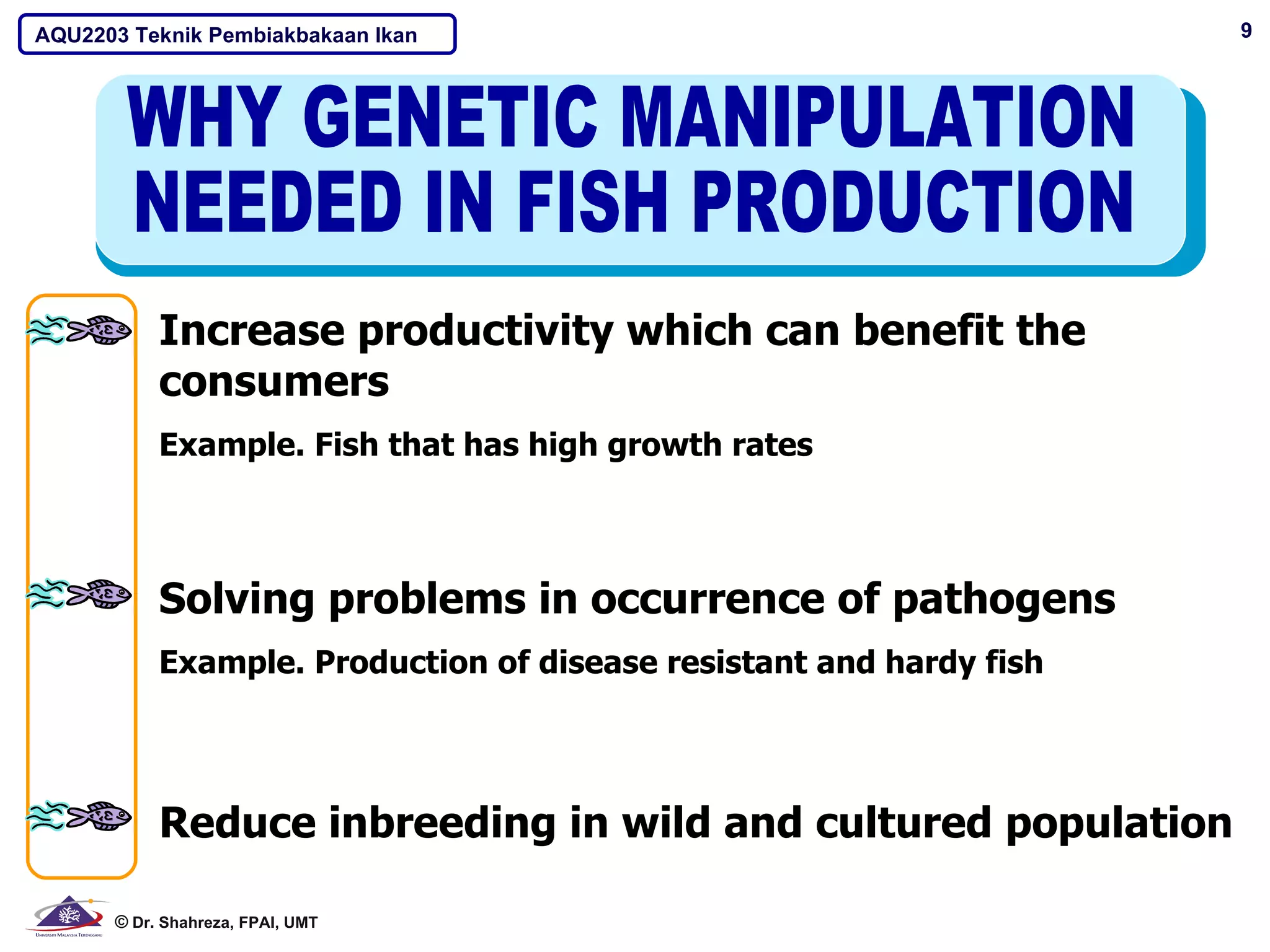
           Increase productivity which can benefit the
           consumers
           Example. Fish that has high growth rates


           Solving problems in occurrence of pathogens
           Example. Production of disease resistant and hardy fish


           Reduce inbreeding in wild and cultured population

      © Dr. Shahreza, FPAI, UMT
AQU2203 Teknik Pembiakbakaan Ikan                                           10


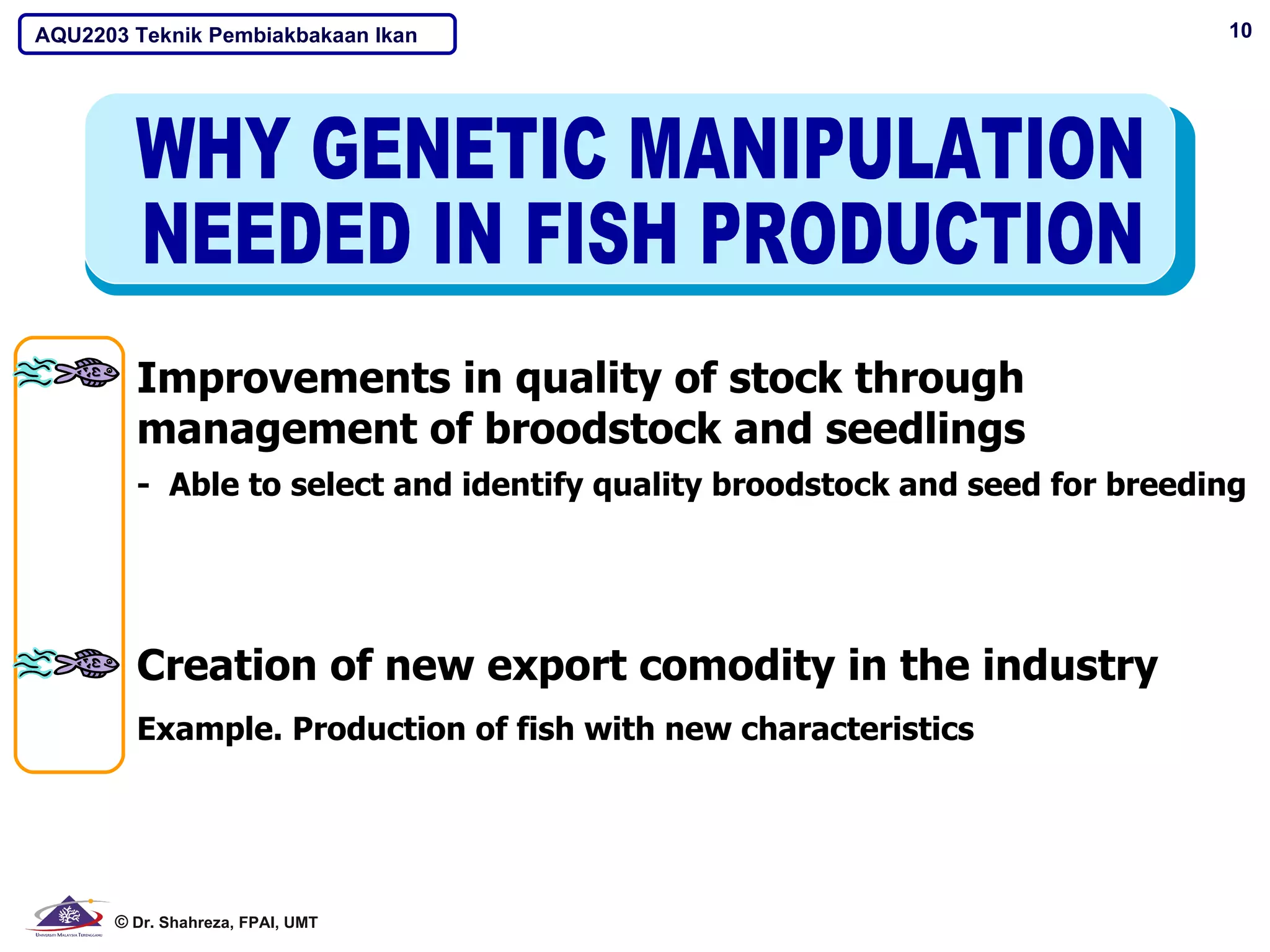
        Improvements in quality of stock through
        management of broodstock and seedlings
        - Able to select and identify quality broodstock and seed for breeding


        Creation of new export comodity in the industry
        Example. Production of fish with new characteristics


      © Dr. Shahreza, FPAI, UMT
AQU2203 Teknik Pembiakbakaan Ikan                             11


              BREEDING
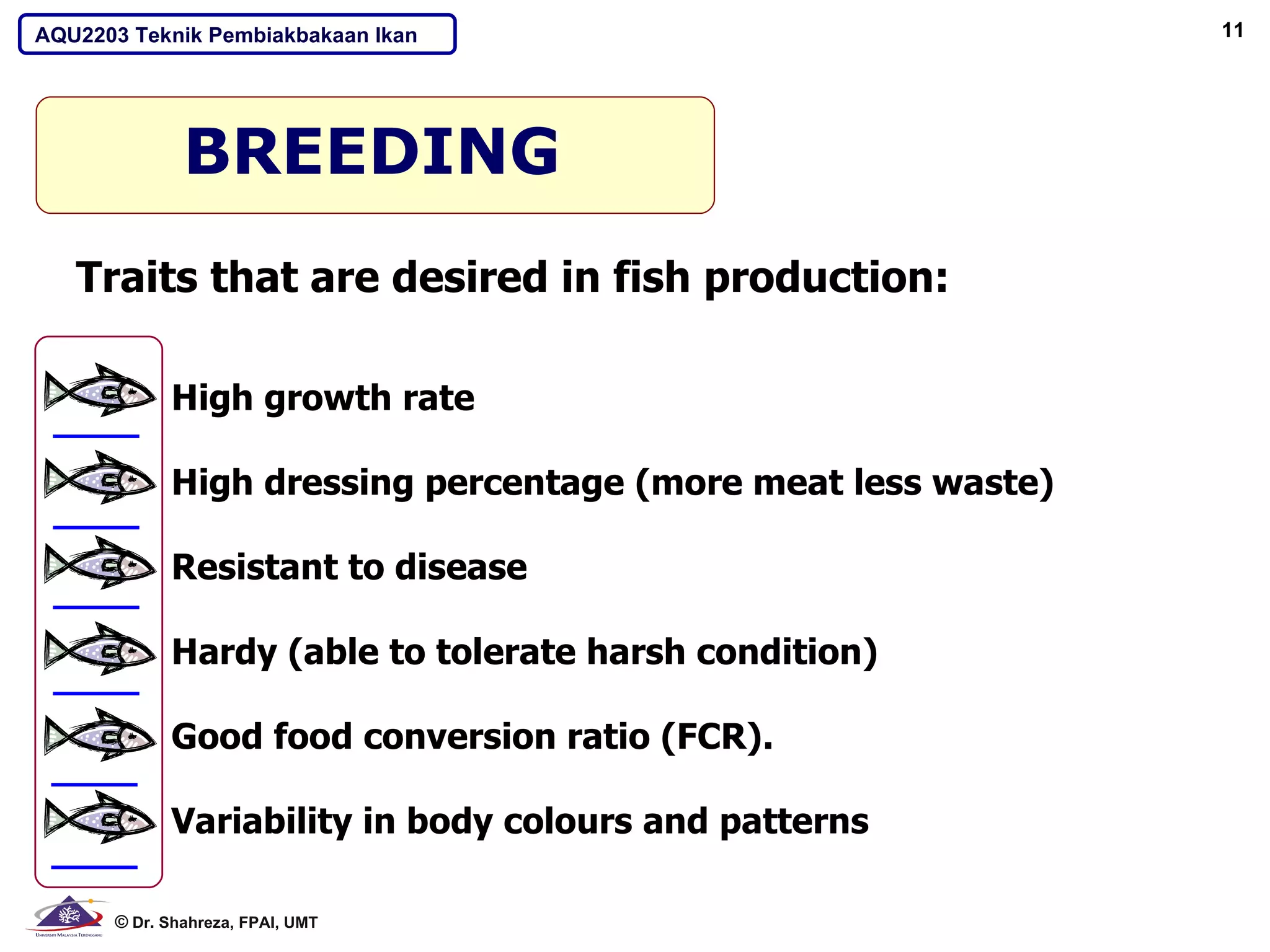
   Traits that are desired in fish production:

            High growth rate

            High dressing percentage (more meat less waste)

            Resistant to disease

            Hardy (able to tolerate harsh condition)

            Good food conversion ratio (FCR).

            Variability in body colours and patterns

      © Dr. Shahreza, FPAI, UMT
AQU2203 Teknik Pembiakbakaan Ikan                    12


              BREEDING
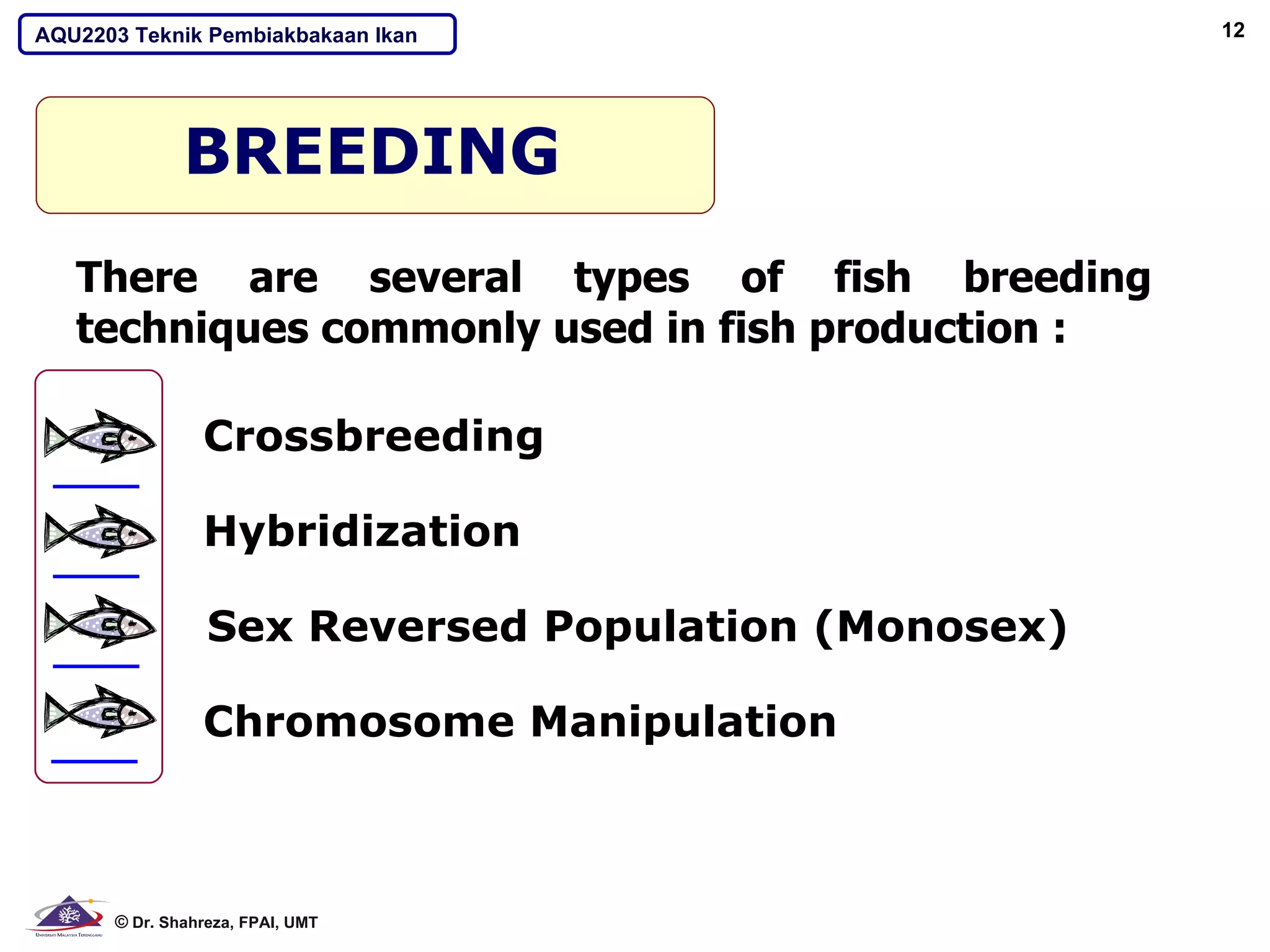
   There are several types of fish breeding
   techniques commonly used in fish production :

                Crossbreeding

                Hybridization

                 Sex Reversed Population (Monosex)

                Chromosome Manipulation


      © Dr. Shahreza, FPAI, UMT
13


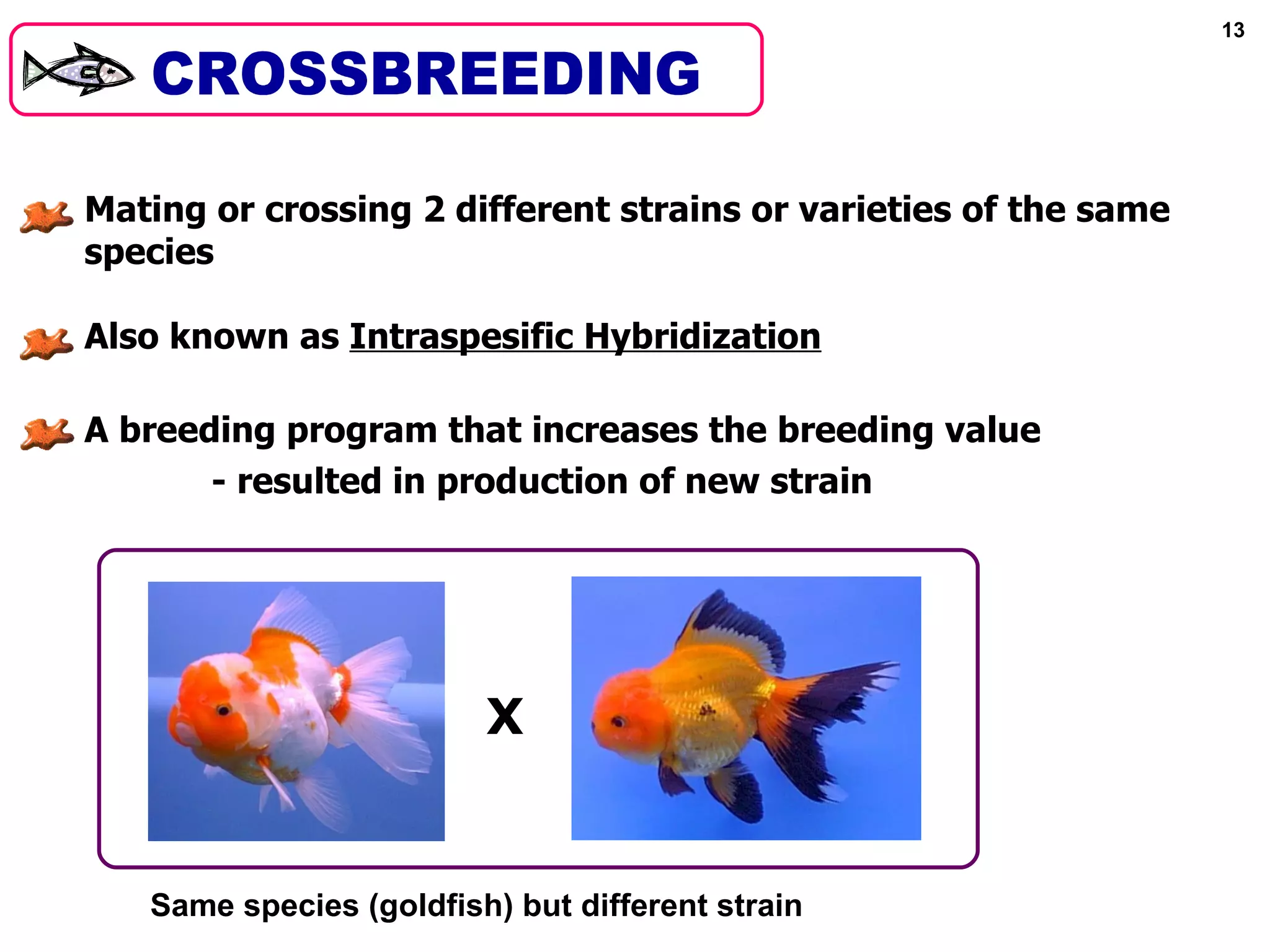
Mating or crossing 2 different strains or varieties of the same
species

Also known as Intraspesific Hybridization

A breeding program that increases the breeding value
       - resulted in production of new strain


                         X


   Same species (goldfish) but different strain
14


Application of Crossbreeding :

  Increase performance of the entire stocks

  Producing progeny that has intermediate performance
  obtained from the broodstocks

  Produce and increase the quality or performance of a new
  pure stock (pure breed).

  To exploit heterosis


 Heterosis : increase in performance of progeny that exceed the
             performance of the broodstock.
AQU2203 Teknik Pembiakbakaan Ikan                        15


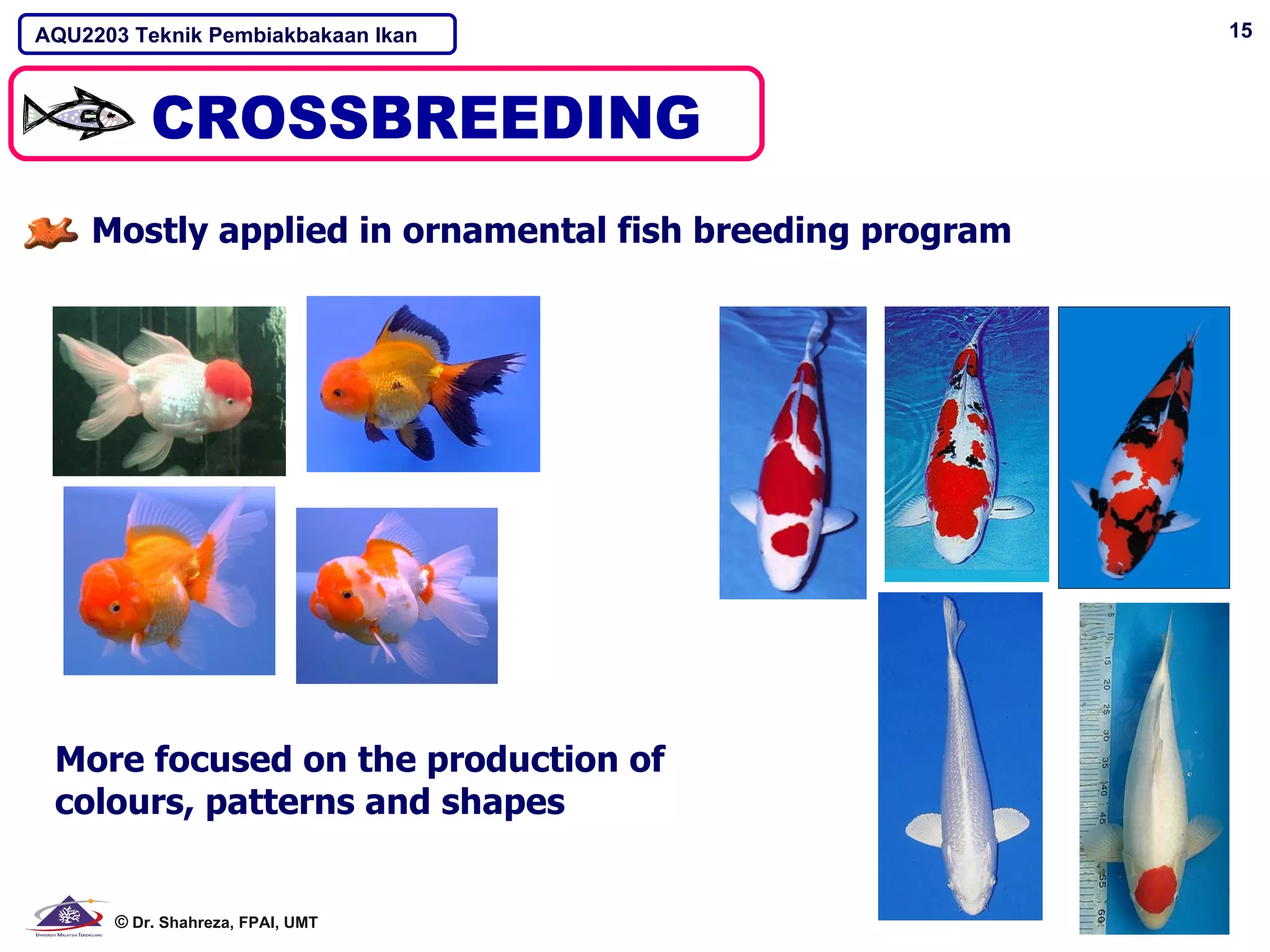
    Mostly applied in ornamental fish breeding program


 More focused on the production of
 colours, patterns and shapes


      © Dr. Shahreza, FPAI, UMT
AQU2203 Teknik Pembiakbakaan Ikan                                                       16


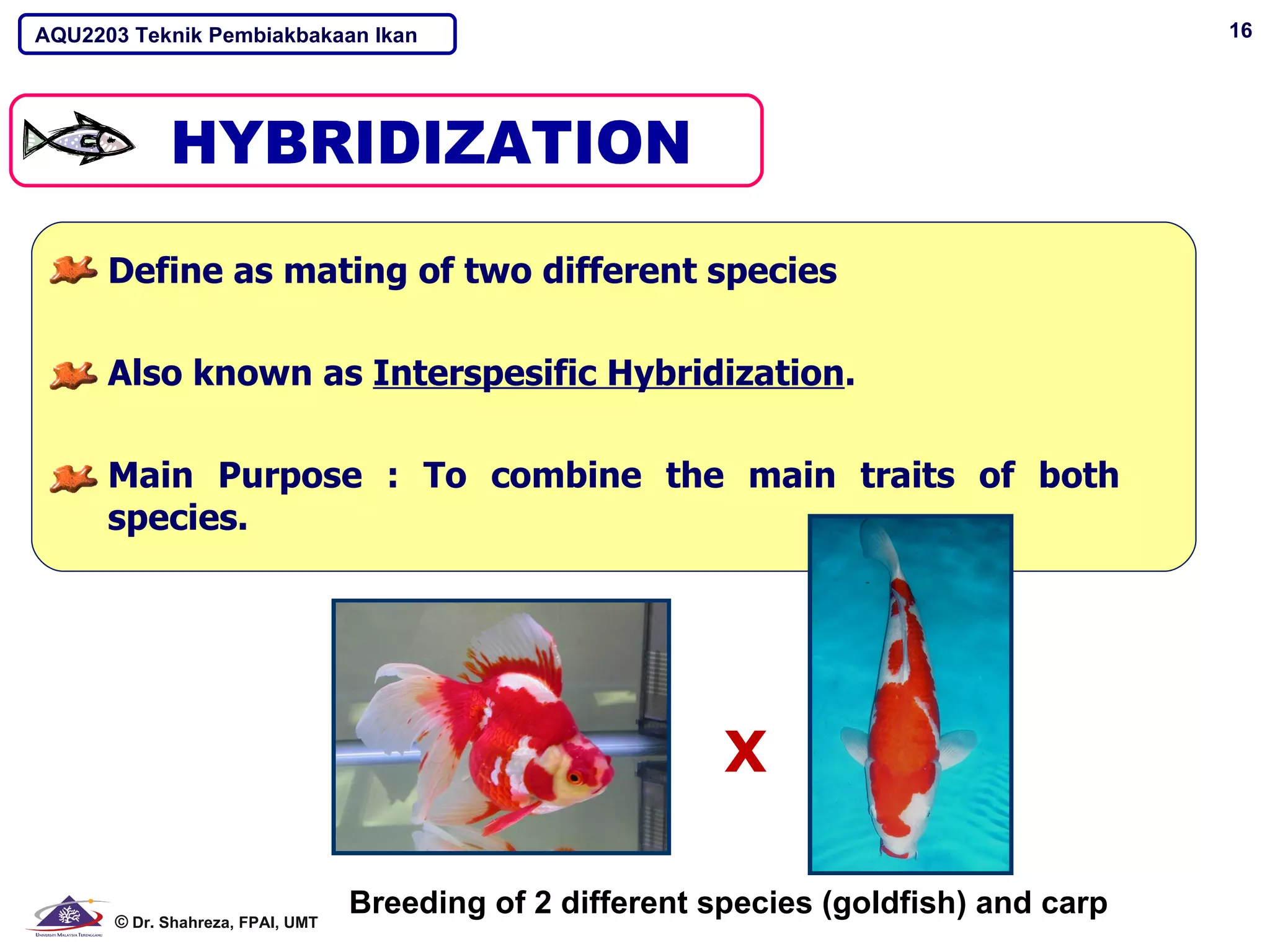
      Define as mating of two different species

      Also known as Interspesific Hybridization.

      Main Purpose : To combine the main traits of both
      species.


                                                           X

      © Dr. Shahreza, FPAI, UMT
                                  Breeding of 2 different species (goldfish) and carp
AQU2203 Teknik Pembiakbakaan Ikan                                17


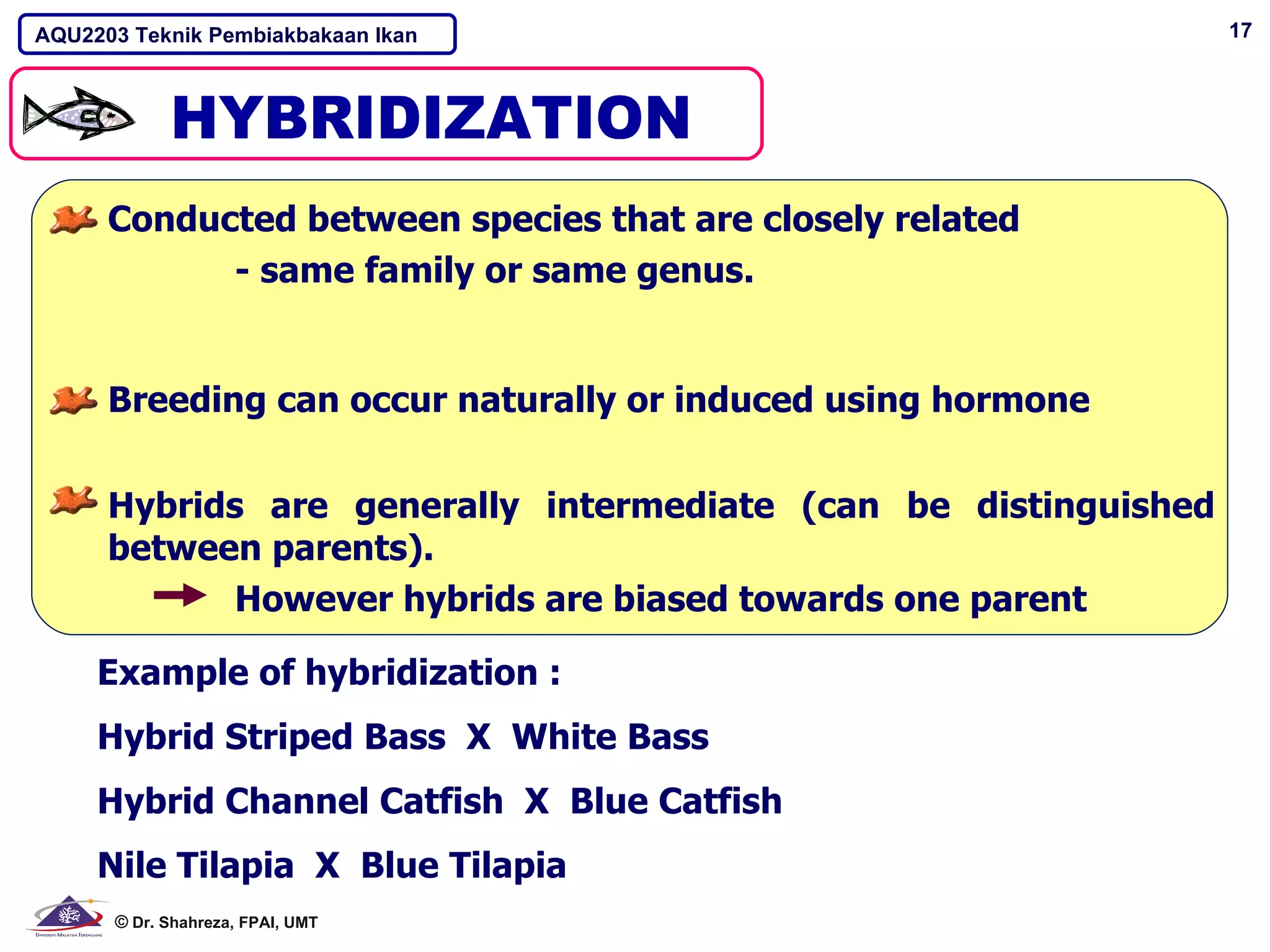
      Conducted between species that are closely related
            - same family or same genus.


      Breeding can occur naturally or induced using hormone


      Hybrids are generally intermediate (can be distinguished
      between parents).
             However hybrids are biased towards one parent

     Example of hybridization :
     Hybrid Striped Bass X White Bass
     Hybrid Channel Catfish X Blue Catfish
     Nile Tilapia X Blue Tilapia
      © Dr. Shahreza, FPAI, UMT
AQU2203 Teknik Pembiakbakaan Ikan                                  18


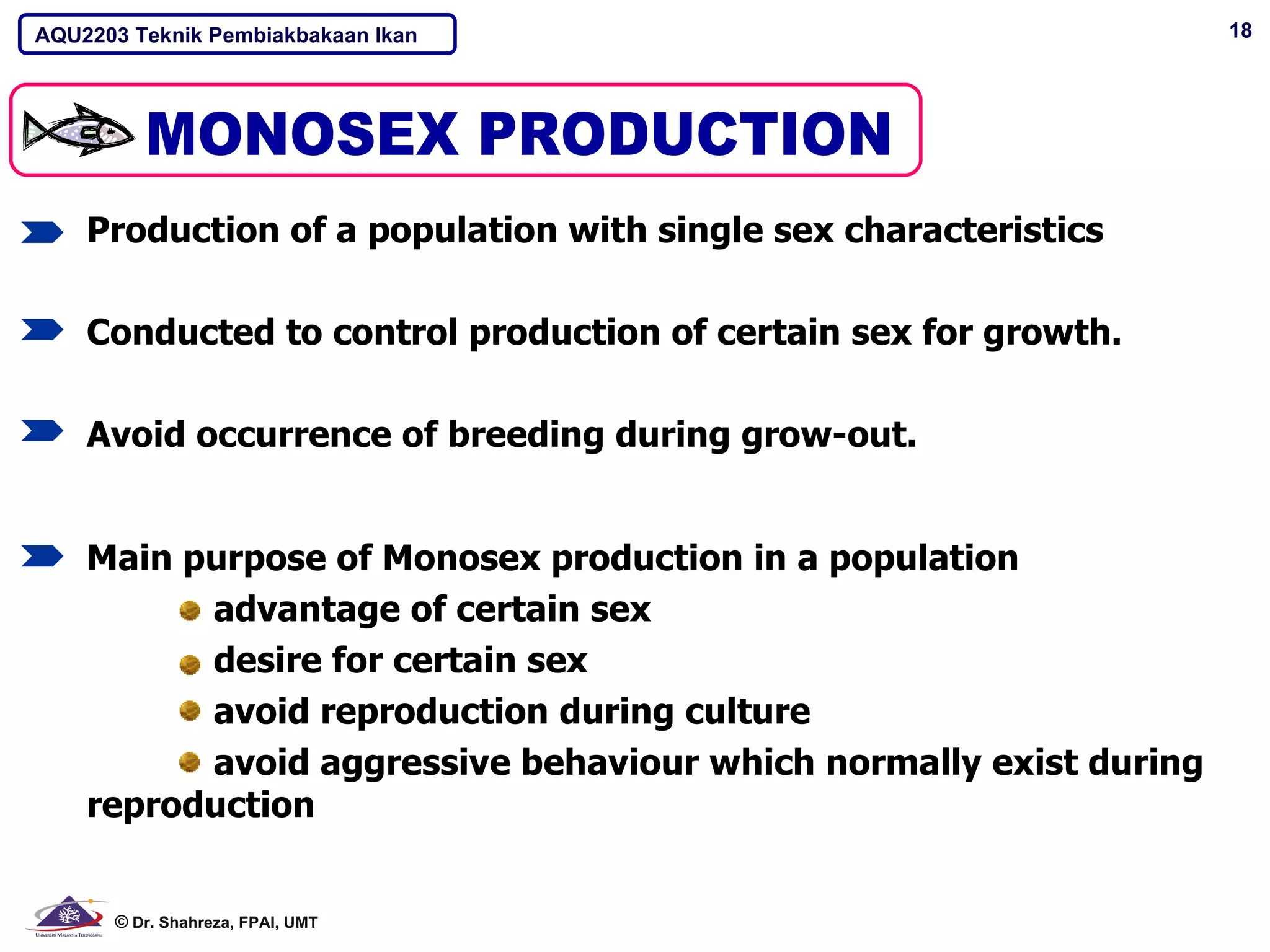
    Production of a population with single sex characteristics

    Conducted to control production of certain sex for growth.

    Avoid occurrence of breeding during grow-out.


    Main purpose of Monosex production in a population
          advantage of certain sex
          desire for certain sex
          avoid reproduction during culture
          avoid aggressive behaviour which normally exist during
    reproduction


      © Dr. Shahreza, FPAI, UMT
AQU2203 Teknik Pembiakbakaan Ikan                                  19


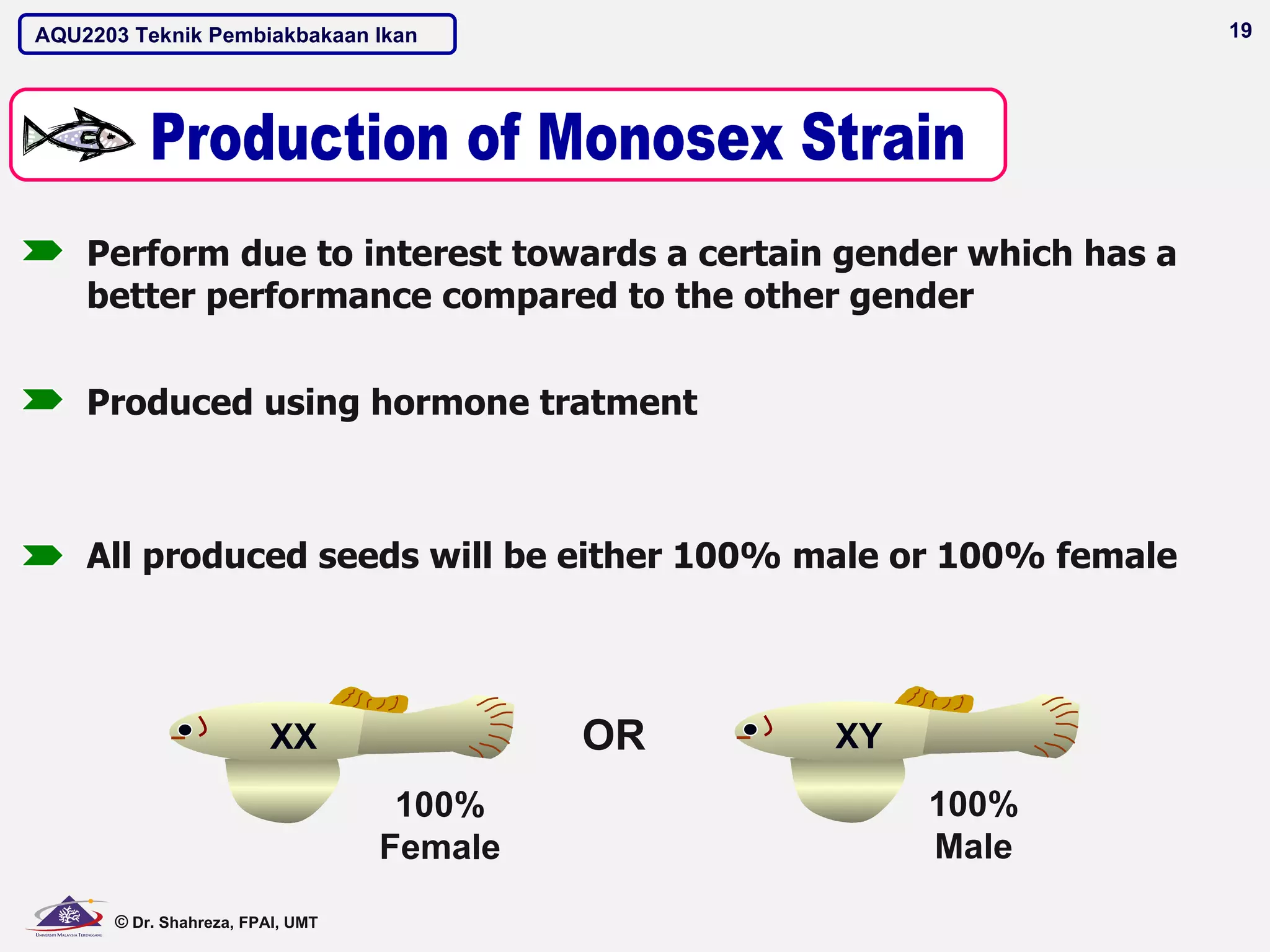
    Perform due to interest towards a certain gender which has a
    better performance compared to the other gender


    Produced using hormone tratment


    All produced seeds will be either 100% male or 100% female


                         XX                OR   XY
                                   100%              100%
                                  Female             Male
      © Dr. Shahreza, FPAI, UMT
AQU2203 Teknik Pembiakbakaan Ikan                                   20


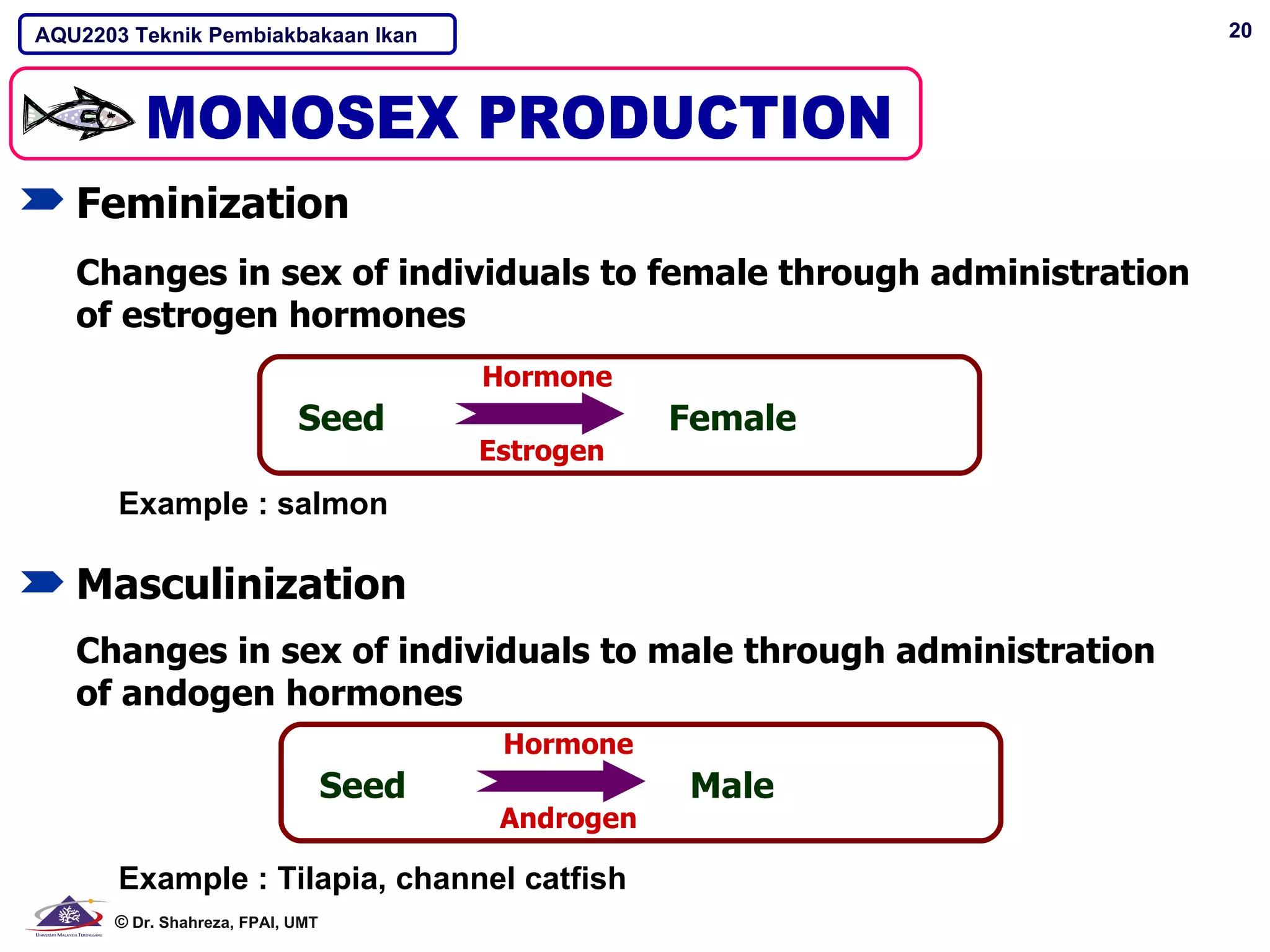
   Feminization
   Changes in sex of individuals to female through administration
   of estrogen hormones
                                         Hormone
                            Seed                     Female
                                         Estrogen
       Example : salmon

   Masculinization
   Changes in sex of individuals to male through administration
   of andogen hormones
                                          Hormone
                                  Seed                Male
                                          Androgen

       Example : Tilapia, channel catfish
      © Dr. Shahreza, FPAI, UMT
AQU2203 Teknik Pembiakbakaan Ikan                                   21


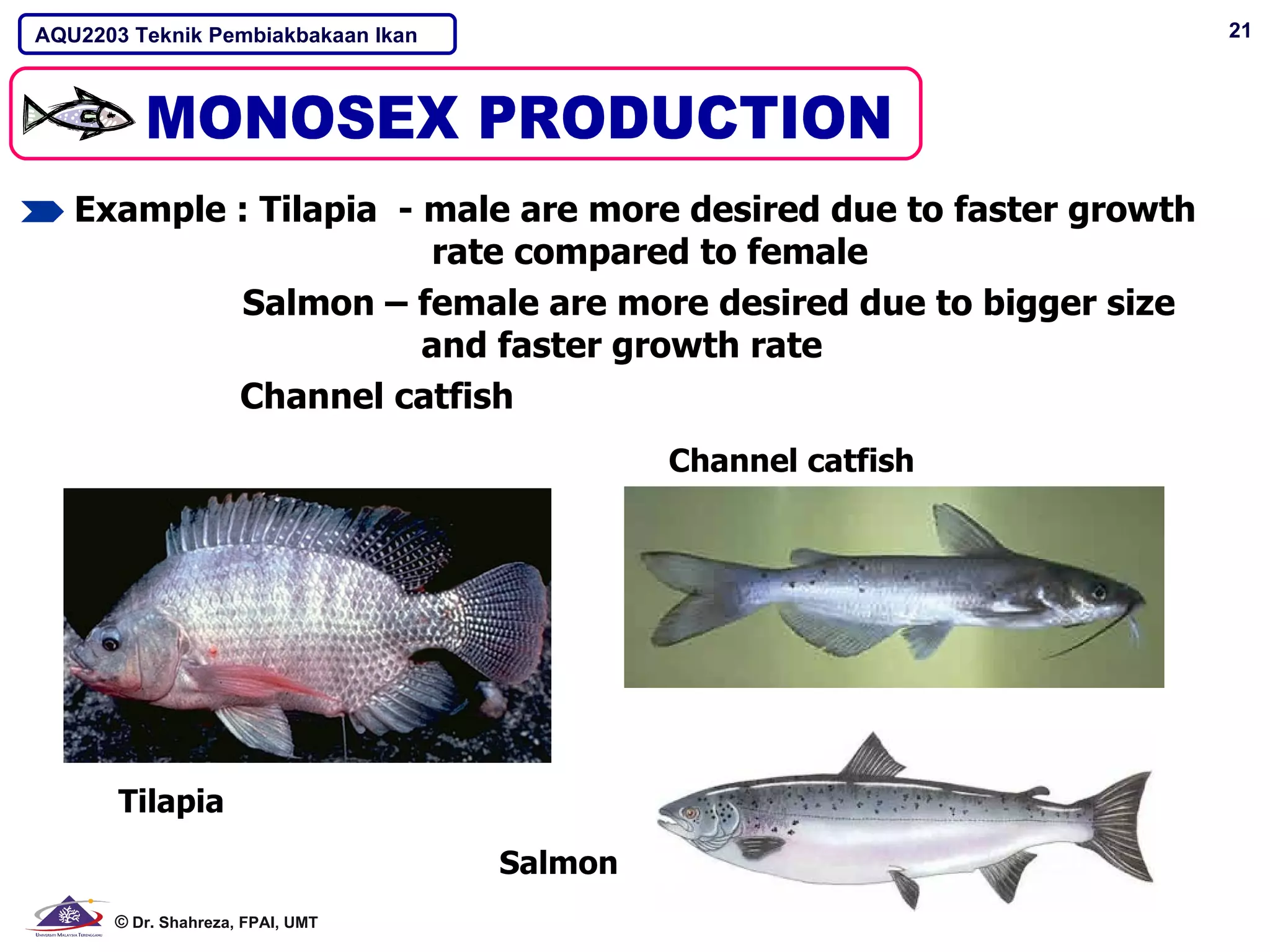
   Example : Tilapia - male are more desired due to faster growth
                       rate compared to female
           Salmon – female are more desired due to bigger size
                       and faster growth rate
           Channel catfish
                                             Channel catfish


       Tilapia
                                    Salmon
      © Dr. Shahreza, FPAI, UMT
36


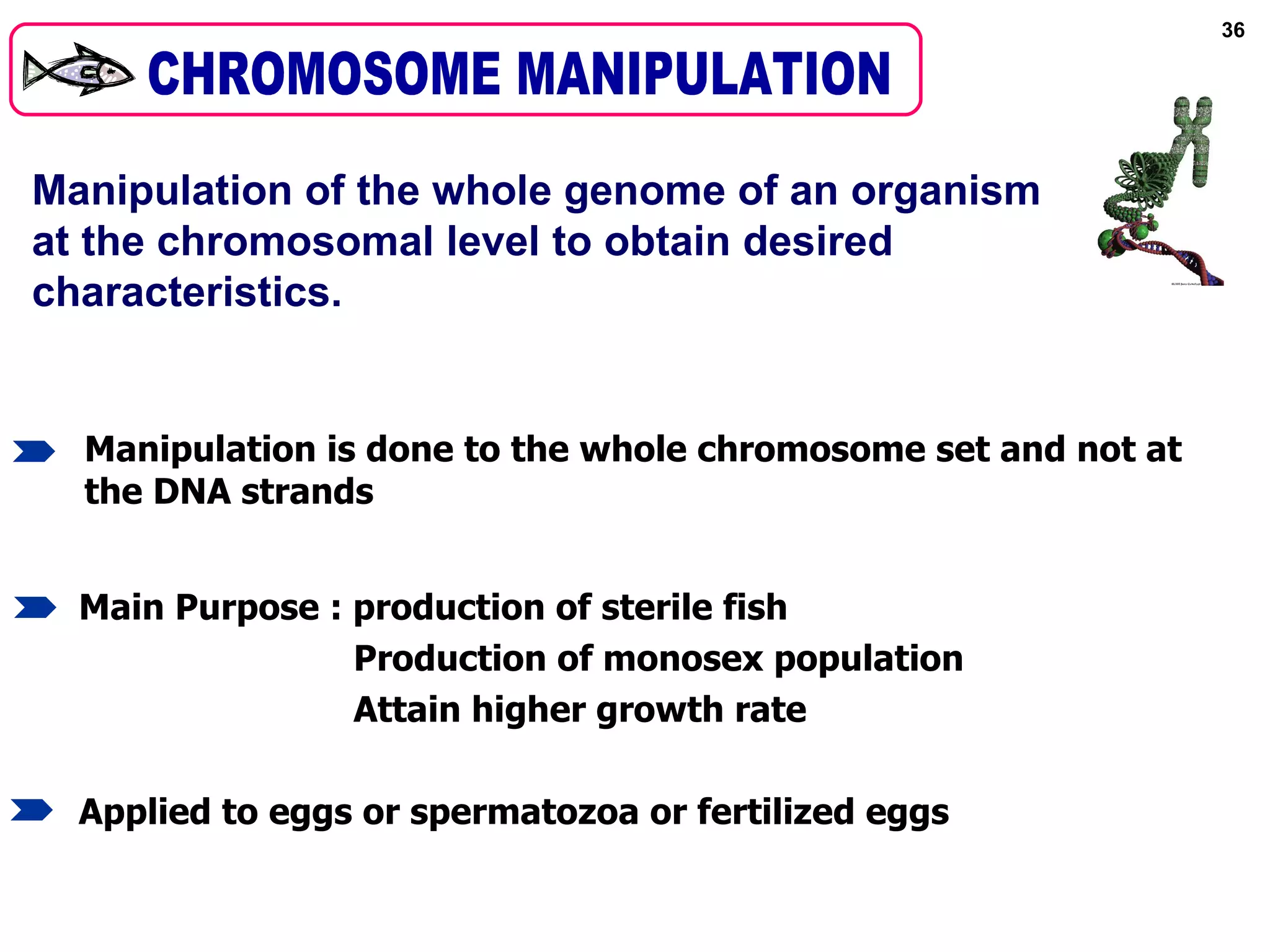
Manipulation of the whole genome of an organism
at the chromosomal level to obtain desired
characteristics.


  Manipulation is done to the whole chromosome set and not at
  the DNA strands


  Main Purpose : production of sterile fish
                 Production of monosex population
                 Attain higher growth rate

  Applied to eggs or spermatozoa or fertilized eggs
38


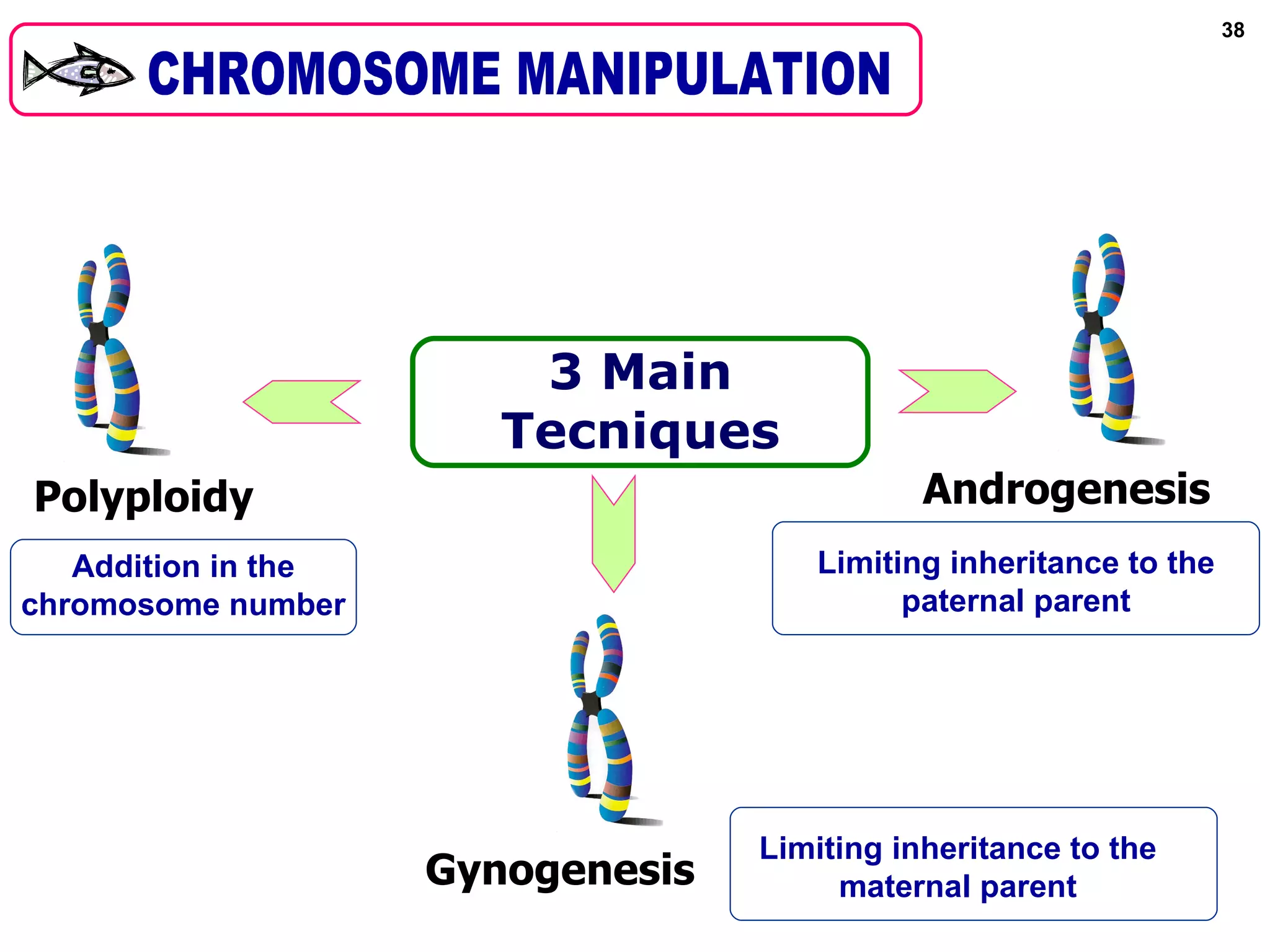
                         3 Main
                        Tecniques
Polyploidy                                    Androgenesis
   Addition in the                    Limiting inheritance to the
chromosome number                           paternal parent


                                   Limiting inheritance to the
                     Gynogenesis        maternal parent

Notes lecture 2 AQU2203

  • 1.
    AQU2203 Teknik PembiakbakaanIkan LECTURE 2 TYPES OF FISH BREEDING TECHNIQUES IN FISH PRODUCTION © Dr. Shahreza, FPAI, UMT
  • 2.
    AQU2203 Teknik PembiakbakaanIkan 2 Lecture 1 TYPES OF FISH BREEDING TECHNIQUES IN FISH PRODUCTION Objective : 3)To expose students to the different types of breeding for stock improvement 5)To develop understanding about fish breeding techniques in fish production. © Dr. Shahreza, FPAI, UMT
  • 3.
    AQU2203 Teknik PembiakbakaanIkan 3 Introduction Types of Breeding Crossbreeding Hybridization Monosex Culture Chromosome Manipulation © Dr. Shahreza, FPAI, UMT
  • 4.
    AQU2203 Teknik PembiakbakaanIkan 4 Lecture 1 TYPES OF FISH BREEDING TECHNIQUES IN FISH PRODUCTION Learning Outcome : At the end of lecture, students should be able to : Explain the breeding techniques in fish production Diferentiate the different breeding techniques in fish production © Dr. Shahreza, FPAI, UMT
  • 5.
    AQU2203 Teknik PembiakbakaanIkan 5 IMPROVEMENTS IN AQUACULTURE • IMPROVEMENT IN REPRODUCTION • IMPROVEMENT IN GROWTH AND NUTRITION • IMPROVEMENT IN HEALTH • IMPROVEMENT IN QUALITY AND VALUE • CONSERVATION OF GENETIC RESOURCES • IMPROVEMENT IN BIOMEDICINAL VALUE INCREASE PRODUCTIVITY © Dr. Shahreza, FPAI, UMT
  • 6.
    AQU2203 Teknik PembiakbakaanIkan 6 Increase Productivity Environmental Manipulation Genetic Manipulation Culture System Feed Additives – hormone, © Dr. Shahreza, FPAI, UMT probiotic, chemicals
  • 7.
    AQU2203 Teknik PembiakbakaanIkan 7 GENETIC IMPROVEMENT IN FISH BREEDING A method to increase the quality or to obtain the desired traits using various selected breeding techniques Involves genetic manipulation in which the traits can be modified and inherit © Dr. Shahreza, FPAI, UMT
  • 8.
    AQU2203 Teknik PembiakbakaanIkan 8 BREEDING Main Aim : Increase quality of stocks (stock improvement) Produce high commercial value and profitable cultured fish © Dr. Shahreza, FPAI, UMT
  • 9.
    AQU2203 Teknik PembiakbakaanIkan 9 Increase productivity which can benefit the consumers Example. Fish that has high growth rates Solving problems in occurrence of pathogens Example. Production of disease resistant and hardy fish Reduce inbreeding in wild and cultured population © Dr. Shahreza, FPAI, UMT
  • 10.
    AQU2203 Teknik PembiakbakaanIkan 10 Improvements in quality of stock through management of broodstock and seedlings - Able to select and identify quality broodstock and seed for breeding Creation of new export comodity in the industry Example. Production of fish with new characteristics © Dr. Shahreza, FPAI, UMT
  • 11.
    AQU2203 Teknik PembiakbakaanIkan 11 BREEDING Traits that are desired in fish production: High growth rate High dressing percentage (more meat less waste) Resistant to disease Hardy (able to tolerate harsh condition) Good food conversion ratio (FCR). Variability in body colours and patterns © Dr. Shahreza, FPAI, UMT
  • 12.
    AQU2203 Teknik PembiakbakaanIkan 12 BREEDING There are several types of fish breeding techniques commonly used in fish production : Crossbreeding Hybridization Sex Reversed Population (Monosex) Chromosome Manipulation © Dr. Shahreza, FPAI, UMT
  • 13.
    13 Mating or crossing2 different strains or varieties of the same species Also known as Intraspesific Hybridization A breeding program that increases the breeding value - resulted in production of new strain X Same species (goldfish) but different strain
  • 14.
    14 Application of Crossbreeding: Increase performance of the entire stocks Producing progeny that has intermediate performance obtained from the broodstocks Produce and increase the quality or performance of a new pure stock (pure breed). To exploit heterosis Heterosis : increase in performance of progeny that exceed the performance of the broodstock.
  • 15.
    AQU2203 Teknik PembiakbakaanIkan 15 Mostly applied in ornamental fish breeding program More focused on the production of colours, patterns and shapes © Dr. Shahreza, FPAI, UMT
  • 16.
    AQU2203 Teknik PembiakbakaanIkan 16 Define as mating of two different species Also known as Interspesific Hybridization. Main Purpose : To combine the main traits of both species. X © Dr. Shahreza, FPAI, UMT Breeding of 2 different species (goldfish) and carp
  • 17.
    AQU2203 Teknik PembiakbakaanIkan 17 Conducted between species that are closely related - same family or same genus. Breeding can occur naturally or induced using hormone Hybrids are generally intermediate (can be distinguished between parents). However hybrids are biased towards one parent Example of hybridization : Hybrid Striped Bass X White Bass Hybrid Channel Catfish X Blue Catfish Nile Tilapia X Blue Tilapia © Dr. Shahreza, FPAI, UMT
  • 18.
    AQU2203 Teknik PembiakbakaanIkan 18 Production of a population with single sex characteristics Conducted to control production of certain sex for growth. Avoid occurrence of breeding during grow-out. Main purpose of Monosex production in a population advantage of certain sex desire for certain sex avoid reproduction during culture avoid aggressive behaviour which normally exist during reproduction © Dr. Shahreza, FPAI, UMT
  • 19.
    AQU2203 Teknik PembiakbakaanIkan 19 Perform due to interest towards a certain gender which has a better performance compared to the other gender Produced using hormone tratment All produced seeds will be either 100% male or 100% female XX OR XY 100% 100% Female Male © Dr. Shahreza, FPAI, UMT
  • 20.
    AQU2203 Teknik PembiakbakaanIkan 20 Feminization Changes in sex of individuals to female through administration of estrogen hormones Hormone Seed Female Estrogen Example : salmon Masculinization Changes in sex of individuals to male through administration of andogen hormones Hormone Seed Male Androgen Example : Tilapia, channel catfish © Dr. Shahreza, FPAI, UMT
  • 21.
    AQU2203 Teknik PembiakbakaanIkan 21 Example : Tilapia - male are more desired due to faster growth rate compared to female Salmon – female are more desired due to bigger size and faster growth rate Channel catfish Channel catfish Tilapia Salmon © Dr. Shahreza, FPAI, UMT
  • 22.
    36 Manipulation of thewhole genome of an organism at the chromosomal level to obtain desired characteristics. Manipulation is done to the whole chromosome set and not at the DNA strands Main Purpose : production of sterile fish Production of monosex population Attain higher growth rate Applied to eggs or spermatozoa or fertilized eggs
  • 23.
    38 3 Main Tecniques Polyploidy Androgenesis Addition in the Limiting inheritance to the chromosome number paternal parent Limiting inheritance to the Gynogenesis maternal parent