Conics
           What are they? What do they look like? What are their equations?

  The Word Conic Comes from the shape of a cone and the four examples of “conic
  sections” come from taking certain slices out of the 3D cone and observing them
from a 2D perspective. This lets us see certain shapes that we can map onto a graph
                with x and y axis that we can translate and reflect.

      There are four conic Sections that can be taken from a cone and they are:


Ellipses                 Hyperbolae                 Circles              Parabolas


                    By Anderson McCammont 12JA
Ellipses
 An Ellipse is a shape that is similar to the appearance of an oval. It has the equation of:


                                x 2                y 2

                                a2                 b2
                                                                            y
In this example to the right hand side, we can see
that there are two values on the graph. The value of
a is 2 and the value of b is 1. We know this because
as it is “x squared over a squared”, a is paired with x                      1
and so the value that lies on the ellipse and on the x
axis is the value of a. The value of b is 1 because,                                           2
exactly the same as the reason previously stated,                                                  x
the value that lies on the ellipse and y axis is the
value of b.
Hyperbolae
A Hyperbola has a similar equation to that of an ellipse the only difference being that the
sign is a minus instead of an add. This effects the
Conic so that it looks like the image shown below.
                                             The value of a that is used in the
                 y                           hyperbolic equation is where the
                                             hyperbola itself crosses the x axis. This
                                             is a and –a. Using the equations of
                                             y=b/a x and y=-b/a x, you can sub in the
                                             equations of the lines of the asymptotes
                                             and then find b from that which finally
                                             lets you write the hyperbola in the form
                                       x     of an equation seen below.

                                              x 2                y 2

                                              a 2                b 2
Circles

                          (x-a)2+(y-b)2=r2

        Circles are very different to the other conics as their equation involves radii.
         In the case of the other conics, the values of a and b were determined by
    The location of the points of intersection, this time the value of a and b are given by
 Finding out the centre of the circle in the form (x,y). The x value in this co-ordinate is now
 The value of a and the y value is the value of b. R on the other hand is as stated earlier the
                       value of the radius, squared. Ill give an example:

                                    The centre of a circle is:

            (3,4) with radius 5, write this in the form of the equation of a circle.
Using the equation setup and the information given, we can rewrite the data as:

                               (x-3) 2 + (y-4) 2 =52
        This finally becomes: (x-3) 2 + (y-4) 2 =25
Parabolas
ax 2+bx+c=0
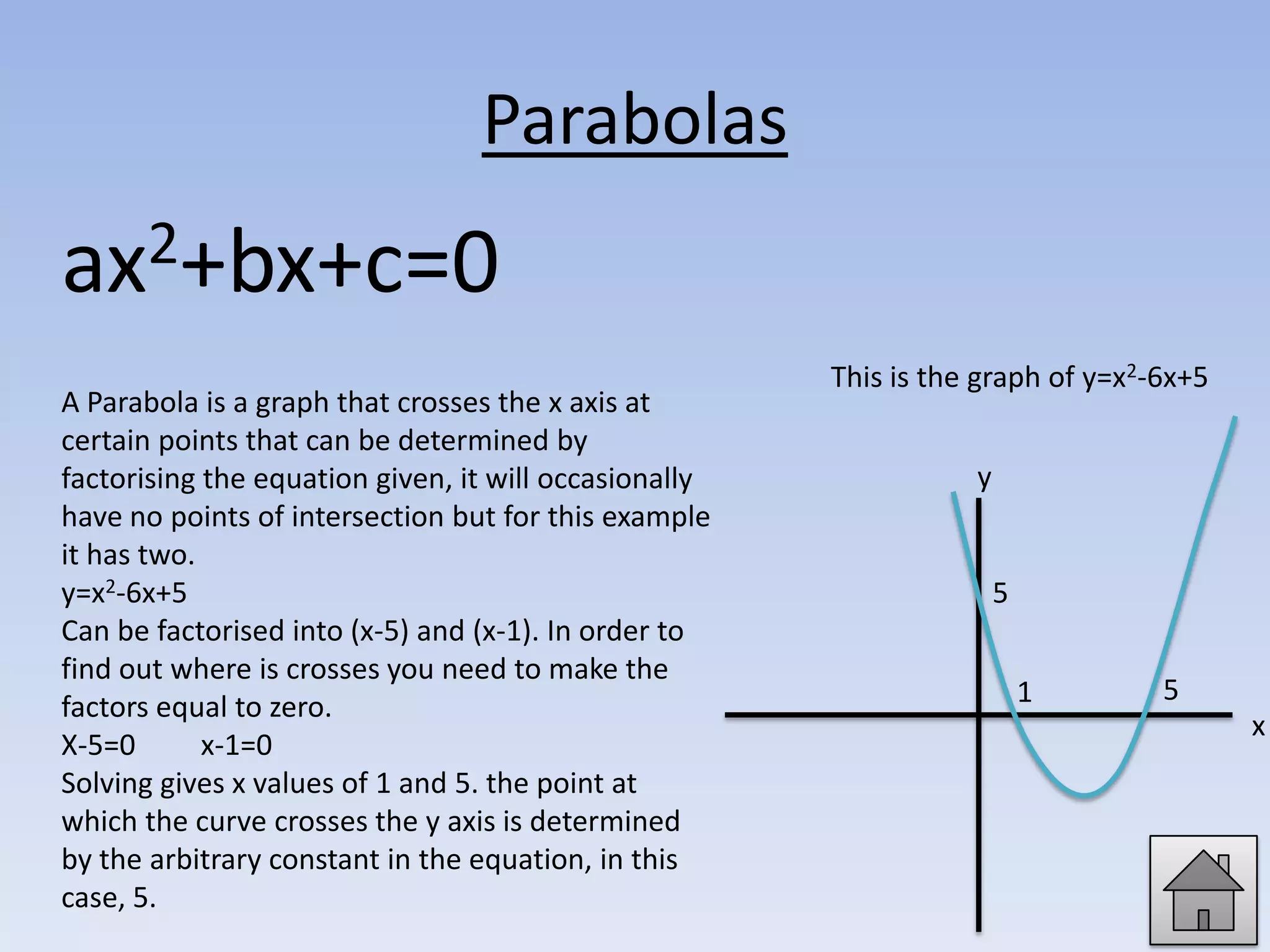
                                                       This is the graph of y=x2-6x+5
A Parabola is a graph that crosses the x axis at
certain points that can be determined by
factorising the equation given, it will occasionally              y
have no points of intersection but for this example
it has two.
y=x2-6x+5                                                             5
Can be factorised into (x-5) and (x-1). In order to
find out where is crosses you need to make the
                                                                          1      5
factors equal to zero.
                                                                                        x
X-5=0       x-1=0
Solving gives x values of 1 and 5. the point at
which the curve crosses the y axis is determined
by the arbitrary constant in the equation, in this
case, 5.

Anderson M conics

  • 1.
    Conics What are they? What do they look like? What are their equations? The Word Conic Comes from the shape of a cone and the four examples of “conic sections” come from taking certain slices out of the 3D cone and observing them from a 2D perspective. This lets us see certain shapes that we can map onto a graph with x and y axis that we can translate and reflect. There are four conic Sections that can be taken from a cone and they are: Ellipses Hyperbolae Circles Parabolas By Anderson McCammont 12JA
  • 2.
    Ellipses An Ellipseis a shape that is similar to the appearance of an oval. It has the equation of: x 2 y 2 a2 b2 y In this example to the right hand side, we can see that there are two values on the graph. The value of a is 2 and the value of b is 1. We know this because as it is “x squared over a squared”, a is paired with x 1 and so the value that lies on the ellipse and on the x axis is the value of a. The value of b is 1 because, 2 exactly the same as the reason previously stated, x the value that lies on the ellipse and y axis is the value of b.
  • 3.
    Hyperbolae A Hyperbola hasa similar equation to that of an ellipse the only difference being that the sign is a minus instead of an add. This effects the Conic so that it looks like the image shown below. The value of a that is used in the y hyperbolic equation is where the hyperbola itself crosses the x axis. This is a and –a. Using the equations of y=b/a x and y=-b/a x, you can sub in the equations of the lines of the asymptotes and then find b from that which finally lets you write the hyperbola in the form x of an equation seen below. x 2 y 2 a 2 b 2
  • 4.
    Circles (x-a)2+(y-b)2=r2 Circles are very different to the other conics as their equation involves radii. In the case of the other conics, the values of a and b were determined by The location of the points of intersection, this time the value of a and b are given by Finding out the centre of the circle in the form (x,y). The x value in this co-ordinate is now The value of a and the y value is the value of b. R on the other hand is as stated earlier the value of the radius, squared. Ill give an example: The centre of a circle is: (3,4) with radius 5, write this in the form of the equation of a circle. Using the equation setup and the information given, we can rewrite the data as: (x-3) 2 + (y-4) 2 =52 This finally becomes: (x-3) 2 + (y-4) 2 =25
  • 5.
    Parabolas ax 2+bx+c=0 This is the graph of y=x2-6x+5 A Parabola is a graph that crosses the x axis at certain points that can be determined by factorising the equation given, it will occasionally y have no points of intersection but for this example it has two. y=x2-6x+5 5 Can be factorised into (x-5) and (x-1). In order to find out where is crosses you need to make the 1 5 factors equal to zero. x X-5=0 x-1=0 Solving gives x values of 1 and 5. the point at which the curve crosses the y axis is determined by the arbitrary constant in the equation, in this case, 5.