Ancient Greek
Governments
Presented By:
Jerry Lee
Period B
The Different Types of
Governments
I. Oligarchy: A government in which only
a few people have the power
II. Tyranny: A government ruled by one
person with absolute power
III. Democracy: A type of government in
which people rule themselves
Oligarchy
 Ruled by aristocrats, who are rich landowners.
 Each aristocrat is trying to get more power than the
other aristocrats, but the other aristocrats keep them
from doing that.
 May be elected, born into position, or have a certain
amount of money or land to get into the oligarchy.
 Have meetings to appoint someone to do something or
when they have important questions.
 Most Greek city-states were under an oligarchy after the
Dark Ages.
Tyranny
 Ruled by a tyrant
 Tyrants were considered good leaders
back in Ancient Greece
 Tyrants kept the cities under control
because they had a strong army.
 Having a strong army helped tyrants stay
in power longer.
 Tyrants were supported by the people
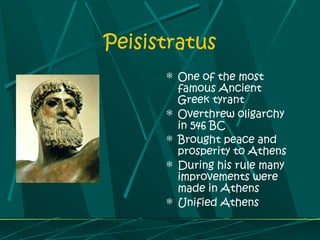
Peisistratus
 One of the most
famous Ancient
Greek tyrant
 Overthrew oligarchy
in 546 BC
 Brought peace and
prosperity to Athens
 During his rule many
improvements were
made in Athens
 Unified Athens
Democracy
Before
 Direct Democracy: A
government that
allows the people to
vote to make their
own laws and rules.
Now
 Representative
Democracy: A
government which
lets the people vote
for representative.
The representatives
make the laws and
rules for the people
and themselves.
Citizenship
 Was first brought up in Athens under Solon’s
laws
 He gave more rights to nonaristocrats and made
all free men citizens.
 Citizens had the right to participate in
government.
 You were able to be a citizen if you were rich or
poor, as long as you were free, you could be a
citizen.
Translation from Tyranny to
Oligarchy
 In Ancient Greece, most of the city-states
started out from an oligarchy.
 One of the aristocrats would have more power
by gaining the poor people’s favor and led to
that one aristocrat becoming a tyrant.
 The other aristocrats would then become
jealous and knock the tyrant down of his power,
which made the government an oligarchy again.
Translation from Democracy to
Dictatorship
 The early form of democracy was started in
Athens.
 It was proven successful as other city-states
began to use democracy.
 Then when Greece was conquered by
Macedonian, it showed that democracy was very
limited.
 Then in the 320’s BC, Greece fell into
dictatorship.
Translation from Democracy to
Dictatorship
 The early form of democracy was started in
Athens.
 It was proven successful as other city-states
began to use democracy.
 Then when Greece was conquered by
Macedonian, it showed that democracy was very
limited.
 Then in the 320’s BC, Greece fell into
dictatorship.

Ancient Greece Governments

  • 1.
  • 2.
    The Different Typesof Governments I. Oligarchy: A government in which only a few people have the power II. Tyranny: A government ruled by one person with absolute power III. Democracy: A type of government in which people rule themselves
  • 3.
    Oligarchy  Ruled byaristocrats, who are rich landowners.  Each aristocrat is trying to get more power than the other aristocrats, but the other aristocrats keep them from doing that.  May be elected, born into position, or have a certain amount of money or land to get into the oligarchy.  Have meetings to appoint someone to do something or when they have important questions.  Most Greek city-states were under an oligarchy after the Dark Ages.
  • 4.
    Tyranny  Ruled bya tyrant  Tyrants were considered good leaders back in Ancient Greece  Tyrants kept the cities under control because they had a strong army.  Having a strong army helped tyrants stay in power longer.  Tyrants were supported by the people
  • 5.
    Peisistratus  One ofthe most famous Ancient Greek tyrant  Overthrew oligarchy in 546 BC  Brought peace and prosperity to Athens  During his rule many improvements were made in Athens  Unified Athens
  • 6.
    Democracy Before  Direct Democracy:A government that allows the people to vote to make their own laws and rules. Now  Representative Democracy: A government which lets the people vote for representative. The representatives make the laws and rules for the people and themselves.
  • 7.
    Citizenship  Was firstbrought up in Athens under Solon’s laws  He gave more rights to nonaristocrats and made all free men citizens.  Citizens had the right to participate in government.  You were able to be a citizen if you were rich or poor, as long as you were free, you could be a citizen.
  • 8.
    Translation from Tyrannyto Oligarchy  In Ancient Greece, most of the city-states started out from an oligarchy.  One of the aristocrats would have more power by gaining the poor people’s favor and led to that one aristocrat becoming a tyrant.  The other aristocrats would then become jealous and knock the tyrant down of his power, which made the government an oligarchy again.
  • 9.
    Translation from Democracyto Dictatorship  The early form of democracy was started in Athens.  It was proven successful as other city-states began to use democracy.  Then when Greece was conquered by Macedonian, it showed that democracy was very limited.  Then in the 320’s BC, Greece fell into dictatorship.
  • 10.
    Translation from Democracyto Dictatorship  The early form of democracy was started in Athens.  It was proven successful as other city-states began to use democracy.  Then when Greece was conquered by Macedonian, it showed that democracy was very limited.  Then in the 320’s BC, Greece fell into dictatorship.