Ancient Greece
Ancient Greece
   Learning Points
     The Greek views of government, law, and reason
     The development of the Greek political ideas
Ancient Greece
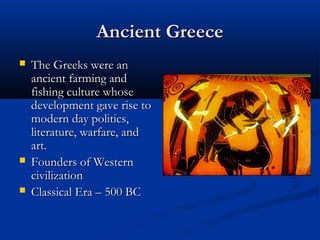
   The Greeks were an
    ancient farming and
    fishing culture whose
    development gave rise to
    modern day politics,
    literature, warfare, and
    art.
   Founders of Western
    civilization
   Classical Era – 500 BC
Ancient Greece
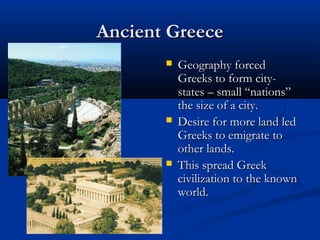
          Geography forced
           Greeks to form city-
           states – small “nations”
           the size of a city.
          Desire for more land led
           Greeks to emigrate to
           other lands.
          This spread Greek
           civilization to the known
           world.
Ancient Greece
   Which culture is considered the founders of
               Western civilization?
Ancient Greece
   Life in a city-state:
       Honored Greek Gods
        (Zeus, Hermes, Poseidon)
       Ruled by kings, later
        democracy
       Built bronze weapons
       Held slaves, mainly
        captured in war
Ancient Greece
          When iron-making is
           discovered, warfare
           changes too.
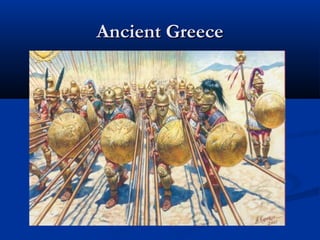
          The Phalanx is the
           Greeks prime weapon.
              Rows of men, armed with
               spears trying to push the
               other side off the field
              All citizens required to
               train in the Phalanx
Ancient Greece
Ancient Greece
Ancient Greece
   Sparta: The Warrior State
   Practiced fighting from
    the time of children.
   Ignored farming in order
    to train, so their diet was
    bland.
   Only males over 30 who
    had proved themselves in
    battle could be citizens
Ancient Greece
   What was the main weapon used by the Greeks?
Ancient Greece
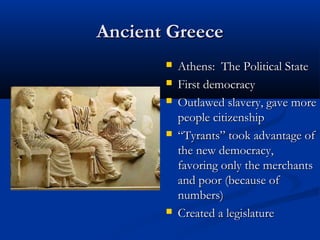
          Athens: The Political State
          First democracy
          Outlawed slavery, gave more
           people citizenship
          “Tyrants” took advantage of
           the new democracy,
           favoring only the merchants
           and poor (because of
           numbers)
          Created a legislature
Ancient Greece
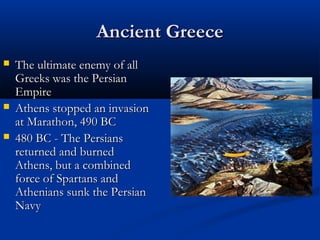
   The ultimate enemy of all
    Greeks was the Persian
    Empire
   Athens stopped an invasion
    at Marathon, 490 BC
   480 BC - The Persians
    returned and burned
    Athens, but a combined
    force of Spartans and
    Athenians sunk the Persian
    Navy
Ancient Greece
          479 BC – The Persians
           return by land and are
           defeated at Thermopylae
          300 Spartans stood
           against 300,000 Persians.
          Athens’ navy again
           defeated the Persian
           navy.
          Now, Greece was safe
           from Persians
Ancient Greece
   What were the two most important city-states?
Ancient Greece
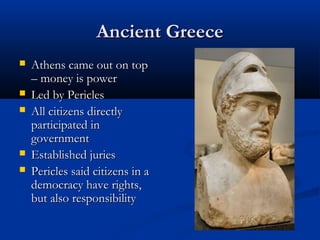
   Athens came out on top
    – money is power
   Led by Pericles
   All citizens directly
    participated in
    government
   Established juries
   Pericles said citizens in a
    democracy have rights,
    but also responsibility
Ancient Greece
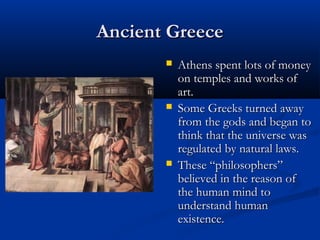
          Athens spent lots of money
           on temples and works of
           art.
          Some Greeks turned away
           from the gods and began to
           think that the universe was
           regulated by natural laws.
          These “philosophers”
           believed in the reason of
           the human mind to
           understand human
           existence.
Ancient Greece
   Peloponnesian War 431
    BC – 404 BC
   With Persia gone, the
    two Greek giants squared
    off – Athens and Sparta.
   Sparta won and Athens’
    power was diminished.
Ancient Greece
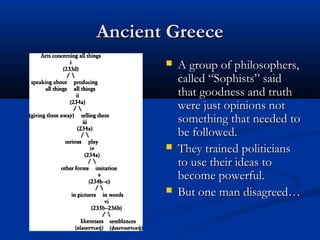
          A group of philosophers,
           called “Sophists” said
           that goodness and truth
           were just opinions not
           something that needed to
           be followed.
          They trained politicians
           to use their ideas to
           become powerful.
          But one man disagreed…
Ancient Greece
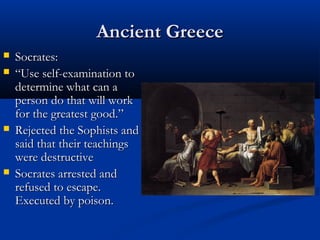
   Socrates:
   “Use self-examination to
    determine what can a
    person do that will work
    for the greatest good.”
   Rejected the Sophists and
    said that their teachings
    were destructive
   Socrates arrested and
    refused to escape.
    Executed by poison.
Ancient Greece
          Plato:
          Socrates’ brightest student.
          Hated democracy for what
           it did to his teacher.
          Said the government
           should control everyone's
           life.
          Said all were born equal,
           but by their actions showed
           their true level.
          Workers, soldiers, thinkers
Ancient Greece
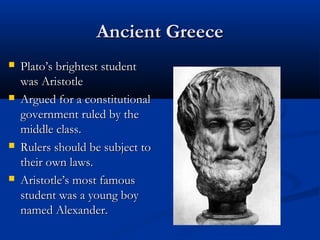
   Plato’s brightest student
    was Aristotle
   Argued for a constitutional
    government ruled by the
    middle class.
   Rulers should be subject to
    their own laws.
   Aristotle’s most famous
    student was a young boy
    named Alexander.
Ancient Greece
   Who was Socrates’ best student?

Ancient greece

  • 1.
  • 2.
    Ancient Greece  Learning Points  The Greek views of government, law, and reason  The development of the Greek political ideas
  • 3.
    Ancient Greece  The Greeks were an ancient farming and fishing culture whose development gave rise to modern day politics, literature, warfare, and art.  Founders of Western civilization  Classical Era – 500 BC
  • 4.
    Ancient Greece  Geography forced Greeks to form city- states – small “nations” the size of a city.  Desire for more land led Greeks to emigrate to other lands.  This spread Greek civilization to the known world.
  • 5.
    Ancient Greece  Which culture is considered the founders of Western civilization?
  • 6.
    Ancient Greece  Life in a city-state:  Honored Greek Gods (Zeus, Hermes, Poseidon)  Ruled by kings, later democracy  Built bronze weapons  Held slaves, mainly captured in war
  • 7.
    Ancient Greece  When iron-making is discovered, warfare changes too.  The Phalanx is the Greeks prime weapon.  Rows of men, armed with spears trying to push the other side off the field  All citizens required to train in the Phalanx
  • 8.
  • 9.
  • 10.
    Ancient Greece  Sparta: The Warrior State  Practiced fighting from the time of children.  Ignored farming in order to train, so their diet was bland.  Only males over 30 who had proved themselves in battle could be citizens
  • 11.
    Ancient Greece  What was the main weapon used by the Greeks?
  • 12.
    Ancient Greece  Athens: The Political State  First democracy  Outlawed slavery, gave more people citizenship  “Tyrants” took advantage of the new democracy, favoring only the merchants and poor (because of numbers)  Created a legislature
  • 13.
    Ancient Greece  The ultimate enemy of all Greeks was the Persian Empire  Athens stopped an invasion at Marathon, 490 BC  480 BC - The Persians returned and burned Athens, but a combined force of Spartans and Athenians sunk the Persian Navy
  • 14.
    Ancient Greece  479 BC – The Persians return by land and are defeated at Thermopylae  300 Spartans stood against 300,000 Persians.  Athens’ navy again defeated the Persian navy.  Now, Greece was safe from Persians
  • 15.
    Ancient Greece  What were the two most important city-states?
  • 16.
    Ancient Greece  Athens came out on top – money is power  Led by Pericles  All citizens directly participated in government  Established juries  Pericles said citizens in a democracy have rights, but also responsibility
  • 17.
    Ancient Greece  Athens spent lots of money on temples and works of art.  Some Greeks turned away from the gods and began to think that the universe was regulated by natural laws.  These “philosophers” believed in the reason of the human mind to understand human existence.
  • 18.
    Ancient Greece  Peloponnesian War 431 BC – 404 BC  With Persia gone, the two Greek giants squared off – Athens and Sparta.  Sparta won and Athens’ power was diminished.
  • 19.
    Ancient Greece  A group of philosophers, called “Sophists” said that goodness and truth were just opinions not something that needed to be followed.  They trained politicians to use their ideas to become powerful.  But one man disagreed…
  • 20.
    Ancient Greece  Socrates:  “Use self-examination to determine what can a person do that will work for the greatest good.”  Rejected the Sophists and said that their teachings were destructive  Socrates arrested and refused to escape. Executed by poison.
  • 21.
    Ancient Greece  Plato:  Socrates’ brightest student.  Hated democracy for what it did to his teacher.  Said the government should control everyone's life.  Said all were born equal, but by their actions showed their true level.  Workers, soldiers, thinkers
  • 22.
    Ancient Greece  Plato’s brightest student was Aristotle  Argued for a constitutional government ruled by the middle class.  Rulers should be subject to their own laws.  Aristotle’s most famous student was a young boy named Alexander.
  • 23.
    Ancient Greece  Who was Socrates’ best student?