- missed my period for 1 week or more.
- tired , feeling sleepy, dizzy, and nauseated.
- abdominal pain or urine frequency.
- Abdominal pain with heavy bleeding and passing clots
- Feeling abnormal movement in my abdomen.
- My tummy gets bigger.
- Or need to do UPT before injection of some medications,
X ray or initiation of contraception.
1- urine pregnancy test
2- serum B- HCG
3- ultrasound
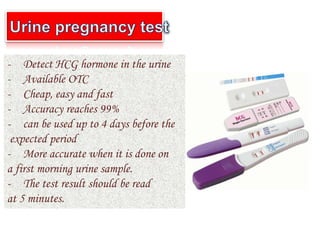
- Detect HCG hormone in the urine
- Available OTC
- Cheap, easy and fast
- Accuracy reaches 99%
- can be used up to 4 days before the
expected period
- More accurate when it is done on
a first morning urine sample.
- The test result should be read
at 5 minutes.
 Can miss some pregnancy .
 If reported as week positive , obtain a first morning urine sample
or repeat the test after 1 week.
 If UPT was done in private and the lady came with report,
repeat UPT in the health center or do scan.
 You need to get the permission from the lady before doing UPT.
False positive result:
1) Interpret the result after the given “reaction time” of the test.
2) Blood or protein in the urine
3) anti-convulsants, anti-parkinson drugs, hypnotics, and tranquilize
False negative result:
1) Using not very sensitive kit
2) Diluted urine
3) Ovulation or implantation occurred late.
4) Certain drugs such as diuretics and promethazine
 Urine hCG decreases at about the same rate as serum
hCG, which can take anywhere from 9 to 35 days,
with a median of 19 days.
 However, the timeframe for when an hCG result will
be negative is dependent on what the hCG level was
at the time of the miscarriage.
How many days after a miscarriage would it take for a
urine pregnancy test to show a negative result?
Frequently, miscarriages are monitored with quantitative blood
hCG testing.
If the levels of hCG do not fall to undetectable levels, some hCG-
producing tissue may remain and have to be removed
 evaluate a suspected ectopic pregnancy
 to monitor a woman following a miscarriage
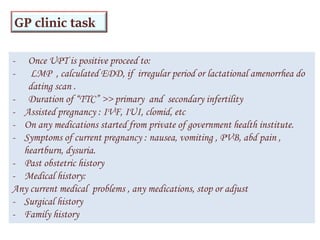
- Once UPT is positive proceed to:
- LMP , calculated EDD, if irregular period or lactational amenorrhea do
dating scan .
- Duration of “TTC” >> primary and secondary infertility
- Assisted pregnancy : IVF, IUI, clomid, etc
- On any medications started from private of government health institute.
- Symptoms of current pregnancy : nausea, vomiting , PVB, abd pain ,
heartburn, dysuria.
- Past obstetric history
- Medical history:
Any current medical problems , any medications, stop or adjust
- Surgical history
- Family history
GP clinic task
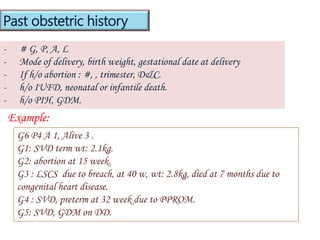
- # G, P, A, L
- Mode of delivery, birth weight, gestational date at delivery
- If h/o abortion : #, , trimester, D&C.
- h/o IUFD, neonatal or infantile death.
- h/o PIH, GDM.
Past obstetric history
Example:
G6 P4 A 1, Alive 3 .
G1: SVD term wt: 2.1kg.
G2: abortion at 15 week.
G3 : LSCS due to breach, at 40 w, wt: 2.8kg, died at 7 months due to
congenital heart disease.
G4 : SVD, preterm at 32 week due to PPROM.
G5: SVD, GDM on DD.
General examination , unless she has specific complaints
BP, PR, T, WEIGHT, HEIGHT, BMI.
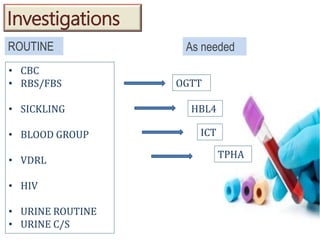
• CBC
• RBS/FBS
• SICKLING
• BLOOD GROUP
• VDRL
• HIV
• URINE ROUTINE
• URINE C/S
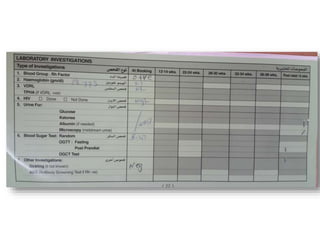
Investigations
ROUTINE As needed
OGTT
ICT
HBL4
TPHA
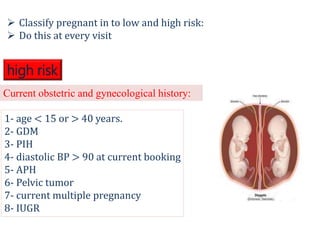
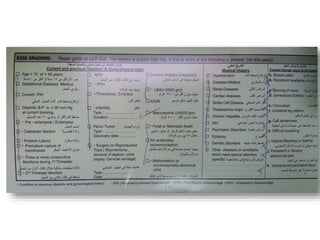
 Classify pregnant in to low and high risk:
 Do this at every visit
high risk
Current obstetric and gynecological history:
1- age < 15 or > 40 years.
2- GDM
3- PIH
4- diastolic BP > 90 at current booking
5- APH
6- Pelvic tumor
7- current multiple pregnancy
8- IUGR
Previous obstetric and gynecological history:
1. pre eclampsia/ eclampsia
2. CS
3. Preterm labour
4. PROM
5. >3 abortion in 1st trimester
6. 2nd trimester abortion
7. PPH
8. Thrombosis embolism
9. Infertility
10. Surgery on reproductive system
11. LBW< 2.5kg
12. Macrosomia >4 kg.
13. Fetal or neonatal death
14. RH antibodies isoimmuisation
15. Malformation or chromosomall abnormal child
Medical history:
1. HTN
2. DM
3. CVD
4. SCD
5. Thalassemia major
6. Chronic hepatitis
7. HIV
8. Psychiatric disorders
9. Epilepsy
10. Thyroid disease
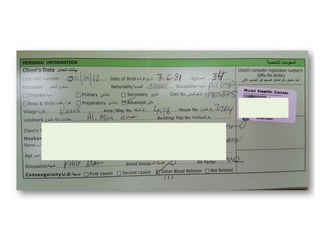
First visit in ANC clinic “booking appointment”
- Confirm that she has appointment today
- Make sure that the pregnant filled the paper
given for personal information
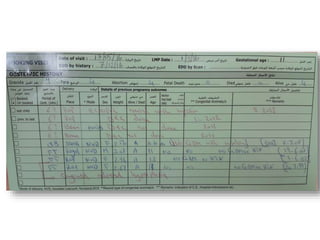
- Fill the first and second page : write the serial number
- Write the date of visit , LMP, EDD by history,
#G, #P, #A
- Measure BP, weigh, height
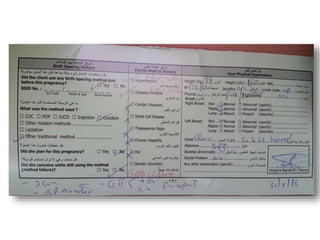
- Take contraception history
- Write the results of investigations done last visit
- Register the pregnant in ANC register
- Give the first dose of TT if primi and write the date of
the next dose
The nurse task
7-10 w
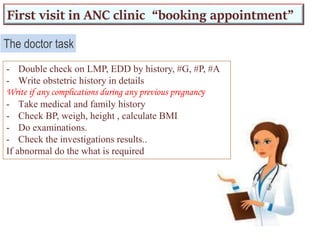
First visit in ANC clinic “booking appointment”
- Double check on LMP, EDD by history, #G, #P, #A
- Write obstetric history in details
Write if any complications during any previous pregnancy
- Take medical and family history
- Check BP, weigh, height , calculate BMI
- Do examinations.
- Check the investigations results..
If abnormal do the what is required
The doctor task
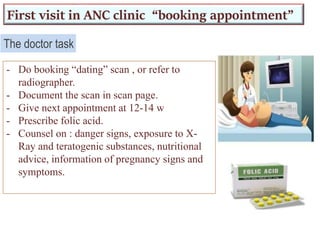
First visit in ANC clinic “booking appointment”
- Do booking “dating” scan , or refer to
radiographer.
- Document the scan in scan page.
- Give next appointment at 12-14 w
- Prescribe folic acid.
- Counsel on : danger signs, exposure to X-
Ray and teratogenic substances, nutritional
advice, information of pregnancy signs and
symptoms.
The doctor task
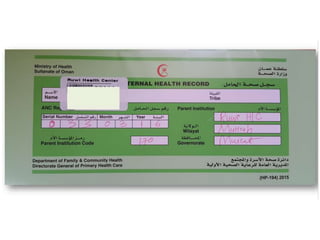
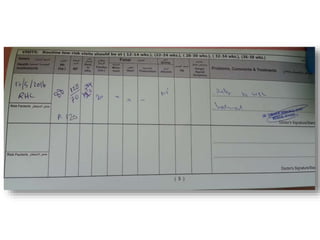
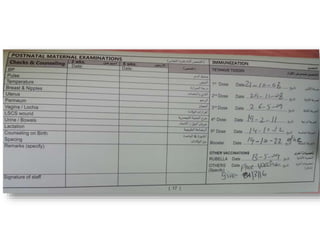
The maternal health record
“The green card”
1. HTN
2. DM
3. Renal disease
4. CVD
5. Thalassemia major
6. Chronic hepatitis
7. HIV
8. Psychiatric disorders
9. Epilepsy
10. Genetic disorder
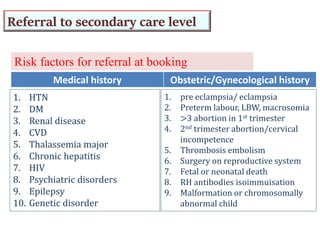
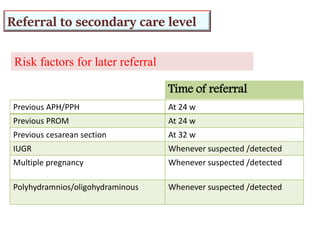
Referral to secondary care level
Risk factors for referral at booking
Medical history Obstetric/Gynecological history
1. pre eclampsia/ eclampsia
2. Preterm labour, LBW, macrosomia
3. >3 abortion in 1st trimester
4. 2nd trimester abortion/cervical
incompetence
5. Thrombosis embolism
6. Surgery on reproductive system
7. Fetal or neonatal death
8. RH antibodies isoimmuisation
9. Malformation or chromosomally
abnormal child
Referral to secondary care level
Risk factors for later referral
Time of referral
Previous APH/PPH At 24 w
Previous PROM At 24 w
Previous cesarean section At 32 w
IUGR Whenever suspected /detected
Multiple pregnancy Whenever suspected /detected
Polyhydramnios/oligohydraminous Whenever suspected /detected
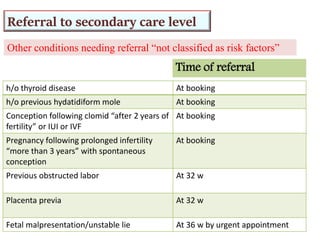
Referral to secondary care level
Other conditions needing referral “not classified as risk factors”
Time of referral
h/o thyroid disease At booking
h/o previous hydatidiform mole At booking
Conception following clomid “after 2 years of
fertility” or IUI or IVF
At booking
Pregnancy following prolonged infertility
“more than 3 years” with spontaneous
conception
At booking
Previous obstructed labor At 32 w
Placenta previa At 32 w
Fetal malpresentation/unstable lie At 36 w by urgent appointment
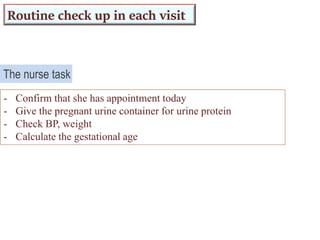
Routine check up in each visit
- Confirm that she has appointment today
- Give the pregnant urine container for urine protein
- Check BP, weight
- Calculate the gestational age
The nurse task
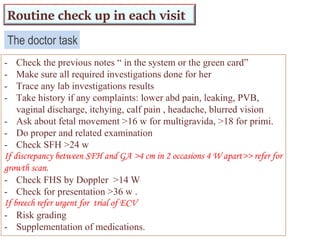
The doctor task
- Check the previous notes “ in the system or the green card”
- Make sure all required investigations done for her
- Trace any lab investigations results
- Take history if any complaints: lower abd pain, leaking, PVB,
vaginal discharge, itchying, calf pain , headache, blurred vision
- Ask about fetal movement >16 w for multigravida, >18 for primi.
- Do proper and related examination
- Check SFH >24 w
If discrepancy between SFH and GA >4 cm in 2 occasions 4 W apart>> refer for
growth scan.
- Check FHS by Doppler >14 W
- Check for presentation >36 w .
If breech refer urgent for trial of ECV
- Risk grading
- Supplementation of medications.
Routine check up in each visit
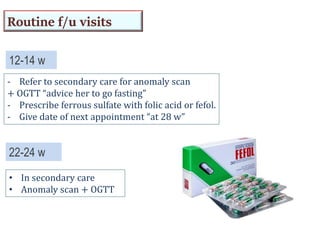
12-14 w
22-24 w
• In secondary care
• Anomaly scan + OGTT
- Refer to secondary care for anomaly scan
+ OGTT “advice her to go fasting”
- Prescribe ferrous sulfate with folic acid or fefol.
- Give date of next appointment “at 28 w”
Routine f/u visits
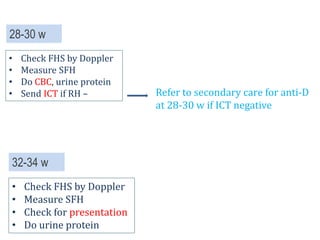
32-34 w
• Check FHS by Doppler
• Measure SFH
• Check for presentation
• Do urine protein
28-30 w
• Check FHS by Doppler
• Measure SFH
• Do CBC, urine protein
• Send ICT if RH – Refer to secondary care for anti-D
at 28-30 w if ICT negative
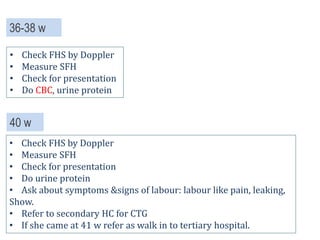
40 w
• Check FHS by Doppler
• Measure SFH
• Check for presentation
• Do urine protein
• Ask about symptoms &signs of labour: labour like pain, leaking,
Show.
• Refer to secondary HC for CTG
• If she came at 41 w refer as walk in to tertiary hospital.
36-38 w
• Check FHS by Doppler
• Measure SFH
• Check for presentation
• Do CBC, urine protein
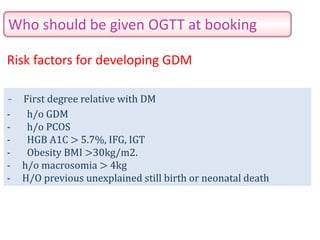
Who should be given OGTT at booking
- First degree relative with DM
- h/o GDM
- h/o PCOS
- HGB A1C > 5.7%, IFG, IGT
- Obesity BMI >30kg/m2.
- h/o macrosomia > 4kg
- H/O previous unexplained still birth or neonatal death
Risk factors for developing GDM
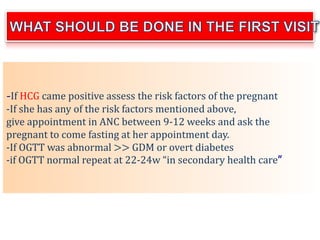
-If HCG came positive assess the risk factors of the pregnant
-If she has any of the risk factors mentioned above,
give appointment in ANC between 9-12 weeks and ask the
pregnant to come fasting at her appointment day.
-If OGTT was abnormal >> GDM or overt diabetes
-if OGTT normal repeat at 22-24w “in secondary health care”
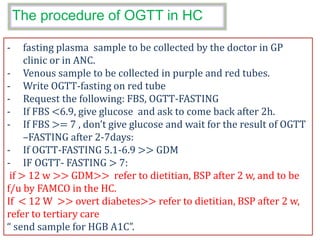
The procedure of OGTT in HC
- fasting plasma sample to be collected by the doctor in GP
clinic or in ANC.
- Venous sample to be collected in purple and red tubes.
- Write OGTT-fasting on red tube
- Request the following: FBS, OGTT-FASTING
- If FBS <6.9, give glucose and ask to come back after 2h.
- If FBS >= 7 , don’t give glucose and wait for the result of OGTT
–FASTING after 2-7days:
- If OGTT-FASTING 5.1-6.9 >> GDM
- IF OGTT- FASTING > 7:
if > 12 w >> GDM>> refer to dietitian, BSP after 2 w, and to be
f/u by FAMCO in the HC.
If < 12 W >> overt diabetes>> refer to dietitian, BSP after 2 w,
refer to tertiary care
“ send sample for HGB A1C”.
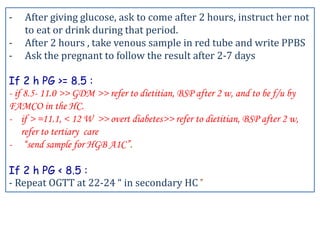
- After giving glucose, ask to come after 2 hours, instruct her not
to eat or drink during that period.
- After 2 hours , take venous sample in red tube and write PPBS
- Ask the pregnant to follow the result after 2-7 days
If 2 h PG >= 8.5 :
- if 8.5- 11.0 >> GDM >> refer to dietitian, BSP after 2 w, and to be f/u by
FAMCO in the HC.
- if > =11.1, < 12 W >> overt diabetes>> refer to dietitian, BSP after 2 w,
refer to tertiary care
- “send sample for HGB A1C”.
If 2 h PG < 8.5 :
- Repeat OGTT at 22-24 “ in secondary HC”
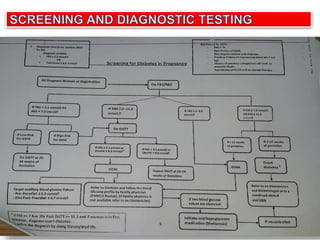
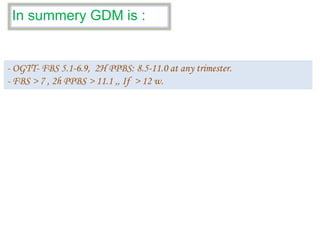
In summery GDM is :
- OGTT- FBS 5.1-6.9, 2H PPBS: 8.5-11.0 at any trimester.
- FBS > 7 , 2h PPBS > 11.1 ,, If > 12 w.
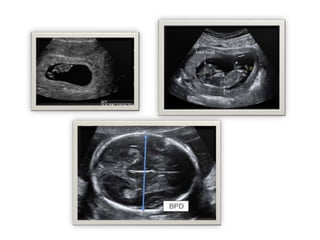
Done by doctor or the radiographer
 Booking ,dating, scan :
- 8-12 W
- Intrauterine pregnancy
- Viability
- Gestational age
- # fetus
 Anomaly sacn:
- At 22-24 w
 Growth scan:
- if indicated, high risk, localization of placenta, EFW, AFI,
presentation, etc
- At 36 W
Ultrasound in ANC
 Offer influenza vaccine in any trimester.
 TT:
- 1st dose At booking
- 2nd dose after 1 month
- 3rd dose after 6 month from the previous dose
- 4th dose after 1 year from the previous dose
- 5th dose after 1 year from the previous dose
- Booster dose after 10 year from the previous dose
- Check for rubella immunization, if not immunized or if
immunization status is unknown give vaccine after delivery
and not to conceive for the following 3 months
Immunization
- If planning to go for Haj, meningococcal vaccine can be given
- Yellow fever vaccine :If travel is unavoidable, and the risks for
YFV exposure are felt to outweigh the vaccination risks, a
pregnant woman should be vaccinated.
- should wait 4 weeks after receiving YF vaccine before conceiving
- If at risk for HBV infection during pregnancy “ has HBsAg-
positive husband’ should be vaccinated with HBV vaccine
- Malaria prophylaxis: Chloroquine or hydroxychloroquine are
considered safe to use in all trimesters of pregnancy. Mefloquine
is the agent of choice for chloroquine-resistant areas
- postexposure prophylaxis for rabies may be given .
Immunization
Management of common medical problems
during pregnancy
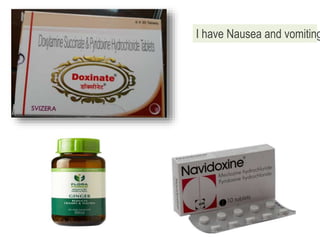
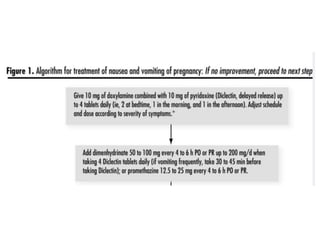
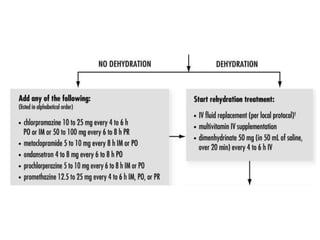
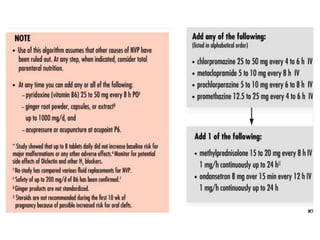
I have Nausea and vomiting
I Cant tolerate ferrous sulphate or fefol
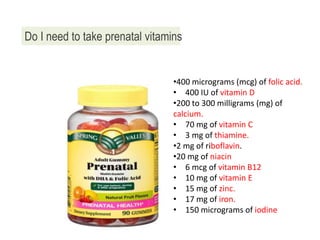
Do I need to take prenatal vitamins
•400 micrograms (mcg) of folic acid.
• 400 IU of vitamin D
•200 to 300 milligrams (mg) of
calcium.
• 70 mg of vitamin C
• 3 mg of thiamine.
•2 mg of riboflavin.
•20 mg of niacin
• 6 mcg of vitamin B12
• 10 mg of vitamin E
• 15 mg of zinc.
• 17 mg of iron.
• 150 micrograms of iodine
1- Pregnancy and childbirth management guidelines, 1st
edition ,
2010. MOH
2- Guidelines for Vaccinating Pregnant Women.CDC. March
2014.
3- www.early-pregnancy-tests.com
ANC

ANC

  • 2.
    - missed myperiod for 1 week or more. - tired , feeling sleepy, dizzy, and nauseated. - abdominal pain or urine frequency. - Abdominal pain with heavy bleeding and passing clots - Feeling abnormal movement in my abdomen. - My tummy gets bigger. - Or need to do UPT before injection of some medications, X ray or initiation of contraception.
  • 3.
    1- urine pregnancytest 2- serum B- HCG 3- ultrasound
  • 4.
    - Detect HCGhormone in the urine - Available OTC - Cheap, easy and fast - Accuracy reaches 99% - can be used up to 4 days before the expected period - More accurate when it is done on a first morning urine sample. - The test result should be read at 5 minutes.
  • 5.
     Can misssome pregnancy .  If reported as week positive , obtain a first morning urine sample or repeat the test after 1 week.  If UPT was done in private and the lady came with report, repeat UPT in the health center or do scan.  You need to get the permission from the lady before doing UPT.
  • 6.
    False positive result: 1)Interpret the result after the given “reaction time” of the test. 2) Blood or protein in the urine 3) anti-convulsants, anti-parkinson drugs, hypnotics, and tranquilize False negative result: 1) Using not very sensitive kit 2) Diluted urine 3) Ovulation or implantation occurred late. 4) Certain drugs such as diuretics and promethazine
  • 7.
     Urine hCGdecreases at about the same rate as serum hCG, which can take anywhere from 9 to 35 days, with a median of 19 days.  However, the timeframe for when an hCG result will be negative is dependent on what the hCG level was at the time of the miscarriage. How many days after a miscarriage would it take for a urine pregnancy test to show a negative result?
  • 8.
    Frequently, miscarriages aremonitored with quantitative blood hCG testing. If the levels of hCG do not fall to undetectable levels, some hCG- producing tissue may remain and have to be removed  evaluate a suspected ectopic pregnancy  to monitor a woman following a miscarriage
  • 9.
    - Once UPTis positive proceed to: - LMP , calculated EDD, if irregular period or lactational amenorrhea do dating scan . - Duration of “TTC” >> primary and secondary infertility - Assisted pregnancy : IVF, IUI, clomid, etc - On any medications started from private of government health institute. - Symptoms of current pregnancy : nausea, vomiting , PVB, abd pain , heartburn, dysuria. - Past obstetric history - Medical history: Any current medical problems , any medications, stop or adjust - Surgical history - Family history GP clinic task
  • 10.
    - # G,P, A, L - Mode of delivery, birth weight, gestational date at delivery - If h/o abortion : #, , trimester, D&C. - h/o IUFD, neonatal or infantile death. - h/o PIH, GDM. Past obstetric history Example: G6 P4 A 1, Alive 3 . G1: SVD term wt: 2.1kg. G2: abortion at 15 week. G3 : LSCS due to breach, at 40 w, wt: 2.8kg, died at 7 months due to congenital heart disease. G4 : SVD, preterm at 32 week due to PPROM. G5: SVD, GDM on DD.
  • 11.
    General examination ,unless she has specific complaints BP, PR, T, WEIGHT, HEIGHT, BMI.
  • 12.
    • CBC • RBS/FBS •SICKLING • BLOOD GROUP • VDRL • HIV • URINE ROUTINE • URINE C/S Investigations ROUTINE As needed OGTT ICT HBL4 TPHA
  • 13.
     Classify pregnantin to low and high risk:  Do this at every visit high risk Current obstetric and gynecological history: 1- age < 15 or > 40 years. 2- GDM 3- PIH 4- diastolic BP > 90 at current booking 5- APH 6- Pelvic tumor 7- current multiple pregnancy 8- IUGR
  • 14.
    Previous obstetric andgynecological history: 1. pre eclampsia/ eclampsia 2. CS 3. Preterm labour 4. PROM 5. >3 abortion in 1st trimester 6. 2nd trimester abortion 7. PPH 8. Thrombosis embolism 9. Infertility 10. Surgery on reproductive system 11. LBW< 2.5kg 12. Macrosomia >4 kg. 13. Fetal or neonatal death 14. RH antibodies isoimmuisation 15. Malformation or chromosomall abnormal child
  • 15.
    Medical history: 1. HTN 2.DM 3. CVD 4. SCD 5. Thalassemia major 6. Chronic hepatitis 7. HIV 8. Psychiatric disorders 9. Epilepsy 10. Thyroid disease
  • 16.
    First visit inANC clinic “booking appointment” - Confirm that she has appointment today - Make sure that the pregnant filled the paper given for personal information - Fill the first and second page : write the serial number - Write the date of visit , LMP, EDD by history, #G, #P, #A - Measure BP, weigh, height - Take contraception history - Write the results of investigations done last visit - Register the pregnant in ANC register - Give the first dose of TT if primi and write the date of the next dose The nurse task 7-10 w
  • 17.
    First visit inANC clinic “booking appointment” - Double check on LMP, EDD by history, #G, #P, #A - Write obstetric history in details Write if any complications during any previous pregnancy - Take medical and family history - Check BP, weigh, height , calculate BMI - Do examinations. - Check the investigations results.. If abnormal do the what is required The doctor task
  • 18.
    First visit inANC clinic “booking appointment” - Do booking “dating” scan , or refer to radiographer. - Document the scan in scan page. - Give next appointment at 12-14 w - Prescribe folic acid. - Counsel on : danger signs, exposure to X- Ray and teratogenic substances, nutritional advice, information of pregnancy signs and symptoms. The doctor task
  • 19.
    The maternal healthrecord “The green card”
  • 30.
    1. HTN 2. DM 3.Renal disease 4. CVD 5. Thalassemia major 6. Chronic hepatitis 7. HIV 8. Psychiatric disorders 9. Epilepsy 10. Genetic disorder Referral to secondary care level Risk factors for referral at booking Medical history Obstetric/Gynecological history 1. pre eclampsia/ eclampsia 2. Preterm labour, LBW, macrosomia 3. >3 abortion in 1st trimester 4. 2nd trimester abortion/cervical incompetence 5. Thrombosis embolism 6. Surgery on reproductive system 7. Fetal or neonatal death 8. RH antibodies isoimmuisation 9. Malformation or chromosomally abnormal child
  • 31.
    Referral to secondarycare level Risk factors for later referral Time of referral Previous APH/PPH At 24 w Previous PROM At 24 w Previous cesarean section At 32 w IUGR Whenever suspected /detected Multiple pregnancy Whenever suspected /detected Polyhydramnios/oligohydraminous Whenever suspected /detected
  • 32.
    Referral to secondarycare level Other conditions needing referral “not classified as risk factors” Time of referral h/o thyroid disease At booking h/o previous hydatidiform mole At booking Conception following clomid “after 2 years of fertility” or IUI or IVF At booking Pregnancy following prolonged infertility “more than 3 years” with spontaneous conception At booking Previous obstructed labor At 32 w Placenta previa At 32 w Fetal malpresentation/unstable lie At 36 w by urgent appointment
  • 33.
    Routine check upin each visit - Confirm that she has appointment today - Give the pregnant urine container for urine protein - Check BP, weight - Calculate the gestational age The nurse task
  • 34.
    The doctor task -Check the previous notes “ in the system or the green card” - Make sure all required investigations done for her - Trace any lab investigations results - Take history if any complaints: lower abd pain, leaking, PVB, vaginal discharge, itchying, calf pain , headache, blurred vision - Ask about fetal movement >16 w for multigravida, >18 for primi. - Do proper and related examination - Check SFH >24 w If discrepancy between SFH and GA >4 cm in 2 occasions 4 W apart>> refer for growth scan. - Check FHS by Doppler >14 W - Check for presentation >36 w . If breech refer urgent for trial of ECV - Risk grading - Supplementation of medications. Routine check up in each visit
  • 35.
    12-14 w 22-24 w •In secondary care • Anomaly scan + OGTT - Refer to secondary care for anomaly scan + OGTT “advice her to go fasting” - Prescribe ferrous sulfate with folic acid or fefol. - Give date of next appointment “at 28 w” Routine f/u visits
  • 36.
    32-34 w • CheckFHS by Doppler • Measure SFH • Check for presentation • Do urine protein 28-30 w • Check FHS by Doppler • Measure SFH • Do CBC, urine protein • Send ICT if RH – Refer to secondary care for anti-D at 28-30 w if ICT negative
  • 37.
    40 w • CheckFHS by Doppler • Measure SFH • Check for presentation • Do urine protein • Ask about symptoms &signs of labour: labour like pain, leaking, Show. • Refer to secondary HC for CTG • If she came at 41 w refer as walk in to tertiary hospital. 36-38 w • Check FHS by Doppler • Measure SFH • Check for presentation • Do CBC, urine protein
  • 38.
    Who should begiven OGTT at booking - First degree relative with DM - h/o GDM - h/o PCOS - HGB A1C > 5.7%, IFG, IGT - Obesity BMI >30kg/m2. - h/o macrosomia > 4kg - H/O previous unexplained still birth or neonatal death Risk factors for developing GDM
  • 40.
    -If HCG camepositive assess the risk factors of the pregnant -If she has any of the risk factors mentioned above, give appointment in ANC between 9-12 weeks and ask the pregnant to come fasting at her appointment day. -If OGTT was abnormal >> GDM or overt diabetes -if OGTT normal repeat at 22-24w “in secondary health care”
  • 41.
    The procedure ofOGTT in HC - fasting plasma sample to be collected by the doctor in GP clinic or in ANC. - Venous sample to be collected in purple and red tubes. - Write OGTT-fasting on red tube - Request the following: FBS, OGTT-FASTING - If FBS <6.9, give glucose and ask to come back after 2h. - If FBS >= 7 , don’t give glucose and wait for the result of OGTT –FASTING after 2-7days: - If OGTT-FASTING 5.1-6.9 >> GDM - IF OGTT- FASTING > 7: if > 12 w >> GDM>> refer to dietitian, BSP after 2 w, and to be f/u by FAMCO in the HC. If < 12 W >> overt diabetes>> refer to dietitian, BSP after 2 w, refer to tertiary care “ send sample for HGB A1C”.
  • 42.
    - After givingglucose, ask to come after 2 hours, instruct her not to eat or drink during that period. - After 2 hours , take venous sample in red tube and write PPBS - Ask the pregnant to follow the result after 2-7 days If 2 h PG >= 8.5 : - if 8.5- 11.0 >> GDM >> refer to dietitian, BSP after 2 w, and to be f/u by FAMCO in the HC. - if > =11.1, < 12 W >> overt diabetes>> refer to dietitian, BSP after 2 w, refer to tertiary care - “send sample for HGB A1C”. If 2 h PG < 8.5 : - Repeat OGTT at 22-24 “ in secondary HC”
  • 43.
    In summery GDMis : - OGTT- FBS 5.1-6.9, 2H PPBS: 8.5-11.0 at any trimester. - FBS > 7 , 2h PPBS > 11.1 ,, If > 12 w.
  • 44.
    Done by doctoror the radiographer  Booking ,dating, scan : - 8-12 W - Intrauterine pregnancy - Viability - Gestational age - # fetus  Anomaly sacn: - At 22-24 w  Growth scan: - if indicated, high risk, localization of placenta, EFW, AFI, presentation, etc - At 36 W Ultrasound in ANC
  • 46.
     Offer influenzavaccine in any trimester.  TT: - 1st dose At booking - 2nd dose after 1 month - 3rd dose after 6 month from the previous dose - 4th dose after 1 year from the previous dose - 5th dose after 1 year from the previous dose - Booster dose after 10 year from the previous dose - Check for rubella immunization, if not immunized or if immunization status is unknown give vaccine after delivery and not to conceive for the following 3 months Immunization
  • 47.
    - If planningto go for Haj, meningococcal vaccine can be given - Yellow fever vaccine :If travel is unavoidable, and the risks for YFV exposure are felt to outweigh the vaccination risks, a pregnant woman should be vaccinated. - should wait 4 weeks after receiving YF vaccine before conceiving - If at risk for HBV infection during pregnancy “ has HBsAg- positive husband’ should be vaccinated with HBV vaccine - Malaria prophylaxis: Chloroquine or hydroxychloroquine are considered safe to use in all trimesters of pregnancy. Mefloquine is the agent of choice for chloroquine-resistant areas - postexposure prophylaxis for rabies may be given . Immunization
  • 48.
    Management of commonmedical problems during pregnancy
  • 49.
    I have Nauseaand vomiting
  • 53.
    I Cant tolerateferrous sulphate or fefol
  • 54.
    Do I needto take prenatal vitamins •400 micrograms (mcg) of folic acid. • 400 IU of vitamin D •200 to 300 milligrams (mg) of calcium. • 70 mg of vitamin C • 3 mg of thiamine. •2 mg of riboflavin. •20 mg of niacin • 6 mcg of vitamin B12 • 10 mg of vitamin E • 15 mg of zinc. • 17 mg of iron. • 150 micrograms of iodine
  • 55.
    1- Pregnancy andchildbirth management guidelines, 1st edition , 2010. MOH 2- Guidelines for Vaccinating Pregnant Women.CDC. March 2014. 3- www.early-pregnancy-tests.com