ANTENATAL CARE
DR.THEJASWINI B L
ASSISTANT PROFESSOR
OBGY DEPT
SUIMS
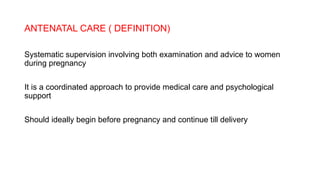
ANTENATAL CARE ( DEFINITION)
Systematic supervision involving both examination and advice to women
during pregnancy
It is a coordinated approach to provide medical care and psychological
support
Should ideally begin before pregnancy and continue till delivery
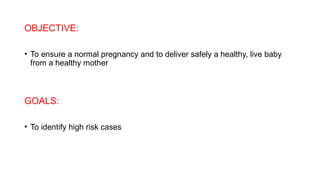
OBJECTIVE:
• To ensure a normal pregnancy and to deliver safely a healthy, live baby
from a healthy mother
GOALS:
• To identify high risk cases
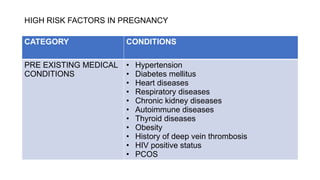
HIGH RISK FACTORS IN PREGNANCY
CATEGORY CONDITIONS
PRE EXISTING MEDICAL
CONDITIONS
• Hypertension
• Diabetes mellitus
• Heart diseases
• Respiratory diseases
• Chronic kidney diseases
• Autoimmune diseases
• Thyroid diseases
• Obesity
• History of deep vein thrombosis
• HIV positive status
• PCOS
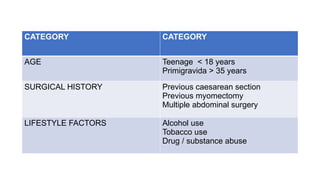
CATEGORY CATEGORY
AGE Teenage < 18 years
Primigravida > 35 years
SURGICAL HISTORY Previous caesarean section
Previous myomectomy
Multiple abdominal surgery
LIFESTYLE FACTORS Alcohol use
Tobacco use
Drug / substance abuse
CATEGORY CATEGORY
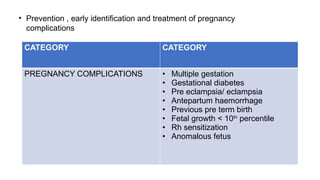
PREGNANCY COMPLICATIONS • Multiple gestation
• Gestational diabetes
• Pre eclampsia/ eclampsia
• Antepartum haemorrhage
• Previous pre term birth
• Fetal growth < 10th
percentile
• Rh sensitization
• Anomalous fetus
• Prevention , early identification and treatment of pregnancy
complications
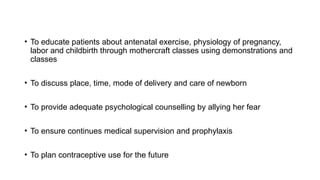
• To educate patients about antenatal exercise, physiology of pregnancy,
labor and childbirth through mothercraft classes using demonstrations and
classes
• To discuss place, time, mode of delivery and care of newborn
• To provide adequate psychological counselling by allying her fear
• To ensure continues medical supervision and prophylaxis
• To plan contraceptive use for the future
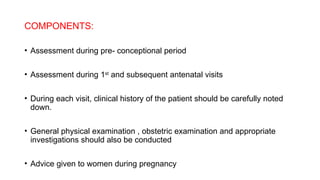
COMPONENTS:
• Assessment during pre- conceptional period
• Assessment during 1st
and subsequent antenatal visits
• During each visit, clinical history of the patient should be carefully noted
down.
• General physical examination , obstetric examination and appropriate
investigations should also be conducted
• Advice given to women during pregnancy
PRE PREGNANCY CARE
Antenatal care should ideally begin before conception while planning
pregnancy
• General check up to confirm physical and mental fitness of the would be
parents
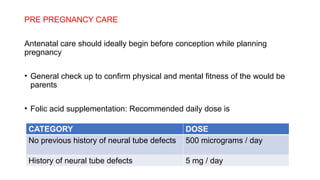
• Folic acid supplementation: Recommended daily dose is
CATEGORY DOSE
No previous history of neural tube defects 500 micrograms / day
History of neural tube defects 5 mg / day
• Immunity to rubella should be checked and immunization given to those
not immune
• Screening for thalassemia ( as incidence is relatively high in India)
• Advice regarding diet and exercise ( more important in obese and
overweight women)
• Hazards of alcohol and tobacco consumption in pregnancy should be
explained and help provided to quit smoking and alcohol consumption
• Periconceptional counselling in women with pre existing medical conditions
such as diabetes, epilepsy, asthma, chronic kidney diseases depression
and optimization of medication and medical condition
DIAGNOSIS OF PREGNANCY:
• Maternal serum or urine hCG levels : Can be detected by 8 to 9 days after
ovulation
• The doubling time of serum hCG is 1.4 to 2 days
CONFIRMATION OF PREGNANCY
SONOGRAPHIC RECOGNITION OF PREGNANCY
• Confirm an intrauterine pregnancy
• Estimate gestational age
• Confirm cardiac activity
• Diagnosis / evaluate a multifetal gestation, including chronicity and
amnionicity
• Assess for certain fetal anomalies, such an anencephaly
• Evaluate for uterine abnormalities or pelvic mass
• Evaluate for suspected ectopic pregnancy
• Evaluate for suspected gestational trophoblastic disease
• Evaluate cause of vaginal bleeding
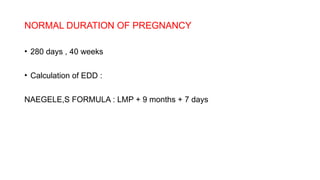
NORMAL DURATION OF PREGNANCY
• 280 days , 40 weeks
• Calculation of EDD :
NAEGELE,S FORMULA : LMP + 9 months + 7 days
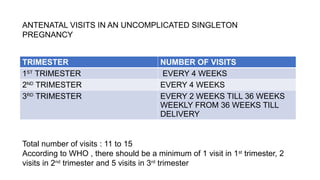
TRIMESTER NUMBER OF VISITS
1ST
TRIMESTER EVERY 4 WEEKS
2ND
TRIMESTER EVERY 4 WEEKS
3RD
TRIMESTER EVERY 2 WEEKS TILL 36 WEEKS
WEEKLY FROM 36 WEEKS TILL
DELIVERY
ANTENATAL VISITS IN AN UNCOMPLICATED SINGLETON
PREGNANCY
Total number of visits : 11 to 15
According to WHO , there should be a minimum of 1 visit in 1st
trimester, 2
visits in 2nd
trimester and 5 visits in 3rd
trimester
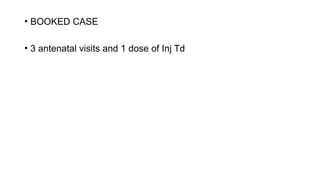
• BOOKED CASE
• 3 antenatal visits and 1 dose of Inj Td
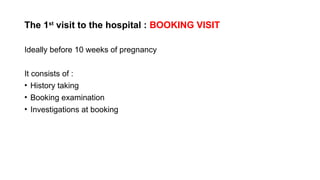
The 1st
visit to the hospital : BOOKING VISIT
Ideally before 10 weeks of pregnancy
It consists of :
• History taking
• Booking examination
• Investigations at booking
HISTORY TAKING
PATIENT PERSONAL:
• Name
• Age
• Religion
• Address
• Date of examination
• Occupation
• Socio – economic status
MENSTRUAL HISTORY:
• First day of last menstrual period ( LMP)
• Regularity of previous menstrual cycles
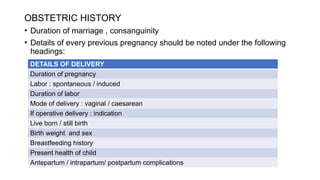
OBSTETRIC HISTORY
• Duration of marriage , consanguinity
• Details of every previous pregnancy should be noted under the following
headings:
DETAILS OF DELIVERY
Duration of pregnancy
Labor : spontaneous / induced
Duration of labor
Mode of delivery : vaginal / caesarean
If operative delivery : indication
Live born / still birth
Birth weight and sex
Breastfeeding history
Present health of child
Antepartum / intrapartum/ postpartum complications
DETAILS OF ABORTION
Period of gestation
Spontaneous / induced
Medical / surgical termination
PAST HISTORY:
• Medical history : History of hypertension, diabetes mellitus, thyroid
disorders, cardiac disorders, asthma , epilepsy , tuberculosis
• Past history of surgical procedures
• Allergies to food or drugs
• History of blood transfusion
• And medications that she is using chronically and whether continues in
pregnancy
FAMILY HISTORY:
• History of hypertension, diabetes mellitus, thyroid disorders, cardiac
disorders, asthma , epilepsy , tuberculosis
• Congenital malformations
• Multiple gestation
PERSONAL HISTORY:
• Diet
• Appetite
• Bowel and bladder
• Smoking and alcohol intake
• Contraceptive practice prior to pregnancy
HISTORY OF PRESENT PREGNANCY:
• Excessive nausea, vomiting
• Fever
• Viral infections
• Drug intake
• Exposure to teratogens
• Irradiation
• When was urine pregnancy test done to confirm pregnancy
• Conception: spontaneous / any drugs used for induction/ ART
• USG confirmation of pregnancy
BOOKING EXAMINATION
GENERAL PHYSICAL EXAMINATION:
• HEIGHT : A short stature : 142 cms or 4 feet 8 inches may be associated
with small pelvis
• Maternal weight
• Body mass index ( BMI) : Weight ( kgs)
Height ( meters) 2
• Built
• Nutrition
• Pallor : Nails, lower palpebral conjunctiva, tongue
To detect anemia
• Examination of sclera : Jaundice
• Neck : Enlarged thyroid , jugular venous pressure, lymphadenopathy
• Legs: Edema
Varicosities
• Pulse rate
• Blood pressure
• Temperature
• BREASTS:
Pregnancy changes and other abnormalities
Nipple : Flat, inverted
Any breast lump , discharge
• CARDIOVASCULAR SYSTEM:
• RESPIRATORY SYSTEM
• ABDOMINAL EXAMINATION
• PAP smear maybe taken , if she is due
INVESTIGATIONS AT BOOKING
• Complete hemogram
• Blood grouping and Rh typing ( Husbands blood group and ICT if
husbands blood group is Rh positive )
• HIV , Hepatitis B , C and VDRL
• RBS
• Serum TSH
• Urine test : Protein , sugar and routine and microscopy
SUBSEQUENT VISITS
• Blood pressure : It is recorded in every visit
• Weight
• Urine analysis for protein: for protein and sugar
• Abdominal examination : done on an empty bladder with patient in dorsal
position and knees slightly flexed
• Look for scars, linea nigra and stria gravidarum, dilated veins, sinuses
• On palpation: Fundal height, symphysio – fundal height, obstetric grips
and adequacy of amniotic fluid
• Auscultation: Fetal heart rate and its location
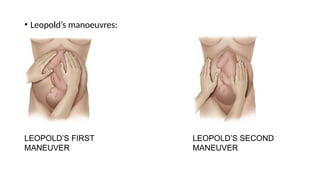
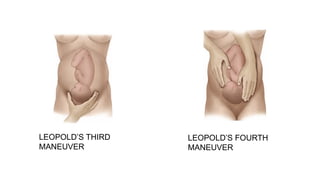
• Leopold’s manoeuvres:
LEOPOLD’S FIRST
MANEUVER
LEOPOLD’S SECOND
MANEUVER
LEOPOLD’S THIRD
MANEUVER
LEOPOLD’S FOURTH
MANEUVER
• ACCORDING TO FOGSI
1ST
VISIT
Ideally prior to 12 weeks
• Identify women who may need additional care and plan pattern of care for
the pregnancy.
• Start folic acid prophylaxis if not started already.
• Check blood group and Rh status.
• Offer screening for anemia, GDM -DIPSI, pre-eclampsia, hepatitis B virus,
HIV, thyroid status, rubella susceptibility, and syphilis
• Offer screening for asymptomatic bacteriuria
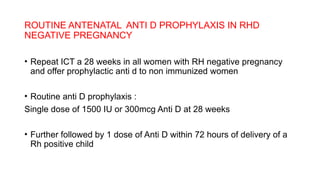
ROUTINE ANTENATAL ANTI D PROPHYLAXIS IN RHD
NEGATIVE PREGNANCY
• Repeat ICT a 28 weeks in all women with RH negative pregnancy
and offer prophylactic anti d to non immunized women
• Routine anti D prophylaxis :
Single dose of 1500 IU or 300mcg Anti D at 28 weeks
• Further followed by 1 dose of Anti D within 72 hours of delivery of a
Rh positive child
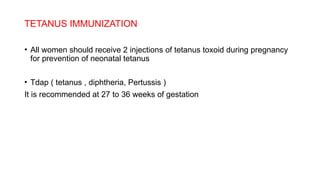
TETANUS IMMUNIZATION
• All women should receive 2 injections of tetanus toxoid during pregnancy
for prevention of neonatal tetanus
• Tdap ( tetanus , diphtheria, Pertussis )
It is recommended at 27 to 36 weeks of gestation
• DIPSI
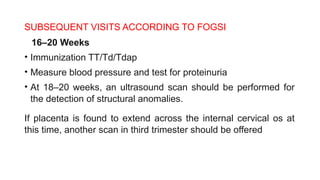
SUBSEQUENT VISITS ACCORDING TO FOGSI
16–20 Weeks
• Immunization TT/Td/Tdap
• Measure blood pressure and test for proteinuria
• At 18–20 weeks, an ultrasound scan should be performed for
the detection of structural anomalies.
If placenta is found to extend across the internal cervical os at
this time, another scan in third trimester should be offered
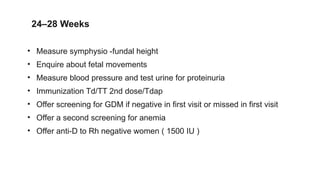
24–28 Weeks
• Measure symphysio -fundal height
• Enquire about fetal movements
• Measure blood pressure and test urine for proteinuria
• Immunization Td/TT 2nd dose/Tdap
• Offer screening for GDM if negative in first visit or missed in first visit
• Offer a second screening for anemia
• Offer anti-D to Rh negative women ( 1500 IU )
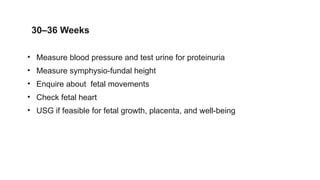
30–36 Weeks
• Measure blood pressure and test urine for proteinuria
• Measure symphysio-fundal height
• Enquire about fetal movements
• Check fetal heart
• USG if feasible for fetal growth, placenta, and well-being
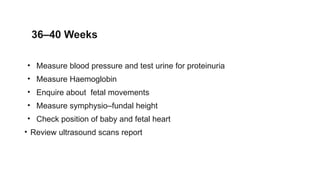
36–40 Weeks
• Measure blood pressure and test urine for proteinuria
• Measure Haemoglobin
• Enquire about fetal movements
• Measure symphysio–fundal height
• Check position of baby and fetal heart
• Review ultrasound scans report
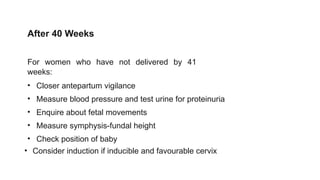
After 40 Weeks
For women who have not delivered by 41
weeks:
• Closer antepartum vigilance
• Measure blood pressure and test urine for proteinuria
• Enquire about fetal movements
• Measure symphysis-fundal height
• Check position of baby
• Consider induction if inducible and favourable cervix
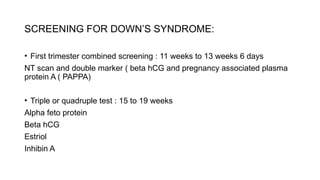
SCREENING FOR DOWN’S SYNDROME:
• First trimester combined screening : 11 weeks to 13 weeks 6 days
NT scan and double marker ( beta hCG and pregnancy associated plasma
protein A ( PAPPA)
• Triple or quadruple test : 15 to 19 weeks
Alpha feto protein
Beta hCG
Estriol
Inhibin A
•NUTRITION
CALORIES
• Eating for two’ is a myth and results only in excessive weight gain
during pregnancy.
• The daily caloric intake should be increased by about 300 kcal, the
normal daily requirements in pregnancy do not generally exceed 2500
kcal.
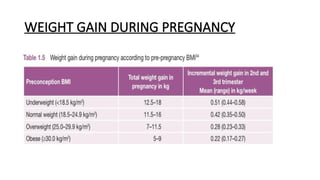
WEIGHT GAIN DURING PREGNANCY
• The weight gain should not exceed 2½ kg in a month or 0.9 kg in a
week.
• Excessive weight gain, in women has been shown to be associated
with increased incidence of gestational hypertension ,Pre-
eclampsia ,gestational diabetes ,macrosomia ,caesarean delivery.
• Low maternal weight gain (<6 kg) in underweight women may be
associated with IUGR.
•PROTEINS
• During the second half of pregnancy, approximately 1000 g of protein
are deposited, amounting to 5 to 6 g/d . To accomplish this, protein
intake that approximates 1 g/kg/d is recommended.
• Meat, poultry, seafood, beans, peas, eggs, processed soy products,
nuts, and seeds all contain protein.
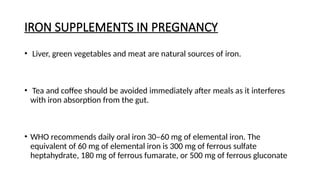
IRON SUPPLEMENTS IN PREGNANCY
• Liver, green vegetables and meat are natural sources of iron.
• Tea and coffee should be avoided immediately after meals as it interferes
with iron absorption from the gut.
• WHO recommends daily oral iron 30–60 mg of elemental iron. The
equivalent of 60 mg of elemental iron is 300 mg of ferrous sulfate
heptahydrate, 180 mg of ferrous fumarate, or 500 mg of ferrous gluconate
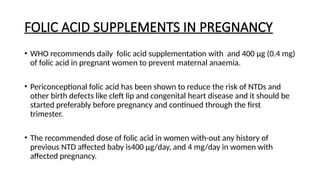
FOLIC ACID SUPPLEMENTS IN PREGNANCY
• WHO recommends daily folic acid supplementation with and 400 µg (0.4 mg)
of folic acid in pregnant women to prevent maternal anaemia.
• Periconceptional folic acid has been shown to reduce the risk of NTDs and
other birth defects like cleft lip and congenital heart disease and it should be
started preferably before pregnancy and continued through the first
trimester.
• The recommended dose of folic acid in women with-out any history of
previous NTD affected baby is400 µg/day, and 4 mg/day in women with
affected pregnancy.
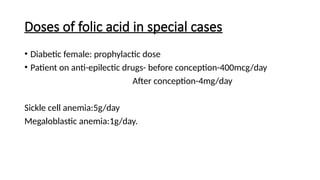
Doses of folic acid in special cases
• Diabetic female: prophylactic dose
• Patient on anti-epilectic drugs- before conception-400mcg/day
After conception-4mg/day
Sickle cell anemia:5g/day
Megaloblastic anemia:1g/day.
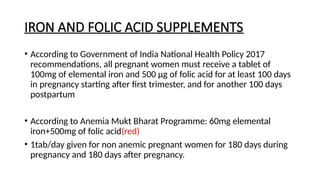
IRON AND FOLIC ACID SUPPLEMENTS
• According to Government of India National Health Policy 2017
recommendations, all pregnant women must receive a tablet of
100mg of elemental iron and 500 µg of folic acid for at least 100 days
in pregnancy starting after first trimester, and for another 100 days
postpartum
• According to Anemia Mukt Bharat Programme: 60mg elemental
iron+500mg of folic acid(red)
• 1tab/day given for non anemic pregnant women for 180 days during
pregnancy and 180 days after pregnancy.
CALCIUM IN PREGNANCY
• RDA-1000mg/day
• In populations with low dietary intake of calcium, WHO recommends 1.5–
2.0 g of oral elemental calcium supplementation daily.
• Sources: Milk, Cheese, Yoghurt,Sardines, dark green leafy vegetables.
• Adequate calcium supplementation may play a role in the prevention of
pregnancy induced hypertension as well. Salt encourages the urinary
excretion of calcium, so its intake should be minimised.
COMMON CONCERNS
1.EMPLOYMENT
2.EXERCISE
3.SEAFOOD CONSUMPTION
4.AUTOMOBILE AND AIR TRAVEL
5.COITUS
6.DENTAL CARE
7.NAUSEA AND HEART BURN
8.PICA AND PTYALISM
9.HEADACHE OR BACKACHE
10.VARICOSITIES AND HEMORRHOIDS
11.SLEEPING
EMPLOYMENT
• The Family and Medical Leave Act of 1993 requires that covered
employers must grant up to 12 work weeks of unpaid leave to an
employee for the birth and care.
• In the absence of complications, most women can continue to work
until labor onset.
• According to the American College of Obstetrics and Gynecologists,
risks of preterm birth are slightly to modestly increased with standing
or walking at work >3hours daily , lifting, and carrying >5kg, or
physically exerting oneself at work.
EXERCISE
• In the absence of contraindications for exercise pregnant women are
encouraged to engage in regular , moderate-intensity physical activity
for atleast 150 minutes each week.
• Examples of Safe activities are walking, running, swimming ,stationary
cycling and low impact aerobics.
• However they should refrain from activities with high risk of falling or
abdominal trauma.
• As a general guideline, 30 minutes or more of moderate exercise a day on
most, if not all, days of the week is recommended for pregnant women.
• Exercise increases the pulse rate, but the blood pressure and temperature
remain unaffected. Being active during pregnancy also helps in reducing
backache, constipation and edema
CONTRAINDICATIONS TO EXERCISE
• Significant cardiovascular or pulmonary disease: chest pain, calf pain
or swelling.
• Significant risk for preterm labor: cerclage, multifetal gestation,
significant bleeding, threatened preterm labor, ruptured membranes.
• Obstetrical complications: preeclampsia, placenta previa, anemia,
poorly controlled diabetes or epilepsy, morbid obesity.
SLEEP
• A minimum of eight hours in bed at night, preferably 10.
• during the afternoon the expectant mother should be encouraged to
lie down or at least put her feet up for an hour.
SMOKING
• mean birth weight of the babies of mothers who smoke is lower and
the prematurity rate higher than in non-smokers
• For the patient who has a known tendency to abort, travel is
contraindicated during the first trimester. Women at risk of preterm
labor should also avoid travel.
• Long car journeys should be interrupted about every two hours in
order to allow a change of position and the re-establishment of
healthy circulation.
TRAVEL
• Travel by air nowadays in pressurized aircraft has no risks to
pregnancy and is particularly suitable for long journeys because it
reduces the travel time.
• In the absence of obstetrical or medical complications, the American
College of Obstetricians and Gynecologists (2018a) has concluded that
pregnant women can safely fly up to 36 weeks' gestation
CAFFEINE
• Heavy Intake of coffee each day-approximately five cups or 500 mg of
caffeine-slightly raises the miscarriage risk.
• CARE Study Group (2008), however, evaluated 2635 low-risk
pregnancies and reported a 1.4-fold risk for fetal-growth restriction
among those whose daily caffeine consumption was > 200 mg/d
compared with those who consumed <100 mg/d
COITUS
• Pregnant women should be informed that sexual intercourse during
pregnancy is not known to be associated with any adverse effects
unless there is a history of bleeding in the pregnancy or a low-lying
placenta.
NAUSEA AND VOMITING
• CAUSE: Hcg+estrogen+progesterone.
• Peaks at 10 weeks of pregnancy due to hcg peak.
• Subsides by 16 weeks of pregnancy.
• TREATMENT: small frequent meals, avoid spicy meals and fatty meals.
DOC: PYRIDOXINE(10MG) + DOXYLAMINE(10MG)
METOCLOPRAMIDE/PROMETHAZINE
ONDENSETRON
PICA AND PTYALISM
• Craving for strange foods is termed as Pica.
• Ice-pagophagia
• Starch-amylophagia
• Clay-geophagia.
• Cravings usually abate once deficiency correction.
• Women during pregnancy are occasionally distressed by profuse
salivation-Ptyalism usually by the ingestion of starch.
BACKACHE
CAUSES-laxity of joints(due to estrogen,relaxin)
Weight gain
Faulty posture
Hyperlordosis
TREATMENT-
Correction of posture
Elevate lower limb while resting
Use of hard bed
Back massage
Analgesics
VARICOSITIES
• Venous leg varicosities have a congenital predisposition.
PATHOPHYSIOLOGY
• Femoral venous pressures in the supine gravida rise from 8 mm Hg in early
pregnancy to 24 mm Hg at term. Thus, leg varicosities typically worsen as
pregnancy advances, especially with prolonged standing.
• Decreased vascular resistance.
• Increased blood volume.
• Progesterone-smooth muscle relaxant
TREATMENT
• AVOID STANDING FOR LONG HOURS
• LEG ELEVATION WHILE RESTING
• USE COMPRESSION STOCKINGS
• LIE IN LEFT LATERAL POSITION.
• NO MEDICAL OR SURGICAL DONE DURING PREGNANCY.
•THANK YOU

ANTENATAL CARE.......................................

  • 1.
    ANTENATAL CARE DR.THEJASWINI BL ASSISTANT PROFESSOR OBGY DEPT SUIMS
  • 2.
    ANTENATAL CARE (DEFINITION) Systematic supervision involving both examination and advice to women during pregnancy It is a coordinated approach to provide medical care and psychological support Should ideally begin before pregnancy and continue till delivery
  • 3.
    OBJECTIVE: • To ensurea normal pregnancy and to deliver safely a healthy, live baby from a healthy mother GOALS: • To identify high risk cases
  • 4.
    HIGH RISK FACTORSIN PREGNANCY CATEGORY CONDITIONS PRE EXISTING MEDICAL CONDITIONS • Hypertension • Diabetes mellitus • Heart diseases • Respiratory diseases • Chronic kidney diseases • Autoimmune diseases • Thyroid diseases • Obesity • History of deep vein thrombosis • HIV positive status • PCOS
  • 5.
    CATEGORY CATEGORY AGE Teenage< 18 years Primigravida > 35 years SURGICAL HISTORY Previous caesarean section Previous myomectomy Multiple abdominal surgery LIFESTYLE FACTORS Alcohol use Tobacco use Drug / substance abuse
  • 6.
    CATEGORY CATEGORY PREGNANCY COMPLICATIONS• Multiple gestation • Gestational diabetes • Pre eclampsia/ eclampsia • Antepartum haemorrhage • Previous pre term birth • Fetal growth < 10th percentile • Rh sensitization • Anomalous fetus • Prevention , early identification and treatment of pregnancy complications
  • 7.
    • To educatepatients about antenatal exercise, physiology of pregnancy, labor and childbirth through mothercraft classes using demonstrations and classes • To discuss place, time, mode of delivery and care of newborn • To provide adequate psychological counselling by allying her fear • To ensure continues medical supervision and prophylaxis • To plan contraceptive use for the future
  • 8.
    COMPONENTS: • Assessment duringpre- conceptional period • Assessment during 1st and subsequent antenatal visits • During each visit, clinical history of the patient should be carefully noted down. • General physical examination , obstetric examination and appropriate investigations should also be conducted • Advice given to women during pregnancy
  • 9.
    PRE PREGNANCY CARE Antenatalcare should ideally begin before conception while planning pregnancy • General check up to confirm physical and mental fitness of the would be parents • Folic acid supplementation: Recommended daily dose is CATEGORY DOSE No previous history of neural tube defects 500 micrograms / day History of neural tube defects 5 mg / day
  • 10.
    • Immunity torubella should be checked and immunization given to those not immune • Screening for thalassemia ( as incidence is relatively high in India) • Advice regarding diet and exercise ( more important in obese and overweight women) • Hazards of alcohol and tobacco consumption in pregnancy should be explained and help provided to quit smoking and alcohol consumption • Periconceptional counselling in women with pre existing medical conditions such as diabetes, epilepsy, asthma, chronic kidney diseases depression and optimization of medication and medical condition
  • 11.
    DIAGNOSIS OF PREGNANCY: •Maternal serum or urine hCG levels : Can be detected by 8 to 9 days after ovulation • The doubling time of serum hCG is 1.4 to 2 days
  • 12.
    CONFIRMATION OF PREGNANCY SONOGRAPHICRECOGNITION OF PREGNANCY • Confirm an intrauterine pregnancy • Estimate gestational age • Confirm cardiac activity • Diagnosis / evaluate a multifetal gestation, including chronicity and amnionicity • Assess for certain fetal anomalies, such an anencephaly • Evaluate for uterine abnormalities or pelvic mass
  • 13.
    • Evaluate forsuspected ectopic pregnancy • Evaluate for suspected gestational trophoblastic disease • Evaluate cause of vaginal bleeding
  • 14.
    NORMAL DURATION OFPREGNANCY • 280 days , 40 weeks • Calculation of EDD : NAEGELE,S FORMULA : LMP + 9 months + 7 days
  • 15.
    TRIMESTER NUMBER OFVISITS 1ST TRIMESTER EVERY 4 WEEKS 2ND TRIMESTER EVERY 4 WEEKS 3RD TRIMESTER EVERY 2 WEEKS TILL 36 WEEKS WEEKLY FROM 36 WEEKS TILL DELIVERY ANTENATAL VISITS IN AN UNCOMPLICATED SINGLETON PREGNANCY Total number of visits : 11 to 15 According to WHO , there should be a minimum of 1 visit in 1st trimester, 2 visits in 2nd trimester and 5 visits in 3rd trimester
  • 16.
    • BOOKED CASE •3 antenatal visits and 1 dose of Inj Td
  • 17.
    The 1st visit tothe hospital : BOOKING VISIT Ideally before 10 weeks of pregnancy It consists of : • History taking • Booking examination • Investigations at booking
  • 18.
    HISTORY TAKING PATIENT PERSONAL: •Name • Age • Religion • Address • Date of examination • Occupation • Socio – economic status
  • 19.
    MENSTRUAL HISTORY: • Firstday of last menstrual period ( LMP) • Regularity of previous menstrual cycles
  • 20.
    OBSTETRIC HISTORY • Durationof marriage , consanguinity • Details of every previous pregnancy should be noted under the following headings: DETAILS OF DELIVERY Duration of pregnancy Labor : spontaneous / induced Duration of labor Mode of delivery : vaginal / caesarean If operative delivery : indication Live born / still birth Birth weight and sex Breastfeeding history Present health of child Antepartum / intrapartum/ postpartum complications
  • 21.
    DETAILS OF ABORTION Periodof gestation Spontaneous / induced Medical / surgical termination
  • 22.
    PAST HISTORY: • Medicalhistory : History of hypertension, diabetes mellitus, thyroid disorders, cardiac disorders, asthma , epilepsy , tuberculosis • Past history of surgical procedures • Allergies to food or drugs • History of blood transfusion • And medications that she is using chronically and whether continues in pregnancy
  • 23.
    FAMILY HISTORY: • Historyof hypertension, diabetes mellitus, thyroid disorders, cardiac disorders, asthma , epilepsy , tuberculosis • Congenital malformations • Multiple gestation
  • 24.
    PERSONAL HISTORY: • Diet •Appetite • Bowel and bladder • Smoking and alcohol intake • Contraceptive practice prior to pregnancy
  • 25.
    HISTORY OF PRESENTPREGNANCY: • Excessive nausea, vomiting • Fever • Viral infections • Drug intake • Exposure to teratogens • Irradiation • When was urine pregnancy test done to confirm pregnancy • Conception: spontaneous / any drugs used for induction/ ART • USG confirmation of pregnancy
  • 26.
    BOOKING EXAMINATION GENERAL PHYSICALEXAMINATION: • HEIGHT : A short stature : 142 cms or 4 feet 8 inches may be associated with small pelvis • Maternal weight • Body mass index ( BMI) : Weight ( kgs) Height ( meters) 2
  • 27.
    • Built • Nutrition •Pallor : Nails, lower palpebral conjunctiva, tongue To detect anemia • Examination of sclera : Jaundice • Neck : Enlarged thyroid , jugular venous pressure, lymphadenopathy • Legs: Edema Varicosities • Pulse rate • Blood pressure • Temperature
  • 28.
    • BREASTS: Pregnancy changesand other abnormalities Nipple : Flat, inverted Any breast lump , discharge • CARDIOVASCULAR SYSTEM: • RESPIRATORY SYSTEM • ABDOMINAL EXAMINATION • PAP smear maybe taken , if she is due
  • 29.
    INVESTIGATIONS AT BOOKING •Complete hemogram • Blood grouping and Rh typing ( Husbands blood group and ICT if husbands blood group is Rh positive ) • HIV , Hepatitis B , C and VDRL • RBS • Serum TSH • Urine test : Protein , sugar and routine and microscopy
  • 30.
    SUBSEQUENT VISITS • Bloodpressure : It is recorded in every visit • Weight • Urine analysis for protein: for protein and sugar • Abdominal examination : done on an empty bladder with patient in dorsal position and knees slightly flexed • Look for scars, linea nigra and stria gravidarum, dilated veins, sinuses • On palpation: Fundal height, symphysio – fundal height, obstetric grips and adequacy of amniotic fluid • Auscultation: Fetal heart rate and its location
  • 31.
    • Leopold’s manoeuvres: LEOPOLD’SFIRST MANEUVER LEOPOLD’S SECOND MANEUVER
  • 32.
  • 33.
    • ACCORDING TOFOGSI 1ST VISIT Ideally prior to 12 weeks • Identify women who may need additional care and plan pattern of care for the pregnancy. • Start folic acid prophylaxis if not started already. • Check blood group and Rh status. • Offer screening for anemia, GDM -DIPSI, pre-eclampsia, hepatitis B virus, HIV, thyroid status, rubella susceptibility, and syphilis • Offer screening for asymptomatic bacteriuria
  • 34.
    ROUTINE ANTENATAL ANTID PROPHYLAXIS IN RHD NEGATIVE PREGNANCY • Repeat ICT a 28 weeks in all women with RH negative pregnancy and offer prophylactic anti d to non immunized women • Routine anti D prophylaxis : Single dose of 1500 IU or 300mcg Anti D at 28 weeks • Further followed by 1 dose of Anti D within 72 hours of delivery of a Rh positive child
  • 35.
    TETANUS IMMUNIZATION • Allwomen should receive 2 injections of tetanus toxoid during pregnancy for prevention of neonatal tetanus • Tdap ( tetanus , diphtheria, Pertussis ) It is recommended at 27 to 36 weeks of gestation
  • 36.
  • 37.
    SUBSEQUENT VISITS ACCORDINGTO FOGSI 16–20 Weeks • Immunization TT/Td/Tdap • Measure blood pressure and test for proteinuria • At 18–20 weeks, an ultrasound scan should be performed for the detection of structural anomalies. If placenta is found to extend across the internal cervical os at this time, another scan in third trimester should be offered
  • 38.
    24–28 Weeks • Measuresymphysio -fundal height • Enquire about fetal movements • Measure blood pressure and test urine for proteinuria • Immunization Td/TT 2nd dose/Tdap • Offer screening for GDM if negative in first visit or missed in first visit • Offer a second screening for anemia • Offer anti-D to Rh negative women ( 1500 IU )
  • 39.
    30–36 Weeks • Measureblood pressure and test urine for proteinuria • Measure symphysio-fundal height • Enquire about fetal movements • Check fetal heart • USG if feasible for fetal growth, placenta, and well-being
  • 40.
    36–40 Weeks • Measureblood pressure and test urine for proteinuria • Measure Haemoglobin • Enquire about fetal movements • Measure symphysio–fundal height • Check position of baby and fetal heart • Review ultrasound scans report
  • 41.
    After 40 Weeks Forwomen who have not delivered by 41 weeks: • Closer antepartum vigilance • Measure blood pressure and test urine for proteinuria • Enquire about fetal movements • Measure symphysis-fundal height • Check position of baby • Consider induction if inducible and favourable cervix
  • 42.
    SCREENING FOR DOWN’SSYNDROME: • First trimester combined screening : 11 weeks to 13 weeks 6 days NT scan and double marker ( beta hCG and pregnancy associated plasma protein A ( PAPPA) • Triple or quadruple test : 15 to 19 weeks Alpha feto protein Beta hCG Estriol Inhibin A
  • 43.
  • 44.
    CALORIES • Eating fortwo’ is a myth and results only in excessive weight gain during pregnancy. • The daily caloric intake should be increased by about 300 kcal, the normal daily requirements in pregnancy do not generally exceed 2500 kcal.
  • 45.
  • 46.
    • The weightgain should not exceed 2½ kg in a month or 0.9 kg in a week. • Excessive weight gain, in women has been shown to be associated with increased incidence of gestational hypertension ,Pre- eclampsia ,gestational diabetes ,macrosomia ,caesarean delivery. • Low maternal weight gain (<6 kg) in underweight women may be associated with IUGR.
  • 47.
    •PROTEINS • During thesecond half of pregnancy, approximately 1000 g of protein are deposited, amounting to 5 to 6 g/d . To accomplish this, protein intake that approximates 1 g/kg/d is recommended. • Meat, poultry, seafood, beans, peas, eggs, processed soy products, nuts, and seeds all contain protein.
  • 48.
    IRON SUPPLEMENTS INPREGNANCY • Liver, green vegetables and meat are natural sources of iron. • Tea and coffee should be avoided immediately after meals as it interferes with iron absorption from the gut. • WHO recommends daily oral iron 30–60 mg of elemental iron. The equivalent of 60 mg of elemental iron is 300 mg of ferrous sulfate heptahydrate, 180 mg of ferrous fumarate, or 500 mg of ferrous gluconate
  • 49.
    FOLIC ACID SUPPLEMENTSIN PREGNANCY • WHO recommends daily folic acid supplementation with and 400 µg (0.4 mg) of folic acid in pregnant women to prevent maternal anaemia. • Periconceptional folic acid has been shown to reduce the risk of NTDs and other birth defects like cleft lip and congenital heart disease and it should be started preferably before pregnancy and continued through the first trimester. • The recommended dose of folic acid in women with-out any history of previous NTD affected baby is400 µg/day, and 4 mg/day in women with affected pregnancy.
  • 50.
    Doses of folicacid in special cases • Diabetic female: prophylactic dose • Patient on anti-epilectic drugs- before conception-400mcg/day After conception-4mg/day Sickle cell anemia:5g/day Megaloblastic anemia:1g/day.
  • 51.
    IRON AND FOLICACID SUPPLEMENTS • According to Government of India National Health Policy 2017 recommendations, all pregnant women must receive a tablet of 100mg of elemental iron and 500 µg of folic acid for at least 100 days in pregnancy starting after first trimester, and for another 100 days postpartum • According to Anemia Mukt Bharat Programme: 60mg elemental iron+500mg of folic acid(red) • 1tab/day given for non anemic pregnant women for 180 days during pregnancy and 180 days after pregnancy.
  • 52.
    CALCIUM IN PREGNANCY •RDA-1000mg/day • In populations with low dietary intake of calcium, WHO recommends 1.5– 2.0 g of oral elemental calcium supplementation daily. • Sources: Milk, Cheese, Yoghurt,Sardines, dark green leafy vegetables. • Adequate calcium supplementation may play a role in the prevention of pregnancy induced hypertension as well. Salt encourages the urinary excretion of calcium, so its intake should be minimised.
  • 53.
  • 54.
    7.NAUSEA AND HEARTBURN 8.PICA AND PTYALISM 9.HEADACHE OR BACKACHE 10.VARICOSITIES AND HEMORRHOIDS 11.SLEEPING
  • 55.
    EMPLOYMENT • The Familyand Medical Leave Act of 1993 requires that covered employers must grant up to 12 work weeks of unpaid leave to an employee for the birth and care. • In the absence of complications, most women can continue to work until labor onset. • According to the American College of Obstetrics and Gynecologists, risks of preterm birth are slightly to modestly increased with standing or walking at work >3hours daily , lifting, and carrying >5kg, or physically exerting oneself at work.
  • 56.
    EXERCISE • In theabsence of contraindications for exercise pregnant women are encouraged to engage in regular , moderate-intensity physical activity for atleast 150 minutes each week. • Examples of Safe activities are walking, running, swimming ,stationary cycling and low impact aerobics. • However they should refrain from activities with high risk of falling or abdominal trauma.
  • 57.
    • As ageneral guideline, 30 minutes or more of moderate exercise a day on most, if not all, days of the week is recommended for pregnant women. • Exercise increases the pulse rate, but the blood pressure and temperature remain unaffected. Being active during pregnancy also helps in reducing backache, constipation and edema
  • 58.
    CONTRAINDICATIONS TO EXERCISE •Significant cardiovascular or pulmonary disease: chest pain, calf pain or swelling. • Significant risk for preterm labor: cerclage, multifetal gestation, significant bleeding, threatened preterm labor, ruptured membranes. • Obstetrical complications: preeclampsia, placenta previa, anemia, poorly controlled diabetes or epilepsy, morbid obesity.
  • 59.
    SLEEP • A minimumof eight hours in bed at night, preferably 10. • during the afternoon the expectant mother should be encouraged to lie down or at least put her feet up for an hour. SMOKING • mean birth weight of the babies of mothers who smoke is lower and the prematurity rate higher than in non-smokers
  • 60.
    • For thepatient who has a known tendency to abort, travel is contraindicated during the first trimester. Women at risk of preterm labor should also avoid travel. • Long car journeys should be interrupted about every two hours in order to allow a change of position and the re-establishment of healthy circulation. TRAVEL
  • 61.
    • Travel byair nowadays in pressurized aircraft has no risks to pregnancy and is particularly suitable for long journeys because it reduces the travel time. • In the absence of obstetrical or medical complications, the American College of Obstetricians and Gynecologists (2018a) has concluded that pregnant women can safely fly up to 36 weeks' gestation
  • 62.
    CAFFEINE • Heavy Intakeof coffee each day-approximately five cups or 500 mg of caffeine-slightly raises the miscarriage risk. • CARE Study Group (2008), however, evaluated 2635 low-risk pregnancies and reported a 1.4-fold risk for fetal-growth restriction among those whose daily caffeine consumption was > 200 mg/d compared with those who consumed <100 mg/d
  • 63.
    COITUS • Pregnant womenshould be informed that sexual intercourse during pregnancy is not known to be associated with any adverse effects unless there is a history of bleeding in the pregnancy or a low-lying placenta.
  • 64.
    NAUSEA AND VOMITING •CAUSE: Hcg+estrogen+progesterone. • Peaks at 10 weeks of pregnancy due to hcg peak. • Subsides by 16 weeks of pregnancy. • TREATMENT: small frequent meals, avoid spicy meals and fatty meals. DOC: PYRIDOXINE(10MG) + DOXYLAMINE(10MG) METOCLOPRAMIDE/PROMETHAZINE ONDENSETRON
  • 65.
    PICA AND PTYALISM •Craving for strange foods is termed as Pica. • Ice-pagophagia • Starch-amylophagia • Clay-geophagia. • Cravings usually abate once deficiency correction. • Women during pregnancy are occasionally distressed by profuse salivation-Ptyalism usually by the ingestion of starch.
  • 66.
    BACKACHE CAUSES-laxity of joints(dueto estrogen,relaxin) Weight gain Faulty posture Hyperlordosis TREATMENT- Correction of posture Elevate lower limb while resting Use of hard bed Back massage Analgesics
  • 67.
    VARICOSITIES • Venous legvaricosities have a congenital predisposition. PATHOPHYSIOLOGY • Femoral venous pressures in the supine gravida rise from 8 mm Hg in early pregnancy to 24 mm Hg at term. Thus, leg varicosities typically worsen as pregnancy advances, especially with prolonged standing. • Decreased vascular resistance. • Increased blood volume. • Progesterone-smooth muscle relaxant
  • 68.
    TREATMENT • AVOID STANDINGFOR LONG HOURS • LEG ELEVATION WHILE RESTING • USE COMPRESSION STOCKINGS • LIE IN LEFT LATERAL POSITION. • NO MEDICAL OR SURGICAL DONE DURING PREGNANCY.
  • 69.