Lymphatics and the Immune
System
2
Lymphatic System
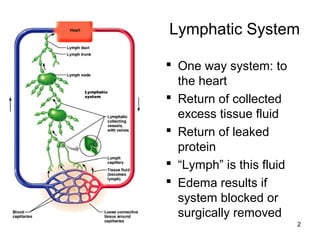
 One way system: to
the heart
 Return of collected
excess tissue fluid
 Return of leaked
protein
 “Lymph” is this fluid
 Edema results if
system blocked or
surgically removed
3
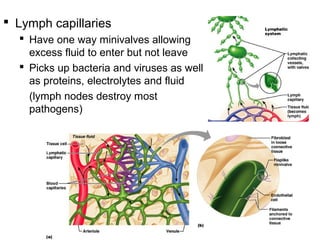
 Lymph capillaries
 Have one way minivalves allowing
excess fluid to enter but not leave
 Picks up bacteria and viruses as well
as proteins, electrolytes and fluid
(lymph nodes destroy most
pathogens)
4
5
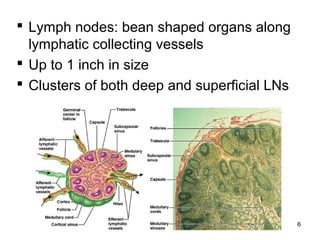
 Lymph capillaries
 Absent from bone, bone marrow, teeth, CNS
 Enter lymphatic collecting vessels
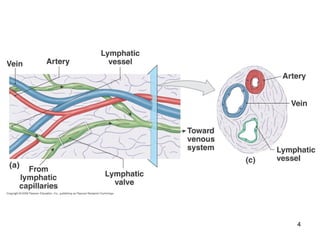
 Lymphatic collecting vessels
 Similar to blood vessels (3 layers), but thin & delicate
 Superficial ones in skin travel with superficial veins
 Deep ones of trunk and digestive viscera travel with
deep arteries
 Very low pressure
 Distinctive appearance on lymphangiography
 Drain into lymph nodes
6
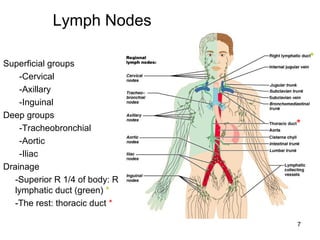
 Lymph nodes: bean shaped organs along
lymphatic collecting vessels
 Up to 1 inch in size
 Clusters of both deep and superficial LNs
7
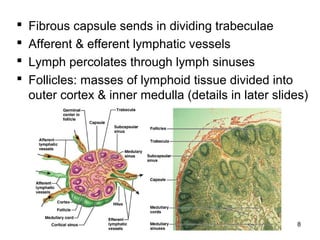
Superficial groups
-Cervical
-Axillary
-Inguinal
Deep groups
-Tracheobronchial
-Aortic
-Iliac
Drainage
-Superior R 1/4 of body: R
lymphatic duct (green) *
-The rest: thoracic duct *
Lymph Nodes
*
*
8
 Fibrous capsule sends in dividing trabeculae
 Afferent & efferent lymphatic vessels
 Lymph percolates through lymph sinuses
 Follicles: masses of lymphoid tissue divided into
outer cortex & inner medulla (details in later slides)
9
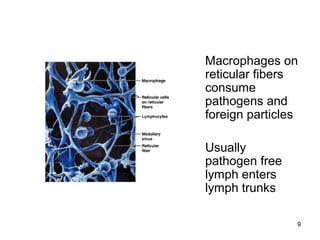
Macrophages on
reticular fibers
consume
pathogens and
foreign particles
Usually
pathogen free
lymph enters
lymph trunks
10
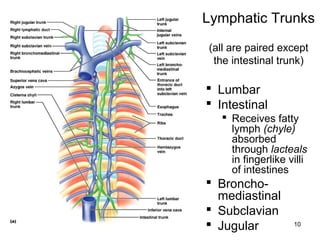
Lymphatic Trunks
(all are paired except
the intestinal trunk)
 Lumbar
 Intestinal
 Receives fatty
lymph (chyle)
absorbed
through lacteals
in fingerlike villi
of intestines
 Broncho-
mediastinal
 Subclavian
 Jugular
11
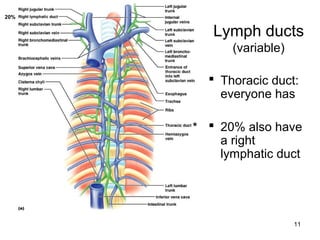
Lymph ducts
(variable)
 Thoracic duct:
everyone has
 20% also have
a right
lymphatic duct
*
20%
12
13
The Immune System
 Recognizes specific foreign molecules
 Each exposure (to the same pathogen) increases the
effectivity of the response
 Lymphoid organs
 Lymph nodes
 Spleen
 Thymus
 Tonsils
 Small intestine & appendix aggregated lymphoid
nodules
14
Basic Immunology
 Depends on the ability of the immune system to
distinguish between self and non-self molecules
 Self molecules are those components of an
organism's body that can be distinguished from
foreign substances by the immune system
 Autoimmunity is an immune reaction against self
molecules (causes various diseases)
 Non-self molecules are those recognized as
foreign molecules
 One class of non-self molecules are called antigens
(short for antibody generators) and are defined as
substances that bind to specific immune receptors
and elicit an immune response
15
Lymphocytes
the primary cells of the lymphoid system
 Respond to:
 Invading organisms
 Abnormal body cells, such as virus-infected
cells or cancer cells
 Foreign proteins such as the toxins released
by some bacteria
 Types of lymphocytes
 T cells (thymus-dependent)
 B cells (bone marrow-derived)
 NK cells (natural killer)
16
T Cells
 80% of circulating lymphocytes
 Some of the types:
 Cytotoxic T cells: attack foreign cells or body
cells infected by viruses (“cell-mediated
immunity”)
 Regulatory T cells: Helper T cells and
suppressor T cells (control activation and
activity of B cells)
 Memory T cells: produced by the division of
activated T cells following exposure to a
particular antigen (remain on reserve, to be
reactivated following later exposure to the
same antigen)
17
B Cells
 10-15% of circulating lymphocytes
 Can differentiate into plasmocytes (plasma cells)
when stimulated by exposure to an antigen
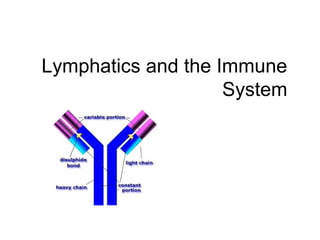
 Plasma cells produce antibodies: soluble
proteins which react with antigens, also known
as immunoglobulins (Ig’s)
 “Humoral immunity”, or antibody-mediated
immunity
 Memory B cells: produced by the division of
activated B cells following exposure to a
particular antigen (remain on reserve, to be
reactivated following later exposure to the same
antigen)
18
NK Cells
 5-10% of circulating lymphocytes
 Attack foreign cells, normal cels infected
with viruses, cancer cells that appear in
normal tissues
 Known as “immunologic surveillance”
19
“Humoral” vs “Cell mediated”
 Cell-mediated immunity - direct attack by activated
T cells (react with foreign antigens on the surface of
other host cells)
 Antibody-mediated (humoral) immunity – attack
by circulating antibodies, also called immunoglobins
(Ig’s), released by the plasma cells derived from
activated B cells
“humor” – from old-fashioned word for stuff in the blood,
like ‘good humors’ and ‘bad humors’
These two systems interact with each other
20
B Lymphocytes
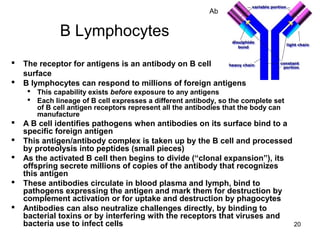
 The receptor for antigens is an antibody on B cell
surface
 B lymphocytes can respond to millions of foreign antigens
 This capability exists before exposure to any antigens
 Each lineage of B cell expresses a different antibody, so the complete set
of B cell antigen receptors represent all the antibodies that the body can
manufacture
 A B cell identifies pathogens when antibodies on its surface bind to a
specific foreign antigen
 This antigen/antibody complex is taken up by the B cell and processed
by proteolysis into peptides (small pieces)
 As the activated B cell then begins to divide (“clonal expansion”), its
offspring secrete millions of copies of the antibody that recognizes
this antigen
 These antibodies circulate in blood plasma and lymph, bind to
pathogens expressing the antigen and mark them for destruction by
complement activation or for uptake and destruction by phagocytes
 Antibodies can also neutralize challenges directly, by binding to
bacterial toxins or by interfering with the receptors that viruses and
bacteria use to infect cells
Ab
21
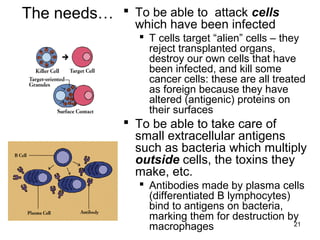
The needs…  To be able to attack cells
which have been infected
 T cells target “alien” cells – they
reject transplanted organs,
destroy our own cells that have
been infected, and kill some
cancer cells: these are all treated
as foreign because they have
altered (antigenic) proteins on
their surfaces
 To be able to take care of
small extracellular antigens
such as bacteria which multiply
outside cells, the toxins they
make, etc.
 Antibodies made by plasma cells
(differentiated B lymphocytes)
bind to antigens on bacteria,
marking them for destruction by
macrophages
22
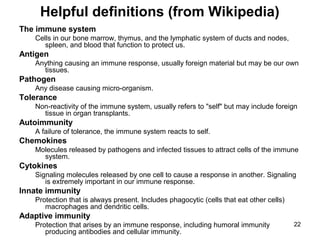
Helpful definitions (from Wikipedia)
The immune system
Cells in our bone marrow, thymus, and the lymphatic system of ducts and nodes,
spleen, and blood that function to protect us.
Antigen
Anything causing an immune response, usually foreign material but may be our own
tissues.
Pathogen
Any disease causing micro-organism.
Tolerance
Non-reactivity of the immune system, usually refers to "self" but may include foreign
tissue in organ transplants.
Autoimmunity
A failure of tolerance, the immune system reacts to self.
Chemokines
Molecules released by pathogens and infected tissues to attract cells of the immune
system.
Cytokines
Signaling molecules released by one cell to cause a response in another. Signaling
is extremely important in our immune response.
Innate immunity
Protection that is always present. Includes phagocytic (cells that eat other cells)
macrophages and dendritic cells.
Adaptive immunity
Protection that arises by an immune response, including humoral immunity
producing antibodies and cellular immunity.
23
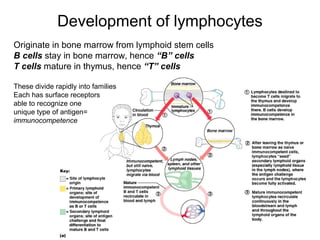
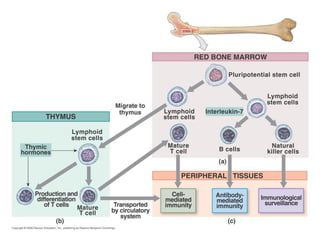
Development of lymphocytes
Originate in bone marrow from lymphoid stem cells
B cells stay in bone marrow, hence “B” cells
T cells mature in thymus, hence “T” cells
These divide rapidly into families
Each has surface receptors
able to recognize one
unique type of antigen=
immunocompetence
24
25
Lymphocytes
 Naive immunocompetent lymphocytes “seed”
secondary lymphoid organs (esp. lymph nodes)
 “Antigenic challenge” – full activation upon
meeting and binding with specific antigen
 The B cell’s antigen receptor is an antibody (see slide
20)
 Full activation
 Gains ability to attack its antigen
 Proliferates rapidly producing mature lymphocytes
 Mature lymphocytes re-circulate seeking same
pathogens
26
Immunologic Memory
 When B cells and T cells are activated and begin to
replicate, some of their offspring will become long-lived
memory cells
 Throughout the lifetime of an animal, these memory cells
will remember each specific pathogen encountered and
can mount a strong response if the pathogen is detected
again
 This is "adaptive" because it occurs during the lifetime
of an individual as an adaptation to infection with that
pathogen and prepares the immune system for future
challenges
 For example immunity to chicken pox after you’ve had
it
 Immunological memory can either be in the form of
passive short-term memory or active long-term memory
 Example of passive immunity: the antibodies in breast
milk (wanes within a short time, weeks to months)
27
The immune system protects organisms with
layered defenses of increasing specificity
 Most simply, 1. physical barriers prevent pathogens such
as bacteria and viruses from entering the body
 If a pathogen breaches these barriers, the 2. innate
immune system provides an immediate, but non-specific
response
 Innate immune systems are found in all plants and animals
 If pathogens successfully evade the innate response,
vertebrates possess a third layer of protection, the 3.
adaptive immune system
 Here, the immune system adapts its response during an infection to
improve its recognition of the pathogen
 This improved response is then retained after the pathogen has
been eliminated, in the form of an immunological memory, and
allows the adaptive immune system to mount faster and stronger
attacks each time this pathogen is encountered
28
Components of the immune system
Innate immune system
 Response is non-specific
 Exposure leads to
immediate maximal
response
 Cell-mediated and
humoral components
 No immunological
memory
 Found in nearly all forms
of life (plants & animals)
Adaptive immune system
 Pathogen and antigen
specific response
 Lag time between
exposure and maximal
response
 Cell-mediated and
humoral components
 Exposure leads to
immunologic memory
 Found only in jawed
vertebrates
29
Innate immunity
 The dominant system of host defense in most
organisms
 Inflammation is one of the first responses
 Redness, swelling, heat and pain
 Chemical and cellular response
 During the acute phase of inflammation, particularly
as a result of bacterial infection, neutrophils migrate
toward the site of inflammation in a process called
chemotaxis, and are usually the first cells to arrive at
the scene of infection
30
Innate immunity continued
 The innate leukocytes include the phagocytes
(macrophages, neutrophils, and dendritic cells),
mast cells, eosinophils, basophils, and natural
killer cells
 These cells identify and eliminate pathogens,
either by attacking larger pathogens through
contact or by engulfing and then killing
microorganisms
 Innate cells are also important mediators in the
activation of the adaptive immune system
31
Innate immunity continued
 Macrophages are versatile cells that
reside within tissues and produce a wide
array of chemicals including enzymes,
complement proteins, and regulatory
factors such as interleukin 1
 Macrophages also act as scavengers, ridding
the body of worn-out cells and other debris
 Also as antigen-presenting cells that
activate the adaptive immune system
32
Innate system continued
 Dendritic cells are phagocytes in tissues that
are in contact with the external environment
 Located mainly in the skin, nose, lungs, stomach, and
intestines (are in no way connected to the nervous
system)
 Dendritic cells serve as a link between the innate and
adaptive immune systems, as they present antigens
to T cells, one of the key cell types of the adaptive
immune system
 Mast cells reside in connective tissues and
mucous membranes, and regulate the
inflammatory response
 They are most often associated with allergy and
anaphylaxis (for example, they release histamine –
this is why anti-histamines help allergic reactions)
33
Phagocytosis
 Phagocytosis is an important feature of cellular innate
immunity performed by cells called 'phagocytes' that
engulf, or eat, pathogens or particles
 Phagocytes generally patrol the body searching for
pathogens, but can be called to specific locations by
cytokines
 The pathogen is killed by the activity of digestive
enzymes or following a respiratory burst that releases
free radicals into the phagolysosome
 Phagocytosis probably represents the oldest form of host
defense, as phagocytes have been identified in both
vertebrate and invertebrate animals
34
Adaptive immunity
 The adaptive immune system evolved in early vertebrates
and allows for a stronger immune response as well as
immunological memory, where each pathogen is
"remembered" by its signature antigen
 The adaptive immune response is antigen-specific and
requires the recognition of specific “non-self” antigens
during a process called antigen presentation
 Antigen specificity allows for the generation of responses
that are tailored to specific pathogens or pathogen-
infected cells
 The ability to mount these tailored responses is
maintained in the body by "memory cells“
 Should a pathogen infect the body more than once, these
specific memory cells are used to quickly eliminate it
35
Optional slide (in more detail next slide)
 MHC = Major HistoCompatibility
 Self proteins
 Class 1: on most nucleated cells
 Class II: only on a few cells (B lymphocytes &
macrophages) which interact with Th cells
 CD8+ = proteins associated with Tc
(cytotoxic or killer T cells)
 CD4+ = proteins associated with Th
(helper T cells)
 Reduced in AIDS
36
MHC = Major HistoCompatibility
Are “self” proteins, and have the most genetic (person to person) variability
Class I: on most nucleated cells
Class II: only on a few cells (B lymphocytes & macrophages) which interact
with Th cells
CD8 is a protein on Tc’s (cytotoxic or killer T cells) which recognizes class
I MHCs
-The class I MHC binds the Ag inside the body’s cell (any cell) which
is being made because of its infection, and takes it to the surface of
the cell
-The Tc cell recognizes Ag as foreign so treats this cell of the body as
foreign and sends a chemical signal to cell for it to self-destruct (by
apoptosis = programmed cell death)
CD4 is a protein on Th (helper T cells) which recognizes class II MHCs
-Class II MHC cells are only B lymphocytes and macrophages: these
take up extracellular antigens, e.g. bacteria which multiply outside
cells, toxins produced by bacteria, etc.; MCH II binds these, takes
them to surface, so the lymphocyte become an “antigen presenting
cell”
-Helper (CD4) T cells secrete cytokines which stimulate the
proliferation of activated B cells, cytotoxic T cells (CD8+) and
macrophages and amplify their response
Optional slide
37
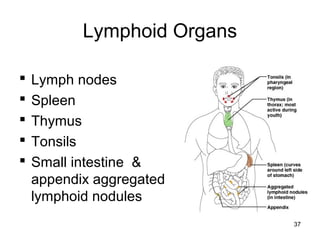
Lymphoid Organs
 Lymph nodes
 Spleen
 Thymus
 Tonsils
 Small intestine &
appendix aggregated
lymphoid nodules
38
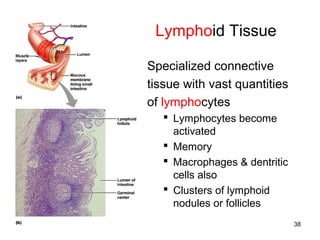
Lymphoid Tissue
Specialized connective
tissue with vast quantities
of lymphocytes
 Lymphocytes become
activated
 Memory
 Macrophages & dentritic
cells also
 Clusters of lymphoid
nodules or follicles
39
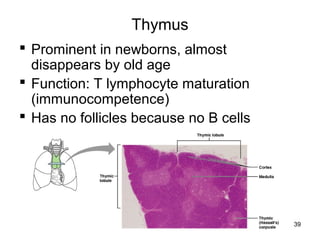
Thymus
 Prominent in newborns, almost
disappears by old age
 Function: T lymphocyte maturation
(immunocompetence)
 Has no follicles because no B cells
40
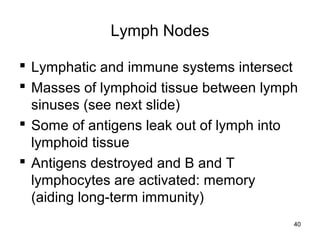
Lymph Nodes
 Lymphatic and immune systems intersect
 Masses of lymphoid tissue between lymph
sinuses (see next slide)
 Some of antigens leak out of lymph into
lymphoid tissue
 Antigens destroyed and B and T
lymphocytes are activated: memory
(aiding long-term immunity)
41
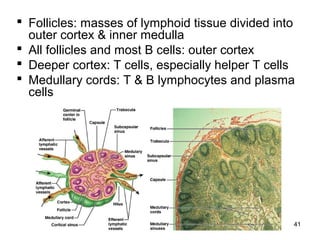
 Follicles: masses of lymphoid tissue divided into
outer cortex & inner medulla
 All follicles and most B cells: outer cortex
 Deeper cortex: T cells, especially helper T cells
 Medullary cords: T & B lymphocytes and plasma
cells
42
43
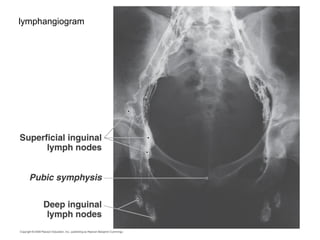
lymphangiogram
44
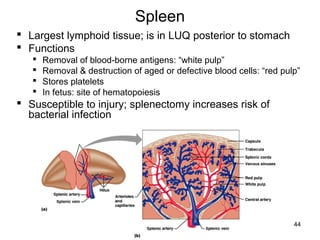
Spleen
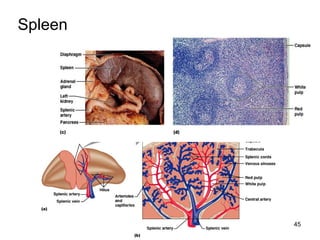
 Largest lymphoid tissue; is in LUQ posterior to stomach
 Functions
 Removal of blood-borne antigens: “white pulp”
 Removal & destruction of aged or defective blood cells: “red pulp”
 Stores platelets
 In fetus: site of hematopoiesis
 Susceptible to injury; splenectomy increases risk of
bacterial infection
45
Spleen
46
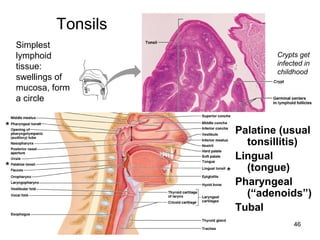
Palatine (usual
tonsillitis)
Lingual
(tongue)
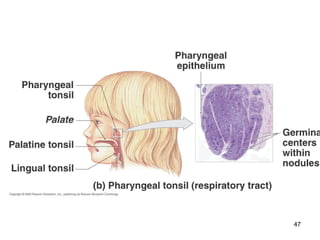
Pharyngeal
(“adenoids”)
Tubal
Tonsils
*
*
*
Simplest
lymphoid
tissue:
swellings of
mucosa, form
a circle
Crypts get
infected in
childhood
47
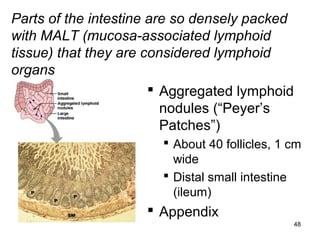
48
 Aggregated lymphoid
nodules (“Peyer’s
Patches”)
 About 40 follicles, 1 cm
wide
 Distal small intestine
(ileum)
 Appendix
Parts of the intestine are so densely packed
with MALT (mucosa-associated lymphoid
tissue) that they are considered lymphoid
organs

Anatomy lab. 8 lymphatics & immune sys.

  • 1.
    Lymphatics and theImmune System
  • 2.
    2 Lymphatic System  Oneway system: to the heart  Return of collected excess tissue fluid  Return of leaked protein  “Lymph” is this fluid  Edema results if system blocked or surgically removed
  • 3.
    3  Lymph capillaries Have one way minivalves allowing excess fluid to enter but not leave  Picks up bacteria and viruses as well as proteins, electrolytes and fluid (lymph nodes destroy most pathogens)
  • 4.
  • 5.
    5  Lymph capillaries Absent from bone, bone marrow, teeth, CNS  Enter lymphatic collecting vessels  Lymphatic collecting vessels  Similar to blood vessels (3 layers), but thin & delicate  Superficial ones in skin travel with superficial veins  Deep ones of trunk and digestive viscera travel with deep arteries  Very low pressure  Distinctive appearance on lymphangiography  Drain into lymph nodes
  • 6.
    6  Lymph nodes:bean shaped organs along lymphatic collecting vessels  Up to 1 inch in size  Clusters of both deep and superficial LNs
  • 7.
    7 Superficial groups -Cervical -Axillary -Inguinal Deep groups -Tracheobronchial -Aortic -Iliac Drainage -SuperiorR 1/4 of body: R lymphatic duct (green) * -The rest: thoracic duct * Lymph Nodes * *
  • 8.
    8  Fibrous capsulesends in dividing trabeculae  Afferent & efferent lymphatic vessels  Lymph percolates through lymph sinuses  Follicles: masses of lymphoid tissue divided into outer cortex & inner medulla (details in later slides)
  • 9.
    9 Macrophages on reticular fibers consume pathogensand foreign particles Usually pathogen free lymph enters lymph trunks
  • 10.
    10 Lymphatic Trunks (all arepaired except the intestinal trunk)  Lumbar  Intestinal  Receives fatty lymph (chyle) absorbed through lacteals in fingerlike villi of intestines  Broncho- mediastinal  Subclavian  Jugular
  • 11.
    11 Lymph ducts (variable)  Thoracicduct: everyone has  20% also have a right lymphatic duct * 20%
  • 12.
  • 13.
    13 The Immune System Recognizes specific foreign molecules  Each exposure (to the same pathogen) increases the effectivity of the response  Lymphoid organs  Lymph nodes  Spleen  Thymus  Tonsils  Small intestine & appendix aggregated lymphoid nodules
  • 14.
    14 Basic Immunology  Dependson the ability of the immune system to distinguish between self and non-self molecules  Self molecules are those components of an organism's body that can be distinguished from foreign substances by the immune system  Autoimmunity is an immune reaction against self molecules (causes various diseases)  Non-self molecules are those recognized as foreign molecules  One class of non-self molecules are called antigens (short for antibody generators) and are defined as substances that bind to specific immune receptors and elicit an immune response
  • 15.
    15 Lymphocytes the primary cellsof the lymphoid system  Respond to:  Invading organisms  Abnormal body cells, such as virus-infected cells or cancer cells  Foreign proteins such as the toxins released by some bacteria  Types of lymphocytes  T cells (thymus-dependent)  B cells (bone marrow-derived)  NK cells (natural killer)
  • 16.
    16 T Cells  80%of circulating lymphocytes  Some of the types:  Cytotoxic T cells: attack foreign cells or body cells infected by viruses (“cell-mediated immunity”)  Regulatory T cells: Helper T cells and suppressor T cells (control activation and activity of B cells)  Memory T cells: produced by the division of activated T cells following exposure to a particular antigen (remain on reserve, to be reactivated following later exposure to the same antigen)
  • 17.
    17 B Cells  10-15%of circulating lymphocytes  Can differentiate into plasmocytes (plasma cells) when stimulated by exposure to an antigen  Plasma cells produce antibodies: soluble proteins which react with antigens, also known as immunoglobulins (Ig’s)  “Humoral immunity”, or antibody-mediated immunity  Memory B cells: produced by the division of activated B cells following exposure to a particular antigen (remain on reserve, to be reactivated following later exposure to the same antigen)
  • 18.
    18 NK Cells  5-10%of circulating lymphocytes  Attack foreign cells, normal cels infected with viruses, cancer cells that appear in normal tissues  Known as “immunologic surveillance”
  • 19.
    19 “Humoral” vs “Cellmediated”  Cell-mediated immunity - direct attack by activated T cells (react with foreign antigens on the surface of other host cells)  Antibody-mediated (humoral) immunity – attack by circulating antibodies, also called immunoglobins (Ig’s), released by the plasma cells derived from activated B cells “humor” – from old-fashioned word for stuff in the blood, like ‘good humors’ and ‘bad humors’ These two systems interact with each other
  • 20.
    20 B Lymphocytes  Thereceptor for antigens is an antibody on B cell surface  B lymphocytes can respond to millions of foreign antigens  This capability exists before exposure to any antigens  Each lineage of B cell expresses a different antibody, so the complete set of B cell antigen receptors represent all the antibodies that the body can manufacture  A B cell identifies pathogens when antibodies on its surface bind to a specific foreign antigen  This antigen/antibody complex is taken up by the B cell and processed by proteolysis into peptides (small pieces)  As the activated B cell then begins to divide (“clonal expansion”), its offspring secrete millions of copies of the antibody that recognizes this antigen  These antibodies circulate in blood plasma and lymph, bind to pathogens expressing the antigen and mark them for destruction by complement activation or for uptake and destruction by phagocytes  Antibodies can also neutralize challenges directly, by binding to bacterial toxins or by interfering with the receptors that viruses and bacteria use to infect cells Ab
  • 21.
    21 The needs… To be able to attack cells which have been infected  T cells target “alien” cells – they reject transplanted organs, destroy our own cells that have been infected, and kill some cancer cells: these are all treated as foreign because they have altered (antigenic) proteins on their surfaces  To be able to take care of small extracellular antigens such as bacteria which multiply outside cells, the toxins they make, etc.  Antibodies made by plasma cells (differentiated B lymphocytes) bind to antigens on bacteria, marking them for destruction by macrophages
  • 22.
    22 Helpful definitions (fromWikipedia) The immune system Cells in our bone marrow, thymus, and the lymphatic system of ducts and nodes, spleen, and blood that function to protect us. Antigen Anything causing an immune response, usually foreign material but may be our own tissues. Pathogen Any disease causing micro-organism. Tolerance Non-reactivity of the immune system, usually refers to "self" but may include foreign tissue in organ transplants. Autoimmunity A failure of tolerance, the immune system reacts to self. Chemokines Molecules released by pathogens and infected tissues to attract cells of the immune system. Cytokines Signaling molecules released by one cell to cause a response in another. Signaling is extremely important in our immune response. Innate immunity Protection that is always present. Includes phagocytic (cells that eat other cells) macrophages and dendritic cells. Adaptive immunity Protection that arises by an immune response, including humoral immunity producing antibodies and cellular immunity.
  • 23.
    23 Development of lymphocytes Originatein bone marrow from lymphoid stem cells B cells stay in bone marrow, hence “B” cells T cells mature in thymus, hence “T” cells These divide rapidly into families Each has surface receptors able to recognize one unique type of antigen= immunocompetence
  • 24.
  • 25.
    25 Lymphocytes  Naive immunocompetentlymphocytes “seed” secondary lymphoid organs (esp. lymph nodes)  “Antigenic challenge” – full activation upon meeting and binding with specific antigen  The B cell’s antigen receptor is an antibody (see slide 20)  Full activation  Gains ability to attack its antigen  Proliferates rapidly producing mature lymphocytes  Mature lymphocytes re-circulate seeking same pathogens
  • 26.
    26 Immunologic Memory  WhenB cells and T cells are activated and begin to replicate, some of their offspring will become long-lived memory cells  Throughout the lifetime of an animal, these memory cells will remember each specific pathogen encountered and can mount a strong response if the pathogen is detected again  This is "adaptive" because it occurs during the lifetime of an individual as an adaptation to infection with that pathogen and prepares the immune system for future challenges  For example immunity to chicken pox after you’ve had it  Immunological memory can either be in the form of passive short-term memory or active long-term memory  Example of passive immunity: the antibodies in breast milk (wanes within a short time, weeks to months)
  • 27.
    27 The immune systemprotects organisms with layered defenses of increasing specificity  Most simply, 1. physical barriers prevent pathogens such as bacteria and viruses from entering the body  If a pathogen breaches these barriers, the 2. innate immune system provides an immediate, but non-specific response  Innate immune systems are found in all plants and animals  If pathogens successfully evade the innate response, vertebrates possess a third layer of protection, the 3. adaptive immune system  Here, the immune system adapts its response during an infection to improve its recognition of the pathogen  This improved response is then retained after the pathogen has been eliminated, in the form of an immunological memory, and allows the adaptive immune system to mount faster and stronger attacks each time this pathogen is encountered
  • 28.
    28 Components of theimmune system Innate immune system  Response is non-specific  Exposure leads to immediate maximal response  Cell-mediated and humoral components  No immunological memory  Found in nearly all forms of life (plants & animals) Adaptive immune system  Pathogen and antigen specific response  Lag time between exposure and maximal response  Cell-mediated and humoral components  Exposure leads to immunologic memory  Found only in jawed vertebrates
  • 29.
    29 Innate immunity  Thedominant system of host defense in most organisms  Inflammation is one of the first responses  Redness, swelling, heat and pain  Chemical and cellular response  During the acute phase of inflammation, particularly as a result of bacterial infection, neutrophils migrate toward the site of inflammation in a process called chemotaxis, and are usually the first cells to arrive at the scene of infection
  • 30.
    30 Innate immunity continued The innate leukocytes include the phagocytes (macrophages, neutrophils, and dendritic cells), mast cells, eosinophils, basophils, and natural killer cells  These cells identify and eliminate pathogens, either by attacking larger pathogens through contact or by engulfing and then killing microorganisms  Innate cells are also important mediators in the activation of the adaptive immune system
  • 31.
    31 Innate immunity continued Macrophages are versatile cells that reside within tissues and produce a wide array of chemicals including enzymes, complement proteins, and regulatory factors such as interleukin 1  Macrophages also act as scavengers, ridding the body of worn-out cells and other debris  Also as antigen-presenting cells that activate the adaptive immune system
  • 32.
    32 Innate system continued Dendritic cells are phagocytes in tissues that are in contact with the external environment  Located mainly in the skin, nose, lungs, stomach, and intestines (are in no way connected to the nervous system)  Dendritic cells serve as a link between the innate and adaptive immune systems, as they present antigens to T cells, one of the key cell types of the adaptive immune system  Mast cells reside in connective tissues and mucous membranes, and regulate the inflammatory response  They are most often associated with allergy and anaphylaxis (for example, they release histamine – this is why anti-histamines help allergic reactions)
  • 33.
    33 Phagocytosis  Phagocytosis isan important feature of cellular innate immunity performed by cells called 'phagocytes' that engulf, or eat, pathogens or particles  Phagocytes generally patrol the body searching for pathogens, but can be called to specific locations by cytokines  The pathogen is killed by the activity of digestive enzymes or following a respiratory burst that releases free radicals into the phagolysosome  Phagocytosis probably represents the oldest form of host defense, as phagocytes have been identified in both vertebrate and invertebrate animals
  • 34.
    34 Adaptive immunity  Theadaptive immune system evolved in early vertebrates and allows for a stronger immune response as well as immunological memory, where each pathogen is "remembered" by its signature antigen  The adaptive immune response is antigen-specific and requires the recognition of specific “non-self” antigens during a process called antigen presentation  Antigen specificity allows for the generation of responses that are tailored to specific pathogens or pathogen- infected cells  The ability to mount these tailored responses is maintained in the body by "memory cells“  Should a pathogen infect the body more than once, these specific memory cells are used to quickly eliminate it
  • 35.
    35 Optional slide (inmore detail next slide)  MHC = Major HistoCompatibility  Self proteins  Class 1: on most nucleated cells  Class II: only on a few cells (B lymphocytes & macrophages) which interact with Th cells  CD8+ = proteins associated with Tc (cytotoxic or killer T cells)  CD4+ = proteins associated with Th (helper T cells)  Reduced in AIDS
  • 36.
    36 MHC = MajorHistoCompatibility Are “self” proteins, and have the most genetic (person to person) variability Class I: on most nucleated cells Class II: only on a few cells (B lymphocytes & macrophages) which interact with Th cells CD8 is a protein on Tc’s (cytotoxic or killer T cells) which recognizes class I MHCs -The class I MHC binds the Ag inside the body’s cell (any cell) which is being made because of its infection, and takes it to the surface of the cell -The Tc cell recognizes Ag as foreign so treats this cell of the body as foreign and sends a chemical signal to cell for it to self-destruct (by apoptosis = programmed cell death) CD4 is a protein on Th (helper T cells) which recognizes class II MHCs -Class II MHC cells are only B lymphocytes and macrophages: these take up extracellular antigens, e.g. bacteria which multiply outside cells, toxins produced by bacteria, etc.; MCH II binds these, takes them to surface, so the lymphocyte become an “antigen presenting cell” -Helper (CD4) T cells secrete cytokines which stimulate the proliferation of activated B cells, cytotoxic T cells (CD8+) and macrophages and amplify their response Optional slide
  • 37.
    37 Lymphoid Organs  Lymphnodes  Spleen  Thymus  Tonsils  Small intestine & appendix aggregated lymphoid nodules
  • 38.
    38 Lymphoid Tissue Specialized connective tissuewith vast quantities of lymphocytes  Lymphocytes become activated  Memory  Macrophages & dentritic cells also  Clusters of lymphoid nodules or follicles
  • 39.
    39 Thymus  Prominent innewborns, almost disappears by old age  Function: T lymphocyte maturation (immunocompetence)  Has no follicles because no B cells
  • 40.
    40 Lymph Nodes  Lymphaticand immune systems intersect  Masses of lymphoid tissue between lymph sinuses (see next slide)  Some of antigens leak out of lymph into lymphoid tissue  Antigens destroyed and B and T lymphocytes are activated: memory (aiding long-term immunity)
  • 41.
    41  Follicles: massesof lymphoid tissue divided into outer cortex & inner medulla  All follicles and most B cells: outer cortex  Deeper cortex: T cells, especially helper T cells  Medullary cords: T & B lymphocytes and plasma cells
  • 42.
  • 43.
  • 44.
    44 Spleen  Largest lymphoidtissue; is in LUQ posterior to stomach  Functions  Removal of blood-borne antigens: “white pulp”  Removal & destruction of aged or defective blood cells: “red pulp”  Stores platelets  In fetus: site of hematopoiesis  Susceptible to injury; splenectomy increases risk of bacterial infection
  • 45.
  • 46.
  • 47.
  • 48.
    48  Aggregated lymphoid nodules(“Peyer’s Patches”)  About 40 follicles, 1 cm wide  Distal small intestine (ileum)  Appendix Parts of the intestine are so densely packed with MALT (mucosa-associated lymphoid tissue) that they are considered lymphoid organs