Chapter 43: The Immune System By Phenix Messersmith Evan Schwartz  Brian Shea  Mike Gaunt
Innate Immunity: Nonspecific Defense Mechanisms External - first line of defense: called barrier defense (ex. skin, mucous membranes, and secretions of skin and mucous membranes) Internal – second line of defense: phagocytic white blood cells, antimicrobial proteins, the inflammatory response
The Inflammatory Response Four main steps: #1- chemical signals cause capillaries to widen  #2- fluid, other clotting elements move to site of injury; clotting begins #3- Chemokines released by various cells attract more phagocytic cells to injury cite #4- Neutrophils and macrophages engulf pathogens and cell debris. Tissue heals.
Leukocytes Phagocytic white blood cells: neutrophils, macrophages, eosinophils, and dendritic cells Engulfs infected bacteria and infected tissue Discharges destructive enzymes
Acquired Immunity: Specific Defense Third line of defense Examples: lymphocytes (white blood cells) and antibodies (proteins secreted by B cells) Able to distinguish one inducing agent from another Fight against antigens (foreign molecule that elicits a specific response by a lymphocyte)
Different Types of Lymphocytes B Lymphocytes (B cells) –  develop in bone marrow;  after encountering antigens  they change to  antibody-secreting plasma  cells (the effector cells of humoral immunity) T Lymphocytes (T cells) – develop in the thymus; after encountering antigens they are responsible for cell mediated immunity
More On B Cells Antigens bind to specific receptors and cytokines secreted from helper T cells then activate B cells Once activated they generate antibody-secreting effector cells or plasma cells
MHC: Major Histocompatibility Complex Responsible for stimulating the immune response of T cells by binding to antigens so that T cell receptors can recognize them Process called antigen presentation
Different Types of T Cells Cytotoxic T Cells- kill infected cells, cancer cells, and transplanted cells after being activated by recognizing Class I MHC molecules Helper T Cells- secrete cytokines that promote response of B cells and cytotoxic T cells to antigens when activated by recognizing Class II MHC molecules
The Lymphatic System A system of vessels and lymph nodes separate from the circulatory system that returns fluid and protein to the blood  Stores and reproduces macrophages and other such white blood cells who fight off infections
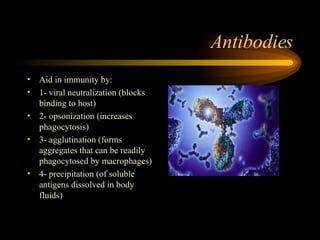
Antibodies Aid in immunity by: 1- viral neutralization (blocks binding to host) 2- opsonization (increases phagocytosis) 3- agglutination (forms aggregates that can be readily phagocytosed by macrophages) 4- precipitation (of soluble antigens dissolved in body fluids)
Primary Response vs. Secondary Response Initial acquired immune response to an antigen which peaks about 10 to 17 upon first exposure When the same antigen enters the body and the response is faster, about 2 to 7 days, because there are more antibodies in the blood
Active vs. Passive Immunity Active: long-lasting, conferred by action of B and T cells and resulting B and T memory cells specific for pathogen Passive: Short-term, conferred by administration of ready made antibodies or the transfer of maternal antibodies to fetus or nursing infant
Allergies Hypersensitive responses to certain environmental antigens, called allergens Scientists believe allergies are evolutionary remnants of immune system’s response to parasitic worms
HIV: Human Immunodeficiency Virus Retrovirus that gains entry into the cells by using different cell types, such macrophages and brain cells, that have low levels of CD4 as receptors and co-receptors Main receptor for HIV is the CD4 molecule on helper T cells, this infection and loss of helper T cells allows the rise of AIDS

E B M P+ A P+ Bio+ Project+V2

  • 1.
    Chapter 43: TheImmune System By Phenix Messersmith Evan Schwartz Brian Shea Mike Gaunt
  • 2.
    Innate Immunity: NonspecificDefense Mechanisms External - first line of defense: called barrier defense (ex. skin, mucous membranes, and secretions of skin and mucous membranes) Internal – second line of defense: phagocytic white blood cells, antimicrobial proteins, the inflammatory response
  • 3.
    The Inflammatory ResponseFour main steps: #1- chemical signals cause capillaries to widen #2- fluid, other clotting elements move to site of injury; clotting begins #3- Chemokines released by various cells attract more phagocytic cells to injury cite #4- Neutrophils and macrophages engulf pathogens and cell debris. Tissue heals.
  • 4.
    Leukocytes Phagocytic whiteblood cells: neutrophils, macrophages, eosinophils, and dendritic cells Engulfs infected bacteria and infected tissue Discharges destructive enzymes
  • 5.
    Acquired Immunity: SpecificDefense Third line of defense Examples: lymphocytes (white blood cells) and antibodies (proteins secreted by B cells) Able to distinguish one inducing agent from another Fight against antigens (foreign molecule that elicits a specific response by a lymphocyte)
  • 6.
    Different Types ofLymphocytes B Lymphocytes (B cells) – develop in bone marrow; after encountering antigens they change to antibody-secreting plasma cells (the effector cells of humoral immunity) T Lymphocytes (T cells) – develop in the thymus; after encountering antigens they are responsible for cell mediated immunity
  • 7.
    More On BCells Antigens bind to specific receptors and cytokines secreted from helper T cells then activate B cells Once activated they generate antibody-secreting effector cells or plasma cells
  • 8.
    MHC: Major HistocompatibilityComplex Responsible for stimulating the immune response of T cells by binding to antigens so that T cell receptors can recognize them Process called antigen presentation
  • 9.
    Different Types ofT Cells Cytotoxic T Cells- kill infected cells, cancer cells, and transplanted cells after being activated by recognizing Class I MHC molecules Helper T Cells- secrete cytokines that promote response of B cells and cytotoxic T cells to antigens when activated by recognizing Class II MHC molecules
  • 10.
    The Lymphatic SystemA system of vessels and lymph nodes separate from the circulatory system that returns fluid and protein to the blood Stores and reproduces macrophages and other such white blood cells who fight off infections
  • 11.
    Antibodies Aid inimmunity by: 1- viral neutralization (blocks binding to host) 2- opsonization (increases phagocytosis) 3- agglutination (forms aggregates that can be readily phagocytosed by macrophages) 4- precipitation (of soluble antigens dissolved in body fluids)
  • 12.
    Primary Response vs.Secondary Response Initial acquired immune response to an antigen which peaks about 10 to 17 upon first exposure When the same antigen enters the body and the response is faster, about 2 to 7 days, because there are more antibodies in the blood
  • 13.
    Active vs. PassiveImmunity Active: long-lasting, conferred by action of B and T cells and resulting B and T memory cells specific for pathogen Passive: Short-term, conferred by administration of ready made antibodies or the transfer of maternal antibodies to fetus or nursing infant
  • 14.
    Allergies Hypersensitive responsesto certain environmental antigens, called allergens Scientists believe allergies are evolutionary remnants of immune system’s response to parasitic worms
  • 15.
    HIV: Human ImmunodeficiencyVirus Retrovirus that gains entry into the cells by using different cell types, such macrophages and brain cells, that have low levels of CD4 as receptors and co-receptors Main receptor for HIV is the CD4 molecule on helper T cells, this infection and loss of helper T cells allows the rise of AIDS