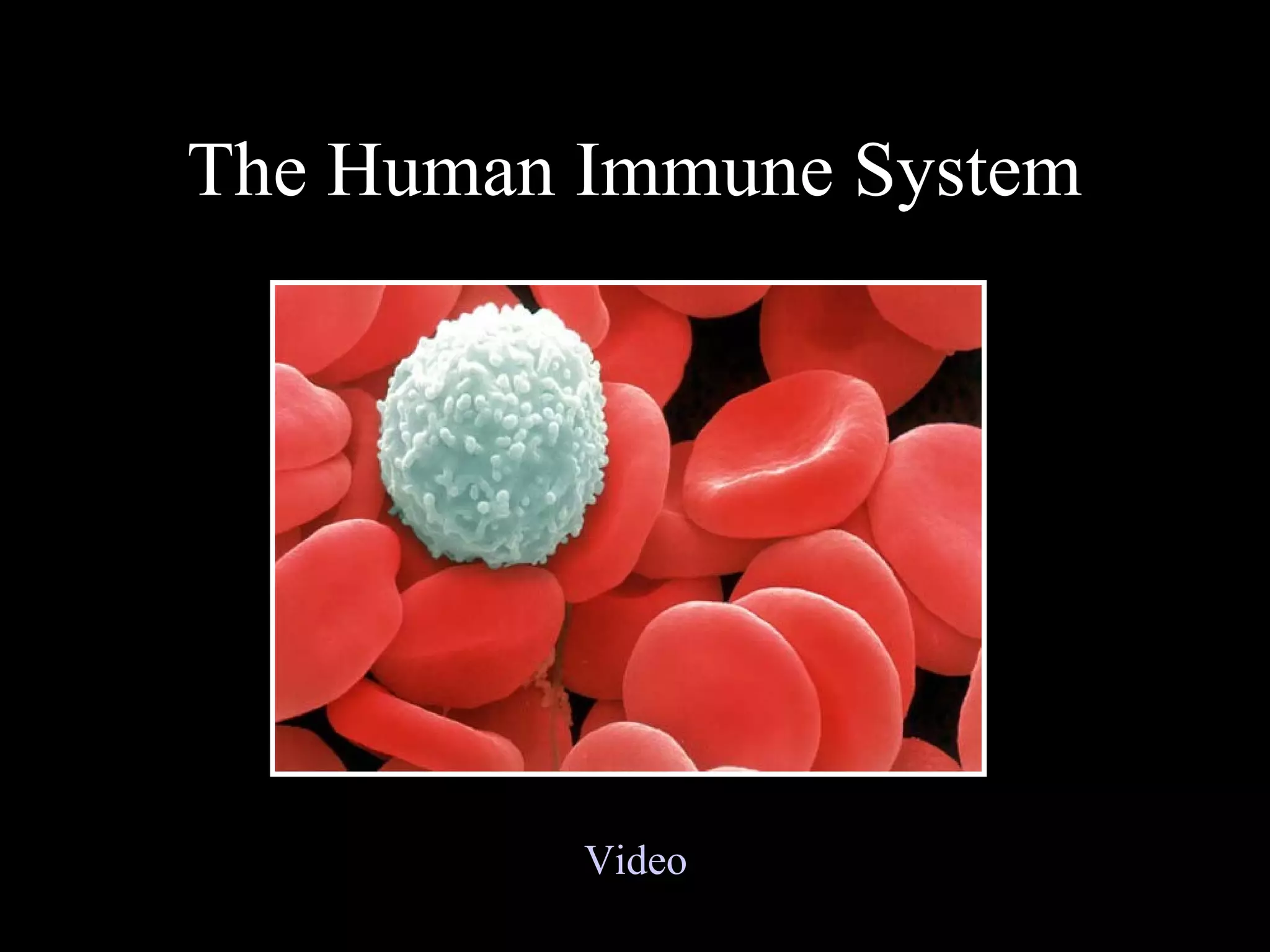
The Human Immune System
Video
What is the immune system?
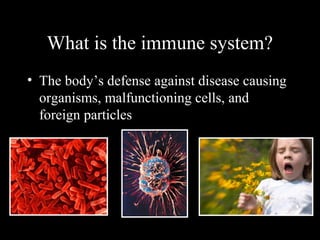
• The body’s defense against disease causing
organisms, malfunctioning cells, and
foreign particles
The First Line of Defense
~Skin~
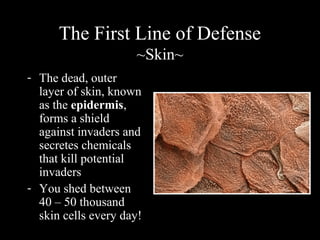
- The dead, outer
layer of skin, known
as the epidermis,
forms a shield
against invaders and
secretes chemicals
that kill potential
invaders
- You shed between
40 – 50 thousand
skin cells every day!
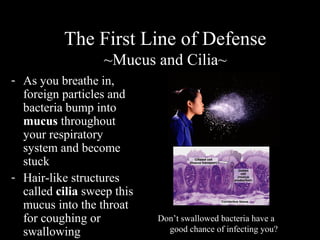
- As you breathe in,
foreign particles and
bacteria bump into
mucus throughout
your respiratory
system and become
stuck
- Hair-like structures
called cilia sweep this
mucus into the throat
for coughing or
swallowing
The First Line of Defense
~Mucus and Cilia~
Don’t swallowed bacteria have a
good chance of infecting you?
The First Line of Defense
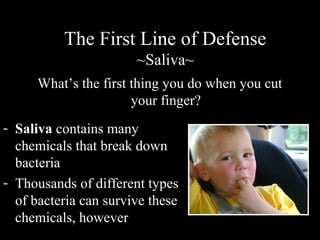
~Saliva~
What’s the first thing you do when you cut
your finger?
- Saliva contains many
chemicals that break down
bacteria
- Thousands of different types
of bacteria can survive these
chemicals, however
- Swallowed bacteria are
broken down by incredibly
strong acids in the stomach
that break down your food
- The stomach must produce a
coating of special mucus or
this acid would eat through
the stomach!
The First Line of Defense
~Stomach Acid~
Think of the human body as a
hollow plastic tube…
The food is digested within the hole in the
tube, but it never actually enters into the
solid plastic material.
Tube inner surface
~Digestive System~
Plastic interior
~Body~
Tube outer surface
~Skin~
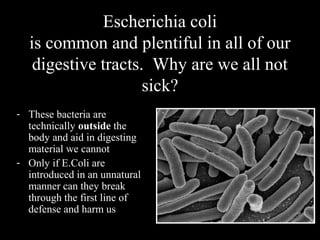
Escherichia coli
is common and plentiful in all of our
digestive tracts. Why are we all not
sick?
- These bacteria are
technically outside the
body and aid in digesting
material we cannot
- Only if E.Coli are
introduced in an unnatural
manner can they break
through the first line of
defense and harm us
The Second Line of Defense
~White Blood Cells~
- If invaders actually
get within the body,
then your white
blood cells (WBCs)
begin their attack
- WBCs normally
circulate throughout
the blood, but will
enter the body’s
tissues if invaders
are detected
Video
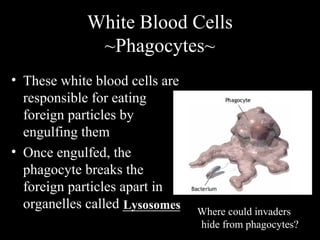
• These white blood cells are
responsible for eating
foreign particles by
engulfing them
• Once engulfed, the
phagocyte breaks the
foreign particles apart in
organelles called ________
White Blood Cells
~Phagocytes~
Lysosomes
Where could invaders
hide from phagocytes?
Viruses
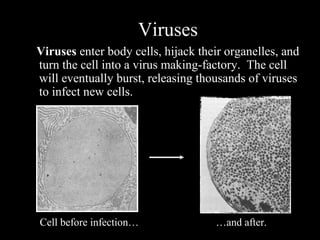
Viruses enter body cells, hijack their organelles, and
turn the cell into a virus making-factory. The cell
will eventually burst, releasing thousands of viruses
to infect new cells.
Cell before infection… …and after.
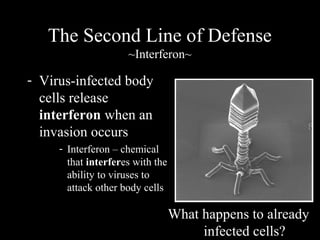
- Virus-infected body
cells release
interferon when an
invasion occurs
- Interferon – chemical
that interferes with the
ability to viruses to
attack other body cells
The Second Line of Defense
~Interferon~
What happens to already
infected cells?
White Blood Cells
~T-Cells~
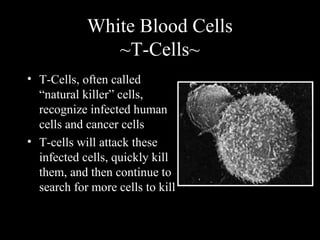
• T-Cells, often called
“natural killer” cells,
recognize infected human
cells and cancer cells
• T-cells will attack these
infected cells, quickly kill
them, and then continue to
search for more cells to kill
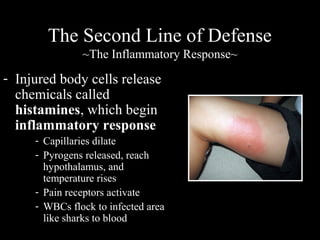
- Injured body cells release
chemicals called
histamines, which begin
inflammatory response
- Capillaries dilate
- Pyrogens released, reach
hypothalamus, and
temperature rises
- Pain receptors activate
- WBCs flock to infected area
like sharks to blood
The Second Line of Defense
~The Inflammatory Response~
Two Divisions of the Immune
System
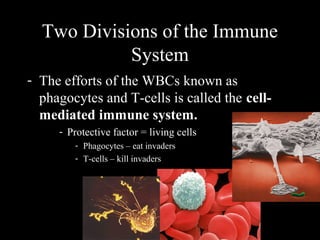
- The efforts of the WBCs known as
phagocytes and T-cells is called the cell-
mediated immune system.
- Protective factor = living cells
- Phagocytes – eat invaders
- T-cells – kill invaders
• The other half of the immune system is
called antibody-mediated immunity,
meaning that is controlled by antibodies
• This represents the third line of defense in
the immune system
Two Divisions of the Immune
System
- Most infections never make it
past the first and second levels
of defense
- Those that do trigger the
production and release of
antibodies
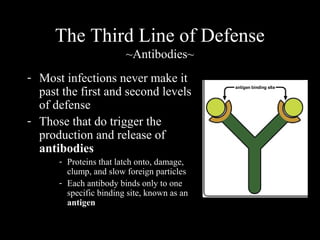
- Proteins that latch onto, damage,
clump, and slow foreign particles
- Each antibody binds only to one
specific binding site, known as an
antigen
The Third Line of Defense
~Antibodies~
Antibody Production
- WBCs gobble up invading
particles and break them up
- They show the particle
pieces to T-cells, who
identify the pieces and find
specific B-cells to help
- B-cells produce antibodies
that are equipped to find
that specific piece on a new
particle and attach
Video - 1:58
Immunity
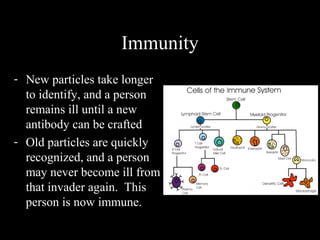
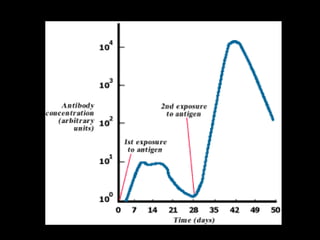
- New particles take longer
to identify, and a person
remains ill until a new
antibody can be crafted
- Old particles are quickly
recognized, and a person
may never become ill from
that invader again. This
person is now immune.
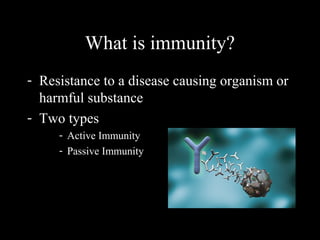
What is immunity?
- Resistance to a disease causing organism or
harmful substance
- Two types
- Active Immunity
- Passive Immunity
Active Immunity
- You produce the antibodies
- Your body has been exposed to the antigen in
the past either through:
- Exposure to the actual disease causing antigen –
You fought it, you won, you remember it
- Planned exposure to a form of the antigen that has
been killed or weakened – You detected it,
eliminated it, and remember it
What is this second type of
exposure called?
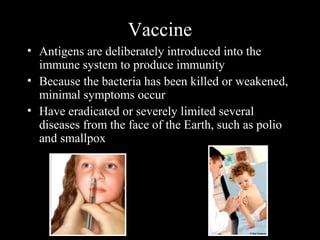
Vaccine
• Antigens are deliberately introduced into the
immune system to produce immunity
• Because the bacteria has been killed or weakened,
minimal symptoms occur
• Have eradicated or severely limited several
diseases from the face of the Earth, such as polio
and smallpox
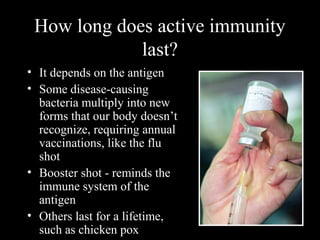
How long does active immunity
last?
• It depends on the antigen
• Some disease-causing
bacteria multiply into new
forms that our body doesn’t
recognize, requiring annual
vaccinations, like the flu
shot
• Booster shot - reminds the
immune system of the
antigen
• Others last for a lifetime,
such as chicken pox
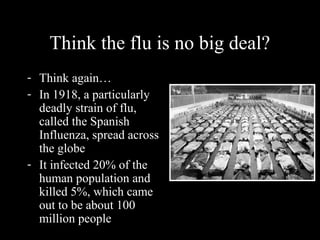
Think the flu is no big deal?
- Think again…
- In 1918, a particularly
deadly strain of flu,
called the Spanish
Influenza, spread across
the globe
- It infected 20% of the
human population and
killed 5%, which came
out to be about 100
million people
Do we get all the possible
vaccines we can?
• Although the Center for
Disease Control (CDC)
recommends certain vaccines,
many individuals go without
them
• Those especially susceptible
include travelers and students
• Consider the vaccine for
meningitis, which is
recommended for all college
students and infects 3,000
people in the U.S., killing 300
annually
Link
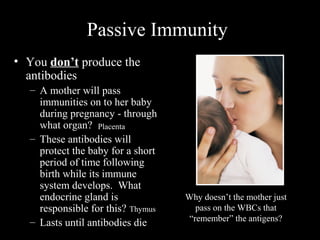
Passive Immunity
• You don’t produce the
antibodies
– A mother will pass
immunities on to her baby
during pregnancy - through
what organ?
– These antibodies will
protect the baby for a short
period of time following
birth while its immune
system develops. What
endocrine gland is
responsible for this?
– Lasts until antibodies die
Why doesn’t the mother just
pass on the WBCs that
“remember” the antigens?
Thymus
Placenta
Immune Disorders
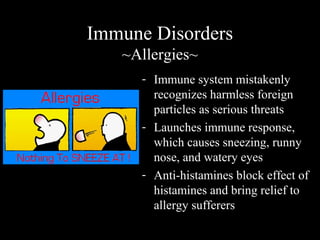
~Allergies~
- Immune system mistakenly
recognizes harmless foreign
particles as serious threats
- Launches immune response,
which causes sneezing, runny
nose, and watery eyes
- Anti-histamines block effect of
histamines and bring relief to
allergy sufferers
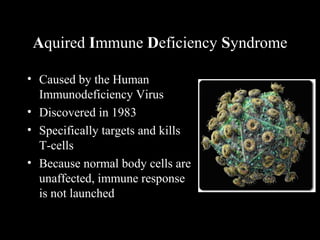
Aquired Immune Deficiency Syndrome
• Caused by the Human
Immunodeficiency Virus
• Discovered in 1983
• Specifically targets and kills
T-cells
• Because normal body cells are
unaffected, immune response
is not launched
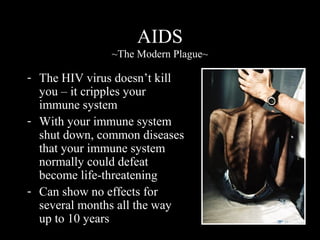
AIDS
~The Modern Plague~
- The HIV virus doesn’t kill
you – it cripples your
immune system
- With your immune system
shut down, common diseases
that your immune system
normally could defeat
become life-threatening
- Can show no effects for
several months all the way
up to 10 years
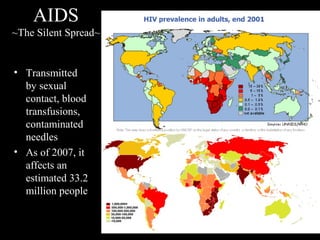
AIDS
~The Silent Spread~
• Transmitted
by sexual
contact, blood
transfusions,
contaminated
needles
• As of 2007, it
affects an
estimated 33.2
million people

The human immune system

  • 1.
    The Human ImmuneSystem Video
  • 2.
    What is theimmune system? • The body’s defense against disease causing organisms, malfunctioning cells, and foreign particles
  • 3.
    The First Lineof Defense ~Skin~ - The dead, outer layer of skin, known as the epidermis, forms a shield against invaders and secretes chemicals that kill potential invaders - You shed between 40 – 50 thousand skin cells every day!
  • 4.
    - As youbreathe in, foreign particles and bacteria bump into mucus throughout your respiratory system and become stuck - Hair-like structures called cilia sweep this mucus into the throat for coughing or swallowing The First Line of Defense ~Mucus and Cilia~ Don’t swallowed bacteria have a good chance of infecting you?
  • 5.
    The First Lineof Defense ~Saliva~ What’s the first thing you do when you cut your finger? - Saliva contains many chemicals that break down bacteria - Thousands of different types of bacteria can survive these chemicals, however
  • 6.
    - Swallowed bacteriaare broken down by incredibly strong acids in the stomach that break down your food - The stomach must produce a coating of special mucus or this acid would eat through the stomach! The First Line of Defense ~Stomach Acid~
  • 7.
    Think of thehuman body as a hollow plastic tube… The food is digested within the hole in the tube, but it never actually enters into the solid plastic material. Tube inner surface ~Digestive System~ Plastic interior ~Body~ Tube outer surface ~Skin~
  • 8.
    Escherichia coli is commonand plentiful in all of our digestive tracts. Why are we all not sick? - These bacteria are technically outside the body and aid in digesting material we cannot - Only if E.Coli are introduced in an unnatural manner can they break through the first line of defense and harm us
  • 9.
    The Second Lineof Defense ~White Blood Cells~ - If invaders actually get within the body, then your white blood cells (WBCs) begin their attack - WBCs normally circulate throughout the blood, but will enter the body’s tissues if invaders are detected Video
  • 10.
    • These whiteblood cells are responsible for eating foreign particles by engulfing them • Once engulfed, the phagocyte breaks the foreign particles apart in organelles called ________ White Blood Cells ~Phagocytes~ Lysosomes Where could invaders hide from phagocytes?
  • 11.
    Viruses Viruses enter bodycells, hijack their organelles, and turn the cell into a virus making-factory. The cell will eventually burst, releasing thousands of viruses to infect new cells. Cell before infection… …and after.
  • 12.
    - Virus-infected body cellsrelease interferon when an invasion occurs - Interferon – chemical that interferes with the ability to viruses to attack other body cells The Second Line of Defense ~Interferon~ What happens to already infected cells?
  • 13.
    White Blood Cells ~T-Cells~ •T-Cells, often called “natural killer” cells, recognize infected human cells and cancer cells • T-cells will attack these infected cells, quickly kill them, and then continue to search for more cells to kill
  • 14.
    - Injured bodycells release chemicals called histamines, which begin inflammatory response - Capillaries dilate - Pyrogens released, reach hypothalamus, and temperature rises - Pain receptors activate - WBCs flock to infected area like sharks to blood The Second Line of Defense ~The Inflammatory Response~
  • 15.
    Two Divisions ofthe Immune System - The efforts of the WBCs known as phagocytes and T-cells is called the cell- mediated immune system. - Protective factor = living cells - Phagocytes – eat invaders - T-cells – kill invaders
  • 16.
    • The otherhalf of the immune system is called antibody-mediated immunity, meaning that is controlled by antibodies • This represents the third line of defense in the immune system Two Divisions of the Immune System
  • 17.
    - Most infectionsnever make it past the first and second levels of defense - Those that do trigger the production and release of antibodies - Proteins that latch onto, damage, clump, and slow foreign particles - Each antibody binds only to one specific binding site, known as an antigen The Third Line of Defense ~Antibodies~
  • 18.
    Antibody Production - WBCsgobble up invading particles and break them up - They show the particle pieces to T-cells, who identify the pieces and find specific B-cells to help - B-cells produce antibodies that are equipped to find that specific piece on a new particle and attach Video - 1:58
  • 19.
    Immunity - New particlestake longer to identify, and a person remains ill until a new antibody can be crafted - Old particles are quickly recognized, and a person may never become ill from that invader again. This person is now immune.
  • 21.
    What is immunity? -Resistance to a disease causing organism or harmful substance - Two types - Active Immunity - Passive Immunity
  • 22.
    Active Immunity - Youproduce the antibodies - Your body has been exposed to the antigen in the past either through: - Exposure to the actual disease causing antigen – You fought it, you won, you remember it - Planned exposure to a form of the antigen that has been killed or weakened – You detected it, eliminated it, and remember it What is this second type of exposure called?
  • 23.
    Vaccine • Antigens aredeliberately introduced into the immune system to produce immunity • Because the bacteria has been killed or weakened, minimal symptoms occur • Have eradicated or severely limited several diseases from the face of the Earth, such as polio and smallpox
  • 24.
    How long doesactive immunity last? • It depends on the antigen • Some disease-causing bacteria multiply into new forms that our body doesn’t recognize, requiring annual vaccinations, like the flu shot • Booster shot - reminds the immune system of the antigen • Others last for a lifetime, such as chicken pox
  • 25.
    Think the fluis no big deal? - Think again… - In 1918, a particularly deadly strain of flu, called the Spanish Influenza, spread across the globe - It infected 20% of the human population and killed 5%, which came out to be about 100 million people
  • 26.
    Do we getall the possible vaccines we can? • Although the Center for Disease Control (CDC) recommends certain vaccines, many individuals go without them • Those especially susceptible include travelers and students • Consider the vaccine for meningitis, which is recommended for all college students and infects 3,000 people in the U.S., killing 300 annually Link
  • 27.
    Passive Immunity • Youdon’t produce the antibodies – A mother will pass immunities on to her baby during pregnancy - through what organ? – These antibodies will protect the baby for a short period of time following birth while its immune system develops. What endocrine gland is responsible for this? – Lasts until antibodies die Why doesn’t the mother just pass on the WBCs that “remember” the antigens? Thymus Placenta
  • 28.
    Immune Disorders ~Allergies~ - Immunesystem mistakenly recognizes harmless foreign particles as serious threats - Launches immune response, which causes sneezing, runny nose, and watery eyes - Anti-histamines block effect of histamines and bring relief to allergy sufferers
  • 29.
    Aquired Immune DeficiencySyndrome • Caused by the Human Immunodeficiency Virus • Discovered in 1983 • Specifically targets and kills T-cells • Because normal body cells are unaffected, immune response is not launched
  • 30.
    AIDS ~The Modern Plague~ -The HIV virus doesn’t kill you – it cripples your immune system - With your immune system shut down, common diseases that your immune system normally could defeat become life-threatening - Can show no effects for several months all the way up to 10 years
  • 31.
    AIDS ~The Silent Spread~ •Transmitted by sexual contact, blood transfusions, contaminated needles • As of 2007, it affects an estimated 33.2 million people