The Immune System
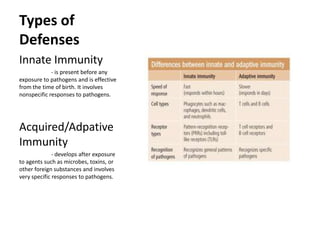
Types of DefensesInnate Immunity	- is present before any exposure to pathogens and is effective from the time of birth. It involves nonspecific responses to pathogens.Acquired/AdpativeImmunity	- develops after exposure to agents such as microbes, toxins, or other foreign substances and involves very specific responses to pathogens.
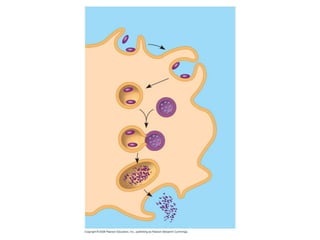
Leukocytes-Innate ImmunityWhite blood cells (leukocytes) engulf pathogens in the bodyA white blood cell engulfs a microbe, then fuses with a lysosome to destroy the microbeThere are different types of phagocytic cells:Neutrophils engulf and destroy microbesMacrophages are part of the lymphatic system and are found throughout the bodyEosinophils discharge destructive enzymesDendritic cells stimulate development of acquired immunity
The Lymphatic System-Adaptive ImmunityThe role of the lymphatic system contains immune cells called lymphocytes, which protect the body against antigensThe lymphatic system is the first line of defense against disease. This network of vessels and nodes transports and filters lymph fluid containing antibodies and lymphocytes. The body’s first contact with these invaders signals the lymphatics.
Lymphocytes-White blood cells called lymphocytes recognize and respond to antigens(any foreign molecule to which a lymphocyte responds) and foreign moleculesLymphocytes contribute to immunological memory, an enhanced response to a foreign molecule encountered previouslyLymphocytes that mature in the thymus above the heart are called T cells,and those that mature in bone marrow are called B cellsA single B cell or T cell has about 100,000 identical antigen receptorsB cells and T cells have receptor proteins that can bind to foreign moleculesEach individual lymphocyte is specialized to recognize a specific type of molecule
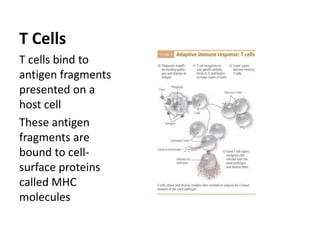
T CellsT cells bind to antigen fragments presented on a host cell These antigen fragments are bound to cell-surface proteins called MHC molecules
The role of MHCIn infected cells, MHC molecules bind and transport antigen fragments to the cell surface, a process called antigen presentationA nearby T cell can then detect the antigen fragment displayed on the cell’s surface
Helper T CellsA surface protein called CD4 binds the class II MHC moleculeThis binding keeps the helper T cell joined to the antigen-presenting cell while activation occursActivated helper T cells secrete cytokines that stimulate other lymphocytes
Cytotoxic T Cells: A Response to Infected CellsCytotoxic T cells are the effector cells in cell-mediated immune responseCytotoxic T cells make CD8, a surface protein that greatly enhances interaction between a target cell and a cytotoxic T cellBinding to a class I MHC complex on an infected cell activates a cytotoxic T cell and makes it an active killerThe activated cytotoxic T cell secretes proteins that destroy the infected target cell
B CellsB cells give rise to plasma cells,which secrete proteins called antibodies or immunoglobulinsB cell receptors bind to specific, intact antigens
In the body there are few lymphocytes with antigen receptors for any particular epitopeThe binding of a mature lymphocyte to an antigen induces the lymphocyte to divide rapidlyThis proliferation of lymphocytes is called clonal selectionTwo types of clones are produced: short-lived activated effector cells and long-lived memory cells
The first exposure to a specific antigen represents the primary immune response During this time, effector B cells called plasma cells are generated, and T cells are activated to their effector formsIn the secondary immune response, memory cells facilitate a faster, more efficient response
The Role of Antibodies in ImmunityNeutralization occurs when a pathogen can no longer infect a host because it is bound to an antibodyOpsonization occurs when antibodies bound to antigens increase phagocytosisAntibodies together with proteins of the complement system generate a membrane attack complex and cell lysis
Active and Passive ImmunityActive immunity develops naturally in response to an infectionIt can also develop following immunization, also called vaccinationIn immunization, a nonpathogenic form of a microbe or part of a microbe elicits an immune response to an immunological memoryPassive immunity provides immediate, short-term protection
Inflammatory ResponseInflammatory is a nonspecific response to any trauma occurring to tissue. Following an injury, mast cells release histamine,which promotes changes in blood vessels; this is part of the inflammatory responseThese changes increase local blood supply and allow more phagocytes and antimicrobial proteins to enter tissues
The Role of Organs in the Immune SystemAdenoids/ Tonsil- Tonsils and adenoids are the body’s first line of defense as part of the immune system. They “sample” bacteria and viruses that enter the body through the mouth or nose, but they sometimes become infectedLymph Node- contains disease-fighting lymphocytes, lymph fluid and tissue that act as a frame or supporting structure called "connective tissue." Lymph nodes are part of the immune system and are interconnected by lymphatic vessels, which are tiny channels that resemble blood vessel capillaries, where lymphatic fluid circulates.Spleen- There are two distinct components of the spleen, the red pulp and the white pulp. The red pulp consists of large numbers of sinuses and sinusoids filled with blood and is responsible for the filtration function of the spleen. The white pulp consists of aggregates of lymphoid tissue and is responsible for the immunological function of the spleen:
Organs cont.Peyer’s Patches- destroy bacteria, preventing them from breaching the wall of the small intestine and entering the bloodstream. They generate memory lymphocytes for long term immunity. Small intestine-Bone Marrow- B cells produced hereAppendix- expose white blood cells to the wide variety of antigens, or foreign substances, present in the gastrointestinal tract. Thus, helps to suppress potentially destructive humoral (blood- and lymph-borne) antibody responses while promoting local immunityLarge Intestine-Thymus- Where T cells are produced.

The immune system

  • 1.
  • 2.
    Types of DefensesInnateImmunity - is present before any exposure to pathogens and is effective from the time of birth. It involves nonspecific responses to pathogens.Acquired/AdpativeImmunity - develops after exposure to agents such as microbes, toxins, or other foreign substances and involves very specific responses to pathogens.
  • 3.
    Leukocytes-Innate ImmunityWhite bloodcells (leukocytes) engulf pathogens in the bodyA white blood cell engulfs a microbe, then fuses with a lysosome to destroy the microbeThere are different types of phagocytic cells:Neutrophils engulf and destroy microbesMacrophages are part of the lymphatic system and are found throughout the bodyEosinophils discharge destructive enzymesDendritic cells stimulate development of acquired immunity
  • 5.
    The Lymphatic System-AdaptiveImmunityThe role of the lymphatic system contains immune cells called lymphocytes, which protect the body against antigensThe lymphatic system is the first line of defense against disease. This network of vessels and nodes transports and filters lymph fluid containing antibodies and lymphocytes. The body’s first contact with these invaders signals the lymphatics.
  • 6.
    Lymphocytes-White blood cellscalled lymphocytes recognize and respond to antigens(any foreign molecule to which a lymphocyte responds) and foreign moleculesLymphocytes contribute to immunological memory, an enhanced response to a foreign molecule encountered previouslyLymphocytes that mature in the thymus above the heart are called T cells,and those that mature in bone marrow are called B cellsA single B cell or T cell has about 100,000 identical antigen receptorsB cells and T cells have receptor proteins that can bind to foreign moleculesEach individual lymphocyte is specialized to recognize a specific type of molecule
  • 7.
    T CellsT cellsbind to antigen fragments presented on a host cell These antigen fragments are bound to cell-surface proteins called MHC molecules
  • 8.
    The role ofMHCIn infected cells, MHC molecules bind and transport antigen fragments to the cell surface, a process called antigen presentationA nearby T cell can then detect the antigen fragment displayed on the cell’s surface
  • 9.
    Helper T CellsAsurface protein called CD4 binds the class II MHC moleculeThis binding keeps the helper T cell joined to the antigen-presenting cell while activation occursActivated helper T cells secrete cytokines that stimulate other lymphocytes
  • 10.
    Cytotoxic T Cells:A Response to Infected CellsCytotoxic T cells are the effector cells in cell-mediated immune responseCytotoxic T cells make CD8, a surface protein that greatly enhances interaction between a target cell and a cytotoxic T cellBinding to a class I MHC complex on an infected cell activates a cytotoxic T cell and makes it an active killerThe activated cytotoxic T cell secretes proteins that destroy the infected target cell
  • 11.
    B CellsB cellsgive rise to plasma cells,which secrete proteins called antibodies or immunoglobulinsB cell receptors bind to specific, intact antigens
  • 12.
    In the bodythere are few lymphocytes with antigen receptors for any particular epitopeThe binding of a mature lymphocyte to an antigen induces the lymphocyte to divide rapidlyThis proliferation of lymphocytes is called clonal selectionTwo types of clones are produced: short-lived activated effector cells and long-lived memory cells
  • 13.
    The first exposureto a specific antigen represents the primary immune response During this time, effector B cells called plasma cells are generated, and T cells are activated to their effector formsIn the secondary immune response, memory cells facilitate a faster, more efficient response
  • 14.
    The Role ofAntibodies in ImmunityNeutralization occurs when a pathogen can no longer infect a host because it is bound to an antibodyOpsonization occurs when antibodies bound to antigens increase phagocytosisAntibodies together with proteins of the complement system generate a membrane attack complex and cell lysis
  • 15.
    Active and PassiveImmunityActive immunity develops naturally in response to an infectionIt can also develop following immunization, also called vaccinationIn immunization, a nonpathogenic form of a microbe or part of a microbe elicits an immune response to an immunological memoryPassive immunity provides immediate, short-term protection
  • 16.
    Inflammatory ResponseInflammatory isa nonspecific response to any trauma occurring to tissue. Following an injury, mast cells release histamine,which promotes changes in blood vessels; this is part of the inflammatory responseThese changes increase local blood supply and allow more phagocytes and antimicrobial proteins to enter tissues
  • 17.
    The Role ofOrgans in the Immune SystemAdenoids/ Tonsil- Tonsils and adenoids are the body’s first line of defense as part of the immune system. They “sample” bacteria and viruses that enter the body through the mouth or nose, but they sometimes become infectedLymph Node- contains disease-fighting lymphocytes, lymph fluid and tissue that act as a frame or supporting structure called "connective tissue." Lymph nodes are part of the immune system and are interconnected by lymphatic vessels, which are tiny channels that resemble blood vessel capillaries, where lymphatic fluid circulates.Spleen- There are two distinct components of the spleen, the red pulp and the white pulp. The red pulp consists of large numbers of sinuses and sinusoids filled with blood and is responsible for the filtration function of the spleen. The white pulp consists of aggregates of lymphoid tissue and is responsible for the immunological function of the spleen:
  • 18.
    Organs cont.Peyer’s Patches-destroy bacteria, preventing them from breaching the wall of the small intestine and entering the bloodstream. They generate memory lymphocytes for long term immunity. Small intestine-Bone Marrow- B cells produced hereAppendix- expose white blood cells to the wide variety of antigens, or foreign substances, present in the gastrointestinal tract. Thus, helps to suppress potentially destructive humoral (blood- and lymph-borne) antibody responses while promoting local immunityLarge Intestine-Thymus- Where T cells are produced.