Introduction:
An information society is a society where the creation,
distribution, use, integration and manipulation of information is a
significant economic, political, and cultural activity. The aim of the
information society is to gain competitive advantage internationally,
through using information technology (IT) in a creative and
productive way. The knowledge economy is its economic
counterpart, whereby wealth is created through the economic
exploitation of understanding. People who have the means to
partake in this form of society are sometimes called digital citizens.
This is one of many dozen labels that have been identified to
suggest that humans are entering a new phase of society.
The markers of this rapid change may be technological,
economic, occupational, spatial, cultural, or some combination of
all of these. Information society is seen as the successor
to industrial society. Closely related concepts are the post-industrial
society (Daniel Bell),post-fordism post-modern society, knowledge
society, telematic society, Information Revolution, liquid modernity,
and network society (Manuel Castells).
Definition
 There are many definitions of the IS,
 some of them are:
 a society in which the creation, distribution,
 diffusion, use and manipulation of information is a
significant economic, political and cultural activity
 Societies that have become dependent upon complex
electronic information networks and which allocate a major
portion of their resources to information and communication
activities” (Melody, 1990: 26-7)
 Information Society means social and economic structure,
where productive usage of a resource such as information, as
well as knowledge-intensive production performs a
prominent role…and where individuals, such as consumers,
workers, use information extensively (OECD, 1994)
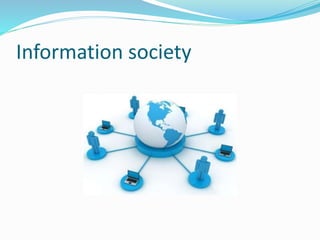
Information society
Closely related concepts...
 Post-industrial society
 Post-fordism
 Post-modern society
 Knowledge society
 Network society
Theoretical Foundations:
 Genealogy of the information society concept is usually
traced to a term “post-industrial society- a term first used
by sociologist Daniel Bell (1973). Refer to Frank Webster,
Chapter 3 on elaboration of the post-industrial society.
 Another source of the information society concept is
attributed to debates on the “information economy”
developed by American economists Fritz Machlup (1962)
and Marc Porat (1977).
 The terms “information economy”, “information society”,
“new economy” and “Networked economy”- all build on
some of Bell´s ideas on the post-industrial society.
 Characteristics of the post-industrial society:
• Rise of the service sector
• Decline of agricultural-based economy
• Predominance of “information-based” work
• Knowledge now key factor in the economy, outstripping
physical plant / manufacturing
Bell on Information Society...
• In the pre-industrial society life is a game against nature
where one works with raw muscle power (Bell 1973 126);
In the industrial era where machines predominates in a technical
and rationalized existence, life is a game against fabricated
nature (126). In contrast to both, life in the post-industrial
society based on services, is a game between persons (127)
what counts is not raw muscle power or energy but
information (127)
Webster´s Five Types of Theories
 Most of the work in information society is futuristic and
technologically deterministic and informed by few theoretical
insights.
 However, Frank Webster (2000) has build a useful typology to
understand IS theories:
 Technological
 Economic
 Occupational
 Spatial
 Cultural
Technological vision of the IS:
• Puts emphasis on ICTs and their transformative powers.
• Technological innovation: new possibilities in transmission and
storage of information.
• Society has moved from the “Industrial Revolution” and now
entered an “Information Age”. “Computer technology is to the
information age what mechanisation was to the industrial
revolution” (John Naisbitt quoted in Frank Webster).
Economic vision of the IS:
• Concerned with “economics of information” (Fritz Machlup).
Assesses the size and growth of the information industries.
• Puts emphasis on the importance of knowledge to the economy.
• Technological innovation central for increasing productivity and
thus for growth of economics and competition between
economies (inspired by Joseph Schumpeter´s thinking).
Occupational vision of the IS:
• Focuses on occupational change- argues that the predominance
of occupation is found in information work: “service workers”
now in the majority
• Emergence of “white collar” society and decline of “blue
collar” workers (influenced by Daniel Bell)
• Many OECD and EU documents on the IS focus on this aspect
of the IS.
Spatial vision of the IS:
• Puts emphasis on the information networks which connect
locations and have great impact on the organisation of time and
space.
• Information Networks are linking together locations within and
between offices, towns, regions, nations, continents and the
entire world, seen in increase in transborder data, telecom
facilities, ISDN, movements of money across nations, internet
(Castells, 1996)
• Concepts of “information superhighway” and “wired society”
are found in these arguments.
Cultural vision of the IS:
• Contemporary culture is manifestly more heavily information
laden than any of its predecessors- we are existing in a media
saturated environment.
• Growth of institutions dedicated to investing everyday life with
symbolic significance - e.g. global advertising, publishing
empires, film industry, fashion industry etc
• Interactivity of new technologies provides many channels to
consume cultural products, thus increasing our dependence on
information for everyday interaction.
Conclusion
 The concept of “Information Society” is losing
relevance. It is being replaced with “Knowledge
Society”.
 Will “Knowledge Society” be technocratic or
humanistic?
 The future is not so much predicted today, but it is more
projected (designed) and practically implemented.
Conclusion:
The Information Society holds the potential to democratize
communication, provide greater access to health care and
education, create jobs and promote economic development,
increase public input to political decisions and government action,
and allow people to be creators of information rather than just
consumers. But ICT and the products and opportunities it has
spawned have been primarily developed and instituted in pursuit of
economic gains - not widely shared social benefits - and the
changes they have wrought have bestowed disproportionate
benefits to the more affluent members of our society. Moreover, it
is important to keep in mind that technological development is not
an autonomous or inevitable force in society. Copyright legislation,
telecommunications regulation, labour law, international trade
regulation - changes in these kinds of laws and regulations both
underlie and give form to technological development.
Consequently, as the forces associated with technological change
continue to reconfigure Canadian society and reshape our lives, it is
important that all Canadians participate in the debates and decisions
that guide this process.
bibliography
 http://whatis.techtarget.com/definition/Information-
Society
 source:
http://www.martinhilbert.net/WorldInfoCapacity.htm
l
 http://en.wikipedia.org/wiki/Information_society
 Belkin, N. J. Towards definition of information for
informatics. (in Horsnell, v., ed. Informatics 2.
London; Aslib, 1975
bibliography
 Fritz Machlup (1962) The Production and Distribution
of Knowledge in the United States. Princeton:
Princeton University Press.
 OECD (1986) Trends in The Information Economy.
Paris: OECD.
 Frank Webster (2002b) Theories of the Information
Society. London: Routledge
 Bell, Daniel. The Coming of Post-Industrial Society.
New York: Harper Colophon Books, 1974.
 Castells, Manuel, The Theory of The Network Society,
Great Britain by MPG Books Ltd, Bodmin, Cornwall,
2006
INFORMATION SOCIETY Anandraj.L

INFORMATION SOCIETY Anandraj.L

  • 2.
    Introduction: An information societyis a society where the creation, distribution, use, integration and manipulation of information is a significant economic, political, and cultural activity. The aim of the information society is to gain competitive advantage internationally, through using information technology (IT) in a creative and productive way. The knowledge economy is its economic counterpart, whereby wealth is created through the economic exploitation of understanding. People who have the means to partake in this form of society are sometimes called digital citizens. This is one of many dozen labels that have been identified to suggest that humans are entering a new phase of society. The markers of this rapid change may be technological, economic, occupational, spatial, cultural, or some combination of all of these. Information society is seen as the successor to industrial society. Closely related concepts are the post-industrial society (Daniel Bell),post-fordism post-modern society, knowledge society, telematic society, Information Revolution, liquid modernity, and network society (Manuel Castells).
  • 3.
    Definition  There aremany definitions of the IS,  some of them are:  a society in which the creation, distribution,  diffusion, use and manipulation of information is a significant economic, political and cultural activity  Societies that have become dependent upon complex electronic information networks and which allocate a major portion of their resources to information and communication activities” (Melody, 1990: 26-7)  Information Society means social and economic structure, where productive usage of a resource such as information, as well as knowledge-intensive production performs a prominent role…and where individuals, such as consumers, workers, use information extensively (OECD, 1994)
  • 4.
  • 5.
    Closely related concepts... Post-industrial society  Post-fordism  Post-modern society  Knowledge society  Network society Theoretical Foundations:  Genealogy of the information society concept is usually traced to a term “post-industrial society- a term first used by sociologist Daniel Bell (1973). Refer to Frank Webster, Chapter 3 on elaboration of the post-industrial society.  Another source of the information society concept is attributed to debates on the “information economy” developed by American economists Fritz Machlup (1962) and Marc Porat (1977).
  • 6.
     The terms“information economy”, “information society”, “new economy” and “Networked economy”- all build on some of Bell´s ideas on the post-industrial society.  Characteristics of the post-industrial society: • Rise of the service sector • Decline of agricultural-based economy • Predominance of “information-based” work • Knowledge now key factor in the economy, outstripping physical plant / manufacturing Bell on Information Society... • In the pre-industrial society life is a game against nature where one works with raw muscle power (Bell 1973 126);
  • 7.
    In the industrialera where machines predominates in a technical and rationalized existence, life is a game against fabricated nature (126). In contrast to both, life in the post-industrial society based on services, is a game between persons (127) what counts is not raw muscle power or energy but information (127) Webster´s Five Types of Theories  Most of the work in information society is futuristic and technologically deterministic and informed by few theoretical insights.  However, Frank Webster (2000) has build a useful typology to understand IS theories:  Technological  Economic  Occupational  Spatial  Cultural
  • 8.
    Technological vision ofthe IS: • Puts emphasis on ICTs and their transformative powers. • Technological innovation: new possibilities in transmission and storage of information. • Society has moved from the “Industrial Revolution” and now entered an “Information Age”. “Computer technology is to the information age what mechanisation was to the industrial revolution” (John Naisbitt quoted in Frank Webster). Economic vision of the IS: • Concerned with “economics of information” (Fritz Machlup). Assesses the size and growth of the information industries. • Puts emphasis on the importance of knowledge to the economy. • Technological innovation central for increasing productivity and thus for growth of economics and competition between economies (inspired by Joseph Schumpeter´s thinking).
  • 9.
    Occupational vision ofthe IS: • Focuses on occupational change- argues that the predominance of occupation is found in information work: “service workers” now in the majority • Emergence of “white collar” society and decline of “blue collar” workers (influenced by Daniel Bell) • Many OECD and EU documents on the IS focus on this aspect of the IS. Spatial vision of the IS: • Puts emphasis on the information networks which connect locations and have great impact on the organisation of time and space. • Information Networks are linking together locations within and between offices, towns, regions, nations, continents and the entire world, seen in increase in transborder data, telecom facilities, ISDN, movements of money across nations, internet (Castells, 1996)
  • 10.
    • Concepts of“information superhighway” and “wired society” are found in these arguments. Cultural vision of the IS: • Contemporary culture is manifestly more heavily information laden than any of its predecessors- we are existing in a media saturated environment. • Growth of institutions dedicated to investing everyday life with symbolic significance - e.g. global advertising, publishing empires, film industry, fashion industry etc • Interactivity of new technologies provides many channels to consume cultural products, thus increasing our dependence on information for everyday interaction.
  • 11.
    Conclusion  The conceptof “Information Society” is losing relevance. It is being replaced with “Knowledge Society”.  Will “Knowledge Society” be technocratic or humanistic?  The future is not so much predicted today, but it is more projected (designed) and practically implemented.
  • 12.
    Conclusion: The Information Societyholds the potential to democratize communication, provide greater access to health care and education, create jobs and promote economic development, increase public input to political decisions and government action, and allow people to be creators of information rather than just consumers. But ICT and the products and opportunities it has spawned have been primarily developed and instituted in pursuit of economic gains - not widely shared social benefits - and the changes they have wrought have bestowed disproportionate benefits to the more affluent members of our society. Moreover, it is important to keep in mind that technological development is not an autonomous or inevitable force in society. Copyright legislation, telecommunications regulation, labour law, international trade regulation - changes in these kinds of laws and regulations both underlie and give form to technological development. Consequently, as the forces associated with technological change continue to reconfigure Canadian society and reshape our lives, it is important that all Canadians participate in the debates and decisions that guide this process.
  • 13.
    bibliography  http://whatis.techtarget.com/definition/Information- Society  source: http://www.martinhilbert.net/WorldInfoCapacity.htm l http://en.wikipedia.org/wiki/Information_society  Belkin, N. J. Towards definition of information for informatics. (in Horsnell, v., ed. Informatics 2. London; Aslib, 1975
  • 14.
    bibliography  Fritz Machlup(1962) The Production and Distribution of Knowledge in the United States. Princeton: Princeton University Press.  OECD (1986) Trends in The Information Economy. Paris: OECD.  Frank Webster (2002b) Theories of the Information Society. London: Routledge  Bell, Daniel. The Coming of Post-Industrial Society. New York: Harper Colophon Books, 1974.  Castells, Manuel, The Theory of The Network Society, Great Britain by MPG Books Ltd, Bodmin, Cornwall, 2006