Technology and Society II Are ICTs Transforming Contemporary Society?
Session Objectives Outline key theories concerning the impact of ICTs on society Consider the implications of these theories for the (welfare) state Examine the UK government’s  broad  response to the emergence of an ‘information society’
Theories: Origins Ideas emerge late 1960s/early 1970s Key theorists: Bell ‘74: Post-Industrial Society Touraine ‘69:  La Société Post-Industrielle Machlup ‘62 & Porat ‘77: Information Economy Minc & Nora ‘77:  L’Informatisation D’ Société Toffler ‘80: The Third Wave Masuda ‘80: Post-Industrial Soc = Info Soc Castells ‘89: Network Society
Theories: Rhetoric of Revolution “…an extraordinary transformation, perhaps even greater in its impact than the industrial revolution of the previous century” Bell (1980)
Theories: Rhetoric of Revolution “[We are entering the ‘Third Wave’,] an event as profound as the First Wave of change unleashed ten thousand years ago by the invention of agriculture, or the earthshaking Second Wave of change touched off by the industrial revolution” Toffler (1980)
Theories: Rhetoric of Revolution “ The coming ‘information age’ is already accepted as the successor to the industrial age” Dizard (1982)
Theories: Bell “ a revolution in organisation and processing of information and knowledge, in which the computer plays a central role” Links to wider shift in the structure of the economy and power relations in society Industrial society being replaced by a new Post-Industrial successor
 
 
Theories: Bell ‘ My basic premise [is] that knowledge and information are becoming the strategic resource and transforming agent of the postindustrial society [just as] the combination of energy, resources, and machine technology were the transforming agencies of industrial society’ Built on ideas of an information economy ‘ The Social Framework of the  Information  Society’ (1979)
 
Theories: Criticisms of Bell What do information and knowledge mean? Is the link with ICTs valid? Problem of technological determinism A continuation of old trends rather than an altogether new epoch?
Theories: Criticisms of Bell [information has] been divorced from its conventional meaning, [and is] up for grabs... for the information theorist, it does not matter whether we are transmitting a fact, a judgement, a shallow cliché, a deep teaching, a sublime truth, or a nasty obscenity. All are ‘information ’  (Roszak )
Beyond Bell Pre- Micro-Computer   pre-internet May, Angell, Negopontre, Virilio Castells
Network Society ‘ a new type of social structure that I call the network society’ ‘ the transformation of our ‘material culture’ by the works of a new technological paradigm organized around information technologies’ ‘ the vast majority of societies are affected in a fundamental way by these transformations’
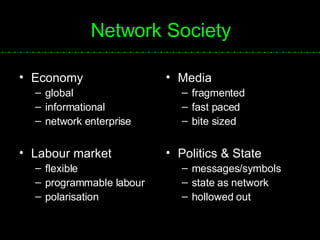
Network Society Economy global informational network enterprise Labour market flexible programmable labour polarisation Media fragmented fast paced bite sized Politics & State messages/symbols state as network hollowed out
Network Society Two forces: ICTs (Informational) Networks Timeless Time Space of Flows
Information Society “The information society is one in which information is used intensively as an aspect of economic, social, cultural and political life”  (UNESCO, World Information Report, 1998)
Politicians & the Info Society Information is the key to the modern age. The new age of information offers possibilities for the future limited only by the boundaries of our imaginations. The potential of the new electronic networks is breathtaking – the prospect of change as widespread and fundamental as the agricultural and industrial revolutions of earlier eras. Tony Blair
Politicians & the Info Society This [information] revolution adds huge new capacities to human intelligence and constitutes a resource which changes the way we work together and the way we live together Bangemann Report (1995)
Politicians & the Info Society The world is undergoing a technological revolution and entering the age of the Information Society. [...] The potential technological, economic, and social upheavals resulting from the information revolution could be of the same order of magnitude as those arising from the shift away from an agricultural to an industrial economy House of Lords Science and Technology Select Committee (1996)
Politicians & the Info Society [the information revolution] promises to change society every bit as radically as the industrial revolution of the nineteenth century Kenneth Baker, 1984
Govt Responses to Info Soc 1970s : France, 1976:  L’Informatisation d’Societe  1980s: 1981 – 1 st  UK Information Technology Minister  1982 - ‘Information Technology Year’ 1990s: USA: Al Gore leads investigation into the Information Society EU: the Bangemann Report Japan & Singapore: ‘Informatization White Papers’ OECD reports on: Information Society Information Economy  IT in Public Administration
UK Govt Responses to I.S. Under Conservatives Information Society Initiative (DTI) Government.Direct Under Labour Information Age Government Information Exclusion  e-Commerce Knowledge Economy
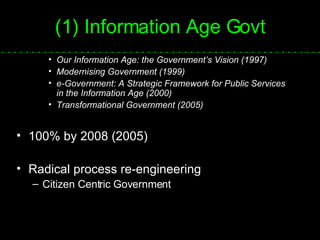
(1) Information Age Govt Our Information Age: the Government’s Vision (1997) Modernising Government (1999) e-Government: A Strategic Framework for Public Services  in the Information Age  (2000) Transformational Government (2005) 100% by 2008 (2005) Radical process re-engineering Citizen Centric Government
(2) Information Exclusion Closing the Digital Divide: Information and Communication Technologies in Deprived Areas [PAT 15]  (2000) Inclusion Through Innovation (2005) Connecting the UK (2005) Digital City Challenge (2007) Universal internet access by 2005, Broadband 2008?  All ICT policies should reduce rather than increase social exclusion Computers Within Reach ,  Wired Up Communities UK Online Centres
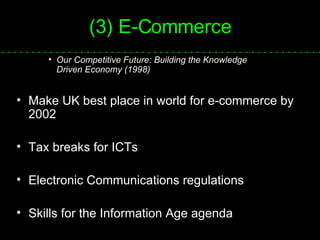
(3) E-Commerce Our Competitive Future: Building the Knowledge  Driven Economy (1998) Make UK best place in world for e-commerce by 2002 Tax breaks for ICTs Electronic Communications regulations Skills for the Information Age agenda
(4) Knowledge Economy abandonment of Keynesianism ‘ Today  [Keynesianism]  has completely broken down. Globalisation has placed a premium on workers with the skills and knowledge to adapt to advancing technology ’ (Blair, 1999) not a free market approach supply side measures important skills and education active labour market policy ‘ a significant redrawing of the boundaries of state activity’ (Glyn & Wood)
(4) Knowledge Economy information revolution & globalisation used to justify policy shifts ‘ in a global marketplace characterised by ever more fierce competition, and unparalleled waves of technological change, we need - more than ever before - to be able to respond to change’ (Brown) the third way ‘looks to develop a wide-ranging supply side policy, which seeks to reconcile economic growth mechanisms with structural reform of the welfare state [because] in the information economy, human (and) social capital becomes central to economic success’ (Giddens) ‘ Adapting to change is never easy and the speed of change appears faster than ever before, not least under the impact of new technologies’  (Blair & Schroeder)
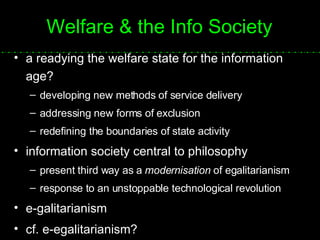
Welfare & the Info Society a readying the welfare state for the information age? developing new methods of service delivery addressing new forms of exclusion redefining the boundaries of state activity information society central to philosophy present third way as a  modernisation  of egalitarianism response to an unstoppable technological revolution e-galitarianism cf. e-egalitarianism?
Technology and Society II Are ICTs Transforming Contemporary Society? (Part 2)
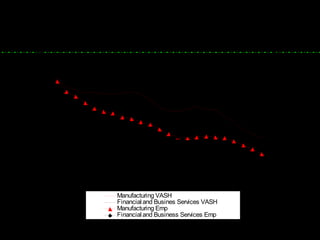
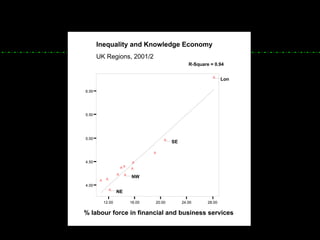
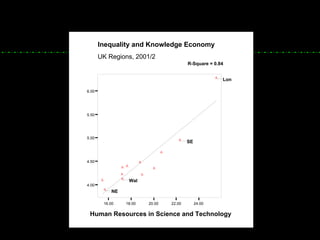
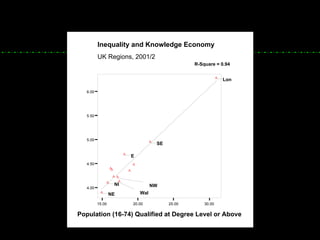
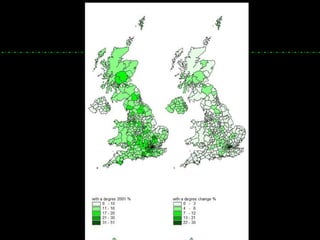
Knowledge Economy Definitions: weightless economy knowledge economy high-tech economy
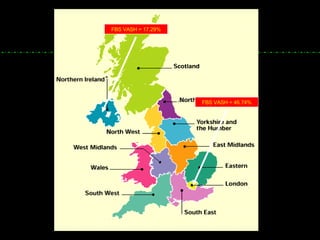
FBS VASH = 17.29% FBS VASH = 46.74%
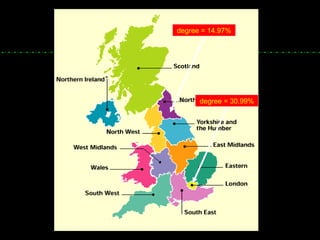
degree = 14.97% degree = 30.99%
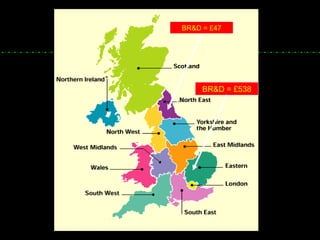
BR&D = £47 BR&D = £538
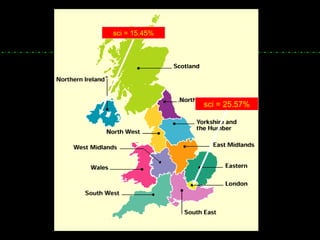
sci = 15.45% sci = 25.57%
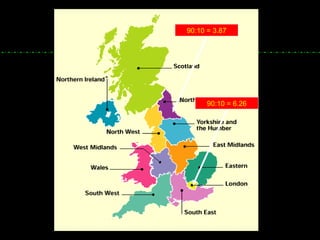
90:10 = 3.87 90:10 = 6.26


Inequality in the Info Soc ‘ Because of [a new] structural divide [and …] in the absence of a determined public policy aimed at correcting structural trends, we have witnessed in the last 20 years a dramatic surge of inequality, social polarization, and social exclusion in the world at large, and in most countries, particularly, among advanced societies, in the USA and in the UK’ Castells, 2000
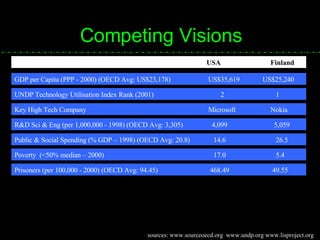
Competing Visions ‘ the paths and outcomes of this transformation are extraordinarily diverse […] there is no one model of information society’   (Castells & Himanen, 2002).
Competing Visions USA Finland GDP per Capita (PPP - 2000) (OECD Avg: US$23,178)  US$35,619  US$25,240 UNDP Technology Utilisation Index Rank (2001)    2   1 Key High Tech Company  Microsoft Nokia R&D Sci & Eng (per 1,000,000 - 1998) (OECD Avg: 3,305)   4,099   5,059 Public & Social Spending (% GDP – 1998) (OECD Avg: 20.8)   14.6   26.5 Poverty  (<50% median – 2000)    17.0    5.4 Prisoners (per 100,000 - 2000) (OECD Avg: 94.45)   468.49  49.55 sources:  www.sourceoecd.org   www.undp.org   www.lisproject.org
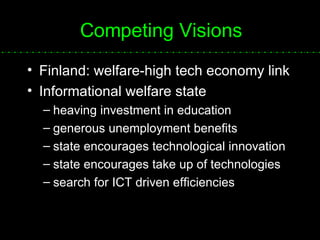
Competing Visions Finland: welfare-high tech economy link Informational welfare state heaving investment in education generous unemployment benefits state encourages technological innovation state encourages take up of technologies search for ICT driven efficiencies

STSP Week3

  • 1.
    Technology and SocietyII Are ICTs Transforming Contemporary Society?
  • 2.
    Session Objectives Outlinekey theories concerning the impact of ICTs on society Consider the implications of these theories for the (welfare) state Examine the UK government’s broad response to the emergence of an ‘information society’
  • 3.
    Theories: Origins Ideasemerge late 1960s/early 1970s Key theorists: Bell ‘74: Post-Industrial Society Touraine ‘69: La Société Post-Industrielle Machlup ‘62 & Porat ‘77: Information Economy Minc & Nora ‘77: L’Informatisation D’ Société Toffler ‘80: The Third Wave Masuda ‘80: Post-Industrial Soc = Info Soc Castells ‘89: Network Society
  • 4.
    Theories: Rhetoric ofRevolution “…an extraordinary transformation, perhaps even greater in its impact than the industrial revolution of the previous century” Bell (1980)
  • 5.
    Theories: Rhetoric ofRevolution “[We are entering the ‘Third Wave’,] an event as profound as the First Wave of change unleashed ten thousand years ago by the invention of agriculture, or the earthshaking Second Wave of change touched off by the industrial revolution” Toffler (1980)
  • 6.
    Theories: Rhetoric ofRevolution “ The coming ‘information age’ is already accepted as the successor to the industrial age” Dizard (1982)
  • 7.
    Theories: Bell “a revolution in organisation and processing of information and knowledge, in which the computer plays a central role” Links to wider shift in the structure of the economy and power relations in society Industrial society being replaced by a new Post-Industrial successor
  • 8.
  • 9.
  • 10.
    Theories: Bell ‘My basic premise [is] that knowledge and information are becoming the strategic resource and transforming agent of the postindustrial society [just as] the combination of energy, resources, and machine technology were the transforming agencies of industrial society’ Built on ideas of an information economy ‘ The Social Framework of the Information Society’ (1979)
  • 11.
  • 12.
    Theories: Criticisms ofBell What do information and knowledge mean? Is the link with ICTs valid? Problem of technological determinism A continuation of old trends rather than an altogether new epoch?
  • 13.
    Theories: Criticisms ofBell [information has] been divorced from its conventional meaning, [and is] up for grabs... for the information theorist, it does not matter whether we are transmitting a fact, a judgement, a shallow cliché, a deep teaching, a sublime truth, or a nasty obscenity. All are ‘information ’ (Roszak )
  • 14.
    Beyond Bell Pre-Micro-Computer pre-internet May, Angell, Negopontre, Virilio Castells
  • 15.
    Network Society ‘a new type of social structure that I call the network society’ ‘ the transformation of our ‘material culture’ by the works of a new technological paradigm organized around information technologies’ ‘ the vast majority of societies are affected in a fundamental way by these transformations’
  • 16.
    Network Society Economyglobal informational network enterprise Labour market flexible programmable labour polarisation Media fragmented fast paced bite sized Politics & State messages/symbols state as network hollowed out
  • 17.
    Network Society Twoforces: ICTs (Informational) Networks Timeless Time Space of Flows
  • 18.
    Information Society “Theinformation society is one in which information is used intensively as an aspect of economic, social, cultural and political life” (UNESCO, World Information Report, 1998)
  • 19.
    Politicians & theInfo Society Information is the key to the modern age. The new age of information offers possibilities for the future limited only by the boundaries of our imaginations. The potential of the new electronic networks is breathtaking – the prospect of change as widespread and fundamental as the agricultural and industrial revolutions of earlier eras. Tony Blair
  • 20.
    Politicians & theInfo Society This [information] revolution adds huge new capacities to human intelligence and constitutes a resource which changes the way we work together and the way we live together Bangemann Report (1995)
  • 21.
    Politicians & theInfo Society The world is undergoing a technological revolution and entering the age of the Information Society. [...] The potential technological, economic, and social upheavals resulting from the information revolution could be of the same order of magnitude as those arising from the shift away from an agricultural to an industrial economy House of Lords Science and Technology Select Committee (1996)
  • 22.
    Politicians & theInfo Society [the information revolution] promises to change society every bit as radically as the industrial revolution of the nineteenth century Kenneth Baker, 1984
  • 23.
    Govt Responses toInfo Soc 1970s : France, 1976: L’Informatisation d’Societe 1980s: 1981 – 1 st UK Information Technology Minister 1982 - ‘Information Technology Year’ 1990s: USA: Al Gore leads investigation into the Information Society EU: the Bangemann Report Japan & Singapore: ‘Informatization White Papers’ OECD reports on: Information Society Information Economy IT in Public Administration
  • 24.
    UK Govt Responsesto I.S. Under Conservatives Information Society Initiative (DTI) Government.Direct Under Labour Information Age Government Information Exclusion e-Commerce Knowledge Economy
  • 25.
    (1) Information AgeGovt Our Information Age: the Government’s Vision (1997) Modernising Government (1999) e-Government: A Strategic Framework for Public Services in the Information Age (2000) Transformational Government (2005) 100% by 2008 (2005) Radical process re-engineering Citizen Centric Government
  • 26.
    (2) Information ExclusionClosing the Digital Divide: Information and Communication Technologies in Deprived Areas [PAT 15] (2000) Inclusion Through Innovation (2005) Connecting the UK (2005) Digital City Challenge (2007) Universal internet access by 2005, Broadband 2008? All ICT policies should reduce rather than increase social exclusion Computers Within Reach , Wired Up Communities UK Online Centres
  • 27.
    (3) E-Commerce OurCompetitive Future: Building the Knowledge Driven Economy (1998) Make UK best place in world for e-commerce by 2002 Tax breaks for ICTs Electronic Communications regulations Skills for the Information Age agenda
  • 28.
    (4) Knowledge Economyabandonment of Keynesianism ‘ Today [Keynesianism] has completely broken down. Globalisation has placed a premium on workers with the skills and knowledge to adapt to advancing technology ’ (Blair, 1999) not a free market approach supply side measures important skills and education active labour market policy ‘ a significant redrawing of the boundaries of state activity’ (Glyn & Wood)
  • 29.
    (4) Knowledge Economyinformation revolution & globalisation used to justify policy shifts ‘ in a global marketplace characterised by ever more fierce competition, and unparalleled waves of technological change, we need - more than ever before - to be able to respond to change’ (Brown) the third way ‘looks to develop a wide-ranging supply side policy, which seeks to reconcile economic growth mechanisms with structural reform of the welfare state [because] in the information economy, human (and) social capital becomes central to economic success’ (Giddens) ‘ Adapting to change is never easy and the speed of change appears faster than ever before, not least under the impact of new technologies’ (Blair & Schroeder)
  • 30.
    Welfare & theInfo Society a readying the welfare state for the information age? developing new methods of service delivery addressing new forms of exclusion redefining the boundaries of state activity information society central to philosophy present third way as a modernisation of egalitarianism response to an unstoppable technological revolution e-galitarianism cf. e-egalitarianism?
  • 31.
    Technology and SocietyII Are ICTs Transforming Contemporary Society? (Part 2)
  • 32.
    Knowledge Economy Definitions:weightless economy knowledge economy high-tech economy
  • 33.
    FBS VASH =17.29% FBS VASH = 46.74%
  • 34.
    degree = 14.97%degree = 30.99%
  • 35.
    BR&D = £47BR&D = £538
  • 36.
    sci = 15.45%sci = 25.57%
  • 37.
    90:10 = 3.8790:10 = 6.26
  • 38.
  • 39.
  • 40.
  • 41.
  • 42.
    Inequality in theInfo Soc ‘ Because of [a new] structural divide [and …] in the absence of a determined public policy aimed at correcting structural trends, we have witnessed in the last 20 years a dramatic surge of inequality, social polarization, and social exclusion in the world at large, and in most countries, particularly, among advanced societies, in the USA and in the UK’ Castells, 2000
  • 43.
    Competing Visions ‘the paths and outcomes of this transformation are extraordinarily diverse […] there is no one model of information society’ (Castells & Himanen, 2002).
  • 44.
    Competing Visions USAFinland GDP per Capita (PPP - 2000) (OECD Avg: US$23,178) US$35,619 US$25,240 UNDP Technology Utilisation Index Rank (2001) 2 1 Key High Tech Company Microsoft Nokia R&D Sci & Eng (per 1,000,000 - 1998) (OECD Avg: 3,305) 4,099 5,059 Public & Social Spending (% GDP – 1998) (OECD Avg: 20.8) 14.6 26.5 Poverty (<50% median – 2000) 17.0 5.4 Prisoners (per 100,000 - 2000) (OECD Avg: 94.45) 468.49 49.55 sources: www.sourceoecd.org www.undp.org www.lisproject.org
  • 45.
    Competing Visions Finland:welfare-high tech economy link Informational welfare state heaving investment in education generous unemployment benefits state encourages technological innovation state encourages take up of technologies search for ICT driven efficiencies