L J Haravu
The origins and concept of a knowledge
economy and society
Characteristics of knowledge as a resource
Relationship between learning and
knowledge
Concept of a learning society and its
characteristics
Challenges and possible future
 Industrial revolution - Technological definition
◦ Cluster of Macro inventions leading to
acceleration in micro inventions
◦ Macro inventions created the seeds for the
gradual:
 Diffusion, adaptation, improvement and
extension of the techniques developed
 Created a mind set that accepted and
eagerly welcomed :
◦ invention and innovation
◦ New products and services
 Created the social values that made
possible the new industries
 Created the ‘Technologist’ and
Entrepreneur
 Recognition that economic progress/power
depends on sustained industrial growth
◦ such growth depends at least partly on support to
scientific research and R & D
 Scientific research in academic centres and R
& D received active support in UK first and in
Europe and USA in the 19th century
 Growth in the volume of scientific and
technical information (STI)
 In the 20th Century, we saw:
◦ New levels of investment in R & D as a result of the
world wars
◦ Intense rivalry for military supremacy by the power
blocks during the wars and in the interim between
the wars
◦ The cold war after the second world war
◦ The push for nuclear supremacy
◦ The push for supremacy in the Space sciences
◦ And now in the Biotechnology and IT areas
 Management of the ever increasing ‘flood’ of
STI became an important issue
◦ Resulted in the development of tools, theories and
techniques
 The birth of another trigger technology, viz.,
the Digital Computer in 1946
 The computer along with other
microelectronic inventions (the transistor,
Integrated circuits) were like macro
inventions of the Industrial Revolution
 Computers led to the emergence of a totally
new industry, the Software Industry
 Unlike industries in the Industrial revolution,
the Software Industry is built on the soft
skills/knowledge of people.
 Initial use of computers was predominantly
for scientific and numeric work
 Its potential as an Information Processing
machine was realized only when computers
became cheaper and more capable
 Scenario in the business world in the 1960’s
and onwards
◦ Increased competition
◦ Larger scales of operation
◦ Increased multinational presence
◦ Greater respect for international standards
◦ Reduced barriers to trade and commerce
 Businesses, industries needed to acquire and
manage a wide range of information
 Information became a product in its own right
 Information became an important element in
decision making in business
 This again fuelled the search for better
methods in information management
 Businesses, manufacturing and service
industries sought to apply computers and
communication technologies in the 1960’s
and 1970’s for data and information
processing
 IT was seen not only as a resource but as a
business environment
 Global interdependencies and pace of
change demanded that businesses become:
◦ More flexible
◦ More adaptive
 Application of IT, it was hoped would help:
◦ Decrease vulnerability by reducing cost of
expected failures
◦ Enhance adaptability by reducing cost of
adjustment
 Drucker (1985) defined organization as “ a
structure in which information is the axis and
central structural support”
 Organizations began to restructure to take
advantage of IT
 Experience with IT was mixed among businesses.
Returns were not always commensurate with
investments
 The development of microcomputers during the
1970’s heralded yet another trigger technology
 This led to an ubiquity in computing and an
explosion in application software
 Rapid technological developments pushed prices
down and increased capabilities
 The software industry became the driving force
 Microcomputers truly democratized computing and
put it in the hands of virtually everyone
 A new class of professional, viz., called the
Knowledge Worker by Drucker emerged. This
resulted from the preoccupation of
business/industry with information
management
 Relative contribution of knowledge workers to GDP in
the developed world has increased over the last
several years
 The Internet was opened to the world in the
1980’s
◦ The emergence of the World Wide Web (WWW) as an
application riding the Internet and based on
commonly agreed language, protocols, software,
standards.
 The Internet and WWW added a new dimension to
the Information world
 The microcomputer made computing ubiquitous;
the Internet made access to information produced
anywhere globally accessible
 Led to the explosion of information of all
kinds (text, images, graphics, sound, video)
 Internet and the Web may also be seen as
macro invention that spawned a number of
micro inventions
 The true impact of the Information Revolution
began to be felt by mid 1980s, e.g.,
◦ The emergence of the Internet as a major worldwide
distribution channel for goods and services, and
jobs (or E-Commerce)
 Not only made information globally accessible, it:
◦ Facilitated one-to-one, one-to-many and many-to-
many interactions between like-minded people
◦ Virtual communities of all kinds proliferated
worldwide thanks to email, chat, netmeeting,
discussion forums
 The Web is much more than an information network
because it:
1. Allows sharing of knowledge
2. Collaboration, sharing and cooperation as opposed to
competition are the paradigms on which new
developments are predicated
 E-Commerce is to the Information Revolution
what the railroad was to the Industrial
Revolution
 E-Commerce was a totally unprecedented
development and is rapidly changing
economies, society and politics
 In the new ‘mental geography’ created by the
railroad, distance was mastered; in the ‘mental
geography’ of E-Commerce, distance has been
eliminated (Drucker 1999)
 In E-Commerce there is only one economy and one
market
 Consequences:
◦ Every business must become globally competitive
even if it manufactures and sells locally
◦ The traditional multi-national may become obsolete
◦ There are neither local companies nor distinct
geographies
 The Web is much more than an information network
because it:
◦ Allows sharing of knowledge
◦ Distributed resources become equally accessible
◦ Permits collaboration
 Collaboration, sharing and cooperation as opposed to
competition are the paradigms on which new
developments are predicated
 Information Overload is a negative
consequence of the Information revolution
◦ a critical factor in the productivity of knowledge
workers
 This is driven not only by ready availability of
vast quantities of information but also
because professionals need more information
in their jobs
 Choosing what information to gather, share
and process can be overwhelming
 People are increasingly concerned with the quality of
their choices around information
 We are beginning to grapple with the relationship
between information and knowledge
 Information overload has created a new kind of
competition, the competition for people’s attention
 ‘Information absorbs the attention of the recipient.
Therefore an overabundance of information creates a
deficit of attention’
 Where are the nuggets of knowledge in a sea of
information?
 Globally competitive business
 Information saturated society
 Businesses need to be constantly alert
 Businesses need to be constantly competitive
 Need for means to make good choices/decisions in
an information overloaded world
 Led to:
◦ Realization that the key to being constantly
competitive is to be constantly innovative in all
aspects of a business
 The key to being innovative is KNOWLEDGE
 World Bank:
◦ For countries in the vanguard of world economy,
the balance between knowledge and resources has
shifted so far towards the former that knowledge
has perhaps become the most important factor
determining the standard of living – more than
land, than tools, than labour. Today’s
technologically advanced economies are truly
knowledge-based.’
√ Alvin Toffler:
√ Knowledge as the source of the highest quality of
power and the key to the powershift that lies ahead.
There is a battle for the control of knowledge and the
means of communication.
√ Peter Drucker argues that in the new economy,
knowledge is not just another resource alongside the
traditional factors of production – land, labour and
capital. – but the only meaningful resource
 Neo classical economists recognized only 3 factors
of production: land, labour and capital. Knowledge
was seen as an exogenous factor
 New Growth economists (Joeseph Schumpeter, Paul
Romer and others) see technology and the
knowledge on which it is based as an intrinsic part
of the system
 New Growth economics differ from earlier
theorists in the following ways:
◦ Knowledge is the basic form of capital. Economic
growth is driven by the accumulation of
knowledge
◦ While any given technological breakthrough may
seem to be random, these rather that having a
one-off impact, can create technical platforms for
further innovations and this technical platform
effect is a key driver of economic growth.
 According to New Growth economics
◦ a country’s capacity to take advantage of the
Knowledge Economy depends on how quickly it
can become a ‘learning economy.’
◦ Learning means not only using new technologies
to access global knowledge, it also means using
them to communicate with other people about
innovation
 According to New Growth economics
◦ In the ‘Learning Economy’ individuals, firms and
countries will be able to create wealth in proportion
to their capacity to learn and share innovation.
◦ Formal education too needs to be less about
passing on information and focus on teaching
people how to learn
√ Most countries today are investing in the becoming
knowledge driven via:
√ policy initiatives,
√ technology
√ Infrastructure
√ Seeking new approaches in higher educational systems
√ Open universities and distance education
√ Open learning, open access, open standards, open
source
√ Collaboration among different stake holders: public,
private, NGOs, International agencies
√ Knowledge and information are not the same
although we speak of these as though they are
synonymous
√ Information alone does not often have the capacity
to resolve uncertainty.
√ Knowledge gives the capacity to act effectively in
order to produce desired outcomes in a complex,
uncertain and fast changing environment
 Knowledge can and should be evaluated by
the decisions and actions to which it leads
 The capacity to act effectively requires considering
and understanding a broad variety of factors in any
situation, making effective decisions, and enacting
them
 This capacity is exclusive to human beings
 Information is something which can be digitized,
while knowledge is intrinsic to people
 Digitized information can be stored indefinitely,
duplicated, communicated
 Knowledge has to be transferred either directly thru
socialization or by delivering information which
people can internalize as their personal knowledge
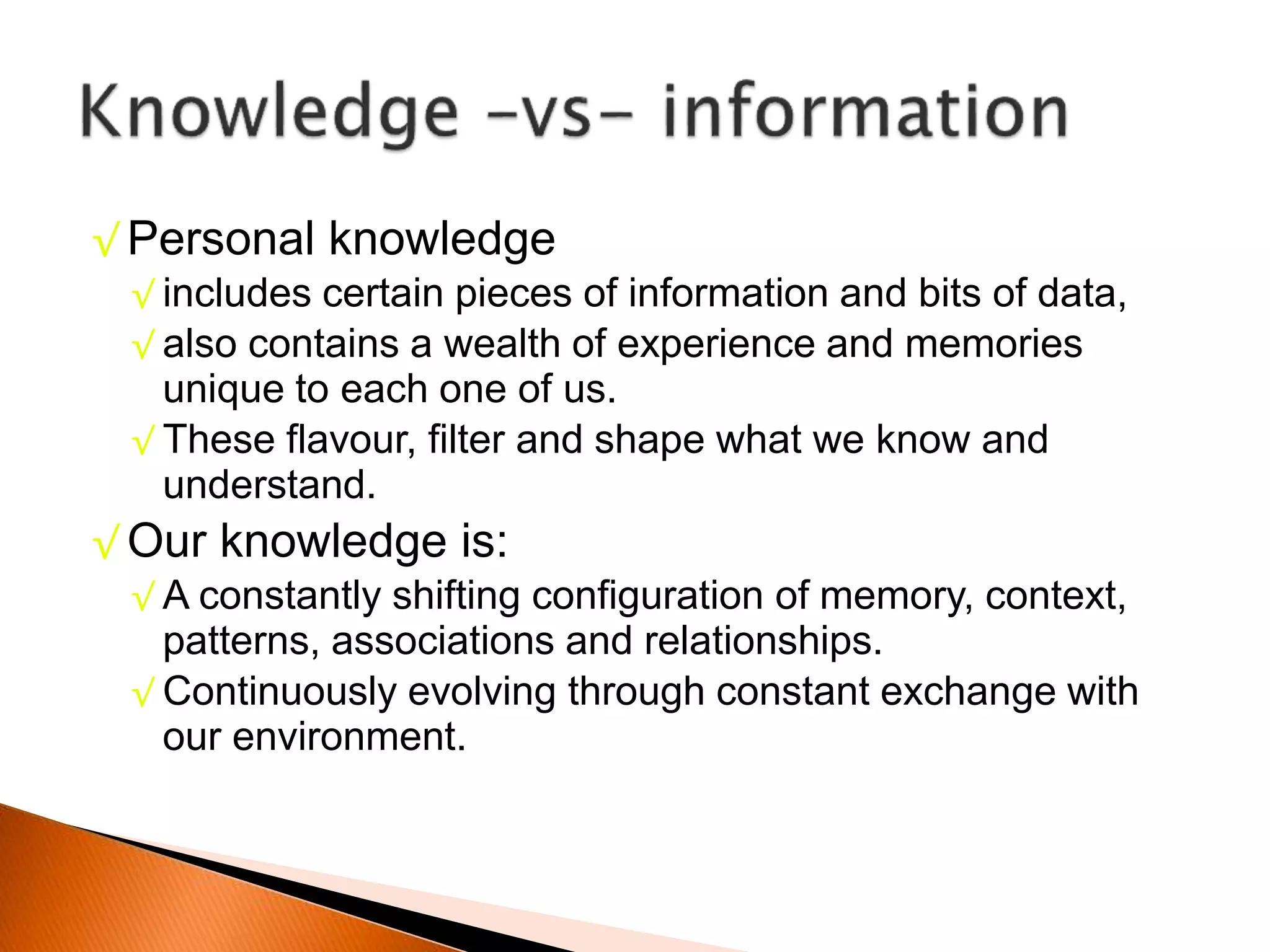
√ Personal knowledge
√ includes certain pieces of information and bits of data,
√ also contains a wealth of experience and memories
unique to each one of us.
√ These flavour, filter and shape what we know and
understand.
√ Our knowledge is:
√ A constantly shifting configuration of memory, context,
patterns, associations and relationships.
√ Continuously evolving through constant exchange with
our environment.
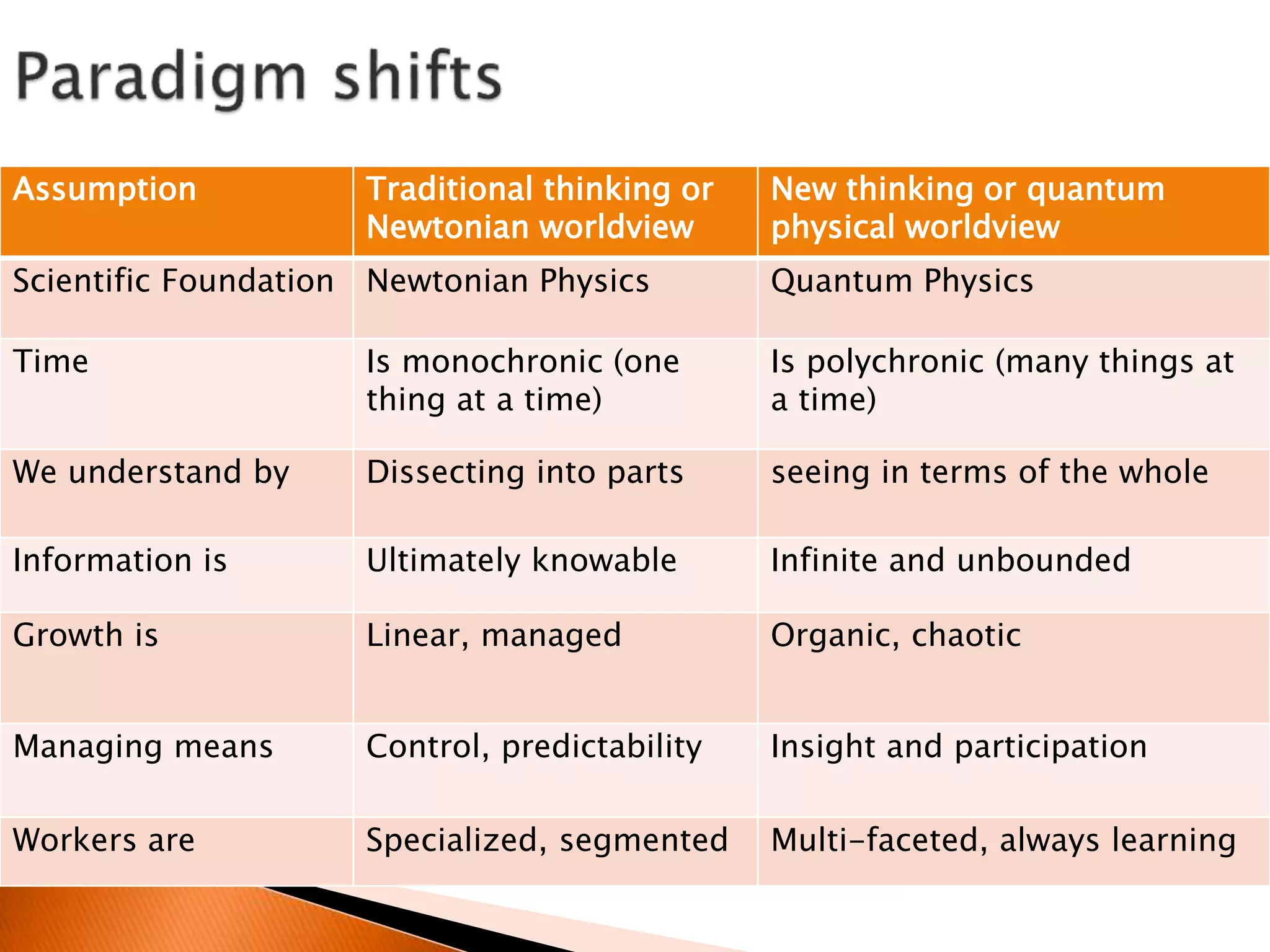
Assumption Traditional thinking or
Newtonian worldview
New thinking or quantum
physical worldview
Scientific Foundation Newtonian Physics Quantum Physics
Time Is monochronic (one
thing at a time)
Is polychronic (many things at
a time)
We understand by Dissecting into parts seeing in terms of the whole
Information is Ultimately knowable Infinite and unbounded
Growth is Linear, managed Organic, chaotic
Managing means Control, predictability Insight and participation
Workers are Specialized, segmented Multi-faceted, always learning
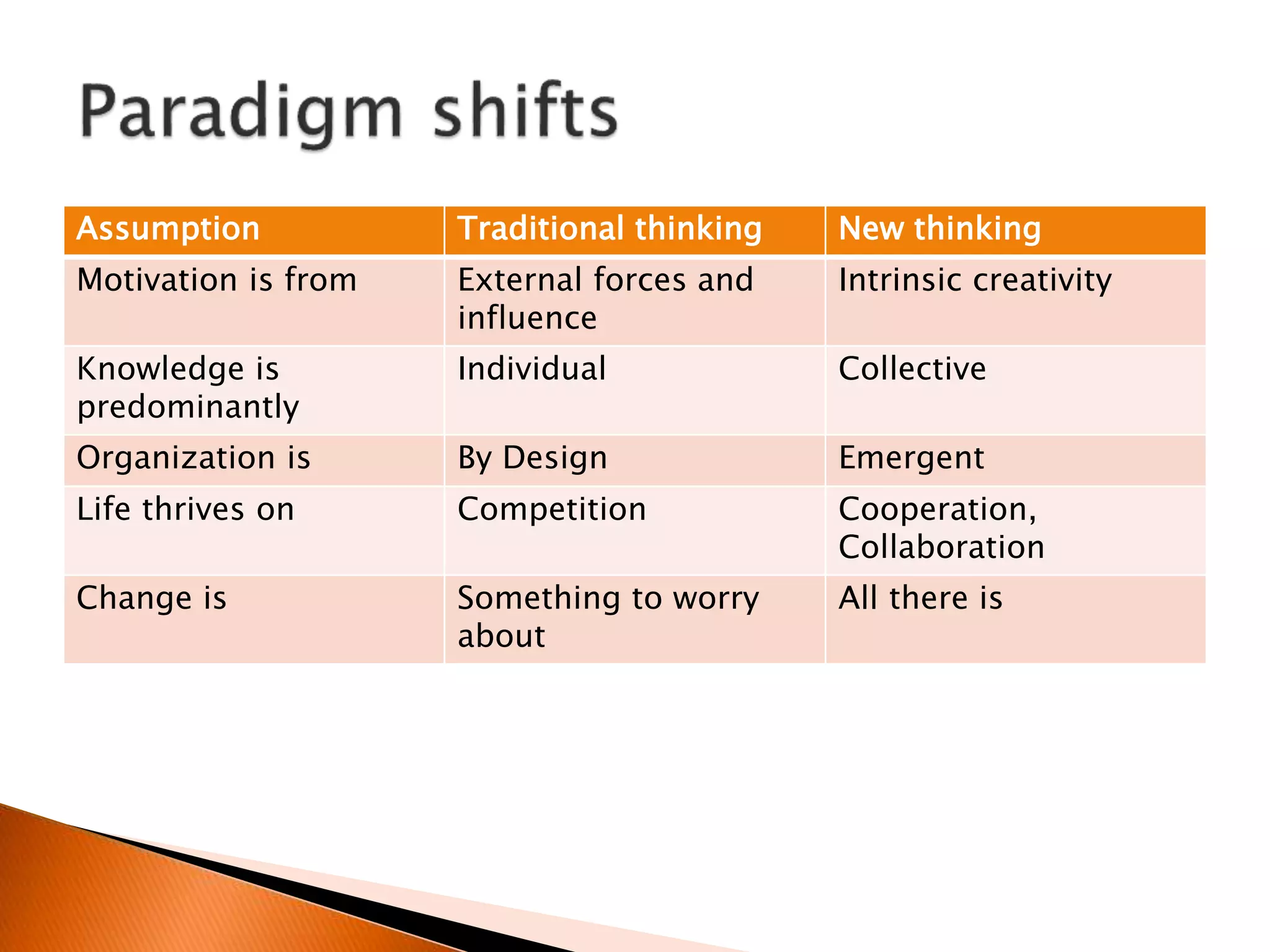
Assumption Traditional thinking New thinking
Motivation is from External forces and
influence
Intrinsic creativity
Knowledge is
predominantly
Individual Collective
Organization is By Design Emergent
Life thrives on Competition Cooperation,
Collaboration
Change is Something to worry
about
All there is
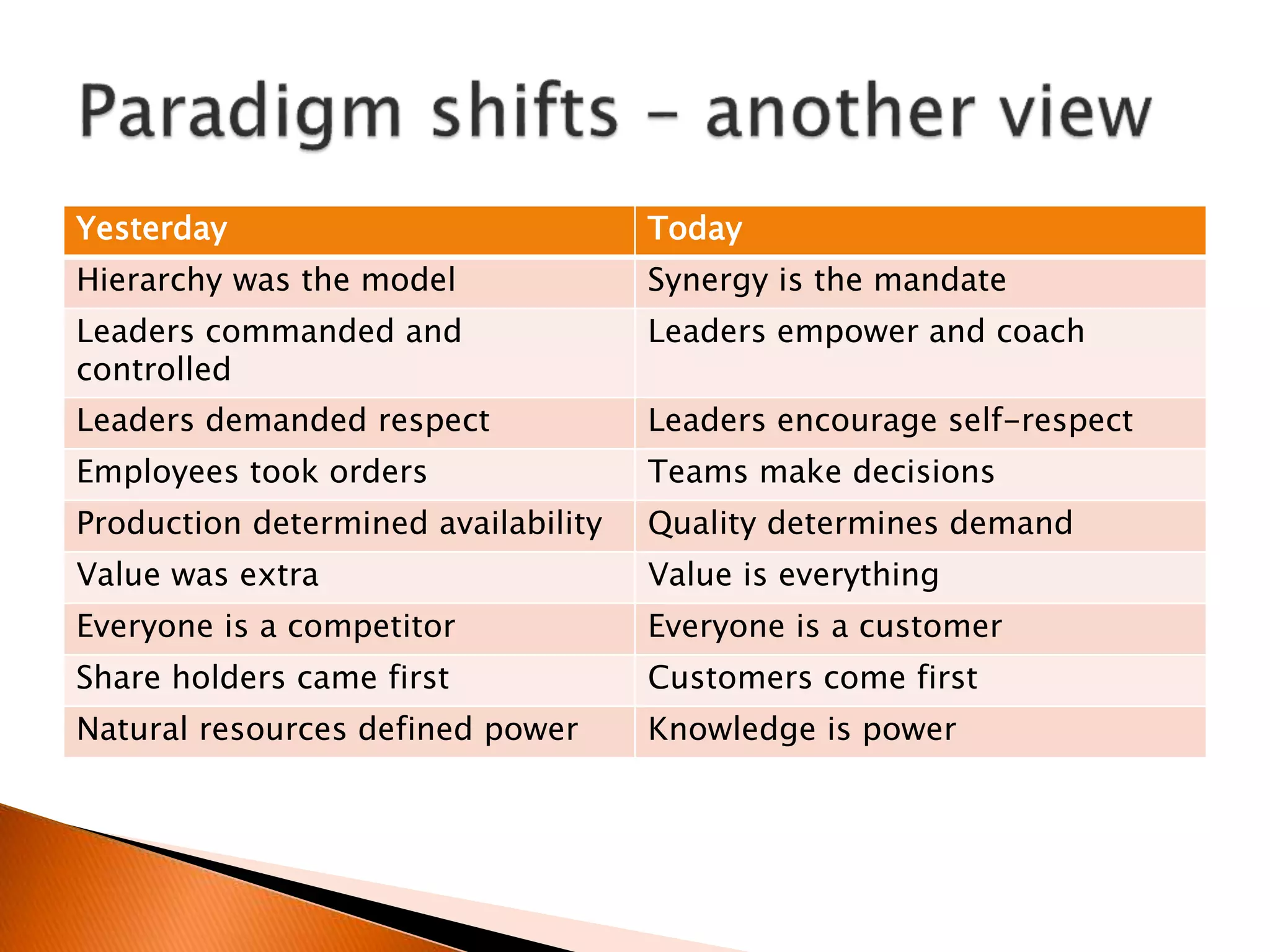
Yesterday Today
Hierarchy was the model Synergy is the mandate
Leaders commanded and
controlled
Leaders empower and coach
Leaders demanded respect Leaders encourage self-respect
Employees took orders Teams make decisions
Production determined availability Quality determines demand
Value was extra Value is everything
Everyone is a competitor Everyone is a customer
Share holders came first Customers come first
Natural resources defined power Knowledge is power
 Learning can be defined as gaining knowledge,
comprehension or mastery through experience or study.
 Learning by individuals, organizations, including
educational institutions is vital to their continued well-
being, survival, and growth in the Knowledge Economy
 Alvin Toffler: In the twenty first century an illiterate
person is not one who cannot read or write, but
one who will not learn, unlearn and relearn”.
 Equally true of organizations
 Many organizations are seeking to become
learning organizations as this is the only way they
can hope to remain relevant, competent and
competitive in a fast changing world.
 Formal education too needs to be less about
passing on information and focus on teaching
people “how to learn”.
 An overarching philosophy, policies and support
systems are needed for people to lean on.
 Such a support system has been called the
Learning Society
 Donald Schon provided a theoretical framework linking
the experience of living in a situation of an increasing
change with the need for learning.
 society and all of its institutions are in continuous
processes of transformation. We cannot expect new
stable states that will endure for our own lifetimes.
 We must learn to understand, guide, influence and
manage these transformations.
 In other words, we must be able not only to transform
our institutions, in response to changing situations and
requirements; we must invent and develop institutions
which are ‘learning systems’
Torsten Husén, another early contributor to the
concept of learning societies:
“it would be necessary for states to become 'learning
societies' - where knowledge and information lay at the
heart of their activities”.
Husén's vision of a relevant educational system
for Learning Societies include the following:
Education is going to be a lifelong process.
No fixed points of entry and 'cut-off' exits.
More a continuous process within formal education and in its
role within other functions of life.
Will take on a more informal character as it becomes
accessible to more and more individuals.
In addition to 'learning centers', facilities will be provided for
learning at home and at the workplace
To an ever-increasing extent, the education system will
become dependent on supporting systems to produce
teaching aids, systems of information processing and multi-
media instructional materials.
 Three key strands in the notion of a learning
society
◦ The learning society is an educated society,
committed to active citizenship, liberal democracy and
equal opportunities. This supports lifelong learning.
◦ A learning society is a learning market, enabling
institutions to provide services for individuals as a
condition for supporting the competitiveness of the
economy.
◦ Learners adopt a learning approach to life, drawing
on a wide range of resources to enable them to
support their lifestyle practices
 Key attributes
• values and fosters habits of lifelong learning
• socially inclusive and ensures that all of its members
are part of its learning communities
• It recognizes the importance of early-childhood
development as part of lifelong learning and
develops organized ways of enhancing the
development of all children.
• It views information technologies, including new
interactive, multimedia technologies, as tools for
enriching learning
 Globalization and new patterns of working
and living are increasing the demand for
specialist skills and knowledge. But to be
“knowledgeable” will no longer be good
enough:
◦ A new set of 21st century skills, will also be
essential to flourish.
◦ Many more people than ever before need to have
advanced capabilities for critical thinking,
collaboration, and problem-solving
 Traditional education systems alone are
simply not capable of serving the world’s
growing and changing needs.
 The knowledge explosion, driven by the
power of the network to connect people and
spread ideas, has changed the very nature of
learning.
 Need to innovate and develop new modes of
learning, both formal and informal
 the social, economic and environmental challenges
of the 21st century demand citizens with a global
perspective and the capacity and passion to engage
with the world’s problems both at home and
abroad
 New technologies increase possibilities for learning
throughout life, have the potential to improve
access, and intensify and spread the process of
knowledge creation
 The future of education is through formal and
informal networks.
 Using the full power of video and mobility,
people can collaborate to create and share
knowledge as well as develop new ways of
teaching and learning that captures the
attention and imagination of learners
anywhere, anytime on any device.
 We can now see examples of the Learning
Society in the adoption of new technologies.
Examples include:
 the rise of social networking, edutainment, the open
source movement, and new trends in educational
technologies.
 Learning as an activity not a place, where it is wide open
to new people with new ideas.
 Learners “pulling” learning toward themselves rather than
teachers “pushing”
 spread far beyond school and involve learners and
parents as contributors as well as customers -
outsourcing
 Learning needs to be organized on a different
set of principles requiring a new learning
system that is characterized by:
◦ new ways of organizing learning, new forms of
assessment and credentialing,
◦ different models of investment and funding, and a
fit-for-purpose infrastructure.
 The Learning Society needs:
◦ strong leadership from a coalition of governments,
businesses, NGOs, and social investors
◦ a mixture of learning providers—public, private,
and third sector
◦ organizations and individuals who provide content
◦ Telecom providers (supported by governments)
must help ensure access to a shared learning
infrastructure
 The Learning Society needs:
◦ That employers and unions encourage their staff, their
members, and their communities to take advantage of learning
opportunities,
◦ To develop legitimate, standard certification systems that offer
the prospect of portable qualifications that are recognized
around the world,
◦ To fund a diversity of innovators—from spreading known
models to experimental work on high-risk and high-reward
projects
 All formal educational systems should
inculcate the thought and put in place
practices that:
◦ They are an integral part of the Learning Society
◦ They can contribute to it as well as benefit from it
◦ They need to innovate and use technology
towards developing new ways of encouraging
learning
Where is the information that we have lost in data?
Where is the knowledge that we have lost in
information?
Where is the wisdom we have lost in knowledge?
Where is the life we have lost in living?
T.S. Elliot

The learning society

  • 1.
  • 2.
    The origins andconcept of a knowledge economy and society Characteristics of knowledge as a resource Relationship between learning and knowledge Concept of a learning society and its characteristics Challenges and possible future
  • 3.
     Industrial revolution- Technological definition ◦ Cluster of Macro inventions leading to acceleration in micro inventions ◦ Macro inventions created the seeds for the gradual:  Diffusion, adaptation, improvement and extension of the techniques developed
  • 4.
     Created amind set that accepted and eagerly welcomed : ◦ invention and innovation ◦ New products and services  Created the social values that made possible the new industries  Created the ‘Technologist’ and Entrepreneur
  • 5.
     Recognition thateconomic progress/power depends on sustained industrial growth ◦ such growth depends at least partly on support to scientific research and R & D  Scientific research in academic centres and R & D received active support in UK first and in Europe and USA in the 19th century
  • 6.
     Growth inthe volume of scientific and technical information (STI)  In the 20th Century, we saw: ◦ New levels of investment in R & D as a result of the world wars ◦ Intense rivalry for military supremacy by the power blocks during the wars and in the interim between the wars ◦ The cold war after the second world war ◦ The push for nuclear supremacy ◦ The push for supremacy in the Space sciences ◦ And now in the Biotechnology and IT areas
  • 7.
     Management ofthe ever increasing ‘flood’ of STI became an important issue ◦ Resulted in the development of tools, theories and techniques  The birth of another trigger technology, viz., the Digital Computer in 1946  The computer along with other microelectronic inventions (the transistor, Integrated circuits) were like macro inventions of the Industrial Revolution
  • 8.
     Computers ledto the emergence of a totally new industry, the Software Industry  Unlike industries in the Industrial revolution, the Software Industry is built on the soft skills/knowledge of people.  Initial use of computers was predominantly for scientific and numeric work  Its potential as an Information Processing machine was realized only when computers became cheaper and more capable
  • 9.
     Scenario inthe business world in the 1960’s and onwards ◦ Increased competition ◦ Larger scales of operation ◦ Increased multinational presence ◦ Greater respect for international standards ◦ Reduced barriers to trade and commerce
  • 10.
     Businesses, industriesneeded to acquire and manage a wide range of information  Information became a product in its own right  Information became an important element in decision making in business  This again fuelled the search for better methods in information management
  • 11.
     Businesses, manufacturingand service industries sought to apply computers and communication technologies in the 1960’s and 1970’s for data and information processing  IT was seen not only as a resource but as a business environment
  • 12.
     Global interdependenciesand pace of change demanded that businesses become: ◦ More flexible ◦ More adaptive  Application of IT, it was hoped would help: ◦ Decrease vulnerability by reducing cost of expected failures ◦ Enhance adaptability by reducing cost of adjustment
  • 13.
     Drucker (1985)defined organization as “ a structure in which information is the axis and central structural support”  Organizations began to restructure to take advantage of IT  Experience with IT was mixed among businesses. Returns were not always commensurate with investments
  • 14.
     The developmentof microcomputers during the 1970’s heralded yet another trigger technology  This led to an ubiquity in computing and an explosion in application software  Rapid technological developments pushed prices down and increased capabilities  The software industry became the driving force  Microcomputers truly democratized computing and put it in the hands of virtually everyone
  • 15.
     A newclass of professional, viz., called the Knowledge Worker by Drucker emerged. This resulted from the preoccupation of business/industry with information management  Relative contribution of knowledge workers to GDP in the developed world has increased over the last several years
  • 16.
     The Internetwas opened to the world in the 1980’s ◦ The emergence of the World Wide Web (WWW) as an application riding the Internet and based on commonly agreed language, protocols, software, standards.  The Internet and WWW added a new dimension to the Information world  The microcomputer made computing ubiquitous; the Internet made access to information produced anywhere globally accessible
  • 17.
     Led tothe explosion of information of all kinds (text, images, graphics, sound, video)  Internet and the Web may also be seen as macro invention that spawned a number of micro inventions  The true impact of the Information Revolution began to be felt by mid 1980s, e.g., ◦ The emergence of the Internet as a major worldwide distribution channel for goods and services, and jobs (or E-Commerce)
  • 18.
     Not onlymade information globally accessible, it: ◦ Facilitated one-to-one, one-to-many and many-to- many interactions between like-minded people ◦ Virtual communities of all kinds proliferated worldwide thanks to email, chat, netmeeting, discussion forums  The Web is much more than an information network because it: 1. Allows sharing of knowledge 2. Collaboration, sharing and cooperation as opposed to competition are the paradigms on which new developments are predicated
  • 19.
     E-Commerce isto the Information Revolution what the railroad was to the Industrial Revolution  E-Commerce was a totally unprecedented development and is rapidly changing economies, society and politics
  • 20.
     In thenew ‘mental geography’ created by the railroad, distance was mastered; in the ‘mental geography’ of E-Commerce, distance has been eliminated (Drucker 1999)  In E-Commerce there is only one economy and one market  Consequences: ◦ Every business must become globally competitive even if it manufactures and sells locally ◦ The traditional multi-national may become obsolete ◦ There are neither local companies nor distinct geographies
  • 21.
     The Webis much more than an information network because it: ◦ Allows sharing of knowledge ◦ Distributed resources become equally accessible ◦ Permits collaboration  Collaboration, sharing and cooperation as opposed to competition are the paradigms on which new developments are predicated
  • 22.
     Information Overloadis a negative consequence of the Information revolution ◦ a critical factor in the productivity of knowledge workers  This is driven not only by ready availability of vast quantities of information but also because professionals need more information in their jobs  Choosing what information to gather, share and process can be overwhelming
  • 23.
     People areincreasingly concerned with the quality of their choices around information  We are beginning to grapple with the relationship between information and knowledge  Information overload has created a new kind of competition, the competition for people’s attention  ‘Information absorbs the attention of the recipient. Therefore an overabundance of information creates a deficit of attention’  Where are the nuggets of knowledge in a sea of information?
  • 24.
     Globally competitivebusiness  Information saturated society  Businesses need to be constantly alert  Businesses need to be constantly competitive  Need for means to make good choices/decisions in an information overloaded world  Led to: ◦ Realization that the key to being constantly competitive is to be constantly innovative in all aspects of a business  The key to being innovative is KNOWLEDGE
  • 25.
     World Bank: ◦For countries in the vanguard of world economy, the balance between knowledge and resources has shifted so far towards the former that knowledge has perhaps become the most important factor determining the standard of living – more than land, than tools, than labour. Today’s technologically advanced economies are truly knowledge-based.’
  • 26.
    √ Alvin Toffler: √Knowledge as the source of the highest quality of power and the key to the powershift that lies ahead. There is a battle for the control of knowledge and the means of communication. √ Peter Drucker argues that in the new economy, knowledge is not just another resource alongside the traditional factors of production – land, labour and capital. – but the only meaningful resource
  • 27.
     Neo classicaleconomists recognized only 3 factors of production: land, labour and capital. Knowledge was seen as an exogenous factor  New Growth economists (Joeseph Schumpeter, Paul Romer and others) see technology and the knowledge on which it is based as an intrinsic part of the system
  • 28.
     New Growtheconomics differ from earlier theorists in the following ways: ◦ Knowledge is the basic form of capital. Economic growth is driven by the accumulation of knowledge ◦ While any given technological breakthrough may seem to be random, these rather that having a one-off impact, can create technical platforms for further innovations and this technical platform effect is a key driver of economic growth.
  • 29.
     According toNew Growth economics ◦ a country’s capacity to take advantage of the Knowledge Economy depends on how quickly it can become a ‘learning economy.’ ◦ Learning means not only using new technologies to access global knowledge, it also means using them to communicate with other people about innovation
  • 30.
     According toNew Growth economics ◦ In the ‘Learning Economy’ individuals, firms and countries will be able to create wealth in proportion to their capacity to learn and share innovation. ◦ Formal education too needs to be less about passing on information and focus on teaching people how to learn
  • 31.
    √ Most countriestoday are investing in the becoming knowledge driven via: √ policy initiatives, √ technology √ Infrastructure √ Seeking new approaches in higher educational systems √ Open universities and distance education √ Open learning, open access, open standards, open source √ Collaboration among different stake holders: public, private, NGOs, International agencies
  • 32.
    √ Knowledge andinformation are not the same although we speak of these as though they are synonymous √ Information alone does not often have the capacity to resolve uncertainty. √ Knowledge gives the capacity to act effectively in order to produce desired outcomes in a complex, uncertain and fast changing environment  Knowledge can and should be evaluated by the decisions and actions to which it leads
  • 33.
     The capacityto act effectively requires considering and understanding a broad variety of factors in any situation, making effective decisions, and enacting them  This capacity is exclusive to human beings  Information is something which can be digitized, while knowledge is intrinsic to people  Digitized information can be stored indefinitely, duplicated, communicated  Knowledge has to be transferred either directly thru socialization or by delivering information which people can internalize as their personal knowledge
  • 34.
    √ Personal knowledge √includes certain pieces of information and bits of data, √ also contains a wealth of experience and memories unique to each one of us. √ These flavour, filter and shape what we know and understand. √ Our knowledge is: √ A constantly shifting configuration of memory, context, patterns, associations and relationships. √ Continuously evolving through constant exchange with our environment.
  • 35.
    Assumption Traditional thinkingor Newtonian worldview New thinking or quantum physical worldview Scientific Foundation Newtonian Physics Quantum Physics Time Is monochronic (one thing at a time) Is polychronic (many things at a time) We understand by Dissecting into parts seeing in terms of the whole Information is Ultimately knowable Infinite and unbounded Growth is Linear, managed Organic, chaotic Managing means Control, predictability Insight and participation Workers are Specialized, segmented Multi-faceted, always learning
  • 36.
    Assumption Traditional thinkingNew thinking Motivation is from External forces and influence Intrinsic creativity Knowledge is predominantly Individual Collective Organization is By Design Emergent Life thrives on Competition Cooperation, Collaboration Change is Something to worry about All there is
  • 37.
    Yesterday Today Hierarchy wasthe model Synergy is the mandate Leaders commanded and controlled Leaders empower and coach Leaders demanded respect Leaders encourage self-respect Employees took orders Teams make decisions Production determined availability Quality determines demand Value was extra Value is everything Everyone is a competitor Everyone is a customer Share holders came first Customers come first Natural resources defined power Knowledge is power
  • 38.
     Learning canbe defined as gaining knowledge, comprehension or mastery through experience or study.  Learning by individuals, organizations, including educational institutions is vital to their continued well- being, survival, and growth in the Knowledge Economy
  • 39.
     Alvin Toffler:In the twenty first century an illiterate person is not one who cannot read or write, but one who will not learn, unlearn and relearn”.  Equally true of organizations  Many organizations are seeking to become learning organizations as this is the only way they can hope to remain relevant, competent and competitive in a fast changing world.
  • 40.
     Formal educationtoo needs to be less about passing on information and focus on teaching people “how to learn”.  An overarching philosophy, policies and support systems are needed for people to lean on.  Such a support system has been called the Learning Society
  • 41.
     Donald Schonprovided a theoretical framework linking the experience of living in a situation of an increasing change with the need for learning.  society and all of its institutions are in continuous processes of transformation. We cannot expect new stable states that will endure for our own lifetimes.  We must learn to understand, guide, influence and manage these transformations.  In other words, we must be able not only to transform our institutions, in response to changing situations and requirements; we must invent and develop institutions which are ‘learning systems’
  • 42.
    Torsten Husén, anotherearly contributor to the concept of learning societies: “it would be necessary for states to become 'learning societies' - where knowledge and information lay at the heart of their activities”.
  • 43.
    Husén's vision ofa relevant educational system for Learning Societies include the following: Education is going to be a lifelong process. No fixed points of entry and 'cut-off' exits. More a continuous process within formal education and in its role within other functions of life. Will take on a more informal character as it becomes accessible to more and more individuals. In addition to 'learning centers', facilities will be provided for learning at home and at the workplace To an ever-increasing extent, the education system will become dependent on supporting systems to produce teaching aids, systems of information processing and multi- media instructional materials.
  • 44.
     Three keystrands in the notion of a learning society ◦ The learning society is an educated society, committed to active citizenship, liberal democracy and equal opportunities. This supports lifelong learning. ◦ A learning society is a learning market, enabling institutions to provide services for individuals as a condition for supporting the competitiveness of the economy. ◦ Learners adopt a learning approach to life, drawing on a wide range of resources to enable them to support their lifestyle practices
  • 45.
     Key attributes •values and fosters habits of lifelong learning • socially inclusive and ensures that all of its members are part of its learning communities • It recognizes the importance of early-childhood development as part of lifelong learning and develops organized ways of enhancing the development of all children. • It views information technologies, including new interactive, multimedia technologies, as tools for enriching learning
  • 46.
     Globalization andnew patterns of working and living are increasing the demand for specialist skills and knowledge. But to be “knowledgeable” will no longer be good enough: ◦ A new set of 21st century skills, will also be essential to flourish. ◦ Many more people than ever before need to have advanced capabilities for critical thinking, collaboration, and problem-solving
  • 47.
     Traditional educationsystems alone are simply not capable of serving the world’s growing and changing needs.  The knowledge explosion, driven by the power of the network to connect people and spread ideas, has changed the very nature of learning.  Need to innovate and develop new modes of learning, both formal and informal
  • 48.
     the social,economic and environmental challenges of the 21st century demand citizens with a global perspective and the capacity and passion to engage with the world’s problems both at home and abroad  New technologies increase possibilities for learning throughout life, have the potential to improve access, and intensify and spread the process of knowledge creation
  • 49.
     The futureof education is through formal and informal networks.  Using the full power of video and mobility, people can collaborate to create and share knowledge as well as develop new ways of teaching and learning that captures the attention and imagination of learners anywhere, anytime on any device.
  • 50.
     We cannow see examples of the Learning Society in the adoption of new technologies. Examples include:  the rise of social networking, edutainment, the open source movement, and new trends in educational technologies.  Learning as an activity not a place, where it is wide open to new people with new ideas.  Learners “pulling” learning toward themselves rather than teachers “pushing”  spread far beyond school and involve learners and parents as contributors as well as customers - outsourcing
  • 51.
     Learning needsto be organized on a different set of principles requiring a new learning system that is characterized by: ◦ new ways of organizing learning, new forms of assessment and credentialing, ◦ different models of investment and funding, and a fit-for-purpose infrastructure.
  • 52.
     The LearningSociety needs: ◦ strong leadership from a coalition of governments, businesses, NGOs, and social investors ◦ a mixture of learning providers—public, private, and third sector ◦ organizations and individuals who provide content ◦ Telecom providers (supported by governments) must help ensure access to a shared learning infrastructure
  • 53.
     The LearningSociety needs: ◦ That employers and unions encourage their staff, their members, and their communities to take advantage of learning opportunities, ◦ To develop legitimate, standard certification systems that offer the prospect of portable qualifications that are recognized around the world, ◦ To fund a diversity of innovators—from spreading known models to experimental work on high-risk and high-reward projects
  • 54.
     All formaleducational systems should inculcate the thought and put in place practices that: ◦ They are an integral part of the Learning Society ◦ They can contribute to it as well as benefit from it ◦ They need to innovate and use technology towards developing new ways of encouraging learning
  • 55.
    Where is theinformation that we have lost in data? Where is the knowledge that we have lost in information? Where is the wisdom we have lost in knowledge? Where is the life we have lost in living? T.S. Elliot