ELECTRONIC RESOURCES
MANAGEMENT (ERM)
TOOLS/DATABASES PROCUREMENT:
USAGE AND CHALLENGES IN LAW
LIBRARY
21st National Workshop On Legal Information Services
In Law Libraries
11th – 12th October, 2021
Venue: Nigerian Institute Of Advancement Legal
Study, Unilag. Akoka
Presented
By
Dr. OKIKI, Olatokunbo C, CLN,
Head, Automation Unit
University of Lagos Library
University of Lagos
cokiki@unilag.edu.ng
EXPECTED OUTCOME
At the end of this workshop, we should be able to sharpen our
understanding of:
 What do we mean by Electronic Resources Management?
 Types of Electronic Resources Management
 Electronic Resources Management- Databases Procurement Process
 Proprietary Electronic Resources Management/Databases For Law
Library
 Open Access Electronic Resources Management/Databases For Law
Library
 Usage of Electronic Resources Management- Databases
 Challenges Facing Electronic Resources Management- Databases
EXPECTED OUTCOMES - ACCESS
After the course all workshop participants will:
 have been introduced to a range of electronic resources
management and databases available online for legal research.
 understand the concept of electronic resources management.
 have hands-on experience of using full range of electronic resources
management and databases available online for legal research
available
EXPECTED OUTCOMES - USE
After the course all workshop participants will have examined:
 tools, tips and techniques to effectively and efficiently use
electronic resources management and databases available online
for Legal Research.
 legal implications for e-resource use electronic resources
management and databases available online for Legal Research.
 issues surrounding e-resource management in law library.
QUESTIONS?
Please pause me and ask any question
during the presentation
—Walter Savage Landor
(1775-1864. English writer and poet)
“Nothing is pleasanter than
exploring a library.”
PREAMBLE
 Libraries have witnessed a prominent transition from print to
electronic resources that have not only impacted their services, but
users too.
 Inflow of resources in electronic format and subscription of library
software, e-books, e-journals, e-databases and other have totally
changed the library operations.
 In this age of rapidly changing technologies, it is essential for all
library professionals to keep abreast of the latest developments,
emerging trends & techniques in the area of Electronic Resource
Management (ERM) in libraries especially in law libraries as certain
issues and challenges faced in these areas need to be taken care of
with probable solutions.
WHAT IS ERM
 Electronic Resource Management AKA E-resource Management, or simply
ERM)refers broadly to an evolving array of problems, tasks, processes and
practices associated with the management of electronic resources such as
databases, electronic journals and electronic books in libraries (Anderson
et al.2004).
 Digital Library Federation (DLF), an electronic resource management
system should facilitate “management of the information and workflows
necessary to efficiently select, evaluate, acquire, maintain, and provide
access to e‐resources” (Jewell et al. 2004).
 A broader concept like a content management system to create Web
pages, provide administrative functions, and track license agreements
(Brown, Nelson, & Wineburgh-Freed, 2005; Robbins & Smith, 2004).
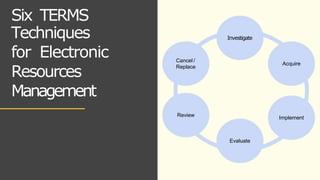
Investigate
Acquire
Implement
Evaluate
Review
Cancel /
Replace
Six TERMS
Techniques
for Electronic
Resources
Management
TYPES OF ERM
 Machine Readable Cataloguing: MARC, MARC 21
 Shared Catalogue: Ohio College Library Centre (OCLC)
 Online Public Access Catalogue/Web-based Catalogue
 Database
 Bibliographic Database
 CD-ROM Database
 Online Database
 Web-based databases
 Institutional Repository
 Emerging Types of E-resources: Blogs Wikis etc
ERM WORKFLOW
 Today, no single approach to the management of electronic
resources management prevails.
 The genre of library services platforms that offer combined
capabilities for managing print and electronic resources has
gained considerable acceptance most especially in academic
libraries and continues to attract other libraries.
 The growing number of electronic resources requires more
sophisticated workflows.
OTHER ERM WORKFLOW
 Beyond the cataloging part of the electronic resources
workflow, there are other workflow functions unique to
electronic resources management.
 These tasks include Licensing, Access, Set-up,
Troubleshooting, Link Maintenance, Interdatabase
Linking (e.g., between catalogs, abstract and indexing
databases, federated search tools, openURL resolvers),
Vendor Negotiation And Management Staffing.
LAW LIBRARY HOLDINGS
Law library holdings include the following, hence these must influence the type
of ERM to be deployed;
 Federal Legislations
 Foreign Law Publications
 Digest & Treatises
 Law Journals
 Textbooks, Dictionaries & Encyclopedias
 Law Dictionaries
 Law Encyclopedias
 Newspapers & Magazines
 Commonwealth Publications
 Casebooks Bibliographies & Directories
 Indexing & Abstracting Materials, etc
POLICIES GUIDING ACQUISITION OF ERM TOOLS
Before acquiring ERM tools/databases you need to be guided by the
following policies or principles:
 State that only those resources that are openURL compliant will be
added to your collection (time can be saved by not adding
nonopenURL resources).
 Who can contact vendors and under what circumstances?
 What sorts of troubleshooting should be done prior to contacting
vendors?
 Should you go with the lowest cost vendor every year or should
you try to stay with fewer vendors?
 What will you do about password-protected resources? Provide
access via OPAC and/or Website?
ACQUISITION PROCESS OF ERM TOOLS/DATABASES
 Selection
▨ Recommendation
▨ Trail offer
▨ Demonstration from publishers/vendors
▨ User recommendation
▨ Discussion lists
▨ Peer Library website
▨ Publisher’s catalogue
▨ From other Library of similar nature
▨ Colleagues suggestions
 Trial Use
▨ Consistency /
Uniformity
▨ Functionality
ACCESS NEED / BUDGET
ACQUISITION PROCESS & METHOD OF ERM (Cont.)
 Evaluation
▨ Recommendation
▨ Content
▨ Updates
▨ Quality – reputation of publishers
▨ intellectual level
▨ Indexing Up-gradation
▨ Authority – scholarly or not
▨ Accessibility
▨ Cost factor
▨ Technical support
▨ Licensing agreement
 Authentication
▨ Verify coverage, content
provider of the product,
frequency of updates and
cost
ACQUISITION PROCESS & METHOD OF ERM (Cont.)
 Price Negotiation
 Product type: aggregator/full
text database
 Product available through
yearly subscription, one-time
purchase or multi-year deals
with fixed price caps
 Article choice model
 Rental model
 Institution size
 Number of uses
 Price of consortia deal
 Patron-Driving Acquisition
ACQUISITION PROCESS & METHOD OF ERM (Cont.)
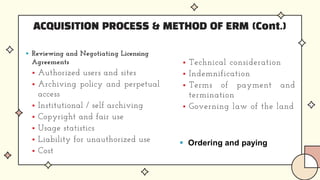
 Reviewing and Negotiating Licensing
Agreements
 Authorized users and sites
 Archiving policy and perpetual
access
 Institutional / self archiving
 Copyright and fair use
 Usage statistics
 Liability for unauthorized use
 Cost
 Technical consideration
 Indemnification
 Terms of payment and
termination
 Governing law of the land
 Ordering and paying
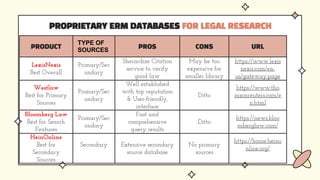
PROPRIETARY ERM DATABASES FOR LEGAL RESEARCH
PRODUCT
TYPE OF
SOURCES
PROS CONS URL
LexisNexis
Best Overall
Primary/Sec
ondary
Sherardize Citation
service to verify
good law
May be too
expensive for
smaller library
https://www.lexis
nexis.com/en-
us/gateway.page
Westlaw
Best for Primary
Sources
Primary/Sec
ondary
Well established
with top reputation
& User-friendly,
interface
Ditto
https://www.tho
msonreuters.com/e
n.html
Bloomberg Law
Best for Search
Features
Primary/Sec
ondary
Fast and
comprehensive
query results
Ditto
https://news.bloo
mberglaw.com/
HeinOnline
Best for
Secondary
Sources
Secondary Extensive secondary
source database
No primary
sources
https://home.heino
nline.org/
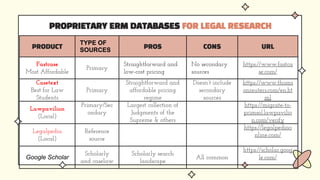
PROPRIETARY ERM DATABASES FOR LEGAL RESEARCH
PRODUCT
TYPE OF
SOURCES
PROS CONS URL
Fastcase
Most Affordable
Primary
Straightforward and
low-cost pricing
No secondary
sources
https://www.fastca
se.com/
Casetext
Best for Law
Students
Primary
Straightforward and
affordable pricing
regime
Doesn’t include
secondary
sources
https://www.thoms
onreuters.com/en.ht
ml
Lawpavilion
(Local)
Primary/Sec
ondary
Largest collection of
Judgments of the
Supreme & others
https://migrate-to-
primsol.lawpavilio
n.com/verify
Legalpedia
(Local)
Reference
source
https://legalpediao
nline.com/
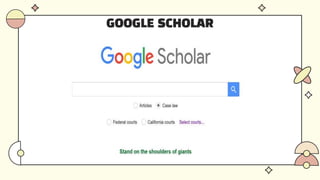
Google Scholar
Scholarly
and caselaw
Scholarly search
landscape
All common
https://scholar.goog
le.com/
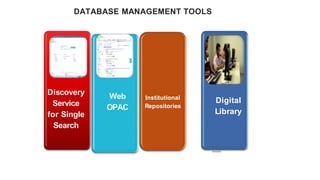
A PICTURE IS WORTH A THOUSAND WORDS
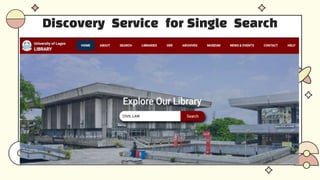
Discovery
Service
for Single
Search
Web
OPAC
Institutional
Repositories
Teaching
Lab
Digital
Library
DATABASE MANAGEMENT TOOLS
Discovery Service for Single Search
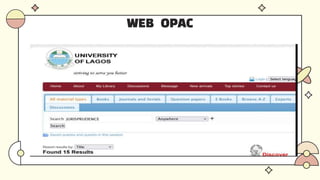
WEB OPAC
Discovery Service for Single Search
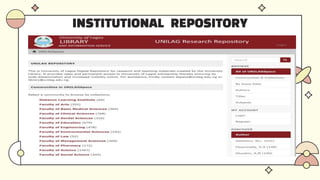
INSTITUTIONAL REPOSITORY
Discovery Service for Single Search
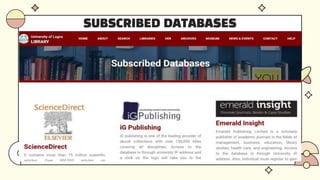
SUBSCRIBED DATABASES
Discovery Service for Single Search
GOOGLE SCHOLAR
Discovery Service for Single Search
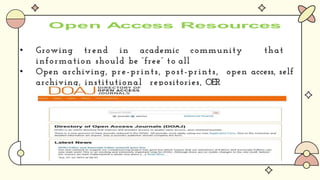
• Growing trend in academic community that
information should be “free” to all
• Open archiving, pre-prints, post-prints, open access, self
archiving, institutional repositories, OER
This is provided as appendix
Open Access
Resources
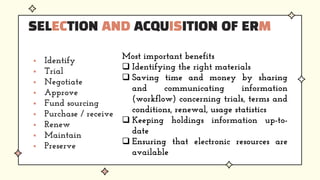
 Identify
 Trial
 Negotiate
 Approve
 Fund sourcing
 Purchase / receive
 Renew
 Maintain
 Preserve
SELECTION AND ACQUISITION OF ERM
Most important benefits
 Identifying the right materials
 Saving time and money by sharing
and communicating information
(workflow) concerning trials, terms and
conditions, renewal, usage statistics
 Keeping holdings information up-to-
date
 Ensuring that electronic resources are
available
AUTHORIZATION AND ACCESS
NEED TO KNOW
 Type of USER
 Number of USERS
 Type of USE
 Course packs, ILL, printing, electronic storage, reserve room
 Type of material
 Including legal deposit
 Format
 Duration
LICENSING AND ACCESS
NEED TO CARRY OTHERS ALONG
 Inform patron about full terms and conditions of the
available resources and services.
 As Librarian enforce access for what can be easily
enforced (e.g. block databases where the user does not
have access) and inform where easily informed

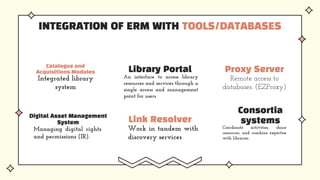
INTEGRATION OF ERM WITH TOOLS/DATABASES
Digital Asset Management
System
Managing digital rights
and permissions (IR).
Catalogue and
Acquisitions Modules
Integrated library
system
Library Portal
An interface to access library
resources and services through a
single access and management
point for users
Link Resolver
Work in tandem with
discovery services
Proxy Server
Remote access to
databases. (EZProxy)
Consortia
systems
Coordinate activities, share
resources, and combine expertise
with libraries.
ERM DEPLOYMENT IN LAW LIBRARY
Law librarians could start considering:
 How much time should a library invest in its Website for
displaying its electronic resources.
 Whether to add OPAC or a federated search tool upon reaching a
threshold for electronic resource interfaces.
 Do note when librarians and patrons start complaining
frequently, the library has probably reached the threshold.
 Which tool(s) are needed to improve services, access, and
management; migration to these tools; and internal and external
training.
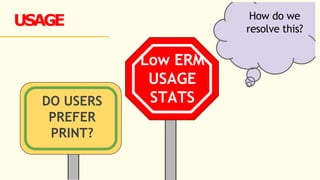
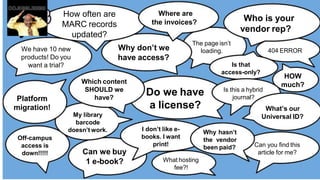
Low ERM
USAGE
STATS
USAGE
DO USERS
PREFER
PRINT?
How do we
resolve this?
What hosting
fee?!
The page isn’t
loading.
Can you find this
article for me?
Can we buy
1 e-book?
I don’t like e-
books. I want
print!
Off-campus
access is
down!!!!!
We have 10 new
products! Do you
want a trial?
My library
barcode
doesn’t work.
Why don’t we
have access?
404 ERROR
Is that
access-only?
How often are
MARC records
updated?
Platform
migration!
Who is your
vendor rep?
HOW
much?
Do we have
a license?
Which content
SHOULD we
have?
Why hasn’t
the vendor
been paid?
Is this a hybrid
journal?
What’s our
Universal ID?
Where are
the invoices?
COLLECTIVE CHALLENGES
 Budgets constraints
 Increased scale/number of e-resources
 User expectations: “instant” access
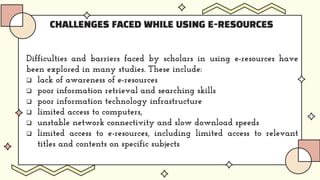
CHALLENGES FACED WHILE USING E-RESOURCES
Difficulties and barriers faced by scholars in using e-resources have
been explored in many studies. These include:
 lack of awareness of e-resources
 poor information retrieval and searching skills
 poor information technology infrastructure
 limited access to computers,
 unstable network connectivity and slow download speeds
 limited access to e-resources, including limited access to relevant
titles and contents on specific subjects
Queries may be sent at : cokiki@Unilag.edu.ng
References
• Anderson, E. K. (2014). Electronic resource management systems and related
products. Library Technology Reports, 50(3), 30–42.
• Collins, M. & Grogg, J. E. (2011). Building a better ERMS. Library Journal,
136(4), 22–28.
• Blanchat, K. & Verminski, A. 2015. Making it your own: transitioning into a
new electronic resources role. Available:
http://www.slideshare.net/amverminski/making-it- your-own-
transitioning-into-a-new-electronic- resources-role-blanchat-and-
verminski-erl- 2015?qid=520e5933-e90a-4df2-aca1-
7a5f953ba4d8&v=default&b=&from_search=1
• Weir, R.O. 2012. Managing Electronic Resources: A LITA Guide

Electronic resources management presentation 2021

  • 1.
    ELECTRONIC RESOURCES MANAGEMENT (ERM) TOOLS/DATABASESPROCUREMENT: USAGE AND CHALLENGES IN LAW LIBRARY 21st National Workshop On Legal Information Services In Law Libraries 11th – 12th October, 2021 Venue: Nigerian Institute Of Advancement Legal Study, Unilag. Akoka
  • 2.
    Presented By Dr. OKIKI, OlatokunboC, CLN, Head, Automation Unit University of Lagos Library University of Lagos cokiki@unilag.edu.ng
  • 3.
    EXPECTED OUTCOME At theend of this workshop, we should be able to sharpen our understanding of:  What do we mean by Electronic Resources Management?  Types of Electronic Resources Management  Electronic Resources Management- Databases Procurement Process  Proprietary Electronic Resources Management/Databases For Law Library  Open Access Electronic Resources Management/Databases For Law Library  Usage of Electronic Resources Management- Databases  Challenges Facing Electronic Resources Management- Databases
  • 4.
    EXPECTED OUTCOMES -ACCESS After the course all workshop participants will:  have been introduced to a range of electronic resources management and databases available online for legal research.  understand the concept of electronic resources management.  have hands-on experience of using full range of electronic resources management and databases available online for legal research available
  • 5.
    EXPECTED OUTCOMES -USE After the course all workshop participants will have examined:  tools, tips and techniques to effectively and efficiently use electronic resources management and databases available online for Legal Research.  legal implications for e-resource use electronic resources management and databases available online for Legal Research.  issues surrounding e-resource management in law library.
  • 6.
    QUESTIONS? Please pause meand ask any question during the presentation
  • 7.
    —Walter Savage Landor (1775-1864.English writer and poet) “Nothing is pleasanter than exploring a library.”
  • 8.
    PREAMBLE  Libraries havewitnessed a prominent transition from print to electronic resources that have not only impacted their services, but users too.  Inflow of resources in electronic format and subscription of library software, e-books, e-journals, e-databases and other have totally changed the library operations.  In this age of rapidly changing technologies, it is essential for all library professionals to keep abreast of the latest developments, emerging trends & techniques in the area of Electronic Resource Management (ERM) in libraries especially in law libraries as certain issues and challenges faced in these areas need to be taken care of with probable solutions.
  • 9.
    WHAT IS ERM Electronic Resource Management AKA E-resource Management, or simply ERM)refers broadly to an evolving array of problems, tasks, processes and practices associated with the management of electronic resources such as databases, electronic journals and electronic books in libraries (Anderson et al.2004).  Digital Library Federation (DLF), an electronic resource management system should facilitate “management of the information and workflows necessary to efficiently select, evaluate, acquire, maintain, and provide access to e‐resources” (Jewell et al. 2004).  A broader concept like a content management system to create Web pages, provide administrative functions, and track license agreements (Brown, Nelson, & Wineburgh-Freed, 2005; Robbins & Smith, 2004).
  • 10.
  • 11.
    TYPES OF ERM Machine Readable Cataloguing: MARC, MARC 21  Shared Catalogue: Ohio College Library Centre (OCLC)  Online Public Access Catalogue/Web-based Catalogue  Database  Bibliographic Database  CD-ROM Database  Online Database  Web-based databases  Institutional Repository  Emerging Types of E-resources: Blogs Wikis etc
  • 12.
    ERM WORKFLOW  Today,no single approach to the management of electronic resources management prevails.  The genre of library services platforms that offer combined capabilities for managing print and electronic resources has gained considerable acceptance most especially in academic libraries and continues to attract other libraries.  The growing number of electronic resources requires more sophisticated workflows.
  • 13.
    OTHER ERM WORKFLOW Beyond the cataloging part of the electronic resources workflow, there are other workflow functions unique to electronic resources management.  These tasks include Licensing, Access, Set-up, Troubleshooting, Link Maintenance, Interdatabase Linking (e.g., between catalogs, abstract and indexing databases, federated search tools, openURL resolvers), Vendor Negotiation And Management Staffing.
  • 14.
    LAW LIBRARY HOLDINGS Lawlibrary holdings include the following, hence these must influence the type of ERM to be deployed;  Federal Legislations  Foreign Law Publications  Digest & Treatises  Law Journals  Textbooks, Dictionaries & Encyclopedias  Law Dictionaries  Law Encyclopedias  Newspapers & Magazines  Commonwealth Publications  Casebooks Bibliographies & Directories  Indexing & Abstracting Materials, etc
  • 15.
    POLICIES GUIDING ACQUISITIONOF ERM TOOLS Before acquiring ERM tools/databases you need to be guided by the following policies or principles:  State that only those resources that are openURL compliant will be added to your collection (time can be saved by not adding nonopenURL resources).  Who can contact vendors and under what circumstances?  What sorts of troubleshooting should be done prior to contacting vendors?  Should you go with the lowest cost vendor every year or should you try to stay with fewer vendors?  What will you do about password-protected resources? Provide access via OPAC and/or Website?
  • 16.
    ACQUISITION PROCESS OFERM TOOLS/DATABASES  Selection ▨ Recommendation ▨ Trail offer ▨ Demonstration from publishers/vendors ▨ User recommendation ▨ Discussion lists ▨ Peer Library website ▨ Publisher’s catalogue ▨ From other Library of similar nature ▨ Colleagues suggestions  Trial Use ▨ Consistency / Uniformity ▨ Functionality ACCESS NEED / BUDGET
  • 17.
    ACQUISITION PROCESS &METHOD OF ERM (Cont.)  Evaluation ▨ Recommendation ▨ Content ▨ Updates ▨ Quality – reputation of publishers ▨ intellectual level ▨ Indexing Up-gradation ▨ Authority – scholarly or not ▨ Accessibility ▨ Cost factor ▨ Technical support ▨ Licensing agreement  Authentication ▨ Verify coverage, content provider of the product, frequency of updates and cost
  • 18.
    ACQUISITION PROCESS &METHOD OF ERM (Cont.)  Price Negotiation  Product type: aggregator/full text database  Product available through yearly subscription, one-time purchase or multi-year deals with fixed price caps  Article choice model  Rental model  Institution size  Number of uses  Price of consortia deal  Patron-Driving Acquisition
  • 19.
    ACQUISITION PROCESS &METHOD OF ERM (Cont.)  Reviewing and Negotiating Licensing Agreements  Authorized users and sites  Archiving policy and perpetual access  Institutional / self archiving  Copyright and fair use  Usage statistics  Liability for unauthorized use  Cost  Technical consideration  Indemnification  Terms of payment and termination  Governing law of the land  Ordering and paying
  • 20.
    PROPRIETARY ERM DATABASESFOR LEGAL RESEARCH PRODUCT TYPE OF SOURCES PROS CONS URL LexisNexis Best Overall Primary/Sec ondary Sherardize Citation service to verify good law May be too expensive for smaller library https://www.lexis nexis.com/en- us/gateway.page Westlaw Best for Primary Sources Primary/Sec ondary Well established with top reputation & User-friendly, interface Ditto https://www.tho msonreuters.com/e n.html Bloomberg Law Best for Search Features Primary/Sec ondary Fast and comprehensive query results Ditto https://news.bloo mberglaw.com/ HeinOnline Best for Secondary Sources Secondary Extensive secondary source database No primary sources https://home.heino nline.org/
  • 21.
    PROPRIETARY ERM DATABASESFOR LEGAL RESEARCH PRODUCT TYPE OF SOURCES PROS CONS URL Fastcase Most Affordable Primary Straightforward and low-cost pricing No secondary sources https://www.fastca se.com/ Casetext Best for Law Students Primary Straightforward and affordable pricing regime Doesn’t include secondary sources https://www.thoms onreuters.com/en.ht ml Lawpavilion (Local) Primary/Sec ondary Largest collection of Judgments of the Supreme & others https://migrate-to- primsol.lawpavilio n.com/verify Legalpedia (Local) Reference source https://legalpediao nline.com/ Google Scholar Scholarly and caselaw Scholarly search landscape All common https://scholar.goog le.com/
  • 22.
    A PICTURE ISWORTH A THOUSAND WORDS
  • 23.
  • 24.
    Discovery Service forSingle Search Discovery Service for Single Search
  • 25.
    WEB OPAC Discovery Servicefor Single Search
  • 26.
  • 27.
  • 28.
  • 29.
    Discovery Service forSingle Search • Growing trend in academic community that information should be “free” to all • Open archiving, pre-prints, post-prints, open access, self archiving, institutional repositories, OER
  • 30.
    This is providedas appendix Open Access Resources
  • 31.
     Identify  Trial Negotiate  Approve  Fund sourcing  Purchase / receive  Renew  Maintain  Preserve SELECTION AND ACQUISITION OF ERM Most important benefits  Identifying the right materials  Saving time and money by sharing and communicating information (workflow) concerning trials, terms and conditions, renewal, usage statistics  Keeping holdings information up-to- date  Ensuring that electronic resources are available
  • 32.
    AUTHORIZATION AND ACCESS NEEDTO KNOW  Type of USER  Number of USERS  Type of USE  Course packs, ILL, printing, electronic storage, reserve room  Type of material  Including legal deposit  Format  Duration
  • 33.
    LICENSING AND ACCESS NEEDTO CARRY OTHERS ALONG  Inform patron about full terms and conditions of the available resources and services.  As Librarian enforce access for what can be easily enforced (e.g. block databases where the user does not have access) and inform where easily informed 
  • 34.
    INTEGRATION OF ERMWITH TOOLS/DATABASES Digital Asset Management System Managing digital rights and permissions (IR). Catalogue and Acquisitions Modules Integrated library system Library Portal An interface to access library resources and services through a single access and management point for users Link Resolver Work in tandem with discovery services Proxy Server Remote access to databases. (EZProxy) Consortia systems Coordinate activities, share resources, and combine expertise with libraries.
  • 35.
    ERM DEPLOYMENT INLAW LIBRARY Law librarians could start considering:  How much time should a library invest in its Website for displaying its electronic resources.  Whether to add OPAC or a federated search tool upon reaching a threshold for electronic resource interfaces.  Do note when librarians and patrons start complaining frequently, the library has probably reached the threshold.  Which tool(s) are needed to improve services, access, and management; migration to these tools; and internal and external training.
  • 36.
  • 37.
    What hosting fee?! The pageisn’t loading. Can you find this article for me? Can we buy 1 e-book? I don’t like e- books. I want print! Off-campus access is down!!!!! We have 10 new products! Do you want a trial? My library barcode doesn’t work. Why don’t we have access? 404 ERROR Is that access-only? How often are MARC records updated? Platform migration! Who is your vendor rep? HOW much? Do we have a license? Which content SHOULD we have? Why hasn’t the vendor been paid? Is this a hybrid journal? What’s our Universal ID? Where are the invoices?
  • 38.
    COLLECTIVE CHALLENGES  Budgetsconstraints  Increased scale/number of e-resources  User expectations: “instant” access
  • 39.
    CHALLENGES FACED WHILEUSING E-RESOURCES Difficulties and barriers faced by scholars in using e-resources have been explored in many studies. These include:  lack of awareness of e-resources  poor information retrieval and searching skills  poor information technology infrastructure  limited access to computers,  unstable network connectivity and slow download speeds  limited access to e-resources, including limited access to relevant titles and contents on specific subjects
  • 42.
    Queries may besent at : cokiki@Unilag.edu.ng
  • 43.
    References • Anderson, E.K. (2014). Electronic resource management systems and related products. Library Technology Reports, 50(3), 30–42. • Collins, M. & Grogg, J. E. (2011). Building a better ERMS. Library Journal, 136(4), 22–28. • Blanchat, K. & Verminski, A. 2015. Making it your own: transitioning into a new electronic resources role. Available: http://www.slideshare.net/amverminski/making-it- your-own- transitioning-into-a-new-electronic- resources-role-blanchat-and- verminski-erl- 2015?qid=520e5933-e90a-4df2-aca1- 7a5f953ba4d8&v=default&b=&from_search=1 • Weir, R.O. 2012. Managing Electronic Resources: A LITA Guide