Information Society 
(according to British researchers)
Information society 
- is a society where the creation, 
distribution, use, integration and 
manipulation of information is a significant 
economic, political and cultural activity.
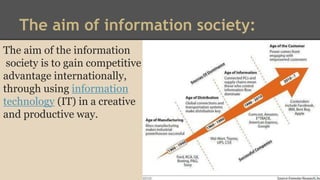
The aim of information society: 
The aim of the information 
society is to gain competitive 
advantage internationally, 
through using information 
technology (IT) in a creative 
and productive way.
The growth of information in society 
The growth of technologically mediated information has been quantified in 
different ways, including society's technological capacity to store information, 
to communicate information, and to compute information. 
It is estimated that, the world's technological capacity to store information 
grew from 2.6 (optimally compressed) exabytes in 1986, which is the 
informational equivalent to less than one 730-MBCD-ROM per person in 1986 
(539 MB per person), to 295 (optimally compressed) exabytes in 2007. 
This is the informational equivalent of 60 CD-ROM per person in 2007 and 
represents a sustained annual growth rate of some 25%. The world’s combined 
technological capacity to receive information through one-way broadcast 
networks was the informational equivalent of 174 newspapers per person per 
day in 2007.
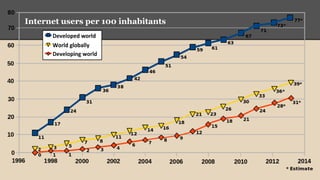
Internet users per 100 inhabitants
Conclusion: 
One of the central paradoxes of the information society is that it 
makes information easily reproducible, leading to a variety of 
freedom/control problems relating to intellectual property. Essentially, 
business and capital, whose place becomes that of producing and 
selling information and knowledge, seems to require control over this 
new resource so that it can effectively be managed and sold as the basis 
of the information economy. 
Information society is often used by politicians meaning something 
like "we all do internet now"; the sociological term information society 
(or informational society) has some deeper implications about change 
of societal structure.

Information society

  • 1.
    Information Society (accordingto British researchers)
  • 2.
    Information society -is a society where the creation, distribution, use, integration and manipulation of information is a significant economic, political and cultural activity.
  • 3.
    The aim ofinformation society: The aim of the information society is to gain competitive advantage internationally, through using information technology (IT) in a creative and productive way.
  • 4.
    The growth ofinformation in society The growth of technologically mediated information has been quantified in different ways, including society's technological capacity to store information, to communicate information, and to compute information. It is estimated that, the world's technological capacity to store information grew from 2.6 (optimally compressed) exabytes in 1986, which is the informational equivalent to less than one 730-MBCD-ROM per person in 1986 (539 MB per person), to 295 (optimally compressed) exabytes in 2007. This is the informational equivalent of 60 CD-ROM per person in 2007 and represents a sustained annual growth rate of some 25%. The world’s combined technological capacity to receive information through one-way broadcast networks was the informational equivalent of 174 newspapers per person per day in 2007.
  • 5.
    Internet users per100 inhabitants
  • 6.
    Conclusion: One ofthe central paradoxes of the information society is that it makes information easily reproducible, leading to a variety of freedom/control problems relating to intellectual property. Essentially, business and capital, whose place becomes that of producing and selling information and knowledge, seems to require control over this new resource so that it can effectively be managed and sold as the basis of the information economy. Information society is often used by politicians meaning something like "we all do internet now"; the sociological term information society (or informational society) has some deeper implications about change of societal structure.