 Introduction of Information and Society
 Origin and Development of Information Society
 Prerequisites for the development of IS
 Economic and Social Factors in relevance to IS
 Technology for Information Society
 Role of Libraries and Skills for Librarians in IS
 Information Laws To Regulate IS
 Relationship of Information Society and Knowledge Society
 Conclusion
 References
“Information is an assemblage of data in a comprehensible form
capable of communication and use; the essence of it is that a
meaning has been attached to the raw facts.”
(Feather, J., & Sturges, P. 2003) p.303
3
 The community of people living in a particular country or
region, associated to one another and having shared customs,
laws and organizations.
 Examples of Society
 Agricultural Society
 Industrial Society
 Information Society
 Knowledge Society
4
A society in which information, rather than material goods, has become the chief
economic, social and cultural motor.
(Whitworth)
An information society is a society where the creation, distribution, use, integration and
manipulation of information is a significant economic, political, and cultural activity.
The aim of the information society is to gain competitive advantage internationally,
through using information technology (IT) in a creative and productive way.
(BRANSCOMB)
 Ever since the 1960s, ‘information society’ has been one of the key terms used to
describe today’s world.
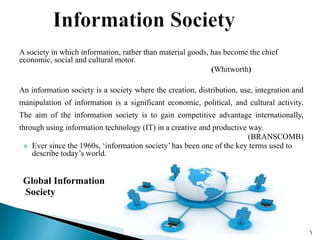
Global Information
Society
5
 Creators of information – writers, musicians, artists,
researchers, database producers, web producers
 Information products -- books, videos, magazines, web sites
 Distributors of information -- publishers, Internet providers,
vendors, producers
 Disseminators of information -- schools, libraries, colleges and
universities, businesses, government, museums
 Users of information -- individuals, business persons,
researchers, employees and employers
6
There are three period of analysis:
1. From 1960 to the mid-1970s analyses concentrated
exclusively on America.
2. Form the late 1970s to the early 1990s, as ICTs were
deployed extensively in the rich or developed states.
3. And now, analyses focus on the potential and promise
of the internet, leading to the current widespread
interest in the global information society.
7
Development of technology (The storage capacity,
communication channels, Computer and Internet)
Structural change of the economy
Social Changes
Work processes
 Organizations used information as resource, increasing
efficiency, effectiveness and stimulating innovation
 Improvement in the quality of the goods and services
produced
 Increased sale through Advertisement
 Consumers also use information to make better choices
between different products
 Explore their entitlements to public services
 Exercise their civil rights and responsibilities
 Extend public access to educational and cultural provision
9
10
 Illiteracy
 Non-cooperation
 Polarization and Intolerance
 Non-book and gun culture
 Ethical and Religious Issues
 Life styles, attitudes and personal beliefs
 Socially Intense
 Now role of IS to eradicate such deficiencies to make society a healthy
society
11
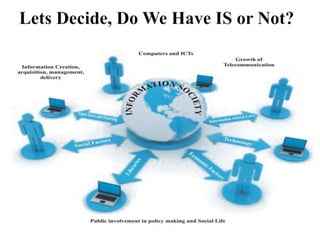
 Growth of Telecommunication
 Computers and ICTs
 Skilled Professionals
 Shift in occupational structure
 Equal opportunities
 Information as a critical asset:
Creation, acquisition, management, delivery
Strong Indicators
Use of information by citizens to increase their
involvement in public policy making and social life
 Freedom of Information
 Laws related in regulating information like Copyright &
Intellectual Property Rights
13
 Telephone
 Broadcasting Media
 Computer
 Intranet and Internet
 World Wide Web (WWW)
 Tele communication
 Satellite
14
 Intermediary Role
 Collaborative Role
 Facilitator Role not only b/w user and Information but also
creating knowledge
15
USER LIBRARY INFO
 Identifying and analyzing user information needs
 Technology skills
 Information Management expertise
 Familiarity with research methods
 Ability to evaluate information
 Ability to organize and store information for effective retrieval
 Knowledge of delivery mechanism and means of disseminating
information
 Training and consultancy skills
 Management skills
 Collaborative Skills
16
Minimum Gap = Progress Society
Information Society
Knowledge Society
17
18
 The information society in many countries like Pakistan is
only considered as the development of telecommunication
infrastructure but we must acknowledge its socio-economic
and institutional importance. (Example: RTI, Punjab Infor. Commission)
 We must understand the knowledge needs of different
communities and groups.
 The developed countries like Japan, Canada USA, Germany,
United Kingdom etc. may be considered as the information
societies but the developing countries like Pakistan are still far
away from information society.
 Lack of education and economic backwardness are hindering
the process of transition to an information society.
19
 Democracy with the presence of dynamic and free media
and independent judiciary will enable us to turn our
society into an information society.
 As a society, we have yet to realize the importance of
having of informed and empowered citizens, more
focuses has been development of infrastructure rather
than human capacity to use that information/
infrastructure.
20
Branscomb, A. W. (1994). Who Owns Information?: From Privacy To Public , Access:
Basic Books.
Feather, J., & Sturges, P. (2003). International Encyclopedia Of Information And
Library Science: Taylor & Francis.
Feather, J. (2000). Information society: A study of continuity and change: Library
Association Publishing.
Ifla. ( 10 July 2013). IFLAAnd The Information Society. Retrieved Dec 28, 2013, From
http://www.ifla.org/information-society
Mahmood, K., & Shafique, F. (2009). Emerging Information Society In Pakistan And The
Role Of Libraries.
Pakistan Telecommunication Authority (Pta). ( 2005, 30 May). Creating Information
Society In Pakistan. Retrieved Dec 28, 2013, From
Http://Www.Pta.Gov.Pk/Index.Php?Option=com_content&task=view&id=596&catid=150
&itemid=747
Shafique, F., & Mahmood, K. (2008). Indicators Of The Emerging Information Society In
Pakistan. Information Development, 24(1), 66-78.
Touraine, A., & Mayhew, L. (1971). The post-industrial society: tomorrow's social
history: classes, conflicts and culture in the programmed society. Random House New
York.
22
 OECD (1986) Trends in The Information Economy. Paris:
OECD.
 Frank Webster (2002b) Theories of the Information Society.
London: Routledge

Information society

  • 2.
     Introduction ofInformation and Society  Origin and Development of Information Society  Prerequisites for the development of IS  Economic and Social Factors in relevance to IS  Technology for Information Society  Role of Libraries and Skills for Librarians in IS  Information Laws To Regulate IS  Relationship of Information Society and Knowledge Society  Conclusion  References
  • 3.
    “Information is anassemblage of data in a comprehensible form capable of communication and use; the essence of it is that a meaning has been attached to the raw facts.” (Feather, J., & Sturges, P. 2003) p.303 3
  • 4.
     The communityof people living in a particular country or region, associated to one another and having shared customs, laws and organizations.  Examples of Society  Agricultural Society  Industrial Society  Information Society  Knowledge Society 4
  • 5.
    A society inwhich information, rather than material goods, has become the chief economic, social and cultural motor. (Whitworth) An information society is a society where the creation, distribution, use, integration and manipulation of information is a significant economic, political, and cultural activity. The aim of the information society is to gain competitive advantage internationally, through using information technology (IT) in a creative and productive way. (BRANSCOMB)  Ever since the 1960s, ‘information society’ has been one of the key terms used to describe today’s world. Global Information Society 5
  • 6.
     Creators ofinformation – writers, musicians, artists, researchers, database producers, web producers  Information products -- books, videos, magazines, web sites  Distributors of information -- publishers, Internet providers, vendors, producers  Disseminators of information -- schools, libraries, colleges and universities, businesses, government, museums  Users of information -- individuals, business persons, researchers, employees and employers 6
  • 7.
    There are threeperiod of analysis: 1. From 1960 to the mid-1970s analyses concentrated exclusively on America. 2. Form the late 1970s to the early 1990s, as ICTs were deployed extensively in the rich or developed states. 3. And now, analyses focus on the potential and promise of the internet, leading to the current widespread interest in the global information society. 7
  • 8.
    Development of technology(The storage capacity, communication channels, Computer and Internet) Structural change of the economy Social Changes Work processes
  • 9.
     Organizations usedinformation as resource, increasing efficiency, effectiveness and stimulating innovation  Improvement in the quality of the goods and services produced  Increased sale through Advertisement  Consumers also use information to make better choices between different products  Explore their entitlements to public services  Exercise their civil rights and responsibilities  Extend public access to educational and cultural provision 9
  • 10.
  • 11.
     Illiteracy  Non-cooperation Polarization and Intolerance  Non-book and gun culture  Ethical and Religious Issues  Life styles, attitudes and personal beliefs  Socially Intense  Now role of IS to eradicate such deficiencies to make society a healthy society 11
  • 12.
     Growth ofTelecommunication  Computers and ICTs  Skilled Professionals  Shift in occupational structure  Equal opportunities  Information as a critical asset: Creation, acquisition, management, delivery Strong Indicators Use of information by citizens to increase their involvement in public policy making and social life
  • 13.
     Freedom ofInformation  Laws related in regulating information like Copyright & Intellectual Property Rights 13
  • 14.
     Telephone  BroadcastingMedia  Computer  Intranet and Internet  World Wide Web (WWW)  Tele communication  Satellite 14
  • 15.
     Intermediary Role Collaborative Role  Facilitator Role not only b/w user and Information but also creating knowledge 15 USER LIBRARY INFO
  • 16.
     Identifying andanalyzing user information needs  Technology skills  Information Management expertise  Familiarity with research methods  Ability to evaluate information  Ability to organize and store information for effective retrieval  Knowledge of delivery mechanism and means of disseminating information  Training and consultancy skills  Management skills  Collaborative Skills 16
  • 17.
    Minimum Gap =Progress Society Information Society Knowledge Society 17
  • 18.
  • 19.
     The informationsociety in many countries like Pakistan is only considered as the development of telecommunication infrastructure but we must acknowledge its socio-economic and institutional importance. (Example: RTI, Punjab Infor. Commission)  We must understand the knowledge needs of different communities and groups.  The developed countries like Japan, Canada USA, Germany, United Kingdom etc. may be considered as the information societies but the developing countries like Pakistan are still far away from information society.  Lack of education and economic backwardness are hindering the process of transition to an information society. 19
  • 20.
     Democracy withthe presence of dynamic and free media and independent judiciary will enable us to turn our society into an information society.  As a society, we have yet to realize the importance of having of informed and empowered citizens, more focuses has been development of infrastructure rather than human capacity to use that information/ infrastructure. 20
  • 22.
    Branscomb, A. W.(1994). Who Owns Information?: From Privacy To Public , Access: Basic Books. Feather, J., & Sturges, P. (2003). International Encyclopedia Of Information And Library Science: Taylor & Francis. Feather, J. (2000). Information society: A study of continuity and change: Library Association Publishing. Ifla. ( 10 July 2013). IFLAAnd The Information Society. Retrieved Dec 28, 2013, From http://www.ifla.org/information-society Mahmood, K., & Shafique, F. (2009). Emerging Information Society In Pakistan And The Role Of Libraries. Pakistan Telecommunication Authority (Pta). ( 2005, 30 May). Creating Information Society In Pakistan. Retrieved Dec 28, 2013, From Http://Www.Pta.Gov.Pk/Index.Php?Option=com_content&task=view&id=596&catid=150 &itemid=747 Shafique, F., & Mahmood, K. (2008). Indicators Of The Emerging Information Society In Pakistan. Information Development, 24(1), 66-78. Touraine, A., & Mayhew, L. (1971). The post-industrial society: tomorrow's social history: classes, conflicts and culture in the programmed society. Random House New York. 22
  • 23.
     OECD (1986)Trends in The Information Economy. Paris: OECD.  Frank Webster (2002b) Theories of the Information Society. London: Routledge