Morphological Awareness of English
Language Among the
Undergraduate Students
TO
MA’AM TANILLA
BY MUZAMIL HUSSAIN (M.PHIL. LINGUISTIC- F-18-3445)
What is Morphological Awareness
 Morphological awareness is the "conscious awareness of the morphemic
structure of words and (the) … ability to reflect on and manipulate that
structure” (Carlisle, 1995, p.194).
 Morphological awareness is a skill that helps students read and
spell. When researchers have studied different skills that contribute to
student performance on reading and spelling tasks, morphological
awareness ability often is one of the skills that predicts how well students
will perform on those tasks (e.g., Bowers, Kirby, & Deacon, 2010; Goodwin
& Ahn, 2013).
Conti……
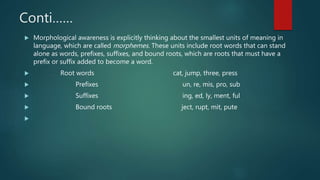
 Morphological awareness is explicitly thinking about the smallest units of meaning in
language, which are called morphemes. These units include root words that can stand
alone as words, prefixes, suffixes, and bound roots, which are roots that must have a
prefix or suffix added to become a word.
 Root words cat, jump, three, press
 Prefixes un, re, mis, pro, sub
 Suffixes ing, ed, ly, ment, ful
 Bound roots ject, rupt, mit, pute

Morphology
MORPHOLOGICAL AND
PHONOLOGICAL AWARENESS
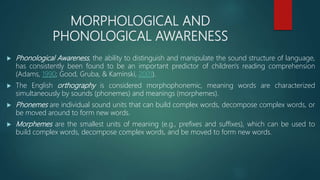
 Phonological Awareness, the ability to distinguish and manipulate the sound structure of language,
has consistently been found to be an important predictor of children's reading comprehension
(Adams, 1990; Good, Gruba, & Kaminski, 2001).
 The English orthography is considered morphophonemic, meaning words are characterized
simultaneously by sounds (phonemes) and meanings (morphemes).
 Phonemes are individual sound units that can build complex words, decompose complex words, or
be moved around to form new words.
 Morphemes are the smallest units of meaning (e.g., prefixes and suffixes), which can be used to
build complex words, decompose complex words, and be moved to form new words.
Orthography
Morphemes
Sentence Structure
.
Morphological Characteristics
CompoundDerivationalInflectional
Inflectional
Inflectional
Derivational
Conti…..
Compound
Compound
Conti…..
Conti…..
.
Inflectional vs Derivational vs
Compound
Abstract
 This research is a quasi-experimental, because it has only one group to
check the morphological awareness before and after the treatment.
 The data was collected through pre-test and post-test.
 . Results of the study indicate that in the pre-test students identified the
different forms of words (noun, verb, adjective, adverb) without the
awareness of word formation phenomenon but in post-test, they
performed well and showed awareness in the formation of words.
 Moreover, they do not only identify the different form of words but also
make the new word from the root words.
Methods
 Teacher used pre-test and post-test.
 In this research 20 participants included male and female students of (CS)
Computer & Science NU-FAST Lahore.
 In pre-test teacher give them a paragraph which was consist on the word
forms such as (verb, noun, adverb, adjective, conjunction and etc..) and
students identified different types of words.
 . In the next class teacher give a post-test to the class where students
identified the words which can further make different form of a word
after uses the prefixes, suffixes and affixes.
Results and Findings
Activity-1
 Pre-test
Paragraph Words and Participant’s Words
Words of Paragraph Noun/Verb Adverb Adjective
Recent Recently
Large Largeness (noun) Largely
First Firstly
Interesting Interestingly Interested
Cities City (singular noun)
Entertainment Entertain (Verb)
Finally Final
located Locate (verb)
Leisure Leisurely
Attracted Attract (Verb)
Museums Museum (singular noun )
Places Place (singular noun)
Theatres Theatre (singular noun)
Facilities Facility (noun)
Industrialization Industrialize (verb)
New Newly
Second Secondly
Conti……
 In this test participants were randomly make further different words of a
word. Because, teacher give instruction to the students to identify the root
words and make further forms of a word with stem word.
 Although there are approximately thirty words in the given paragraph,
which are in different forms of verb, adverb, adjective and noun, but some
students only identify seven words which is the lowest score of this activity
and nineteen words is the highest scores of this activity.
Post-Test
Activity-2
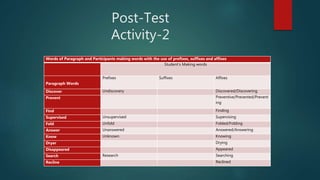
Words of Paragraph and Participants making words with the use of prefixes, suffixes and affixes
Student’s Making words
Paragraph Words
Prefixes Suffixes Affixes
Discover Undiscovery Discovered/Discovering
Prevent Preventive/Prevented/Prevent
ing
Find Finding
Supervised Unsupervised Supervising
Fold Unfold Folded/Folding
Answer Unanswered Answered/Answering
Know Unknown Knowing
Dryer Drying
Disappeared Appeared
Search Research Searching
Recline Reclined
Conti…..
 In the post-test results show that the performance of the participants is
better than the pre-test performance. They just focused on root words and
they use prefixes, suffixes and affixes. Although there are eighteen root
words which can further make different forms of a word after using
prefixes, suffixes and affixes.
Discussion
 This study recognized positive effects of morphological instruction on
student’s writing, and while the study did not emphasis exclusively on
students with weaknesses, involvement effects were among the lower-
performing students in general education system classrooms. Although
students of undergraduate are considering as they have not prior-
knowledge of grammar and they just focused on reading in Pakistan.
Such results suggest that for undergraduate students (particularly those
who struggle), instruction to support morphological insights may be
beneficial in helping master the complex word structures that
characterize academic language.
Conti……
 This research also showed that students also revealed intervention and
students using a greater variety of morphological forms in more authentic
writing contexts. In both identification tasks, students from intervention
classrooms generated language that better approximated the conceptual
density and morphological awareness variety typical of the academic
register.
Conclusion
 In this research, it is reviewed in detail cognitive strategies for increasing morphological
awareness among EFL learners with the participation of FAST-NU undergraduate
students. This research shows that the acquisition order of grammatical morphemes is
highly affected by the learner’s related to the teacher’s strategy of teaching. This study
clearly shows that there is indeed an effective teaching is available when learning
morphological competences happening through using influential strategy by teachers.
The results of this study suggest that other effective strategy which should be use for
influential teaching in order to have good products by learners to make learners be
aware of morphological sections and competences.
References
 Apel, Kenn. 2014. "A Comprehensive Definition of Morphological Awareness." 34 (3):
197-209. Accessed January 2019.
 http://alliedhealth.ceconnection.com/files/Part1AComprehensiveDefinitionofMorphologi
calAwarenessImplicationsforAssessment-1407351198211.pdf.
 Elizabeth L. Tighe, Katherine S. Binder. 2015. "An Investigation of morphological
awareness and processing in adults with low literacy." 36 (2): 245-273. Accessed
January 23, 2019. doi: 10.1017/S0142716413000222.
 El-Saghir, Khalil. 2009. "The Role of Morphological Awareness in English as Second
Language Acquistion." Accessed 2019. http://www.arabguide.net/t2k/wsu/docs/2009-
4-morphology.pdf.
 Oz, Huseyin. 2013. "Morphological Awareness And Some Implication For English
Language Teaching." Social and Behavioral Sciences (Science Direct) 98-103.
http://ac.els-cdn.com/S187704281403777X/1-s2.0-S187704281403777X-
main.pdf?_tid=e6860bf0-9ec3-11e7-8236-
00000aacb362&acdnat=1505995168_106fa5305b412e69d70487335a90abd8.
Thank
You

Morphological awareness

  • 1.
    Morphological Awareness ofEnglish Language Among the Undergraduate Students TO MA’AM TANILLA BY MUZAMIL HUSSAIN (M.PHIL. LINGUISTIC- F-18-3445)
  • 2.
    What is MorphologicalAwareness  Morphological awareness is the "conscious awareness of the morphemic structure of words and (the) … ability to reflect on and manipulate that structure” (Carlisle, 1995, p.194).  Morphological awareness is a skill that helps students read and spell. When researchers have studied different skills that contribute to student performance on reading and spelling tasks, morphological awareness ability often is one of the skills that predicts how well students will perform on those tasks (e.g., Bowers, Kirby, & Deacon, 2010; Goodwin & Ahn, 2013).
  • 3.
    Conti……  Morphological awarenessis explicitly thinking about the smallest units of meaning in language, which are called morphemes. These units include root words that can stand alone as words, prefixes, suffixes, and bound roots, which are roots that must have a prefix or suffix added to become a word.  Root words cat, jump, three, press  Prefixes un, re, mis, pro, sub  Suffixes ing, ed, ly, ment, ful  Bound roots ject, rupt, mit, pute 
  • 4.
  • 5.
    MORPHOLOGICAL AND PHONOLOGICAL AWARENESS Phonological Awareness, the ability to distinguish and manipulate the sound structure of language, has consistently been found to be an important predictor of children's reading comprehension (Adams, 1990; Good, Gruba, & Kaminski, 2001).  The English orthography is considered morphophonemic, meaning words are characterized simultaneously by sounds (phonemes) and meanings (morphemes).  Phonemes are individual sound units that can build complex words, decompose complex words, or be moved around to form new words.  Morphemes are the smallest units of meaning (e.g., prefixes and suffixes), which can be used to build complex words, decompose complex words, and be moved to form new words.
  • 6.
  • 7.
  • 8.
  • 9.
  • 10.
  • 11.
  • 12.
  • 13.
  • 14.
  • 15.
  • 16.
  • 17.
  • 18.
  • 19.
  • 20.
    Abstract  This researchis a quasi-experimental, because it has only one group to check the morphological awareness before and after the treatment.  The data was collected through pre-test and post-test.  . Results of the study indicate that in the pre-test students identified the different forms of words (noun, verb, adjective, adverb) without the awareness of word formation phenomenon but in post-test, they performed well and showed awareness in the formation of words.  Moreover, they do not only identify the different form of words but also make the new word from the root words.
  • 21.
    Methods  Teacher usedpre-test and post-test.  In this research 20 participants included male and female students of (CS) Computer & Science NU-FAST Lahore.  In pre-test teacher give them a paragraph which was consist on the word forms such as (verb, noun, adverb, adjective, conjunction and etc..) and students identified different types of words.  . In the next class teacher give a post-test to the class where students identified the words which can further make different form of a word after uses the prefixes, suffixes and affixes.
  • 22.
    Results and Findings Activity-1 Pre-test Paragraph Words and Participant’s Words Words of Paragraph Noun/Verb Adverb Adjective Recent Recently Large Largeness (noun) Largely First Firstly Interesting Interestingly Interested Cities City (singular noun) Entertainment Entertain (Verb) Finally Final located Locate (verb) Leisure Leisurely Attracted Attract (Verb) Museums Museum (singular noun ) Places Place (singular noun) Theatres Theatre (singular noun) Facilities Facility (noun) Industrialization Industrialize (verb) New Newly Second Secondly
  • 23.
    Conti……  In thistest participants were randomly make further different words of a word. Because, teacher give instruction to the students to identify the root words and make further forms of a word with stem word.  Although there are approximately thirty words in the given paragraph, which are in different forms of verb, adverb, adjective and noun, but some students only identify seven words which is the lowest score of this activity and nineteen words is the highest scores of this activity.
  • 24.
    Post-Test Activity-2 Words of Paragraphand Participants making words with the use of prefixes, suffixes and affixes Student’s Making words Paragraph Words Prefixes Suffixes Affixes Discover Undiscovery Discovered/Discovering Prevent Preventive/Prevented/Prevent ing Find Finding Supervised Unsupervised Supervising Fold Unfold Folded/Folding Answer Unanswered Answered/Answering Know Unknown Knowing Dryer Drying Disappeared Appeared Search Research Searching Recline Reclined
  • 25.
    Conti…..  In thepost-test results show that the performance of the participants is better than the pre-test performance. They just focused on root words and they use prefixes, suffixes and affixes. Although there are eighteen root words which can further make different forms of a word after using prefixes, suffixes and affixes.
  • 26.
    Discussion  This studyrecognized positive effects of morphological instruction on student’s writing, and while the study did not emphasis exclusively on students with weaknesses, involvement effects were among the lower- performing students in general education system classrooms. Although students of undergraduate are considering as they have not prior- knowledge of grammar and they just focused on reading in Pakistan. Such results suggest that for undergraduate students (particularly those who struggle), instruction to support morphological insights may be beneficial in helping master the complex word structures that characterize academic language.
  • 27.
    Conti……  This researchalso showed that students also revealed intervention and students using a greater variety of morphological forms in more authentic writing contexts. In both identification tasks, students from intervention classrooms generated language that better approximated the conceptual density and morphological awareness variety typical of the academic register.
  • 28.
    Conclusion  In thisresearch, it is reviewed in detail cognitive strategies for increasing morphological awareness among EFL learners with the participation of FAST-NU undergraduate students. This research shows that the acquisition order of grammatical morphemes is highly affected by the learner’s related to the teacher’s strategy of teaching. This study clearly shows that there is indeed an effective teaching is available when learning morphological competences happening through using influential strategy by teachers. The results of this study suggest that other effective strategy which should be use for influential teaching in order to have good products by learners to make learners be aware of morphological sections and competences.
  • 29.
    References  Apel, Kenn.2014. "A Comprehensive Definition of Morphological Awareness." 34 (3): 197-209. Accessed January 2019.  http://alliedhealth.ceconnection.com/files/Part1AComprehensiveDefinitionofMorphologi calAwarenessImplicationsforAssessment-1407351198211.pdf.  Elizabeth L. Tighe, Katherine S. Binder. 2015. "An Investigation of morphological awareness and processing in adults with low literacy." 36 (2): 245-273. Accessed January 23, 2019. doi: 10.1017/S0142716413000222.  El-Saghir, Khalil. 2009. "The Role of Morphological Awareness in English as Second Language Acquistion." Accessed 2019. http://www.arabguide.net/t2k/wsu/docs/2009- 4-morphology.pdf.  Oz, Huseyin. 2013. "Morphological Awareness And Some Implication For English Language Teaching." Social and Behavioral Sciences (Science Direct) 98-103. http://ac.els-cdn.com/S187704281403777X/1-s2.0-S187704281403777X- main.pdf?_tid=e6860bf0-9ec3-11e7-8236- 00000aacb362&acdnat=1505995168_106fa5305b412e69d70487335a90abd8.
  • 30.