International Research Journal of Engineering and Technology (IRJET) e-ISSN: 2395-0056
Volume: 07 Issue: 01 | Jan 2020 www.irjet.net p-ISSN: 2395-0072
© 2020, IRJET | Impact Factor value: 7.34 | ISO 9001:2008 Certified Journal | Page 1595
GSM Based Voltage Monitoring & Power Factor Correction
Priyanka K. Sonone1, Vaishali D. Kamble2, Shital V. Uke3, N. V. Yawale4
1,2,3Student, Dept. of Electrical Engineering, DES’S COET, Dhamangaon Rly
4Professor, Dept. of Electrical Engineering, DES’S COET, Dhamangaon Rly
---------------------------------------------------------------------***---------------------------------------------------------------------
Abstract – Now a days, a controller that improves the power
factor (PF) is automatically designed and implemented to
correct the value of the power factor once they falls below a
certain one. Due to the modern civilization the growth of
industry has been increased as thus the usage of energy has
been raised. So , every industry needs to implement power
factor correction to limit power wastage and to avoid penalty
due to the same. Lower power factor means that higher
current is flowing through it, Higher current resultsingreater
voltage drop. The aim is to build a simple compact and energy
efficient system for automatic power factor monitoring and
control. It incorporates PIC 16F877 microcontroller kit along
with zero crossing detector circuitandrelaydrivercircuit. The
voltage and current parameters are detected and controlled
by using GSM.
Key Words: Power Factor Correction, GSM Module, PIC
Microcontroller.
1. INTRODUCTION
Power factor for the sake of simple definition is the
ratio between the real power andtheapparent powerdrawn
by an electrical load and this ratio can vary between 0 and 1.
The ratio which we have defined above is not a mere
theoretical quantity which can be confined to books. It is a
quantity that has got wide range of significance in real world
day to day phenomena. It is a measure of how effectively the
current is being converted into useful work outputandmore
particularly is a good indicator of the effect of the load
current on the efficiency of the supply system. Real power is
the capacity of the circuit for performingwork ina particular
time. Apparent power is the product of the current and
voltage of the circuit. At inductive loads, the useful work is
done by the active power while the reactive one returns to
the source on current cycle, since it dissipates no energy in
the load. This may reduce the consumersidevoltagebecause
of the high requirement of the reactive power consequently,
the continuous load Power Factor monitoring is very
essential. When PF falls below a specified value, the line
current increases, making the line loss and voltage drop
increase too.
The effect of low power factor is large copper loss
and poor voltage regulations. The main reasons of low
power factor are most of the AC motors are ofinductiontype
which have low lagging power factor and arc lamps ,electric
discharge lamps and industrial heating furnaces operate at
lower power factors.Poorpowerfactorcostsourcommunity
in increased electricitychargesandunnecessarygreenhouse
gasses. While some countries provide incentives for
customers to maintain requires power factor, some impose
penalties for power factor dropping beyond the limit. Thus,
power factor control is the most important part of efficient
power management.
A new method which improves the power factor
automatically of varying lagging loads to unity, using one
single large shunt capacitor instead of using a bank of
switching capacitors. Basically,thiscontrol schemeisa static
power factor correction method by continuous voltage or
current control of a capacitor. In thiswork thevoltageacross
the capacitor is being changed by a bi-directional switch to
control the magnitude of compensating capacitor current
and thereby attaining unity power factor.
This system incorporates high-speed insulatedgate
bipolar transistor switching technology. The gate signal of
the switching devices is generated by using a compact and
commercially available IC chip SG1524B.The scheme is
simple in this sense that it uses only one static bi-directional
switch controlled by an electronic control circuit that uses
only analog ICs and some discrete digital components. T. W.
Kim et al. suggested a high-performance line conditioner
with excellent efficiency and power factor. In thispaperthey
proposed a fast output voltage controller by utilizing a fast
input voltage detection method and a feed forward
controller with current-limiting capability for various
impulsive loads. This paper proposes a technique that is
characterized by successful impulsive loading and quick
recovery of the output voltage. They proposed a high-
efficient line conditioner with excellent performance. The
line conditioner comprises of a three-leg rectifier-inverter,
which functioned as a boost converter and a buck converter.
2. RELATED WORK
A. GSM technology
GSM stands for Global System for Mobile
communications. Developed in 1990, ithasbecomethemost
popular standard for mobile phones in the world. The
implementation environment determines the coveragearea
of each cell. The boundaries of cells can overlap between
adjacent cells (large cells can be converted into smaller
cells). The technology uses a blend of frequency division
multiplexing (FDM) and time division multiplexing (TDM).
Different users at different time slot use differentfrequency,
hence when user is ON, uses channel 900MHz for three
seconds, then hop to channel 910MHz for the next three
seconds and so on. Frequency Hoping is the term giving to
International Research Journal of Engineering and Technology (IRJET) e-ISSN: 2395-0056
Volume: 07 Issue: 01 | Jan 2020 www.irjet.net p-ISSN: 2395-0072
© 2020, IRJET | Impact Factor value: 7.34 | ISO 9001:2008 Certified Journal | Page 1596
such process. Amongst the various frequency of the GSM,
900MHz is the operational frequency. It has the ability to re-
use frequencies in order to increase capacityand atthesame
time coverage.
B. Short message service (SMS)
Short Message Service is a common economically
affordable service used for receiving and sending messages
in text. It uses the GSM network to transfer information.This
method of transmitting data is quite popular due to
convenience and low cost factor. A single text message can
consist up to 160 characters. SMSmobileoriginatedisa term
used when a message is sent by a mobile, however when a
message is received by a mobile it is termed SMS mobile
terminated. Remote data communication and monitoring is
supported by SMS due to it bi-directional data transferandit
stable performance. Amit sachen et al have discussed the
user can read remote electrical parameters by sending a
command in form of SMS messages. Based on the setting,
real time electrical parameter can be automatically sent in
form of SMS periodically.
Rectification of faults during occurrence of any
abnormality in power lines and using SMS through GSM
network to inform personnel of this action is also made
available. Andriy Palamar et al proposed the system, a
Cellular phone which as a Subscriber’s Identifying Module
(SIM) card with a specific number through which
communication is made. The medium of communication is
wireless that works on the Global System for Mobile
communication technology (GSM). Using cooperative
relaying strategies these gains are also possible for single-
antenna nodes. The scholars considered the necessary
parameters to monitor in this research, with the overall
objective of improving the reliability of the power system as
a whole. With a cloud-based remote management solution,
user can have immediate access to generatorparametersvia
a regular web browser. Temperature sensors is used to
sense the temperature of the room and a message is sent to
the master mobile whenever the temperature rises beyond
the threshold parameter using the GSM modem.
C. Operation of the GSM
GSM Modems are controlled by the microcontroller
using the AT commands. However theGSMmodemsupports
a fixed and extended set of AT commands. Defined in the
GSM standards are these extended set of AT commands
which enables the following functions; -SendSMSmessages.
- Reading, writing and searching phone contacts. - Monitor
signal strength. - Read, write and delete SMS messages.
D. The Arduino Uno Microcontroller
Arduino Uno is one of the famous microcontrollers
that has been developed recently and it uses in many
applications since it is cheap and easy to program. The
ATmega328 represents the base of its board. It has 6 analog
inputs, 14 digital input/output (6 of them can be used as
PWM outputs), a crystal oscillator withfrequencyof16MHz,
a USB connection, a power jack, an ICSP header, and a reset
button. It includes all things that needed for supporting the
microcontroller. Arduino Uno can be connected to a battery,
power supply with an AC-DC adapter or through a USBcable
by using a computer to get started. In this research, the
Arduino is programed to calculate the phase difference
between the current and voltage, and then decide which
suitable capacitor must be connected with the load to
enhance the PF. The decision is made by the aid of a Fuzzy
algorithm, which chooses what a fuzzy group doesthe phase
deference belongs to. The C++ program is utilized here for
programing the microcontroller (Arduino Uno), and it is
downloaded to the board via USB cable. The board of
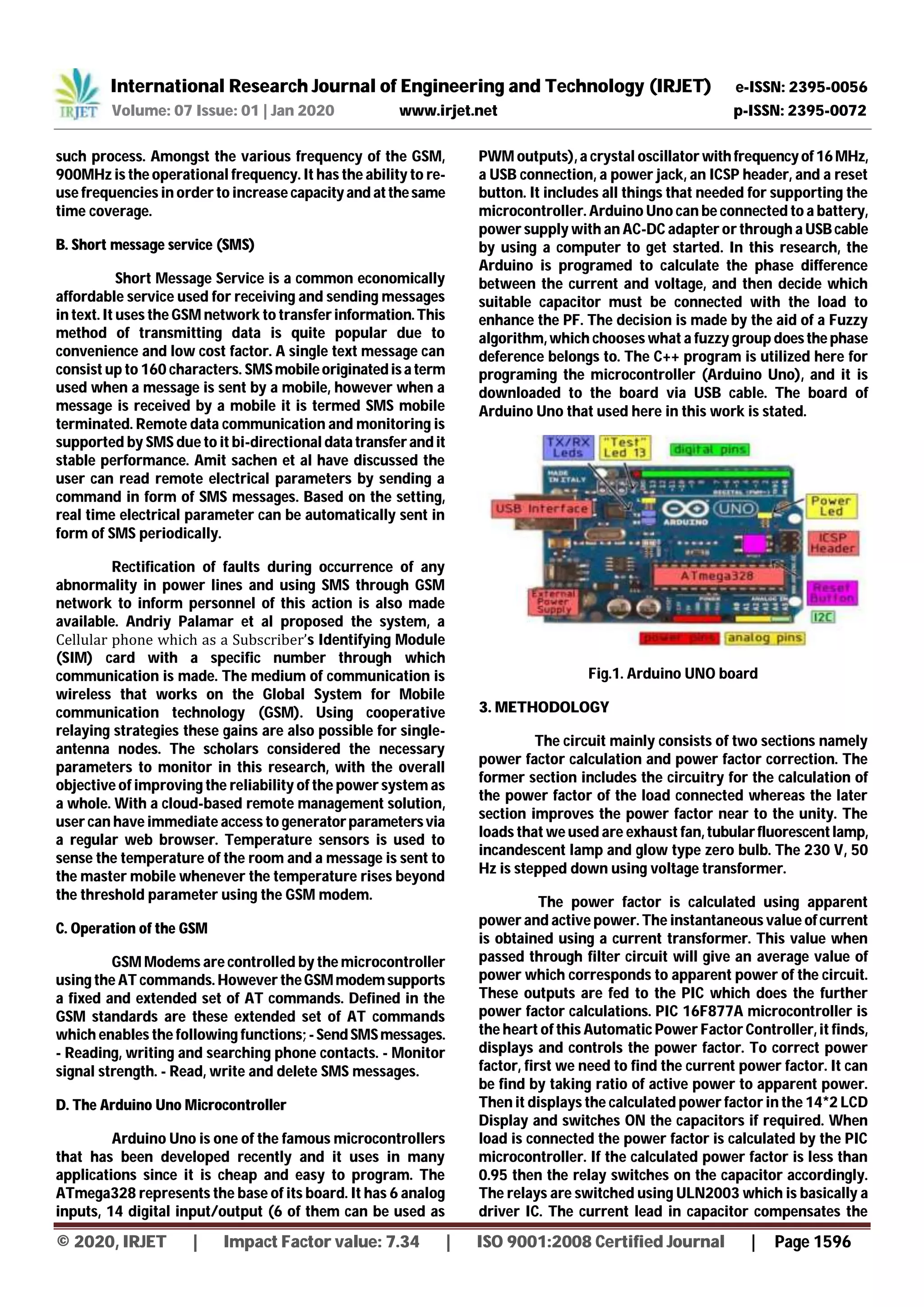
Arduino Uno that used here in this work is stated.
Fig.1. Arduino UNO board
3. METHODOLOGY
The circuit mainly consists of two sections namely
power factor calculation and power factor correction. The
former section includes the circuitry for the calculation of
the power factor of the load connected whereas the later
section improves the power factor near to the unity. The
loads that we used are exhaust fan, tubularfluorescentlamp,
incandescent lamp and glow type zero bulb. The 230 V, 50
Hz is stepped down using voltage transformer.
The power factor is calculated using apparent
power and active power. The instantaneous value ofcurrent
is obtained using a current transformer. This value when
passed through filter circuit will give an average value of
power which corresponds to apparent power of the circuit.
These outputs are fed to the PIC which does the further
power factor calculations. PIC 16F877A microcontroller is
the heart of this Automatic Power Factor Controller, it finds,
displays and controls the power factor. To correct power
factor, first we need to find the current power factor. It can
be find by taking ratio of active power to apparent power.
Then it displays the calculated power factor in the 14*2 LCD
Display and switches ON the capacitors if required. When
load is connected the power factor is calculated by the PIC
microcontroller. If the calculated power factor is less than
0.95 then the relay switches on the capacitor accordingly.
The relays are switched using ULN2003 which is basically a
driver IC. The current lead in capacitor compensates the
International Research Journal of Engineering and Technology (IRJET) e-ISSN: 2395-0056
Volume: 07 Issue: 01 | Jan 2020 www.irjet.net p-ISSN: 2395-0072
© 2020, IRJET | Impact Factor value: 7.34 | ISO 9001:2008 Certified Journal | Page 1597
corresponding current lag which is usually present in loads.
Hence the phase difference between the current and voltage
will be reduced.
Fig. 2 Block Diagram of the system
4. CONCLUSION
It can be concluded that power factor correction
techniques can be applied to the industries, power systems
and also households to make them stable so that the system
becomes stable and efficiency of the system increases. The
use of microcontroller reduces the costs. Due to use of
microcontroller multiple parameters can be controlled at a
time and the use of extra hardwares such as timer, RAM,
ROM and input output ports reduces. The occurrences of
faults were displayed and the message was sent through the
GSM network over to the utility mobile phone. A bi-
directional communication was established as the system
was able to receive command from the utility phone to set a
short circuit limit.
REFERENCES
[1] Md. Raju, Ahmed M. J. Alam, Power Factor
Improvement by Pulse Width Modulated Switched
Single Capacitor, IEEE Proceedings of India
International Conference on Power Electronics,
Chennai, December 2006, pp. 212 – 215.
[2] T.W. Kim, J.H. Choi and B.H. Kwon, High-
performance line conditioner with output voltage
regulation and power factor correction, IEEE
Proceedings of Electric Power Applications, ISSN
:1350-2352, Vol. 151, No. 1,January2004,pp.91-97
[3] Mr.Anant Kumar Tiwari, Mrs. Durga Sharma,
Mr.Vijay Kumar Sharma, Automatic Power Factor
Correction Using Capacitive Bank, International
Journal of Engineering Research and Applications,
ISSN : 2248-9622, Vol. 4, Issue 2 ( Version 1),
February 2014, pp.393-395.
[4] Abhinav Sharma, Vishal Nayyar, S. Chatterji, Ritula
Thakur, P.K. Lehana, PIC MicrocontrollerBasedSVC
for ReactivePowerCompensationandPowerFactor
Correction.
[5] International Journal of EngineeringandInnovative
Technology (IJEIT) Volume 3, Issue 4,October2013
272 Power Factor Correction Using PIC
Microcontroller www.arduino.cc
[6] Design and Implementation of Microcontroller-
Based Controlling of Power Factor Using Capacitor
Banks with Load Monitoring, Global Journal of
Researches in Engineering Electrical and
Electronics Engineering, Volume 13, Issue 2,
Version 1.0 Year 2013 Type: Double Blind Peer
Reviewed International ResearchJournal Publisher:
Global Journals Inc. (USA) Online ISSN: 2249-4596
& Print ISSN: 0975-5861
[7] Electric power industry reconstructing in India,
Present scenario and future prospects,S.N. Singh,
senior member,IEEE and S.C. Srivastava.
[8] Muhammad Bilal Khan, Muhammad Owais
Department of Electronic Engineering Faculty of
Engineering Sciences & Technology, Hamdard
Institute of Engineering & Technology, Hamdard
University Karachi, Pakistan2016
[9] P.P. Machado Jr , T. P. Abud Fluminense Federal
University - UFF Electric and Telecommunications
Engineering Master Program – PPGEET Niterói, Rio
de Janeiro, Brazil.

IRJET- GSM based Voltage Monitoring & Power Factor Correction

  • 1.
    International Research Journalof Engineering and Technology (IRJET) e-ISSN: 2395-0056 Volume: 07 Issue: 01 | Jan 2020 www.irjet.net p-ISSN: 2395-0072 © 2020, IRJET | Impact Factor value: 7.34 | ISO 9001:2008 Certified Journal | Page 1595 GSM Based Voltage Monitoring & Power Factor Correction Priyanka K. Sonone1, Vaishali D. Kamble2, Shital V. Uke3, N. V. Yawale4 1,2,3Student, Dept. of Electrical Engineering, DES’S COET, Dhamangaon Rly 4Professor, Dept. of Electrical Engineering, DES’S COET, Dhamangaon Rly ---------------------------------------------------------------------***--------------------------------------------------------------------- Abstract – Now a days, a controller that improves the power factor (PF) is automatically designed and implemented to correct the value of the power factor once they falls below a certain one. Due to the modern civilization the growth of industry has been increased as thus the usage of energy has been raised. So , every industry needs to implement power factor correction to limit power wastage and to avoid penalty due to the same. Lower power factor means that higher current is flowing through it, Higher current resultsingreater voltage drop. The aim is to build a simple compact and energy efficient system for automatic power factor monitoring and control. It incorporates PIC 16F877 microcontroller kit along with zero crossing detector circuitandrelaydrivercircuit. The voltage and current parameters are detected and controlled by using GSM. Key Words: Power Factor Correction, GSM Module, PIC Microcontroller. 1. INTRODUCTION Power factor for the sake of simple definition is the ratio between the real power andtheapparent powerdrawn by an electrical load and this ratio can vary between 0 and 1. The ratio which we have defined above is not a mere theoretical quantity which can be confined to books. It is a quantity that has got wide range of significance in real world day to day phenomena. It is a measure of how effectively the current is being converted into useful work outputandmore particularly is a good indicator of the effect of the load current on the efficiency of the supply system. Real power is the capacity of the circuit for performingwork ina particular time. Apparent power is the product of the current and voltage of the circuit. At inductive loads, the useful work is done by the active power while the reactive one returns to the source on current cycle, since it dissipates no energy in the load. This may reduce the consumersidevoltagebecause of the high requirement of the reactive power consequently, the continuous load Power Factor monitoring is very essential. When PF falls below a specified value, the line current increases, making the line loss and voltage drop increase too. The effect of low power factor is large copper loss and poor voltage regulations. The main reasons of low power factor are most of the AC motors are ofinductiontype which have low lagging power factor and arc lamps ,electric discharge lamps and industrial heating furnaces operate at lower power factors.Poorpowerfactorcostsourcommunity in increased electricitychargesandunnecessarygreenhouse gasses. While some countries provide incentives for customers to maintain requires power factor, some impose penalties for power factor dropping beyond the limit. Thus, power factor control is the most important part of efficient power management. A new method which improves the power factor automatically of varying lagging loads to unity, using one single large shunt capacitor instead of using a bank of switching capacitors. Basically,thiscontrol schemeisa static power factor correction method by continuous voltage or current control of a capacitor. In thiswork thevoltageacross the capacitor is being changed by a bi-directional switch to control the magnitude of compensating capacitor current and thereby attaining unity power factor. This system incorporates high-speed insulatedgate bipolar transistor switching technology. The gate signal of the switching devices is generated by using a compact and commercially available IC chip SG1524B.The scheme is simple in this sense that it uses only one static bi-directional switch controlled by an electronic control circuit that uses only analog ICs and some discrete digital components. T. W. Kim et al. suggested a high-performance line conditioner with excellent efficiency and power factor. In thispaperthey proposed a fast output voltage controller by utilizing a fast input voltage detection method and a feed forward controller with current-limiting capability for various impulsive loads. This paper proposes a technique that is characterized by successful impulsive loading and quick recovery of the output voltage. They proposed a high- efficient line conditioner with excellent performance. The line conditioner comprises of a three-leg rectifier-inverter, which functioned as a boost converter and a buck converter. 2. RELATED WORK A. GSM technology GSM stands for Global System for Mobile communications. Developed in 1990, ithasbecomethemost popular standard for mobile phones in the world. The implementation environment determines the coveragearea of each cell. The boundaries of cells can overlap between adjacent cells (large cells can be converted into smaller cells). The technology uses a blend of frequency division multiplexing (FDM) and time division multiplexing (TDM). Different users at different time slot use differentfrequency, hence when user is ON, uses channel 900MHz for three seconds, then hop to channel 910MHz for the next three seconds and so on. Frequency Hoping is the term giving to
  • 2.
    International Research Journalof Engineering and Technology (IRJET) e-ISSN: 2395-0056 Volume: 07 Issue: 01 | Jan 2020 www.irjet.net p-ISSN: 2395-0072 © 2020, IRJET | Impact Factor value: 7.34 | ISO 9001:2008 Certified Journal | Page 1596 such process. Amongst the various frequency of the GSM, 900MHz is the operational frequency. It has the ability to re- use frequencies in order to increase capacityand atthesame time coverage. B. Short message service (SMS) Short Message Service is a common economically affordable service used for receiving and sending messages in text. It uses the GSM network to transfer information.This method of transmitting data is quite popular due to convenience and low cost factor. A single text message can consist up to 160 characters. SMSmobileoriginatedisa term used when a message is sent by a mobile, however when a message is received by a mobile it is termed SMS mobile terminated. Remote data communication and monitoring is supported by SMS due to it bi-directional data transferandit stable performance. Amit sachen et al have discussed the user can read remote electrical parameters by sending a command in form of SMS messages. Based on the setting, real time electrical parameter can be automatically sent in form of SMS periodically. Rectification of faults during occurrence of any abnormality in power lines and using SMS through GSM network to inform personnel of this action is also made available. Andriy Palamar et al proposed the system, a Cellular phone which as a Subscriber’s Identifying Module (SIM) card with a specific number through which communication is made. The medium of communication is wireless that works on the Global System for Mobile communication technology (GSM). Using cooperative relaying strategies these gains are also possible for single- antenna nodes. The scholars considered the necessary parameters to monitor in this research, with the overall objective of improving the reliability of the power system as a whole. With a cloud-based remote management solution, user can have immediate access to generatorparametersvia a regular web browser. Temperature sensors is used to sense the temperature of the room and a message is sent to the master mobile whenever the temperature rises beyond the threshold parameter using the GSM modem. C. Operation of the GSM GSM Modems are controlled by the microcontroller using the AT commands. However theGSMmodemsupports a fixed and extended set of AT commands. Defined in the GSM standards are these extended set of AT commands which enables the following functions; -SendSMSmessages. - Reading, writing and searching phone contacts. - Monitor signal strength. - Read, write and delete SMS messages. D. The Arduino Uno Microcontroller Arduino Uno is one of the famous microcontrollers that has been developed recently and it uses in many applications since it is cheap and easy to program. The ATmega328 represents the base of its board. It has 6 analog inputs, 14 digital input/output (6 of them can be used as PWM outputs), a crystal oscillator withfrequencyof16MHz, a USB connection, a power jack, an ICSP header, and a reset button. It includes all things that needed for supporting the microcontroller. Arduino Uno can be connected to a battery, power supply with an AC-DC adapter or through a USBcable by using a computer to get started. In this research, the Arduino is programed to calculate the phase difference between the current and voltage, and then decide which suitable capacitor must be connected with the load to enhance the PF. The decision is made by the aid of a Fuzzy algorithm, which chooses what a fuzzy group doesthe phase deference belongs to. The C++ program is utilized here for programing the microcontroller (Arduino Uno), and it is downloaded to the board via USB cable. The board of Arduino Uno that used here in this work is stated. Fig.1. Arduino UNO board 3. METHODOLOGY The circuit mainly consists of two sections namely power factor calculation and power factor correction. The former section includes the circuitry for the calculation of the power factor of the load connected whereas the later section improves the power factor near to the unity. The loads that we used are exhaust fan, tubularfluorescentlamp, incandescent lamp and glow type zero bulb. The 230 V, 50 Hz is stepped down using voltage transformer. The power factor is calculated using apparent power and active power. The instantaneous value ofcurrent is obtained using a current transformer. This value when passed through filter circuit will give an average value of power which corresponds to apparent power of the circuit. These outputs are fed to the PIC which does the further power factor calculations. PIC 16F877A microcontroller is the heart of this Automatic Power Factor Controller, it finds, displays and controls the power factor. To correct power factor, first we need to find the current power factor. It can be find by taking ratio of active power to apparent power. Then it displays the calculated power factor in the 14*2 LCD Display and switches ON the capacitors if required. When load is connected the power factor is calculated by the PIC microcontroller. If the calculated power factor is less than 0.95 then the relay switches on the capacitor accordingly. The relays are switched using ULN2003 which is basically a driver IC. The current lead in capacitor compensates the
  • 3.
    International Research Journalof Engineering and Technology (IRJET) e-ISSN: 2395-0056 Volume: 07 Issue: 01 | Jan 2020 www.irjet.net p-ISSN: 2395-0072 © 2020, IRJET | Impact Factor value: 7.34 | ISO 9001:2008 Certified Journal | Page 1597 corresponding current lag which is usually present in loads. Hence the phase difference between the current and voltage will be reduced. Fig. 2 Block Diagram of the system 4. CONCLUSION It can be concluded that power factor correction techniques can be applied to the industries, power systems and also households to make them stable so that the system becomes stable and efficiency of the system increases. The use of microcontroller reduces the costs. Due to use of microcontroller multiple parameters can be controlled at a time and the use of extra hardwares such as timer, RAM, ROM and input output ports reduces. The occurrences of faults were displayed and the message was sent through the GSM network over to the utility mobile phone. A bi- directional communication was established as the system was able to receive command from the utility phone to set a short circuit limit. REFERENCES [1] Md. Raju, Ahmed M. J. Alam, Power Factor Improvement by Pulse Width Modulated Switched Single Capacitor, IEEE Proceedings of India International Conference on Power Electronics, Chennai, December 2006, pp. 212 – 215. [2] T.W. Kim, J.H. Choi and B.H. Kwon, High- performance line conditioner with output voltage regulation and power factor correction, IEEE Proceedings of Electric Power Applications, ISSN :1350-2352, Vol. 151, No. 1,January2004,pp.91-97 [3] Mr.Anant Kumar Tiwari, Mrs. Durga Sharma, Mr.Vijay Kumar Sharma, Automatic Power Factor Correction Using Capacitive Bank, International Journal of Engineering Research and Applications, ISSN : 2248-9622, Vol. 4, Issue 2 ( Version 1), February 2014, pp.393-395. [4] Abhinav Sharma, Vishal Nayyar, S. Chatterji, Ritula Thakur, P.K. Lehana, PIC MicrocontrollerBasedSVC for ReactivePowerCompensationandPowerFactor Correction. [5] International Journal of EngineeringandInnovative Technology (IJEIT) Volume 3, Issue 4,October2013 272 Power Factor Correction Using PIC Microcontroller www.arduino.cc [6] Design and Implementation of Microcontroller- Based Controlling of Power Factor Using Capacitor Banks with Load Monitoring, Global Journal of Researches in Engineering Electrical and Electronics Engineering, Volume 13, Issue 2, Version 1.0 Year 2013 Type: Double Blind Peer Reviewed International ResearchJournal Publisher: Global Journals Inc. (USA) Online ISSN: 2249-4596 & Print ISSN: 0975-5861 [7] Electric power industry reconstructing in India, Present scenario and future prospects,S.N. Singh, senior member,IEEE and S.C. Srivastava. [8] Muhammad Bilal Khan, Muhammad Owais Department of Electronic Engineering Faculty of Engineering Sciences & Technology, Hamdard Institute of Engineering & Technology, Hamdard University Karachi, Pakistan2016 [9] P.P. Machado Jr , T. P. Abud Fluminense Federal University - UFF Electric and Telecommunications Engineering Master Program – PPGEET Niterói, Rio de Janeiro, Brazil.