ANALOG FUNCTION GENERATOR
MUHAMMAD AMEER MOHAVIA
BS(ELECTRONICS ENGINEERING)
BALOCHISTAN UNIVERSITY OF INFROMATION
TECHNOLOGY ENGINEERING AND MANAGEMENT
SCIENCE’S, QUETTA, PAKISTAN.
1. INTRODUCTION
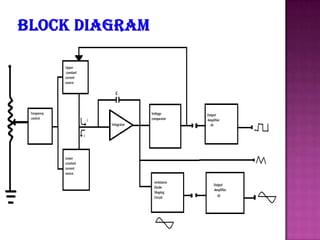
2. OPERATING PRINCIPLE
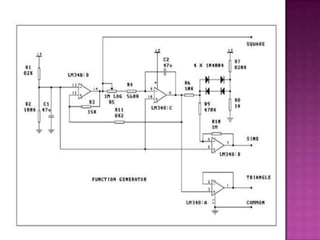
3. CIRCUIT DIAGRAM
4. WORKING OF CIRCUIT
5. Applications
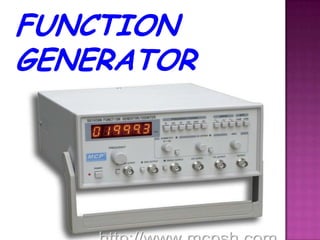
 A function generator is a piece of electronic
test equipment used to generate electrical
waveforms. These waveforms can be either
repetitive, or single-shot (once only) in
which case some kind of triggering source is
required (internal or external). The resultant
waveforms can be applied to a device under
test and analyzed as they progress through
the device, confirming the proper operation
of the device or pinpointing a fault in it.
 An electronic instrument which generates
periodic voltage or current waveforms that
duplicate various types of well-defined
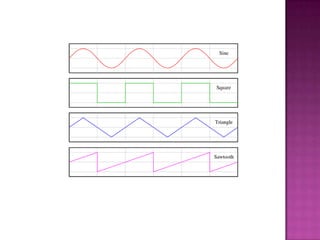
mathematical functions. The simplest
function generator usually generates a
combination of square waves, triangular
waves, and sine waves.
 A typical function generator can provide
frequencies up to 20 MHz.
 The ICL8038 is a function generator chip, capable of
generating triangular, square , sine, pulse and
sawtooth waveforms . From these sine, square &
triangular wave forms can be made simultaneously.
 There is an option to control the parameters like
frequency, duty cycle and distortion of these
functions.
 This is the best function generator circuit for a
beginner to start with and is of course a must on the
work bench of an electronics hobbyist.
 The circuit here is designed to produce waveforms
from 20Hz to 20 kHz
 The circuit needs a dual power supply. A +15 -15
power supply as shown in the circuit is enough for
the purpose.
 The frequency of the output wave form can be
adjusted using R7.It must be a 100K Log POT.
 The duty cycle can be adjusted using R3 , a 1K
POT.
 The distortion of the wave form can be adjusted
using R5 , a 100K POT.
 Square, triangle & sine waveforms can be
obtained simultaneously at pins 9,3,2
respectively.
 Square, sine and triangle waves are produced
using an LM348 and passive components. The
LM348 is a quad operational amplifier IC
package; that is, it contains four separate
opamps all in the one IC. They are marked A,
B, C & D in the schematic diagram
 A pseudo or imitation sine wave is produced
by a wave shaping circuit. A diode is a non-
linear device. As the potential difference
across it increases the current rises in the
characteristic way. This circuit 'joins
together' this characteristic curve to produce
an approximation to a sine wave. Two diodes
have been joined together as a series pair in
order to provide a higher amplitude than
would be obtained using only a single diode
 One opamp (LM324:D) is used. The voltage
level to pin 13 is set by the resistor divider
pair R1 and R2. The input to pin 12 depends
on two things; firstly the potential of pin 14,
and secondly, the voltage output of opamp C
at pin 8. When the input at pin 13 is higher
than the input at pin 12 the output goes low.
If it is lower then the output goes high.
Switching back and forth between the two
states causes a square wave to be produced.
The time constant (R4+R5)C2 determines the
frequency.
 Function Generators are used in
development, testing and repair of
electronic equipment, e.g. as a signal source
to test amplifiers, or to introduce an error
signal into a control loop
 They are generally used in designing, testing,
troubleshooting, and repairing electronic or
electroacoustic devices; though they often
have artistic uses as well.. A device such as
an oscilloscope is then used to measure the
circuit's output.
 There are many different types of signal
generators, with different purposes and
applications (and at varying levels of expense); in
general, no device is suitable for all possible
applications.
 Another type of function generator is a sub-
system that provides an output proportional to
some mathematical function of its input; for
example, the output may be proportional to the
square root of the input. Such devices are used in
feedback control systems and in analog computers
 Technology Behind Multi-Instrument
Synchronization
 Semiconductor Characterization
 Ultrasonic Phase Array Testing
 Disk Array Configuration
 Response testing using square
waves, pulses, and noise.
Analog function-generator

Analog function-generator

  • 1.
  • 2.
    MUHAMMAD AMEER MOHAVIA BS(ELECTRONICSENGINEERING) BALOCHISTAN UNIVERSITY OF INFROMATION TECHNOLOGY ENGINEERING AND MANAGEMENT SCIENCE’S, QUETTA, PAKISTAN.
  • 4.
    1. INTRODUCTION 2. OPERATINGPRINCIPLE 3. CIRCUIT DIAGRAM 4. WORKING OF CIRCUIT 5. Applications
  • 5.
     A functiongenerator is a piece of electronic test equipment used to generate electrical waveforms. These waveforms can be either repetitive, or single-shot (once only) in which case some kind of triggering source is required (internal or external). The resultant waveforms can be applied to a device under test and analyzed as they progress through the device, confirming the proper operation of the device or pinpointing a fault in it.
  • 7.
     An electronicinstrument which generates periodic voltage or current waveforms that duplicate various types of well-defined mathematical functions. The simplest function generator usually generates a combination of square waves, triangular waves, and sine waves.  A typical function generator can provide frequencies up to 20 MHz.
  • 11.
     The ICL8038is a function generator chip, capable of generating triangular, square , sine, pulse and sawtooth waveforms . From these sine, square & triangular wave forms can be made simultaneously.  There is an option to control the parameters like frequency, duty cycle and distortion of these functions.  This is the best function generator circuit for a beginner to start with and is of course a must on the work bench of an electronics hobbyist.  The circuit here is designed to produce waveforms from 20Hz to 20 kHz
  • 12.
     The circuitneeds a dual power supply. A +15 -15 power supply as shown in the circuit is enough for the purpose.  The frequency of the output wave form can be adjusted using R7.It must be a 100K Log POT.  The duty cycle can be adjusted using R3 , a 1K POT.  The distortion of the wave form can be adjusted using R5 , a 100K POT.  Square, triangle & sine waveforms can be obtained simultaneously at pins 9,3,2 respectively.
  • 13.
     Square, sineand triangle waves are produced using an LM348 and passive components. The LM348 is a quad operational amplifier IC package; that is, it contains four separate opamps all in the one IC. They are marked A, B, C & D in the schematic diagram
  • 14.
     A pseudoor imitation sine wave is produced by a wave shaping circuit. A diode is a non- linear device. As the potential difference across it increases the current rises in the characteristic way. This circuit 'joins together' this characteristic curve to produce an approximation to a sine wave. Two diodes have been joined together as a series pair in order to provide a higher amplitude than would be obtained using only a single diode
  • 15.
     One opamp(LM324:D) is used. The voltage level to pin 13 is set by the resistor divider pair R1 and R2. The input to pin 12 depends on two things; firstly the potential of pin 14, and secondly, the voltage output of opamp C at pin 8. When the input at pin 13 is higher than the input at pin 12 the output goes low. If it is lower then the output goes high. Switching back and forth between the two states causes a square wave to be produced. The time constant (R4+R5)C2 determines the frequency.
  • 16.
     Function Generatorsare used in development, testing and repair of electronic equipment, e.g. as a signal source to test amplifiers, or to introduce an error signal into a control loop  They are generally used in designing, testing, troubleshooting, and repairing electronic or electroacoustic devices; though they often have artistic uses as well.. A device such as an oscilloscope is then used to measure the circuit's output.
  • 17.
     There aremany different types of signal generators, with different purposes and applications (and at varying levels of expense); in general, no device is suitable for all possible applications.  Another type of function generator is a sub- system that provides an output proportional to some mathematical function of its input; for example, the output may be proportional to the square root of the input. Such devices are used in feedback control systems and in analog computers  Technology Behind Multi-Instrument Synchronization
  • 18.
     Semiconductor Characterization Ultrasonic Phase Array Testing  Disk Array Configuration  Response testing using square waves, pulses, and noise.