BUCK CONVERTER
SUBSYSTEM
BY: TROY STAHLEY
1
OBJECTIVE
• To efficiently reduce DC voltage by also reducing the ripples in the
waveforms so have a smooth output DC voltage.
• Efficiently apply a current sensor or a current sensing technique to measure
the current for the inductor.
2
SUBSYSTEM OF BUCK (STEP DOWN)
CONVERTER
• Circuit Configuration
• Simulink Circuit Schematic
• Circuit Components
• Design Equations
• Current Waveforms
• Finding the slopes to get ∆𝑖 𝐿
• Current Sensing Technique
• Simplified and Advanced Techniques
3
SIMULINK CIRCUIT CONFIGURATION
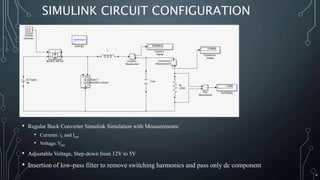
• Regular Buck Converter Simulink Simulation with Measurements:
• Currents: iL and Iout
• Voltage: Vout
• Adjustable Voltage, Step-down from 12V to 5V
• Insertion of low-pass filter to remove switching harmonics and pass only dc component
4
CIRCUIT COMPONENTS
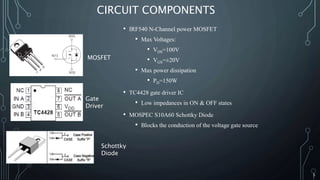
• IRF540 N-Channel power MOSFET
• Max Voltages:
• VDS=100V
• VGS=±20V
• Max power dissipation
• PD=150W
• TC4428 gate driver IC
• Low impedances in ON & OFF states
• MOSPEC S10A60 Schottky Diode
• Blocks the conduction of the voltage gate source
MOSFET
Gate
Driver
Schottky
Diode
5
DESIGN EQUATIONS
Desired voltage Vout
𝑉𝑜𝑢𝑡 = 𝐷𝑉𝑖𝑛
𝐷 =
𝑉𝑜𝑢𝑡
𝑉𝑖𝑛
D => duty cycle of the switch:
𝐷 =
𝑡 𝑜𝑛
𝑇
=
𝑡 𝑜𝑛
𝑡 𝑜𝑛 + 𝑡 𝑜𝑓𝑓
Switching frequency:
𝑓𝑠 =
1
𝑇
Choosing an inductor L by:
𝐿 =
𝑉𝑜𝑢𝑡(𝑉𝑖𝑛 − 𝑉𝑜𝑢𝑡)
∆𝑖 𝐿 𝑓𝑠 𝑉𝑖𝑛
6
DESIGN EQUATIONS CONTINUED
• The inductor current changes with an essentially constant slope so solving for both slopes (ON and OFF states) and simplified we
get:
∆𝑖 𝐿 =
𝑉𝑖𝑛 − 𝑉𝑜𝑢𝑡
2𝐿
𝐷𝑇𝑠
𝐿 =
𝑉𝑖𝑛 − 𝑉𝑜𝑢𝑡
2∆𝑖 𝐿
𝐷𝑇𝑠
• Equivalent Series Resistance (ESR) due to the capacitance
• reduced by adding capacitors in parallel
• Adding ceramic capacitor in parallel with the input dc voltage supply, thus
𝐶𝑖𝑛 = 𝐼 𝑜𝑢𝑡
𝐷 1 − 𝐷 1000
𝑓𝑠 𝑉𝑝𝑚𝑎𝑥
• Where 𝑉𝑝𝑚𝑎𝑥 is maximum allowed peak−to peak ripple voltage, the minimum output capacitance, Cout is given by
𝐶 𝑜𝑢𝑡 =
∆𝑖 𝐿
8𝑓𝑠∆𝑉𝑜𝑢𝑡
7
CURRENT WAVEFORMS
• The current Iout = Iavg,L
• ∆iL= pk-pk I change during ton
• (change in iL) = (slope)(length of subinterval)
• L must be able to handle the peak switching current without
saturating the core.
• Higher output-voltage ripple, small-value inductors result in a
higher output current slew rate, improving the load transient
response of the converter
• Large-value inductors lower the ripple current and reduce the core
magnetic hysteresis losses
8
A CURRENT SENSING TECHNIQUE
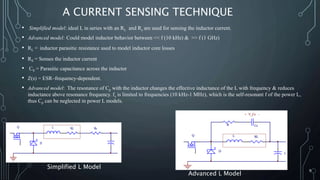
• Simplified model: ideal L in series with an RL and Rs are used for sensing the inductor current.
• Advanced model: Could model inductor behavior between << f (10 kHz) & >> f (1 GHz)
• RL = inductor parasitic resistance used to model inductor core losses
• RS = Senses the inductor current
• CS = Parasitic capacitance across the inductor
• Z(s) = ESR–frequency-dependent.
• Advanced model: The resonance of Cp with the inductor changes the effective inductance of the L with frequency & reduces
inductance above resonance frequency. fs is limited to frequencies (10 kHz-1 MHz), which is the self-resonant f of the power L,
thus Cp can be neglected in power L models.
9
Simplified L Model
Advanced L Model
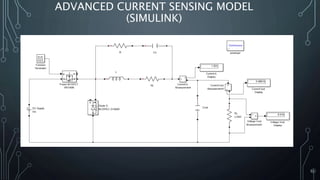
ADVANCED CURRENT SENSING MODEL
(SIMULINK)
10
ADVANCED CURRENT SENSING
TECHNIQUE
• The voltage across the ceramic capacitor, VCS is the sensor’s output.
𝐿
𝑅 𝐿
≫ 𝑇
• One can determine the capacitor voltage that is directly proportional to the inductor current that is:
𝑉𝐶𝑆 = 𝑖 𝐿 𝑅 𝐿
• Thus, one can use the capacitor voltage VCS for over current protection
• Assumptions for advanced current sensing:
• R has 5% accuracy
• L has a value with possible max at2.5µH at low current and a min of 1.1µH at high current
• Cs has 10% tolerance, and RL is 3mΩ at 20°C
11

Buck converter

  • 1.
  • 2.
    OBJECTIVE • To efficientlyreduce DC voltage by also reducing the ripples in the waveforms so have a smooth output DC voltage. • Efficiently apply a current sensor or a current sensing technique to measure the current for the inductor. 2
  • 3.
    SUBSYSTEM OF BUCK(STEP DOWN) CONVERTER • Circuit Configuration • Simulink Circuit Schematic • Circuit Components • Design Equations • Current Waveforms • Finding the slopes to get ∆𝑖 𝐿 • Current Sensing Technique • Simplified and Advanced Techniques 3
  • 4.
    SIMULINK CIRCUIT CONFIGURATION •Regular Buck Converter Simulink Simulation with Measurements: • Currents: iL and Iout • Voltage: Vout • Adjustable Voltage, Step-down from 12V to 5V • Insertion of low-pass filter to remove switching harmonics and pass only dc component 4
  • 5.
    CIRCUIT COMPONENTS • IRF540N-Channel power MOSFET • Max Voltages: • VDS=100V • VGS=±20V • Max power dissipation • PD=150W • TC4428 gate driver IC • Low impedances in ON & OFF states • MOSPEC S10A60 Schottky Diode • Blocks the conduction of the voltage gate source MOSFET Gate Driver Schottky Diode 5
  • 6.
    DESIGN EQUATIONS Desired voltageVout 𝑉𝑜𝑢𝑡 = 𝐷𝑉𝑖𝑛 𝐷 = 𝑉𝑜𝑢𝑡 𝑉𝑖𝑛 D => duty cycle of the switch: 𝐷 = 𝑡 𝑜𝑛 𝑇 = 𝑡 𝑜𝑛 𝑡 𝑜𝑛 + 𝑡 𝑜𝑓𝑓 Switching frequency: 𝑓𝑠 = 1 𝑇 Choosing an inductor L by: 𝐿 = 𝑉𝑜𝑢𝑡(𝑉𝑖𝑛 − 𝑉𝑜𝑢𝑡) ∆𝑖 𝐿 𝑓𝑠 𝑉𝑖𝑛 6
  • 7.
    DESIGN EQUATIONS CONTINUED •The inductor current changes with an essentially constant slope so solving for both slopes (ON and OFF states) and simplified we get: ∆𝑖 𝐿 = 𝑉𝑖𝑛 − 𝑉𝑜𝑢𝑡 2𝐿 𝐷𝑇𝑠 𝐿 = 𝑉𝑖𝑛 − 𝑉𝑜𝑢𝑡 2∆𝑖 𝐿 𝐷𝑇𝑠 • Equivalent Series Resistance (ESR) due to the capacitance • reduced by adding capacitors in parallel • Adding ceramic capacitor in parallel with the input dc voltage supply, thus 𝐶𝑖𝑛 = 𝐼 𝑜𝑢𝑡 𝐷 1 − 𝐷 1000 𝑓𝑠 𝑉𝑝𝑚𝑎𝑥 • Where 𝑉𝑝𝑚𝑎𝑥 is maximum allowed peak−to peak ripple voltage, the minimum output capacitance, Cout is given by 𝐶 𝑜𝑢𝑡 = ∆𝑖 𝐿 8𝑓𝑠∆𝑉𝑜𝑢𝑡 7
  • 8.
    CURRENT WAVEFORMS • Thecurrent Iout = Iavg,L • ∆iL= pk-pk I change during ton • (change in iL) = (slope)(length of subinterval) • L must be able to handle the peak switching current without saturating the core. • Higher output-voltage ripple, small-value inductors result in a higher output current slew rate, improving the load transient response of the converter • Large-value inductors lower the ripple current and reduce the core magnetic hysteresis losses 8
  • 9.
    A CURRENT SENSINGTECHNIQUE • Simplified model: ideal L in series with an RL and Rs are used for sensing the inductor current. • Advanced model: Could model inductor behavior between << f (10 kHz) & >> f (1 GHz) • RL = inductor parasitic resistance used to model inductor core losses • RS = Senses the inductor current • CS = Parasitic capacitance across the inductor • Z(s) = ESR–frequency-dependent. • Advanced model: The resonance of Cp with the inductor changes the effective inductance of the L with frequency & reduces inductance above resonance frequency. fs is limited to frequencies (10 kHz-1 MHz), which is the self-resonant f of the power L, thus Cp can be neglected in power L models. 9 Simplified L Model Advanced L Model
  • 10.
    ADVANCED CURRENT SENSINGMODEL (SIMULINK) 10
  • 11.
    ADVANCED CURRENT SENSING TECHNIQUE •The voltage across the ceramic capacitor, VCS is the sensor’s output. 𝐿 𝑅 𝐿 ≫ 𝑇 • One can determine the capacitor voltage that is directly proportional to the inductor current that is: 𝑉𝐶𝑆 = 𝑖 𝐿 𝑅 𝐿 • Thus, one can use the capacitor voltage VCS for over current protection • Assumptions for advanced current sensing: • R has 5% accuracy • L has a value with possible max at2.5µH at low current and a min of 1.1µH at high current • Cs has 10% tolerance, and RL is 3mΩ at 20°C 11