INTRODUCTION TO REAL ANALYSIS 1
INDIVIDUAL TASK
EXERCISES 3.2
LIMIT THEOREMS
By:
Muhammad Nur Chalim
4101414101
MATHEMATICS DEPARTMENT
MATHEMATICS AND NATURAL SCIENCES FACULTY
SEMARANG STATE UNIVERSITY
2016
EXERCISES 3.2
Problem
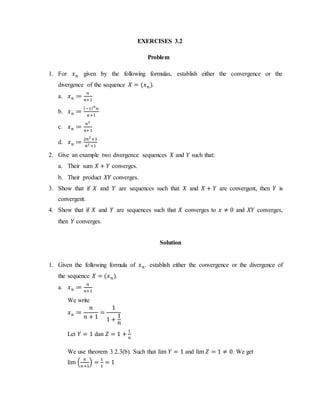
1. For 𝑥 𝑛 given by the following formulas, establish either the convergence or the
divergence of the sequence 𝑋 = (𝑥 𝑛).
a. 𝑥 𝑛 ≔
𝑛
𝑛+1
b. 𝑥 𝑛 ≔
(−1) 𝑛
𝑛
𝑛+1
c. 𝑥 𝑛 ≔
𝑛2
𝑛+1
d. 𝑥 𝑛 ≔
2𝑛2
+3
𝑛2 +1
2. Give an example two divergence sequences 𝑋 and 𝑌 such that:
a. Their sum 𝑋 + 𝑌 converges.
b. Their product 𝑋𝑌 converges.
3. Show that if 𝑋 and 𝑌 are sequences such that 𝑋 and 𝑋 + 𝑌 are convergent, then 𝑌 is
convergent.
4. Show that if 𝑋 and 𝑌 are sequences such that 𝑋 converges to 𝑥 ≠ 0 and 𝑋𝑌 converges,
then 𝑌 converges.
Solution
1. Given the following formula of 𝑥 𝑛. establish either the convergence or the divergence of
the sequence 𝑋 = (𝑥 𝑛).
a. 𝑥 𝑛 ≔
𝑛
𝑛+1
We write
𝑥 𝑛 ≔
𝑛
𝑛 + 1
=
1
1 +
1
𝑛
Let 𝑌 = 1 dan 𝑍 = 1 +
1
𝑛
We use theorem 3.2.3(b). Such that lim 𝑌 = 1 and lim 𝑍 = 1 ≠ 0. We get
lim (
𝑛
𝑛+1
) =
1
1
= 1
since lim (
𝑛
𝑛+1
) =
1
1
= 1 (exist), then 𝑥 𝑛 =
𝑛
𝑛+1
convergence
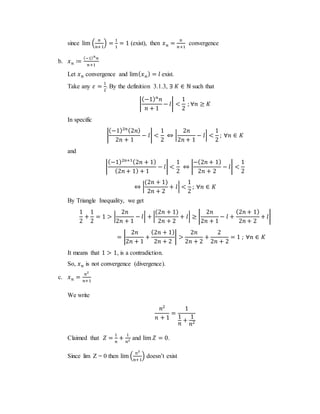
b. 𝑥 𝑛 ≔
(−1) 𝑛
𝑛
𝑛+1
Let 𝑥 𝑛 convergence and lim( 𝑥 𝑛) = 𝑙 exist.
Take any 𝜀 =
1
2
. By the definition 3.1.3, ∃ 𝐾 ∈ ℕ such that
|
(−1) 𝑛
𝑛
𝑛 + 1
− 𝑙| <
1
2
; ∀𝑛 ≥ 𝐾
In specific
|
(−1)2𝑛(2𝑛)
2𝑛 + 1
− 𝑙| <
1
2
⇔ |
2𝑛
2𝑛 + 1
− 𝑙| <
1
2
; ∀𝑛 ∈ 𝐾
and
|
(−1)2𝑛+1(2𝑛 + 1)
(2𝑛 + 1) + 1
− 𝑙| <
1
2
⇔ |
−(2𝑛 + 1)
2𝑛 + 2
− 𝑙| <
1
2
⇔ |
(2𝑛 + 1)
2𝑛 + 2
+ 𝑙| <
1
2
; ∀𝑛 ∈ 𝐾
By Triangle Inequality, we get
1
2
+
1
2
= 1 > |
2𝑛
2𝑛 + 1
− 𝑙| + |
(2𝑛 + 1)
2𝑛 + 2
+ 𝑙| ≥ |
2𝑛
2𝑛 + 1
− 𝑙 +
(2𝑛 + 1)
2𝑛 + 2
+ 𝑙|
= |
2𝑛
2𝑛 + 1
+
(2𝑛 + 1)
2𝑛 + 2
| >
2𝑛
2𝑛 + 2
+
2
2𝑛 + 2
= 1 ; ∀𝑛 ∈ 𝐾
It means that 1 > 1, is a contradiction.
So, 𝑥 𝑛 is not convergence (divergence).
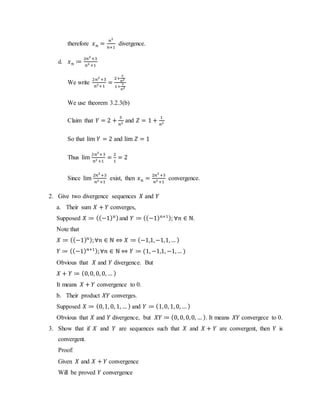
c. 𝑥 𝑛 =
𝑛2
𝑛+1
We write
𝑛2
𝑛 + 1
=
1
1
𝑛
+
1
𝑛2
Claimed that 𝑍 =
1
𝑛
+
1
𝑛2 and lim 𝑍 = 0.
Since lim Z = 0 then lim (
n2
n+1
) doesn’t exist
therefore 𝑥 𝑛 =
𝑛2
𝑛+1
divergence.
d. 𝑥 𝑛 ≔
2𝑛2
+3
𝑛2 +1
We write
2𝑛2
+3
𝑛2+1
=
2+
3
𝑛2
1+
1
𝑛2
We use theorem 3.2.3(b)
Claim that 𝑌 = 2 +
3
𝑛2 and 𝑍 = 1 +
1
𝑛2
So that lim 𝑌 = 2 and lim 𝑍 = 1
Thus lim
2𝑛2
+3
𝑛2 +1
=
2
1
= 2
Since lim
2𝑛2
+3
𝑛2 +1
exist, then 𝑥 𝑛 =
2𝑛2
+3
𝑛2 +1
convergence.
2. Give two divergence sequences 𝑋 and 𝑌
a. Their sum 𝑋 + 𝑌 converges,
Supposed 𝑋 ≔ ((−1) 𝑛)and 𝑌 ≔ ((−1) 𝑛+1); ∀𝑛 ∈ ℕ.
Note that
𝑋 ≔ ((−1) 𝑛);∀𝑛 ∈ ℕ ⇔ 𝑋 ≔ (−1,1,−1,1,… )
𝑌 ≔ ((−1) 𝑛+1);∀𝑛 ∈ ℕ ⇔ 𝑌 ≔ (1, −1,1, −1,… )
Obvious that 𝑋 and 𝑌 divergence. But
𝑋 + 𝑌 ≔ (0,0, 0, 0, … )
It means 𝑋 + 𝑌 convergence to 0.
b. Their product 𝑋𝑌 converges.
Supposed 𝑋 ≔ (0,1, 0, 1, … ) and 𝑌 ≔ (1,0, 1, 0, … )
Obvious that 𝑋 and 𝑌 divergence, but 𝑋𝑌 ≔ (0, 0, 0,0, … ). It means 𝑋𝑌 convergece to 0.
3. Show that if 𝑋 and 𝑌 are sequences such that 𝑋 and 𝑋 + 𝑌 are convergent, then 𝑌 is
convergent.
Proof:
Given 𝑋 and 𝑋 + 𝑌 convergence
Will be proved 𝑌 convergence
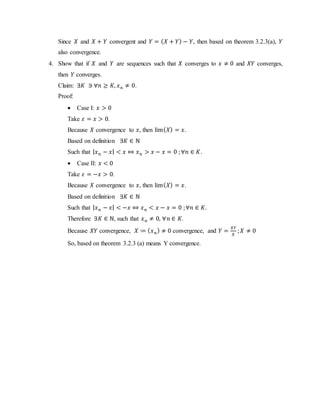
Since 𝑋 and 𝑋 + 𝑌 convergent and 𝑌 = ( 𝑋 + 𝑌) − 𝑌, then based on theorem 3.2.3(a), 𝑌
also convergence.
4. Show that if 𝑋 and 𝑌 are sequences such that 𝑋 converges to 𝑥 ≠ 0 and 𝑋𝑌 converges,
then 𝑌 converges.
Claim: ∃𝐾 ∋ ∀𝑛 ≥ 𝐾, 𝑥 𝑛 ≠ 0.
Proof:
 Case I: 𝑥 > 0
Take 𝜀 = 𝑥 > 0.
Because 𝑋 convergence to 𝑥, then lim( 𝑋) = 𝑥.
Based on definition ∃𝐾 ∈ ℕ
Such that | 𝑥 𝑛 − 𝑥| < 𝑥 ⇔ 𝑥 𝑛 > 𝑥 − 𝑥 = 0 ;∀𝑛 ∈ 𝐾.
 Case II: 𝑥 < 0
Take 𝜀 = −𝑥 > 0.
Because 𝑋 convergence to 𝑥, then lim( 𝑋) = 𝑥.
Based on definition ∃𝐾 ∈ ℕ
Such that | 𝑥 𝑛 − 𝑥| < −𝑥 ⇔ 𝑥 𝑛 < 𝑥 − 𝑥 = 0 ;∀𝑛 ∈ 𝐾.
Therefore ∃𝐾 ∈ ℕ, such that 𝑥 𝑛 ≠ 0, ∀𝑛 ∈ 𝐾.
Because 𝑋𝑌 convergence, 𝑋 ≔ ( 𝑥 𝑛) ≠ 0 convergence, and 𝑌 =
𝑋𝑌
𝑋
; 𝑋 ≠ 0
So, based on theorem 3.2.3 (a) means Y convergence.

ANALISIS RIIL 1 3.2 ROBERT G BARTLE

  • 1.
    INTRODUCTION TO REALANALYSIS 1 INDIVIDUAL TASK EXERCISES 3.2 LIMIT THEOREMS By: Muhammad Nur Chalim 4101414101 MATHEMATICS DEPARTMENT MATHEMATICS AND NATURAL SCIENCES FACULTY SEMARANG STATE UNIVERSITY 2016
  • 2.
    EXERCISES 3.2 Problem 1. For𝑥 𝑛 given by the following formulas, establish either the convergence or the divergence of the sequence 𝑋 = (𝑥 𝑛). a. 𝑥 𝑛 ≔ 𝑛 𝑛+1 b. 𝑥 𝑛 ≔ (−1) 𝑛 𝑛 𝑛+1 c. 𝑥 𝑛 ≔ 𝑛2 𝑛+1 d. 𝑥 𝑛 ≔ 2𝑛2 +3 𝑛2 +1 2. Give an example two divergence sequences 𝑋 and 𝑌 such that: a. Their sum 𝑋 + 𝑌 converges. b. Their product 𝑋𝑌 converges. 3. Show that if 𝑋 and 𝑌 are sequences such that 𝑋 and 𝑋 + 𝑌 are convergent, then 𝑌 is convergent. 4. Show that if 𝑋 and 𝑌 are sequences such that 𝑋 converges to 𝑥 ≠ 0 and 𝑋𝑌 converges, then 𝑌 converges. Solution 1. Given the following formula of 𝑥 𝑛. establish either the convergence or the divergence of the sequence 𝑋 = (𝑥 𝑛). a. 𝑥 𝑛 ≔ 𝑛 𝑛+1 We write 𝑥 𝑛 ≔ 𝑛 𝑛 + 1 = 1 1 + 1 𝑛 Let 𝑌 = 1 dan 𝑍 = 1 + 1 𝑛 We use theorem 3.2.3(b). Such that lim 𝑌 = 1 and lim 𝑍 = 1 ≠ 0. We get lim ( 𝑛 𝑛+1 ) = 1 1 = 1
  • 3.
    since lim ( 𝑛 𝑛+1 )= 1 1 = 1 (exist), then 𝑥 𝑛 = 𝑛 𝑛+1 convergence b. 𝑥 𝑛 ≔ (−1) 𝑛 𝑛 𝑛+1 Let 𝑥 𝑛 convergence and lim( 𝑥 𝑛) = 𝑙 exist. Take any 𝜀 = 1 2 . By the definition 3.1.3, ∃ 𝐾 ∈ ℕ such that | (−1) 𝑛 𝑛 𝑛 + 1 − 𝑙| < 1 2 ; ∀𝑛 ≥ 𝐾 In specific | (−1)2𝑛(2𝑛) 2𝑛 + 1 − 𝑙| < 1 2 ⇔ | 2𝑛 2𝑛 + 1 − 𝑙| < 1 2 ; ∀𝑛 ∈ 𝐾 and | (−1)2𝑛+1(2𝑛 + 1) (2𝑛 + 1) + 1 − 𝑙| < 1 2 ⇔ | −(2𝑛 + 1) 2𝑛 + 2 − 𝑙| < 1 2 ⇔ | (2𝑛 + 1) 2𝑛 + 2 + 𝑙| < 1 2 ; ∀𝑛 ∈ 𝐾 By Triangle Inequality, we get 1 2 + 1 2 = 1 > | 2𝑛 2𝑛 + 1 − 𝑙| + | (2𝑛 + 1) 2𝑛 + 2 + 𝑙| ≥ | 2𝑛 2𝑛 + 1 − 𝑙 + (2𝑛 + 1) 2𝑛 + 2 + 𝑙| = | 2𝑛 2𝑛 + 1 + (2𝑛 + 1) 2𝑛 + 2 | > 2𝑛 2𝑛 + 2 + 2 2𝑛 + 2 = 1 ; ∀𝑛 ∈ 𝐾 It means that 1 > 1, is a contradiction. So, 𝑥 𝑛 is not convergence (divergence). c. 𝑥 𝑛 = 𝑛2 𝑛+1 We write 𝑛2 𝑛 + 1 = 1 1 𝑛 + 1 𝑛2 Claimed that 𝑍 = 1 𝑛 + 1 𝑛2 and lim 𝑍 = 0. Since lim Z = 0 then lim ( n2 n+1 ) doesn’t exist
  • 4.
    therefore 𝑥 𝑛= 𝑛2 𝑛+1 divergence. d. 𝑥 𝑛 ≔ 2𝑛2 +3 𝑛2 +1 We write 2𝑛2 +3 𝑛2+1 = 2+ 3 𝑛2 1+ 1 𝑛2 We use theorem 3.2.3(b) Claim that 𝑌 = 2 + 3 𝑛2 and 𝑍 = 1 + 1 𝑛2 So that lim 𝑌 = 2 and lim 𝑍 = 1 Thus lim 2𝑛2 +3 𝑛2 +1 = 2 1 = 2 Since lim 2𝑛2 +3 𝑛2 +1 exist, then 𝑥 𝑛 = 2𝑛2 +3 𝑛2 +1 convergence. 2. Give two divergence sequences 𝑋 and 𝑌 a. Their sum 𝑋 + 𝑌 converges, Supposed 𝑋 ≔ ((−1) 𝑛)and 𝑌 ≔ ((−1) 𝑛+1); ∀𝑛 ∈ ℕ. Note that 𝑋 ≔ ((−1) 𝑛);∀𝑛 ∈ ℕ ⇔ 𝑋 ≔ (−1,1,−1,1,… ) 𝑌 ≔ ((−1) 𝑛+1);∀𝑛 ∈ ℕ ⇔ 𝑌 ≔ (1, −1,1, −1,… ) Obvious that 𝑋 and 𝑌 divergence. But 𝑋 + 𝑌 ≔ (0,0, 0, 0, … ) It means 𝑋 + 𝑌 convergence to 0. b. Their product 𝑋𝑌 converges. Supposed 𝑋 ≔ (0,1, 0, 1, … ) and 𝑌 ≔ (1,0, 1, 0, … ) Obvious that 𝑋 and 𝑌 divergence, but 𝑋𝑌 ≔ (0, 0, 0,0, … ). It means 𝑋𝑌 convergece to 0. 3. Show that if 𝑋 and 𝑌 are sequences such that 𝑋 and 𝑋 + 𝑌 are convergent, then 𝑌 is convergent. Proof: Given 𝑋 and 𝑋 + 𝑌 convergence Will be proved 𝑌 convergence
  • 5.
    Since 𝑋 and𝑋 + 𝑌 convergent and 𝑌 = ( 𝑋 + 𝑌) − 𝑌, then based on theorem 3.2.3(a), 𝑌 also convergence. 4. Show that if 𝑋 and 𝑌 are sequences such that 𝑋 converges to 𝑥 ≠ 0 and 𝑋𝑌 converges, then 𝑌 converges. Claim: ∃𝐾 ∋ ∀𝑛 ≥ 𝐾, 𝑥 𝑛 ≠ 0. Proof:  Case I: 𝑥 > 0 Take 𝜀 = 𝑥 > 0. Because 𝑋 convergence to 𝑥, then lim( 𝑋) = 𝑥. Based on definition ∃𝐾 ∈ ℕ Such that | 𝑥 𝑛 − 𝑥| < 𝑥 ⇔ 𝑥 𝑛 > 𝑥 − 𝑥 = 0 ;∀𝑛 ∈ 𝐾.  Case II: 𝑥 < 0 Take 𝜀 = −𝑥 > 0. Because 𝑋 convergence to 𝑥, then lim( 𝑋) = 𝑥. Based on definition ∃𝐾 ∈ ℕ Such that | 𝑥 𝑛 − 𝑥| < −𝑥 ⇔ 𝑥 𝑛 < 𝑥 − 𝑥 = 0 ;∀𝑛 ∈ 𝐾. Therefore ∃𝐾 ∈ ℕ, such that 𝑥 𝑛 ≠ 0, ∀𝑛 ∈ 𝐾. Because 𝑋𝑌 convergence, 𝑋 ≔ ( 𝑥 𝑛) ≠ 0 convergence, and 𝑌 = 𝑋𝑌 𝑋 ; 𝑋 ≠ 0 So, based on theorem 3.2.3 (a) means Y convergence.