Anesthesia-Management-of-Burn
patient
Objectives;
At the end of this session students be able to;
 Understand the pathophysiology of burn
 Identify and adequately resuscitate for those patients in
need.
 Provide safe anesthesia management
Introduction
• The skin is the largest organ of the human body. It
has four principal functions:
– The skin contains the majority of sensory nerve endings
and, hence, is a sensory organ.
– The skin performs a major role in thermoregulation and
helps maintain body temperature within a relatively
narrow range.
– Intact skin prevents a loss of body fluids.
– It is a barrier against microorganisms.
• With loss of intact skin, burned patients become
hypothermic, experience significant water loss, and
are at great risk for infection and sepsis.
2
• Burns are among the most devastating injuries
encountered in medicine.
• Approximately 2.4 million burn injuries per year
• Average 75,000 require hospitalization
• Between 8,000 and 12,000 patients die from burn injuries
each year
• It’s the 2nd cause of accidental deaths
• According to the CDC and Prevention, someone dies in US
in a fire every 175 minutes and is injured every 31
minutes.
3
• Groups with an increased risk of fire-related injury
and death include
– children under 5 and adults more than 65 years of age,
– Socio-economic status (poor); overcrowding and lack of
proper safety measures;
– occupations that increase exposure to fire (females
with open fire cooking);
– underlying medical conditions, including epilepsy,
peripheral neuropathy, and physical and cognitive
disabilities;
– alcohol abuse; smoking; and easy access to chemicals
used for assault (such as in acid violence attacks);
– use of kerosene (paraffin) as a fuel source for non-electric
domestic appliances; 4
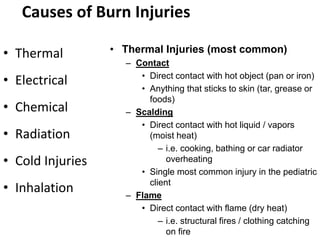
Causes of Burn Injuries
• Thermal
• Electrical
• Chemical
• Radiation
• Cold Injuries
• Inhalation
• Thermal Injuries (most common)
– Contact
• Direct contact with hot object (pan or iron)
• Anything that sticks to skin (tar, grease or
foods)
– Scalding
• Direct contact with hot liquid / vapors
(moist heat)
– i.e. cooking, bathing or car radiator
overheating
• Single most common injury in the pediatric
client
– Flame
• Direct contact with flame (dry heat)
– i.e. structural fires / clothing catching
on fire
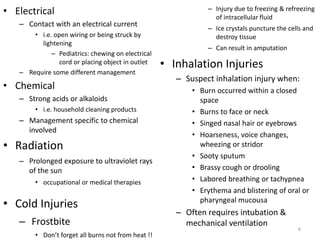
• Electrical
– Contact with an electrical current
• i.e. open wiring or being struck by
lightening
– Pediatrics: chewing on electrical
cord or placing object in outlet
– Require some different management
• Chemical
– Strong acids or alkaloids
• i.e. household cleaning products
– Management specific to chemical
involved
• Radiation
– Prolonged exposure to ultraviolet rays
of the sun
• occupational or medical therapies
• Cold Injuries
– Frostbite
• Don’t forget all burns not from heat !!
– Injury due to freezing & refreezing
of intracellular fluid
– Ice crystals puncture the cells and
destroy tissue
– Can result in amputation
• Inhalation Injuries
– Suspect inhalation injury when:
• Burn occurred within a closed
space
• Burns to face or neck
• Singed nasal hair or eyebrows
• Hoarseness, voice changes,
wheezing or stridor
• Sooty sputum
• Brassy cough or drooling
• Labored breathing or tachypnea
• Erythema and blistering of oral or
pharyngeal mucousa
– Often requires intubation &
mechanical ventilation
6
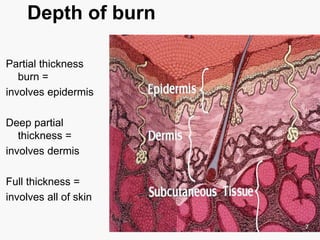
Depth of burn
Partial thickness
burn =
involves epidermis
Deep partial
thickness =
involves dermis
Full thickness =
involves all of skin
7
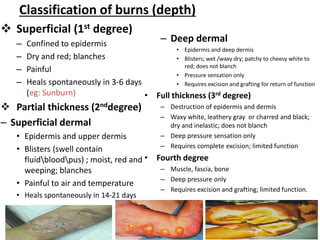
Classification of burns (depth)
– Deep dermal
• Epidermis and deep dermis
• Blisters; wet /waxy dry; patchy to cheesy white to
red; does not blanch
• Pressure sensation only
• Requires excision and grafting for return of function
• Full thickness (3rd degree)
– Destruction of epidermis and dermis
– Waxy white, leathery gray or charred and black;
dry and inelastic; does not blanch
– Deep pressure sensation only
– Requires complete excision; limited function
• Fourth degree
– Muscle, fascia, bone
– Deep pressure only
– Requires excision and grafting; limited function.
 Superficial (1st degree)
– Confined to epidermis
– Dry and red; blanches
– Painful
– Heals spontaneously in 3-6 days
(eg: Sunburn)
 Partial thickness (2nddegree)
– Superficial dermal
• Epidermis and upper dermis
• Blisters (swell contain
fluidbloodpus) ; moist, red and
weeping; blanches
• Painful to air and temperature
• Heals spontaneously in 14-21 days
8
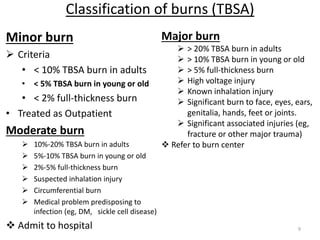
Classification of burns (TBSA)
Minor burn
 Criteria
• < 10% TBSA burn in adults
• < 5% TBSA burn in young or old
• < 2% full-thickness burn
• Treated as Outpatient
Moderate burn
 10%-20% TBSA burn in adults
 5%-10% TBSA burn in young or old
 2%-5% full-thickness burn
 Suspected inhalation injury
 Circumferential burn
 Medical problem predisposing to
infection (eg, DM, sickle cell disease)
 Admit to hospital
Major burn
 > 20% TBSA burn in adults
 > 10% TBSA burn in young or old
 > 5% full-thickness burn
 High voltage injury
 Known inhalation injury
 Significant burn to face, eyes, ears,
genitalia, hands, feet or joints.
 Significant associated injuries (eg,
fracture or other major trauma)
 Refer to burn center
9
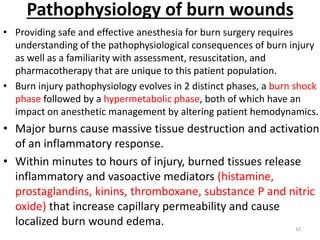
Pathophysiology of burn wounds
• Providing safe and effective anesthesia for burn surgery requires
understanding of the pathophysiological consequences of burn injury
as well as a familiarity with assessment, resuscitation, and
pharmacotherapy that are unique to this patient population.
• Burn injury pathophysiology evolves in 2 distinct phases, a burn shock
phase followed by a hypermetabolic phase, both of which have an
impact on anesthetic management by altering patient hemodynamics.
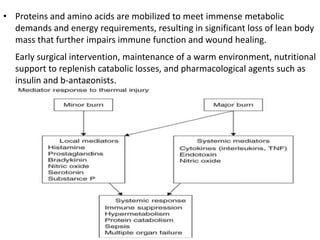
• Major burns cause massive tissue destruction and activation
of an inflammatory response.
• Within minutes to hours of injury, burned tissues release
inflammatory and vasoactive mediators (histamine,
prostaglandins, kinins, thromboxane, substance P and nitric
oxide) that increase capillary permeability and cause
localized burn wound edema. 10
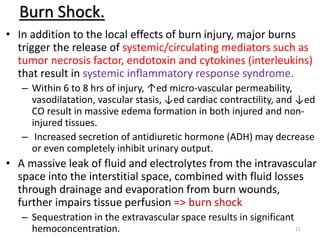
Burn Shock.
• In addition to the local effects of burn injury, major burns
trigger the release of systemic/circulating mediators such as
tumor necrosis factor, endotoxin and cytokines (interleukins)
that result in systemic inflammatory response syndrome.
– Within 6 to 8 hrs of injury, ↑ed micro-vascular permeability,
vasodilatation, vascular stasis, ↓ed cardiac contractility, and ↓ed
CO result in massive edema formation in both injured and non-
injured tissues.
– Increased secretion of antidiuretic hormone (ADH) may decrease
or even completely inhibit urinary output.
• A massive leak of fluid and electrolytes from the intravascular
space into the interstitial space, combined with fluid losses
through drainage and evaporation from burn wounds,
further impairs tissue perfusion => burn shock
– Sequestration in the extravascular space results in significant
hemoconcentration. 11
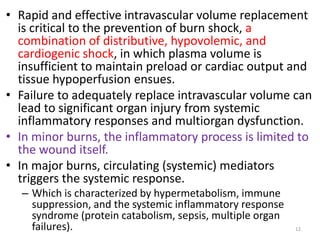
• Rapid and effective intravascular volume replacement
is critical to the prevention of burn shock, a
combination of distributive, hypovolemic, and
cardiogenic shock, in which plasma volume is
insufficient to maintain preload or cardiac output and
tissue hypoperfusion ensues.
• Failure to adequately replace intravascular volume can
lead to significant organ injury from systemic
inflammatory responses and multiorgan dysfunction.
• In minor burns, the inflammatory process is limited to
the wound itself.
• In major burns, circulating (systemic) mediators
triggers the systemic response.
– Which is characterized by hypermetabolism, immune
suppression, and the systemic inflammatory response
syndrome (protein catabolism, sepsis, multiple organ
failures). 12
Hypermetabolic Phase
• The hypermetabolic response to burns is more severe and
sustained than any other form of trauma.
• A massive surge in catecholamines and corticosteroids, 10
to 50 times greater than non-burned plasma levels, drives
the hypermetabolic response causing increased myocardial
oxygen consumption and cardiac work.
• Compensate for the large amounts of heat and water loss.
– Persistent tachycardia,
– systemic hypertension,
– increased muscle protein degradation,
– insulin resistance,
– elevated core temperature, and
– liver dysfunction are characteristic of this hyperdynamic phase
of burn injury.
• Hyperventilation occurs during the hypermetabolic phase
and persists until wound closure. 13
• Proteins and amino acids are mobilized to meet immense metabolic
demands and energy requirements, resulting in significant loss of lean body
mass that further impairs immune function and wound healing.
Early surgical intervention, maintenance of a warm environment, nutritional
support to replenish catabolic losses, and pharmacological agents such as
insulin and b-antagonists.
14
15
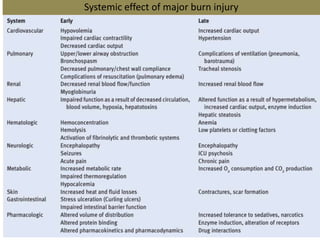
Systemic effect of major burn injury
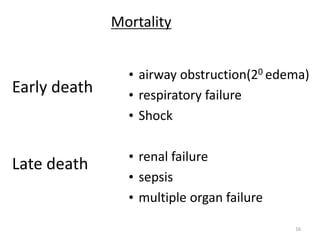
Mortality
Early death
Late death
• airway obstruction(20 edema)
• respiratory failure
• Shock
• renal failure
• sepsis
• multiple organ failure
194
16
General Approach
• Stop the burning
• ABCDE
• Determine area of burn
• Good IV access
• Early fluid replacement
• Prevent hypothermia
193
17
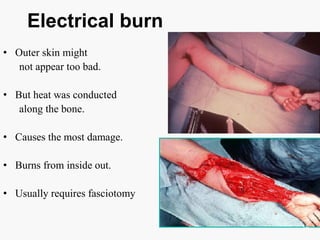
Electrical burn
• Outer skin might
not appear too bad.
• But heat was conducted
along the bone.
• Causes the most damage.
• Burns from inside out.
• Usually requires fasciotomy
18
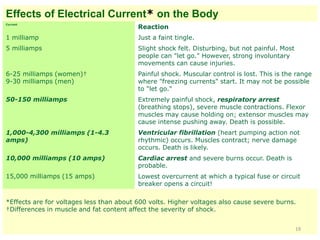
Effects of Electrical Current* on the Body
Current
Reaction
1 milliamp Just a faint tingle.
5 milliamps Slight shock felt. Disturbing, but not painful. Most
people can "let go." However, strong involuntary
movements can cause injuries.
6-25 milliamps (women)†
9-30 milliamps (men)
Painful shock. Muscular control is lost. This is the range
where "freezing currents" start. It may not be possible
to "let go."
50-150 milliamps Extremely painful shock, respiratory arrest
(breathing stops), severe muscle contractions. Flexor
muscles may cause holding on; extensor muscles may
cause intense pushing away. Death is possible.
1,000-4,300 milliamps (1-4.3
amps)
Ventricular fibrillation (heart pumping action not
rhythmic) occurs. Muscles contract; nerve damage
occurs. Death is likely.
10,000 milliamps (10 amps) Cardiac arrest and severe burns occur. Death is
probable.
15,000 milliamps (15 amps) Lowest overcurrent at which a typical fuse or circuit
breaker opens a circuit!
*Effects are for voltages less than about 600 volts. Higher voltages also cause severe burns.
†Differences in muscle and fat content affect the severity of shock.
19
Chemical burn
3 factors determine the severity
• Type of chemical and its concentration
Acid burns may penetrate deeply down to the bone
Alkali can cause deep dermal or full thickness burn
• Temperature
• Contact time
 At scene, cool the tar with cool water.
 Remove Particles from under the skin with forceps; debride.
 Must apply wet dressing to prevent re-igniting.
20
Inhalation Injury
Smoke inhalation injury results in 3 types
• Thermal injury mostly restricted to the upper airway,
• Chemical irritation of the respiratory tract, and
• Systemic toxicity due to the absorption of toxic gases such
as carbon monoxide.
• Heat destroys the epithelial layer, denatures proteins, and
activates the complement cascade leading to the release of
histamine and nitric oxide and the formation of xanthine
oxidase, which ultimately result in the production of reactive
oxygen species and reactive nitrogen species.
• both cause increased endothelium permeability that results in edema
formation
• Chemical injury from incomplete products of combustion (eg,
aldehydes and oxides of sulfur and nitrogen, hydrochloric acid
and carbon monoxide) is the primary cause for damage to the
tracheobronchial area and lung parenchyma.
21
• Destruction of bronchial epithelium results in
mucosal edema and sloughing, impaired
mucociliary clearance, interstitial edema,
inactivation of surfactant, and the formation of
endobronchial casts, which can lead to partial
or complete airway obstruction.==> lung
compliance ↓ed by 50%.
Suspect inhalational injury
• Fire in enclosed space
• Burns around mouth, face, nasal hair
• Respiratory distress
• Hoarseness, cough, stridor
• Ash in sputum
Consider early intubation
• ↑es Hoarseness
195
22
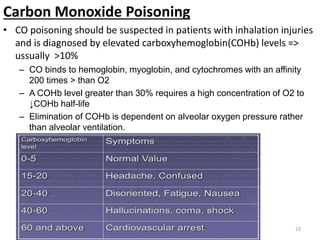
Carbon Monoxide Poisoning
• CO poisoning should be suspected in patients with inhalation injuries
and is diagnosed by elevated carboxyhemoglobin(COHb) levels =>
ussually >10%
– CO binds to hemoglobin, myoglobin, and cytochromes with an affinity
200 times > than O2
– A COHb level greater than 30% requires a high concentration of O2 to
↓COHb half-life
– Elimination of COHb is dependent on alveolar oxygen pressure rather
than alveolar ventilation.
23
• Treatment
– Awake: High flow O2 by mask, FiO2 100% until COHgb
<5% DO NOT DECREASE
• CO Half Life 240-360 Minutes breathing room air; 30-60
minutes breathing 100% Oxygen
– Obtunded: Intubate, FiO2 100% by ventilator.
• Hyperbaric Oxygen Chamber can be used if COHgb remains
elevated despite 100% O2
– 100% O2 displaces the CO from the Hgb
– Therapy Must base on ABGs and not O2 Sat if available.
24
Circulation-
Calculate fluid loss replacement from burn wound
• Goal
• Treat shock
• Calculate on going fluids loss based on size of burn
• Oral rehydration possible in smaller burns
• Maintain urinary output 0.5-1.0 ml/kg/hr
• Fluid resuscitation is required in burns greater than 20%
total body surface area (TBSA); in pediatrics >10% needs
fluid resuscitation.
Parkland formula:- calculated for the first 24 hours post-burn
2 - 4cc X wt in kg X TBSA % burn=>over 1st
24hrs
 Administer half of this over 8hrs, and the remaining over the rest
hrs (i.e 16hrs) + maintenance fluid
How do we know if this is too much fluid, or too little?
25
Monitor at least: Check UOP, urine specific gravity,
Hct, Blood Lactate Levels < 2mmol/l
 Expected urine output - in adults: around 50 cc / hr
- for child: 1 cc / kg /hr
- for infant: 2 cc/ kg / hr
Decreasing urine output = need for more fluids.
• If >40%TBSA burn, add 1amp bicarbonate to
each liter.
Q-E.g: A100 kg patient sustain burn come with 50% TBSA;
what is fluid requirement for the first 8hr of first 24 hrs post-
burn ???
26
Crystalloid vs Colloid ??
• In a burn injury the capillary integrity is compromised, leading to a
loss of serum albumin.
• Integrity is usually restored within16-24 hours
• Crystalloid: just as effective as colloid in the first 24 hours post
burn
• Colloid may be more beneficial in the second day post burn once
capillary integrity is restored.
 In patients with large burns, do not initially spend much time
carefully calculating fluids.
 Instead, start an IV fluids => 500cc/hr is a good rule until
calculated.
27
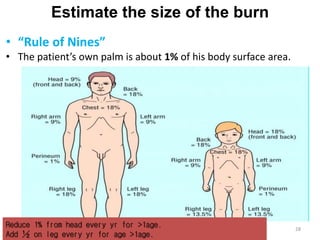
Estimate the size of the burn
• “Rule of Nines”
• The patient’s own palm is about 1% of his body surface area.
Reduce 1% from head every yr for >1age.
Add ½ on leg every yr for age >1age.
28
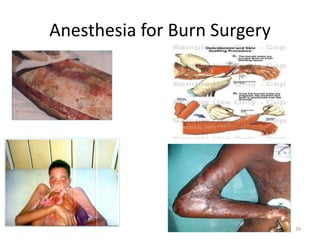
Anesthesia for Burn Surgery
29
Challenging’s/ problems
1. Difficult airway management
2. Inadequate resuscitated patient
3. Difficulty in establishing IV access
4. Hyperkalemic response to scoline
5. Resistance to non-depolarizing muscle relaxant
6. Significant blood and plasma loss
7. Patient positioning
8. Hypothermia
9. Postoperative analgesia
30
1. Emphasis on the following:
– extent & site of burn
– extent & site of proposed surgery
– Volume status
– Airway, ease of intubation
– Associated injury
– Evidence of infection
2. Mechanism of injury (flame, explosion, chemical, electrical,
scald) and time elapsed since injury
3. Vascular access and adequacy of resuscitation (current fluid
requirements, urine output)
4. Surgical plan (patient positioning, estimate of areas to be
excised, and donor sites to harvest) and previous anesthetic
records
5. Review latest I(x), correct abnormalities, GXM for blood
and plasma
6. Premedication in suitable patient
Preoperative Evaluation of the Patient With Major Burn Injuries.
31
Intraop management
1. Prepare for difficult intubation if the burn area involved
head and neck region
2. Means to reduce heat loss:
- warming blanket
- blood warmers
- humidifiers
3. Monitors:
- ECG, BP, SpO2, ETCO2, CVP, urine output
- maybe difficult to place because of the burn area involved
- Invasive BP may be indicated if the surgery is extensive
and there is no suitable site for placement of
sphygmomanometer cuff.
32
Altered pharmacokinetics
 Volume of distribution increases for water soluble drugs
(resistance to non-depolarizing agents occurs.)
 Because of ↑sed extracellular fluid: intracellular fluid ratio
 Albumin falls - less protein binding ==>
 Because of hyper catabolism state.
 Increased metabolic rate / temperature leading to altered half
life.
 Burn injury causes proliferation of extrajunctional nicotinic
acetylcholine receptors leading to increased resistance to
nondepolarizing muscle relaxants and increased sensitivity to
depolarizing muscle relaxants (ie, succinylcholine).
33
Anaethesia management
• Most patients receive a general anesthetic - Balanced
anesthesia
– Large portions of the body are involved
– Burn injury covers regional injection sites
– Undetermined duration &/ positioning of surgery.
• Smaller lower extremity burns can utilize a regional
technique.
– Must be able to provide anesthesia to the surgical and graft site
34
Induction.
• Balanced general anesthesia consisting of an opioid, muscle
relaxant, and volatile agent is the most common anesthetic
technique used for burn excision and grafting.
• Propofol and thiopental have been used successfully for
induction, though they should be carefully titrated to minimize
dose dependent cardiac and respiratory depression.
• Thiopental requirements are ↑sed in children for more than 1
year after burn injuries
– Significant when burned area is more than 15% BSA
• No change in pharmacology of propofol
• Etomidate is a good choice for patients who are
hemodynamically unstable.
• Ketamine offers many advantages for induction and
maintenance of anesthesia for burn-injured patients and is
routinely used for burn-related procedures
=> sympathomimetic(↑ed HR & BP) & analgesic. 35
Opioids
 The foremost cause of inadequate pain relief in burn patient is
undermedication.
 Strong opioids could be used much more effectively in burn
patients, and their dosage reduced by co-administering drugs that
block nociceptive or inflammatory afferent input, glutamate
release.
 Dose requirement of opioids in burn patient is increased
↓
altered pharmacokinetics or altered pharmacodynamics ?????
 Moreover, the functioning of the body's endogenous system of
endorphins may alter the response to exogenous opioids.
36
Muscle relaxant
• Burn injury causes proliferation of extrajunctional
nicotinic acetylcholine receptors
– resistance to NDMR And; may require a 2- to 5-fold
greater dose (rocuronium 1.2mg/kg)
– increased sensitivity to depolarizing muscle relaxants
– Administration of succinylcholine greater than 24 hours
post burn injury may result in a potentially lethal
hyperkalemic => massive release of K+ from cell.
 ↑es with increasing dose, TBSA burned, and the amount of
time elapsed since burn injury
– The response may persist for up to 18 months after
burn injury, during which time succinylcholine should be
avoided. 37
Succinylcholine
• There are no reports in the literature of
succinylcholine-induced hyperkalemia in humans
occurring within 1 week after a burn injury
• The upregulation of acetylcholine receptors
(AChRs) after burns occurs at sites immediately
beneath and distant from the burn
• a positive correlation between AChR number and
the intensity of the hyperkalemia after
succinylcholine has been confirmed and occurs as
early as 72 h after burn
• succinylcholine is probably safe up to 48 h after
burn injury, but it may be wise to avoid it beyond
that period
38
Intubation
• BE READY FOR ANYTHING
 DL
 LMA
 Video Laryngoscopy
 Awake FOB
 Intubating LMA
 All patients with face, neck, and upper chest burns are considered
potential difficult airways due to facial and airway edema that may
distort the normal anatomy and/or limit neck and mandibular
mobility.
 Mask ventilation after anesthetic induction may be challenging and
intubation may be impossible.
 Fiber-optic intubation in the awake and spontaneously breathing
adult patient
 may be the safest and most efficacious option for patients with a
suspected difficult airway and can be facilitated with topical
anesthesia and sedation.
– Cuffed endotracheal tubes (ETTs) are the standard of care for burn-injured patients
39
Maintenance
• Volatile anesthetics are routinely used during
maintenance of adult patients and for induction and
maintenance of pediatric patients.
– Its bronchodilatory effect is advantageous in patients with inhalation
injuries.
– Dose-dependent vasodilation and cardiac depression may limit its use.
• Anesthetic agents including fentanyl, sufentanil, propofol,
ketamine, and midazolam may be used as continuous infusions
to provide anesthesia for surgical procedures in HDU patients.
• Otherwise;
– Isoflurane is agent of choice
– Halothane is not suitable as it’s rare possibility of
– halothane hepatitis
– sevoflurane should be used in burns surgery as a routine anaesthetic
for pediatrics.
40
• Blood loss during burn wound excision and grafting
can be deceptively large.
– It is not difficult for the surgical team to remove eschar
so rapidly that the patient becomes hypovolemic and
unstable.
– Good communication between the surgical and
anesthesia teams as well as limiting the operative
duration and extent of excision can prevent such
problems ==> usually not > 20% body surface area at a
time.
41
Post operative pain management
• Burn injuries are intensely painful due to direct
tissue injury and inflammation-mediated
hyperalgesia.
• The following aspect should be taken care:
- oxygen therapy
- analgesia
- temperature: radiant heater, warming
blanket
- fluid and blood transfusion
42
• Preemptive /multimodal analgesia uses two or more
drugs with different mechanisms of action
– (e.g., local anesthetics, NSAIDs, and opioids) applied before,
during, and after surgery to different targets (at the
periphery or centrally), along with nonpharmacological
techniques to reduce stress and anxiety.
– To improve analgesic efficacy and reduce drug side effects in
postoperative patients
• Acetaminophen or NSAIDs with one of strong opioids
could be a basic treatment for burn pain
• NSAIDs are not recommended in burn patients who
undergo extensive excision and grafting procedures
because their antiplatelet effects may increase blood
loss.
– Newer NSAIDs, the cyclooxygenase-2 (COX-2) inhibitors, offer analgesia
with few side effects. 43
• The finding of opioid receptors on peripheral nerve
terminals in inflammatory states such as thermal
injuries suggests that the peripheral administration
of opioids may decrease burn pain .
• NMDA-receptor antagonism may offer specific
advantages in treating post-burn hyperalgesia and
lessening opioid dose escalation.
• Epidural bupivacaine + morphine – effective in
relief of pain and improve circulation
• Epidural morphine reduces incidence of
hyperalgesia in burn patient
44
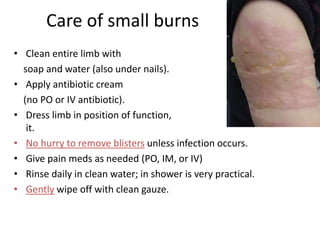
Care of small burns
• Clean entire limb with
soap and water (also under nails).
• Apply antibiotic cream
(no PO or IV antibiotic).
• Dress limb in position of function, and elevate
it.
• No hurry to remove blisters unless infection occurs.
• Give pain meds as needed (PO, IM, or IV)
• Rinse daily in clean water; in shower is very practical.
• Gently wipe off with clean gauze.

Anaesthetic-Management-of-Burns.pptx

  • 1.
    Anesthesia-Management-of-Burn patient Objectives; At the endof this session students be able to;  Understand the pathophysiology of burn  Identify and adequately resuscitate for those patients in need.  Provide safe anesthesia management
  • 2.
    Introduction • The skinis the largest organ of the human body. It has four principal functions: – The skin contains the majority of sensory nerve endings and, hence, is a sensory organ. – The skin performs a major role in thermoregulation and helps maintain body temperature within a relatively narrow range. – Intact skin prevents a loss of body fluids. – It is a barrier against microorganisms. • With loss of intact skin, burned patients become hypothermic, experience significant water loss, and are at great risk for infection and sepsis. 2
  • 3.
    • Burns areamong the most devastating injuries encountered in medicine. • Approximately 2.4 million burn injuries per year • Average 75,000 require hospitalization • Between 8,000 and 12,000 patients die from burn injuries each year • It’s the 2nd cause of accidental deaths • According to the CDC and Prevention, someone dies in US in a fire every 175 minutes and is injured every 31 minutes. 3
  • 4.
    • Groups withan increased risk of fire-related injury and death include – children under 5 and adults more than 65 years of age, – Socio-economic status (poor); overcrowding and lack of proper safety measures; – occupations that increase exposure to fire (females with open fire cooking); – underlying medical conditions, including epilepsy, peripheral neuropathy, and physical and cognitive disabilities; – alcohol abuse; smoking; and easy access to chemicals used for assault (such as in acid violence attacks); – use of kerosene (paraffin) as a fuel source for non-electric domestic appliances; 4
  • 5.
    Causes of BurnInjuries • Thermal • Electrical • Chemical • Radiation • Cold Injuries • Inhalation • Thermal Injuries (most common) – Contact • Direct contact with hot object (pan or iron) • Anything that sticks to skin (tar, grease or foods) – Scalding • Direct contact with hot liquid / vapors (moist heat) – i.e. cooking, bathing or car radiator overheating • Single most common injury in the pediatric client – Flame • Direct contact with flame (dry heat) – i.e. structural fires / clothing catching on fire
  • 6.
    • Electrical – Contactwith an electrical current • i.e. open wiring or being struck by lightening – Pediatrics: chewing on electrical cord or placing object in outlet – Require some different management • Chemical – Strong acids or alkaloids • i.e. household cleaning products – Management specific to chemical involved • Radiation – Prolonged exposure to ultraviolet rays of the sun • occupational or medical therapies • Cold Injuries – Frostbite • Don’t forget all burns not from heat !! – Injury due to freezing & refreezing of intracellular fluid – Ice crystals puncture the cells and destroy tissue – Can result in amputation • Inhalation Injuries – Suspect inhalation injury when: • Burn occurred within a closed space • Burns to face or neck • Singed nasal hair or eyebrows • Hoarseness, voice changes, wheezing or stridor • Sooty sputum • Brassy cough or drooling • Labored breathing or tachypnea • Erythema and blistering of oral or pharyngeal mucousa – Often requires intubation & mechanical ventilation 6
  • 7.
    Depth of burn Partialthickness burn = involves epidermis Deep partial thickness = involves dermis Full thickness = involves all of skin 7
  • 8.
    Classification of burns(depth) – Deep dermal • Epidermis and deep dermis • Blisters; wet /waxy dry; patchy to cheesy white to red; does not blanch • Pressure sensation only • Requires excision and grafting for return of function • Full thickness (3rd degree) – Destruction of epidermis and dermis – Waxy white, leathery gray or charred and black; dry and inelastic; does not blanch – Deep pressure sensation only – Requires complete excision; limited function • Fourth degree – Muscle, fascia, bone – Deep pressure only – Requires excision and grafting; limited function.  Superficial (1st degree) – Confined to epidermis – Dry and red; blanches – Painful – Heals spontaneously in 3-6 days (eg: Sunburn)  Partial thickness (2nddegree) – Superficial dermal • Epidermis and upper dermis • Blisters (swell contain fluidbloodpus) ; moist, red and weeping; blanches • Painful to air and temperature • Heals spontaneously in 14-21 days 8
  • 9.
    Classification of burns(TBSA) Minor burn  Criteria • < 10% TBSA burn in adults • < 5% TBSA burn in young or old • < 2% full-thickness burn • Treated as Outpatient Moderate burn  10%-20% TBSA burn in adults  5%-10% TBSA burn in young or old  2%-5% full-thickness burn  Suspected inhalation injury  Circumferential burn  Medical problem predisposing to infection (eg, DM, sickle cell disease)  Admit to hospital Major burn  > 20% TBSA burn in adults  > 10% TBSA burn in young or old  > 5% full-thickness burn  High voltage injury  Known inhalation injury  Significant burn to face, eyes, ears, genitalia, hands, feet or joints.  Significant associated injuries (eg, fracture or other major trauma)  Refer to burn center 9
  • 10.
    Pathophysiology of burnwounds • Providing safe and effective anesthesia for burn surgery requires understanding of the pathophysiological consequences of burn injury as well as a familiarity with assessment, resuscitation, and pharmacotherapy that are unique to this patient population. • Burn injury pathophysiology evolves in 2 distinct phases, a burn shock phase followed by a hypermetabolic phase, both of which have an impact on anesthetic management by altering patient hemodynamics. • Major burns cause massive tissue destruction and activation of an inflammatory response. • Within minutes to hours of injury, burned tissues release inflammatory and vasoactive mediators (histamine, prostaglandins, kinins, thromboxane, substance P and nitric oxide) that increase capillary permeability and cause localized burn wound edema. 10
  • 11.
    Burn Shock. • Inaddition to the local effects of burn injury, major burns trigger the release of systemic/circulating mediators such as tumor necrosis factor, endotoxin and cytokines (interleukins) that result in systemic inflammatory response syndrome. – Within 6 to 8 hrs of injury, ↑ed micro-vascular permeability, vasodilatation, vascular stasis, ↓ed cardiac contractility, and ↓ed CO result in massive edema formation in both injured and non- injured tissues. – Increased secretion of antidiuretic hormone (ADH) may decrease or even completely inhibit urinary output. • A massive leak of fluid and electrolytes from the intravascular space into the interstitial space, combined with fluid losses through drainage and evaporation from burn wounds, further impairs tissue perfusion => burn shock – Sequestration in the extravascular space results in significant hemoconcentration. 11
  • 12.
    • Rapid andeffective intravascular volume replacement is critical to the prevention of burn shock, a combination of distributive, hypovolemic, and cardiogenic shock, in which plasma volume is insufficient to maintain preload or cardiac output and tissue hypoperfusion ensues. • Failure to adequately replace intravascular volume can lead to significant organ injury from systemic inflammatory responses and multiorgan dysfunction. • In minor burns, the inflammatory process is limited to the wound itself. • In major burns, circulating (systemic) mediators triggers the systemic response. – Which is characterized by hypermetabolism, immune suppression, and the systemic inflammatory response syndrome (protein catabolism, sepsis, multiple organ failures). 12
  • 13.
    Hypermetabolic Phase • Thehypermetabolic response to burns is more severe and sustained than any other form of trauma. • A massive surge in catecholamines and corticosteroids, 10 to 50 times greater than non-burned plasma levels, drives the hypermetabolic response causing increased myocardial oxygen consumption and cardiac work. • Compensate for the large amounts of heat and water loss. – Persistent tachycardia, – systemic hypertension, – increased muscle protein degradation, – insulin resistance, – elevated core temperature, and – liver dysfunction are characteristic of this hyperdynamic phase of burn injury. • Hyperventilation occurs during the hypermetabolic phase and persists until wound closure. 13
  • 14.
    • Proteins andamino acids are mobilized to meet immense metabolic demands and energy requirements, resulting in significant loss of lean body mass that further impairs immune function and wound healing. Early surgical intervention, maintenance of a warm environment, nutritional support to replenish catabolic losses, and pharmacological agents such as insulin and b-antagonists. 14
  • 15.
    15 Systemic effect ofmajor burn injury
  • 16.
    Mortality Early death Late death •airway obstruction(20 edema) • respiratory failure • Shock • renal failure • sepsis • multiple organ failure 194 16
  • 17.
    General Approach • Stopthe burning • ABCDE • Determine area of burn • Good IV access • Early fluid replacement • Prevent hypothermia 193 17
  • 18.
    Electrical burn • Outerskin might not appear too bad. • But heat was conducted along the bone. • Causes the most damage. • Burns from inside out. • Usually requires fasciotomy 18
  • 19.
    Effects of ElectricalCurrent* on the Body Current Reaction 1 milliamp Just a faint tingle. 5 milliamps Slight shock felt. Disturbing, but not painful. Most people can "let go." However, strong involuntary movements can cause injuries. 6-25 milliamps (women)† 9-30 milliamps (men) Painful shock. Muscular control is lost. This is the range where "freezing currents" start. It may not be possible to "let go." 50-150 milliamps Extremely painful shock, respiratory arrest (breathing stops), severe muscle contractions. Flexor muscles may cause holding on; extensor muscles may cause intense pushing away. Death is possible. 1,000-4,300 milliamps (1-4.3 amps) Ventricular fibrillation (heart pumping action not rhythmic) occurs. Muscles contract; nerve damage occurs. Death is likely. 10,000 milliamps (10 amps) Cardiac arrest and severe burns occur. Death is probable. 15,000 milliamps (15 amps) Lowest overcurrent at which a typical fuse or circuit breaker opens a circuit! *Effects are for voltages less than about 600 volts. Higher voltages also cause severe burns. †Differences in muscle and fat content affect the severity of shock. 19
  • 20.
    Chemical burn 3 factorsdetermine the severity • Type of chemical and its concentration Acid burns may penetrate deeply down to the bone Alkali can cause deep dermal or full thickness burn • Temperature • Contact time  At scene, cool the tar with cool water.  Remove Particles from under the skin with forceps; debride.  Must apply wet dressing to prevent re-igniting. 20
  • 21.
    Inhalation Injury Smoke inhalationinjury results in 3 types • Thermal injury mostly restricted to the upper airway, • Chemical irritation of the respiratory tract, and • Systemic toxicity due to the absorption of toxic gases such as carbon monoxide. • Heat destroys the epithelial layer, denatures proteins, and activates the complement cascade leading to the release of histamine and nitric oxide and the formation of xanthine oxidase, which ultimately result in the production of reactive oxygen species and reactive nitrogen species. • both cause increased endothelium permeability that results in edema formation • Chemical injury from incomplete products of combustion (eg, aldehydes and oxides of sulfur and nitrogen, hydrochloric acid and carbon monoxide) is the primary cause for damage to the tracheobronchial area and lung parenchyma. 21
  • 22.
    • Destruction ofbronchial epithelium results in mucosal edema and sloughing, impaired mucociliary clearance, interstitial edema, inactivation of surfactant, and the formation of endobronchial casts, which can lead to partial or complete airway obstruction.==> lung compliance ↓ed by 50%. Suspect inhalational injury • Fire in enclosed space • Burns around mouth, face, nasal hair • Respiratory distress • Hoarseness, cough, stridor • Ash in sputum Consider early intubation • ↑es Hoarseness 195 22
  • 23.
    Carbon Monoxide Poisoning •CO poisoning should be suspected in patients with inhalation injuries and is diagnosed by elevated carboxyhemoglobin(COHb) levels => ussually >10% – CO binds to hemoglobin, myoglobin, and cytochromes with an affinity 200 times > than O2 – A COHb level greater than 30% requires a high concentration of O2 to ↓COHb half-life – Elimination of COHb is dependent on alveolar oxygen pressure rather than alveolar ventilation. 23
  • 24.
    • Treatment – Awake:High flow O2 by mask, FiO2 100% until COHgb <5% DO NOT DECREASE • CO Half Life 240-360 Minutes breathing room air; 30-60 minutes breathing 100% Oxygen – Obtunded: Intubate, FiO2 100% by ventilator. • Hyperbaric Oxygen Chamber can be used if COHgb remains elevated despite 100% O2 – 100% O2 displaces the CO from the Hgb – Therapy Must base on ABGs and not O2 Sat if available. 24
  • 25.
    Circulation- Calculate fluid lossreplacement from burn wound • Goal • Treat shock • Calculate on going fluids loss based on size of burn • Oral rehydration possible in smaller burns • Maintain urinary output 0.5-1.0 ml/kg/hr • Fluid resuscitation is required in burns greater than 20% total body surface area (TBSA); in pediatrics >10% needs fluid resuscitation. Parkland formula:- calculated for the first 24 hours post-burn 2 - 4cc X wt in kg X TBSA % burn=>over 1st 24hrs  Administer half of this over 8hrs, and the remaining over the rest hrs (i.e 16hrs) + maintenance fluid How do we know if this is too much fluid, or too little? 25
  • 26.
    Monitor at least:Check UOP, urine specific gravity, Hct, Blood Lactate Levels < 2mmol/l  Expected urine output - in adults: around 50 cc / hr - for child: 1 cc / kg /hr - for infant: 2 cc/ kg / hr Decreasing urine output = need for more fluids. • If >40%TBSA burn, add 1amp bicarbonate to each liter. Q-E.g: A100 kg patient sustain burn come with 50% TBSA; what is fluid requirement for the first 8hr of first 24 hrs post- burn ??? 26
  • 27.
    Crystalloid vs Colloid?? • In a burn injury the capillary integrity is compromised, leading to a loss of serum albumin. • Integrity is usually restored within16-24 hours • Crystalloid: just as effective as colloid in the first 24 hours post burn • Colloid may be more beneficial in the second day post burn once capillary integrity is restored.  In patients with large burns, do not initially spend much time carefully calculating fluids.  Instead, start an IV fluids => 500cc/hr is a good rule until calculated. 27
  • 28.
    Estimate the sizeof the burn • “Rule of Nines” • The patient’s own palm is about 1% of his body surface area. Reduce 1% from head every yr for >1age. Add ½ on leg every yr for age >1age. 28
  • 29.
  • 30.
    Challenging’s/ problems 1. Difficultairway management 2. Inadequate resuscitated patient 3. Difficulty in establishing IV access 4. Hyperkalemic response to scoline 5. Resistance to non-depolarizing muscle relaxant 6. Significant blood and plasma loss 7. Patient positioning 8. Hypothermia 9. Postoperative analgesia 30
  • 31.
    1. Emphasis onthe following: – extent & site of burn – extent & site of proposed surgery – Volume status – Airway, ease of intubation – Associated injury – Evidence of infection 2. Mechanism of injury (flame, explosion, chemical, electrical, scald) and time elapsed since injury 3. Vascular access and adequacy of resuscitation (current fluid requirements, urine output) 4. Surgical plan (patient positioning, estimate of areas to be excised, and donor sites to harvest) and previous anesthetic records 5. Review latest I(x), correct abnormalities, GXM for blood and plasma 6. Premedication in suitable patient Preoperative Evaluation of the Patient With Major Burn Injuries. 31
  • 32.
    Intraop management 1. Preparefor difficult intubation if the burn area involved head and neck region 2. Means to reduce heat loss: - warming blanket - blood warmers - humidifiers 3. Monitors: - ECG, BP, SpO2, ETCO2, CVP, urine output - maybe difficult to place because of the burn area involved - Invasive BP may be indicated if the surgery is extensive and there is no suitable site for placement of sphygmomanometer cuff. 32
  • 33.
    Altered pharmacokinetics  Volumeof distribution increases for water soluble drugs (resistance to non-depolarizing agents occurs.)  Because of ↑sed extracellular fluid: intracellular fluid ratio  Albumin falls - less protein binding ==>  Because of hyper catabolism state.  Increased metabolic rate / temperature leading to altered half life.  Burn injury causes proliferation of extrajunctional nicotinic acetylcholine receptors leading to increased resistance to nondepolarizing muscle relaxants and increased sensitivity to depolarizing muscle relaxants (ie, succinylcholine). 33
  • 34.
    Anaethesia management • Mostpatients receive a general anesthetic - Balanced anesthesia – Large portions of the body are involved – Burn injury covers regional injection sites – Undetermined duration &/ positioning of surgery. • Smaller lower extremity burns can utilize a regional technique. – Must be able to provide anesthesia to the surgical and graft site 34
  • 35.
    Induction. • Balanced generalanesthesia consisting of an opioid, muscle relaxant, and volatile agent is the most common anesthetic technique used for burn excision and grafting. • Propofol and thiopental have been used successfully for induction, though they should be carefully titrated to minimize dose dependent cardiac and respiratory depression. • Thiopental requirements are ↑sed in children for more than 1 year after burn injuries – Significant when burned area is more than 15% BSA • No change in pharmacology of propofol • Etomidate is a good choice for patients who are hemodynamically unstable. • Ketamine offers many advantages for induction and maintenance of anesthesia for burn-injured patients and is routinely used for burn-related procedures => sympathomimetic(↑ed HR & BP) & analgesic. 35
  • 36.
    Opioids  The foremostcause of inadequate pain relief in burn patient is undermedication.  Strong opioids could be used much more effectively in burn patients, and their dosage reduced by co-administering drugs that block nociceptive or inflammatory afferent input, glutamate release.  Dose requirement of opioids in burn patient is increased ↓ altered pharmacokinetics or altered pharmacodynamics ?????  Moreover, the functioning of the body's endogenous system of endorphins may alter the response to exogenous opioids. 36
  • 37.
    Muscle relaxant • Burninjury causes proliferation of extrajunctional nicotinic acetylcholine receptors – resistance to NDMR And; may require a 2- to 5-fold greater dose (rocuronium 1.2mg/kg) – increased sensitivity to depolarizing muscle relaxants – Administration of succinylcholine greater than 24 hours post burn injury may result in a potentially lethal hyperkalemic => massive release of K+ from cell.  ↑es with increasing dose, TBSA burned, and the amount of time elapsed since burn injury – The response may persist for up to 18 months after burn injury, during which time succinylcholine should be avoided. 37
  • 38.
    Succinylcholine • There areno reports in the literature of succinylcholine-induced hyperkalemia in humans occurring within 1 week after a burn injury • The upregulation of acetylcholine receptors (AChRs) after burns occurs at sites immediately beneath and distant from the burn • a positive correlation between AChR number and the intensity of the hyperkalemia after succinylcholine has been confirmed and occurs as early as 72 h after burn • succinylcholine is probably safe up to 48 h after burn injury, but it may be wise to avoid it beyond that period 38
  • 39.
    Intubation • BE READYFOR ANYTHING  DL  LMA  Video Laryngoscopy  Awake FOB  Intubating LMA  All patients with face, neck, and upper chest burns are considered potential difficult airways due to facial and airway edema that may distort the normal anatomy and/or limit neck and mandibular mobility.  Mask ventilation after anesthetic induction may be challenging and intubation may be impossible.  Fiber-optic intubation in the awake and spontaneously breathing adult patient  may be the safest and most efficacious option for patients with a suspected difficult airway and can be facilitated with topical anesthesia and sedation. – Cuffed endotracheal tubes (ETTs) are the standard of care for burn-injured patients 39
  • 40.
    Maintenance • Volatile anestheticsare routinely used during maintenance of adult patients and for induction and maintenance of pediatric patients. – Its bronchodilatory effect is advantageous in patients with inhalation injuries. – Dose-dependent vasodilation and cardiac depression may limit its use. • Anesthetic agents including fentanyl, sufentanil, propofol, ketamine, and midazolam may be used as continuous infusions to provide anesthesia for surgical procedures in HDU patients. • Otherwise; – Isoflurane is agent of choice – Halothane is not suitable as it’s rare possibility of – halothane hepatitis – sevoflurane should be used in burns surgery as a routine anaesthetic for pediatrics. 40
  • 41.
    • Blood lossduring burn wound excision and grafting can be deceptively large. – It is not difficult for the surgical team to remove eschar so rapidly that the patient becomes hypovolemic and unstable. – Good communication between the surgical and anesthesia teams as well as limiting the operative duration and extent of excision can prevent such problems ==> usually not > 20% body surface area at a time. 41
  • 42.
    Post operative painmanagement • Burn injuries are intensely painful due to direct tissue injury and inflammation-mediated hyperalgesia. • The following aspect should be taken care: - oxygen therapy - analgesia - temperature: radiant heater, warming blanket - fluid and blood transfusion 42
  • 43.
    • Preemptive /multimodalanalgesia uses two or more drugs with different mechanisms of action – (e.g., local anesthetics, NSAIDs, and opioids) applied before, during, and after surgery to different targets (at the periphery or centrally), along with nonpharmacological techniques to reduce stress and anxiety. – To improve analgesic efficacy and reduce drug side effects in postoperative patients • Acetaminophen or NSAIDs with one of strong opioids could be a basic treatment for burn pain • NSAIDs are not recommended in burn patients who undergo extensive excision and grafting procedures because their antiplatelet effects may increase blood loss. – Newer NSAIDs, the cyclooxygenase-2 (COX-2) inhibitors, offer analgesia with few side effects. 43
  • 44.
    • The findingof opioid receptors on peripheral nerve terminals in inflammatory states such as thermal injuries suggests that the peripheral administration of opioids may decrease burn pain . • NMDA-receptor antagonism may offer specific advantages in treating post-burn hyperalgesia and lessening opioid dose escalation. • Epidural bupivacaine + morphine – effective in relief of pain and improve circulation • Epidural morphine reduces incidence of hyperalgesia in burn patient 44
  • 45.
    Care of smallburns • Clean entire limb with soap and water (also under nails). • Apply antibiotic cream (no PO or IV antibiotic). • Dress limb in position of function, and elevate it. • No hurry to remove blisters unless infection occurs. • Give pain meds as needed (PO, IM, or IV) • Rinse daily in clean water; in shower is very practical. • Gently wipe off with clean gauze.