An Overview of
Machine Learning
Speaker: Yi-Fan Chang
Adviser: Prof. J. J. Ding
Date: 2011/10/21
 What is machine learning?
 Learning system model
 Training and testing
 Performance
 Algorithms
 Machine learning structure
 What are we seeking?
 Learning techniques
 Applications
 Conclusion
Outline & Content
 A branch of artificial intelligence, concerned with the
design and development of algorithms that allow
computers to evolve behaviors based on empirical data.
 As intelligence requires knowledge, it is necessary for
the computers to acquire knowledge.
What is machine learning?
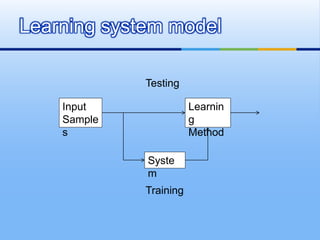
Learning system model
Input
Sample
s
Learnin
g
Method
Syste
m
Training
Testing
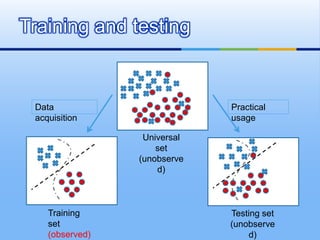
Training and testing
Training
set
(observed)
Universal
set
(unobserve
d)
Testing set
(unobserve
d)
Data
acquisition
Practical
usage
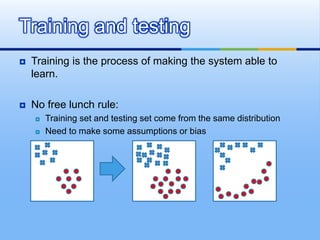
 Training is the process of making the system able to
learn.
 No free lunch rule:
 Training set and testing set come from the same distribution
 Need to make some assumptions or bias
Training and testing
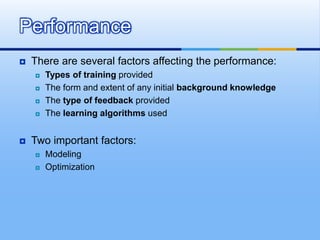
 There are several factors affecting the performance:
 Types of training provided
 The form and extent of any initial background knowledge
 The type of feedback provided
 The learning algorithms used
 Two important factors:
 Modeling
 Optimization
Performance
 The success of machine learning system also depends
on the algorithms.
 The algorithms control the search to find and build the
knowledge structures.
 The learning algorithms should extract useful information
from training examples.
Algorithms
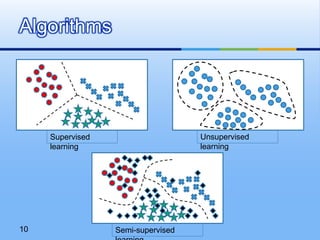
 Supervised learning ( )
 Prediction
 Classification (discrete labels), Regression (real values)
 Unsupervised learning ( )
 Clustering
 Probability distribution estimation
 Finding association (in features)
 Dimension reduction
 Semi-supervised learning
 Reinforcement learning
 Decision making (robot, chess machine)
Algorithms
10
Algorithms
Supervised
learning
Unsupervised
learning
Semi-supervised
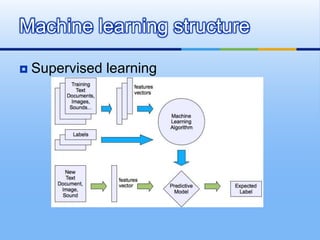
 Supervised learning
Machine learning structure
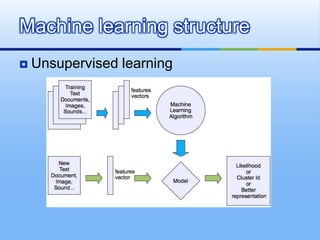
 Unsupervised learning
Machine learning structure
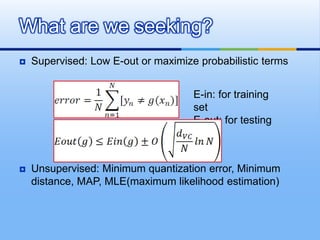
 Supervised: Low E-out or maximize probabilistic terms
 Unsupervised: Minimum quantization error, Minimum
distance, MAP, MLE(maximum likelihood estimation)
What are we seeking?
E-in: for training
set
E-out: for testing
set
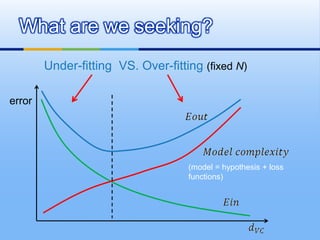
Under-fitting VS. Over-fitting (fixed N)
What are we seeking?
error
(model = hypothesis + loss
functions)
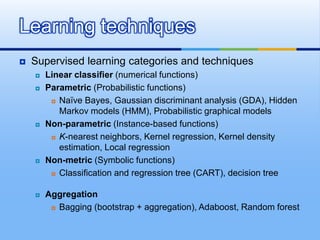
 Supervised learning categories and techniques
 Linear classifier (numerical functions)
 Parametric (Probabilistic functions)
 Naïve Bayes, Gaussian discriminant analysis (GDA), Hidden
Markov models (HMM), Probabilistic graphical models
 Non-parametric (Instance-based functions)
 K-nearest neighbors, Kernel regression, Kernel density
estimation, Local regression
 Non-metric (Symbolic functions)
 Classification and regression tree (CART), decision tree
 Aggregation
 Bagging (bootstrap + aggregation), Adaboost, Random forest
Learning techniques
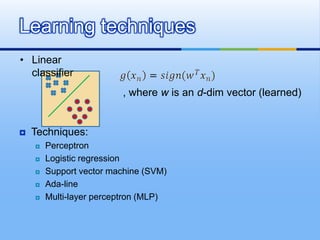
 Techniques:
 Perceptron
 Logistic regression
 Support vector machine (SVM)
 Ada-line
 Multi-layer perceptron (MLP)
Learning techniques
, where w is an d-dim vector (learned)
• Linear
classifier
Learning techniques
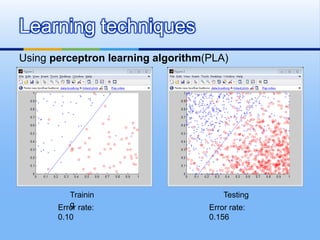
Using perceptron learning algorithm(PLA)
Trainin
g
Testing
Error rate:
0.10
Error rate:
0.156
Learning techniques
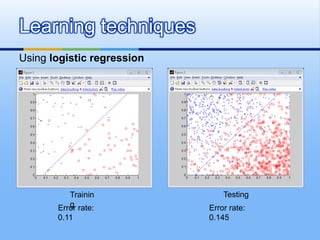
Using logistic regression
Trainin
g
Testing
Error rate:
0.11
Error rate:
0.145
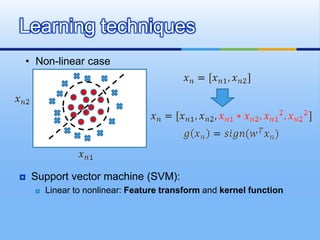
 Support vector machine (SVM):
 Linear to nonlinear: Feature transform and kernel function
Learning techniques
• Non-linear case
 Unsupervised learning categories and techniques
 Clustering
 K-means clustering
 Spectral clustering
 Density Estimation
 Gaussian mixture model (GMM)
 Graphical models
 Dimensionality reduction
 Principal component analysis (PCA)
 Factor analysis
Learning techniques
 Face detection
 Object detection and recognition
 Image segmentation
 Multimedia event detection
 Economical and commercial usage
Applications
We have a simple overview of some
techniques and algorithms in machine
learning. Furthermore, there are more and
more techniques apply machine learning as
a solution. In the future, machine learning
will play an important role in our daily life.
Conclusion
[1] W. L. Chao, J. J. Ding, “Integrated
Machine Learning Algorithms for Human
Age Estimation”, NTU, 2011.
Reference

An overview of machine learning (1)

  • 1.
    An Overview of MachineLearning Speaker: Yi-Fan Chang Adviser: Prof. J. J. Ding Date: 2011/10/21
  • 2.
     What ismachine learning?  Learning system model  Training and testing  Performance  Algorithms  Machine learning structure  What are we seeking?  Learning techniques  Applications  Conclusion Outline & Content
  • 3.
     A branchof artificial intelligence, concerned with the design and development of algorithms that allow computers to evolve behaviors based on empirical data.  As intelligence requires knowledge, it is necessary for the computers to acquire knowledge. What is machine learning?
  • 4.
  • 5.
  • 6.
     Training isthe process of making the system able to learn.  No free lunch rule:  Training set and testing set come from the same distribution  Need to make some assumptions or bias Training and testing
  • 7.
     There areseveral factors affecting the performance:  Types of training provided  The form and extent of any initial background knowledge  The type of feedback provided  The learning algorithms used  Two important factors:  Modeling  Optimization Performance
  • 8.
     The successof machine learning system also depends on the algorithms.  The algorithms control the search to find and build the knowledge structures.  The learning algorithms should extract useful information from training examples. Algorithms
  • 9.
     Supervised learning( )  Prediction  Classification (discrete labels), Regression (real values)  Unsupervised learning ( )  Clustering  Probability distribution estimation  Finding association (in features)  Dimension reduction  Semi-supervised learning  Reinforcement learning  Decision making (robot, chess machine) Algorithms
  • 10.
  • 11.
  • 12.
  • 13.
     Supervised: LowE-out or maximize probabilistic terms  Unsupervised: Minimum quantization error, Minimum distance, MAP, MLE(maximum likelihood estimation) What are we seeking? E-in: for training set E-out: for testing set
  • 14.
    Under-fitting VS. Over-fitting(fixed N) What are we seeking? error (model = hypothesis + loss functions)
  • 15.
     Supervised learningcategories and techniques  Linear classifier (numerical functions)  Parametric (Probabilistic functions)  Naïve Bayes, Gaussian discriminant analysis (GDA), Hidden Markov models (HMM), Probabilistic graphical models  Non-parametric (Instance-based functions)  K-nearest neighbors, Kernel regression, Kernel density estimation, Local regression  Non-metric (Symbolic functions)  Classification and regression tree (CART), decision tree  Aggregation  Bagging (bootstrap + aggregation), Adaboost, Random forest Learning techniques
  • 16.
     Techniques:  Perceptron Logistic regression  Support vector machine (SVM)  Ada-line  Multi-layer perceptron (MLP) Learning techniques , where w is an d-dim vector (learned) • Linear classifier
  • 17.
    Learning techniques Using perceptronlearning algorithm(PLA) Trainin g Testing Error rate: 0.10 Error rate: 0.156
  • 18.
    Learning techniques Using logisticregression Trainin g Testing Error rate: 0.11 Error rate: 0.145
  • 19.
     Support vectormachine (SVM):  Linear to nonlinear: Feature transform and kernel function Learning techniques • Non-linear case
  • 20.
     Unsupervised learningcategories and techniques  Clustering  K-means clustering  Spectral clustering  Density Estimation  Gaussian mixture model (GMM)  Graphical models  Dimensionality reduction  Principal component analysis (PCA)  Factor analysis Learning techniques
  • 21.
     Face detection Object detection and recognition  Image segmentation  Multimedia event detection  Economical and commercial usage Applications
  • 22.
    We have asimple overview of some techniques and algorithms in machine learning. Furthermore, there are more and more techniques apply machine learning as a solution. In the future, machine learning will play an important role in our daily life. Conclusion
  • 23.
    [1] W. L.Chao, J. J. Ding, “Integrated Machine Learning Algorithms for Human Age Estimation”, NTU, 2011. Reference