INTRODUCTION
TO MACHINE
LEARNING
Methods, applications, etc.
Overview
 What is machine learning?
 Applications of machine learning
 Types of algorithms
 Basics of statistical pattern recognition
 Preprocessing
 Feature Extraction/Selection
 Learning
 Final remarks
Overview
 What is machine learning?
 Applications of machine learning
 Types of algorithms
 Basics of statistical pattern recognition
 Preprocessing
 Feature Extraction/Selection
 Learning
 Final remarks
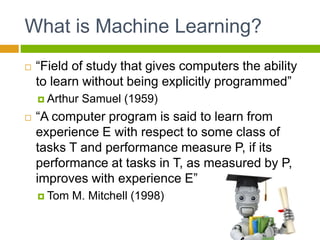
What is Machine Learning?
 “Field of study that gives computers the ability
to learn without being explicitly programmed”
 Arthur Samuel (1959)
 “A computer program is said to learn from
experience E with respect to some class of
tasks T and performance measure P, if its
performance at tasks in T, as measured by P,
improves with experience E”
 Tom M. Mitchell (1998)
Example: Spam Email
Detection
 “A computer program is said to learn from
experience E with respect to some class of
tasks T and performance measure P, if its
performance at tasks in T, as measured by P,
improves with experience E”
 In our project,
 T: classify emails as spam or not spam
 E: watch the user label emails as spam or not
spam
 P: percentage of correctly-identified emails
Overview
 What is machine learning?
 Applications of machine learning
 Types of algorithms
 Basics of statistical pattern recognition
 Preprocessing
 Feature Extraction/Selection
 Learning
 Final remarks
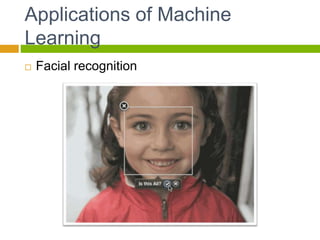
Applications of Machine
Learning
 Facial recognition
Applications of Machine
Learning
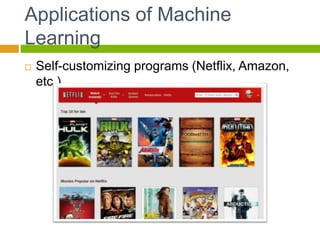
 Self-customizing programs (Netflix, Amazon,
etc.)
Applications of Machine
Learning
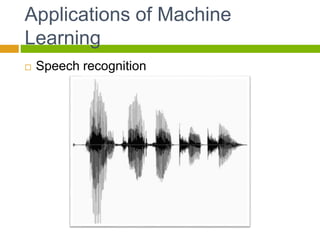
 Speech recognition
Applications of Machine
Learning
 Other applications:
 Spam detection
 Internet search
 Data mining medical records
 Many more!
Overview
 What is machine learning?
 Applications of machine learning
 Types of algorithms
 Basics of statistical pattern recognition
 Preprocessing
 Feature Extraction/Selection
 Learning
 Final remarks
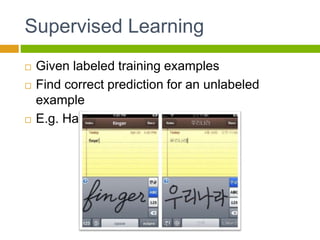
Supervised Learning
 Given labeled training examples
 Find correct prediction for an unlabeled
example
 E.g. Handwriting recognition
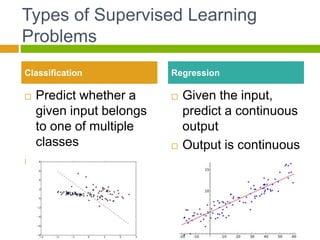
 Predict whether a
given input belongs
to one of multiple
classes
 Output is discrete
Types of Supervised Learning
Problems
 Given the input,
predict a continuous
output
 Output is continuous
Classification Regression
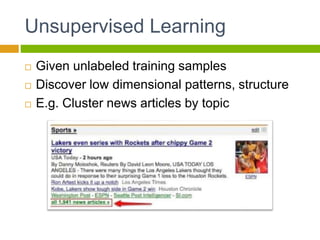
Unsupervised Learning
 Given unlabeled training samples
 Discover low dimensional patterns, structure
 E.g. Cluster news articles by topic
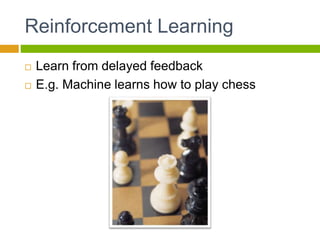
Reinforcement Learning
 Learn from delayed feedback
 E.g. Machine learns how to play chess
Overview
 What is machine learning?
 Applications of machine learning
 Types of algorithms
 Basics of statistical pattern recognition
 Preprocessing
 Feature Extraction/Selection
 Learning
 Final remarks
Model of Statistical Pattern
Recognition
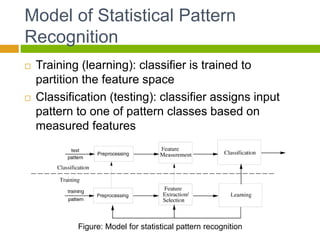
 Training (learning): classifier is trained to
partition the feature space
 Classification (testing): classifier assigns input
pattern to one of pattern classes based on
measured features
Figure: Model for statistical pattern recognition
Model of Statistical Pattern
Recognition
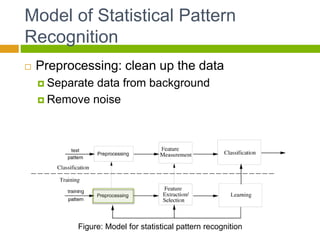
 Preprocessing: clean up the data
 Separate data from background
 Remove noise
Figure: Model for statistical pattern recognition
Model of Statistical Pattern
Recognition
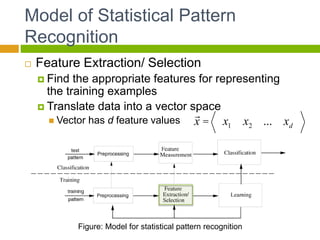
 Feature Extraction/ Selection
 Find the appropriate features for representing
the training examples
 Translate data into a vector space
 Vector has d feature values
Figure: Model for statistical pattern recognition
x = x1 x2 ... xd
Feature Extraction/ Selection
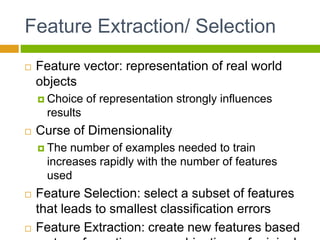
 Feature vector: representation of real world
objects
 Choice of representation strongly influences
results
 Curse of Dimensionality
 The number of examples needed to train
increases rapidly with the number of features
used
 Feature Selection: select a subset of features
that leads to smallest classification errors
 Feature Extraction: create new features based
Model of Statistical Pattern
Recognition
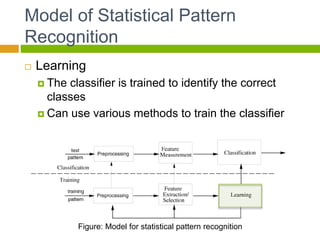
 Learning
 The classifier is trained to identify the correct
classes
 Can use various methods to train the classifier
Figure: Model for statistical pattern recognition
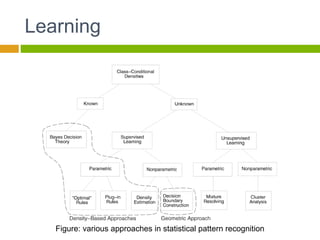
Learning
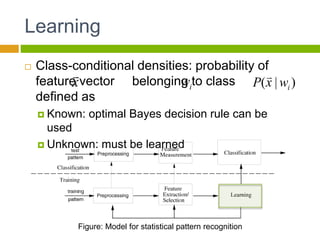
 Class-conditional densities: probability of
feature vector belonging to class
defined as
 Known: optimal Bayes decision rule can be
used
 Unknown: must be learned
Figure: Model for statistical pattern recognition
P(x | wi )
x wi
Learning
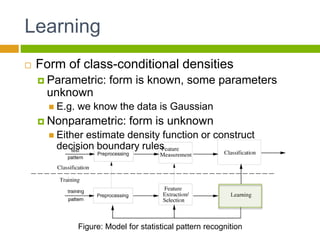
 Form of class-conditional densities
 Parametric: form is known, some parameters
unknown
 E.g. we know the data is Gaussian
 Nonparametric: form is unknown
 Either estimate density function or construct
decision boundary rules
Figure: Model for statistical pattern recognition
Learning
Figure: various approaches in statistical pattern recognition
Overview
 What is machine learning?
 Applications of machine learning
 Types of algorithms
 Basics of statistical pattern recognition
 Preprocessing
 Feature Extraction/Selection
 Learning
 Final remarks
Summary
 Machine learning: computers learn from
experience to improve performance of certain
tasks
 Many useful applications that we use today
 Different steps to machine learning process
 Preprocessing
 Feature Extraction/Selection
 Learning
 Type of problem will affect which approach you
decide to use
Sources
 “Statistical Pattern Recognition: A Review”
 Jain, Anil. K; Duin, Robert. P.W.; Mao, Jianchang
(2000). “Statistical pattern recognition: a review”.
IEEE Transtactions on Pattern Analysis and Machine
Intelligence 22 (1): 4-37
 “Machine Learning” Online Course
 Andrew Ng
 http://openclassroom.stanford.edu/MainFolder/Course
Page.php?course=MachineLearning
 “Machine Learning” Course
 Kilian Weinberger
 http://www.cse.wustl.edu/~kilian/cse517a2010/
Image Sources
 http://googlenewsblog.blogspot.com/2009_05_01
_archive.html
 https://www.coursera.org/course/ml
 http://visionwang.com/2009/01/11/apples-iphoto-
vs-googles-picasa-technology-and-strategy/
 http://www.techhive.com/article/2024221/
 http://forums.macrumors.com/showthread.php?t=
480428
 http://www.stanford.edu/class/cs224s/
 http://en.wikipedia.org/wiki/Machine_learning
Any questions?
Thank you

5864281.ppt

  • 1.
  • 2.
    Overview  What ismachine learning?  Applications of machine learning  Types of algorithms  Basics of statistical pattern recognition  Preprocessing  Feature Extraction/Selection  Learning  Final remarks
  • 3.
    Overview  What ismachine learning?  Applications of machine learning  Types of algorithms  Basics of statistical pattern recognition  Preprocessing  Feature Extraction/Selection  Learning  Final remarks
  • 4.
    What is MachineLearning?  “Field of study that gives computers the ability to learn without being explicitly programmed”  Arthur Samuel (1959)  “A computer program is said to learn from experience E with respect to some class of tasks T and performance measure P, if its performance at tasks in T, as measured by P, improves with experience E”  Tom M. Mitchell (1998)
  • 5.
    Example: Spam Email Detection “A computer program is said to learn from experience E with respect to some class of tasks T and performance measure P, if its performance at tasks in T, as measured by P, improves with experience E”  In our project,  T: classify emails as spam or not spam  E: watch the user label emails as spam or not spam  P: percentage of correctly-identified emails
  • 6.
    Overview  What ismachine learning?  Applications of machine learning  Types of algorithms  Basics of statistical pattern recognition  Preprocessing  Feature Extraction/Selection  Learning  Final remarks
  • 7.
  • 8.
    Applications of Machine Learning Self-customizing programs (Netflix, Amazon, etc.)
  • 9.
  • 10.
    Applications of Machine Learning Other applications:  Spam detection  Internet search  Data mining medical records  Many more!
  • 11.
    Overview  What ismachine learning?  Applications of machine learning  Types of algorithms  Basics of statistical pattern recognition  Preprocessing  Feature Extraction/Selection  Learning  Final remarks
  • 12.
    Supervised Learning  Givenlabeled training examples  Find correct prediction for an unlabeled example  E.g. Handwriting recognition
  • 13.
     Predict whethera given input belongs to one of multiple classes  Output is discrete Types of Supervised Learning Problems  Given the input, predict a continuous output  Output is continuous Classification Regression
  • 14.
    Unsupervised Learning  Givenunlabeled training samples  Discover low dimensional patterns, structure  E.g. Cluster news articles by topic
  • 15.
    Reinforcement Learning  Learnfrom delayed feedback  E.g. Machine learns how to play chess
  • 16.
    Overview  What ismachine learning?  Applications of machine learning  Types of algorithms  Basics of statistical pattern recognition  Preprocessing  Feature Extraction/Selection  Learning  Final remarks
  • 17.
    Model of StatisticalPattern Recognition  Training (learning): classifier is trained to partition the feature space  Classification (testing): classifier assigns input pattern to one of pattern classes based on measured features Figure: Model for statistical pattern recognition
  • 18.
    Model of StatisticalPattern Recognition  Preprocessing: clean up the data  Separate data from background  Remove noise Figure: Model for statistical pattern recognition
  • 19.
    Model of StatisticalPattern Recognition  Feature Extraction/ Selection  Find the appropriate features for representing the training examples  Translate data into a vector space  Vector has d feature values Figure: Model for statistical pattern recognition x = x1 x2 ... xd
  • 20.
    Feature Extraction/ Selection Feature vector: representation of real world objects  Choice of representation strongly influences results  Curse of Dimensionality  The number of examples needed to train increases rapidly with the number of features used  Feature Selection: select a subset of features that leads to smallest classification errors  Feature Extraction: create new features based
  • 21.
    Model of StatisticalPattern Recognition  Learning  The classifier is trained to identify the correct classes  Can use various methods to train the classifier Figure: Model for statistical pattern recognition
  • 22.
    Learning  Class-conditional densities:probability of feature vector belonging to class defined as  Known: optimal Bayes decision rule can be used  Unknown: must be learned Figure: Model for statistical pattern recognition P(x | wi ) x wi
  • 23.
    Learning  Form ofclass-conditional densities  Parametric: form is known, some parameters unknown  E.g. we know the data is Gaussian  Nonparametric: form is unknown  Either estimate density function or construct decision boundary rules Figure: Model for statistical pattern recognition
  • 24.
    Learning Figure: various approachesin statistical pattern recognition
  • 25.
    Overview  What ismachine learning?  Applications of machine learning  Types of algorithms  Basics of statistical pattern recognition  Preprocessing  Feature Extraction/Selection  Learning  Final remarks
  • 26.
    Summary  Machine learning:computers learn from experience to improve performance of certain tasks  Many useful applications that we use today  Different steps to machine learning process  Preprocessing  Feature Extraction/Selection  Learning  Type of problem will affect which approach you decide to use
  • 27.
    Sources  “Statistical PatternRecognition: A Review”  Jain, Anil. K; Duin, Robert. P.W.; Mao, Jianchang (2000). “Statistical pattern recognition: a review”. IEEE Transtactions on Pattern Analysis and Machine Intelligence 22 (1): 4-37  “Machine Learning” Online Course  Andrew Ng  http://openclassroom.stanford.edu/MainFolder/Course Page.php?course=MachineLearning  “Machine Learning” Course  Kilian Weinberger  http://www.cse.wustl.edu/~kilian/cse517a2010/
  • 28.
    Image Sources  http://googlenewsblog.blogspot.com/2009_05_01 _archive.html https://www.coursera.org/course/ml  http://visionwang.com/2009/01/11/apples-iphoto- vs-googles-picasa-technology-and-strategy/  http://www.techhive.com/article/2024221/  http://forums.macrumors.com/showthread.php?t= 480428  http://www.stanford.edu/class/cs224s/  http://en.wikipedia.org/wiki/Machine_learning
  • 29.

Editor's Notes

  • #8 Training examples: tagged photos of person of interest Output: prediction if picture is of person of interest
  • #9 Input: movies watched and movies rated positively Output: prediction of movies that watcher will enjoy
  • #10 Input: speech waveform Output: actual words spoken
  • #11 Spam detection – classify emails into spam vs ham Internet search – select most relevent web pages Medical records – predict disease or risks from patterns in medical data
  • #13 Supervised Learning – We know the correct answer
  • #14 Two main types of supervised learning problems
  • #15 Need to seek out patterns in the data
  • #16 Example – learn from past experience In chess, the computer will learn which positions lead to winning games
  • #21 Want to reduce the number of features needed