Road To
Machine
Learning
Md. Mahfujur Rahman,
Lecturer, CSE, DIU
CONTENTS
❏ What is Machine Learning?
❏ Machine Learning VS Traditional Programming
❏ Types of Machine learning
❏ Supervised Learning
❏ Unsupervised Learning
❏ ML VS DEEP Learning
❏ How a machine learning algorithm learns?
❏ Working Procedure of ML
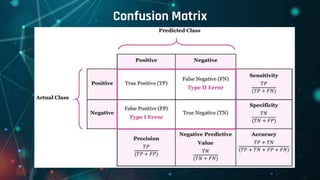
❏ Confusion Matrix
❏ ML Performance Analysis
❏ ML Case Studies
❏ Need Math Background?
❏ Programming experience
❏ Where we do ML Code?
What is Machine Learning?
❖ Show the computer some real world data and
let it learn from it
❖ Machine Learning is the study of
algorithms that improve their
performance at some task with
experience
❖ Machine learning is a field of computer science
that gives computers the ability to learn
without being explicitly programmed.
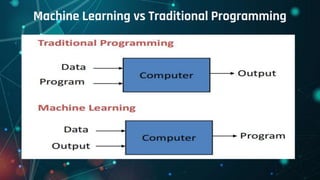
Machine Learning vs Traditional Programming
Types of Machine Learning
❖ Supervised learning
– Given: training data +
desired outputs (labels)
❖ Unsupervised learning – Given: training
data (without desired outputs)
❖ Reinforcement learning – Rewards from
sequence of actions
Supervised Learning Algorithms
Common classification algorithms include:
❖ Support vector machines (SVM)
❖ Neural networks
❖ Naïve Bayes classifier
❖ Decision trees
❖ Discriminant analysis
❖ Nearest neighbors (kNN)
Common regression algorithms include:
❖ Linear regression
❖ Nonlinear regression
❖ Generalized linear models
❖ Decision trees
❖ Neural networks
Unsupervised Algorithms
❖ K-means clustering
❖ Principal Component Analysis (PCA)
❖ Gaussian Mixture Models (GMM)
❖ Self-organizing Maps (SOM)
❖ Hidden Markov Models (HMM)
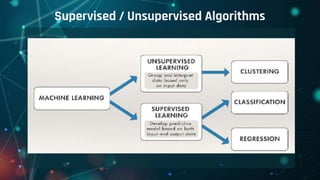
Supervised / Unsupervised Algorithms
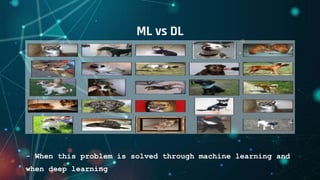
ML vs DL
- When this problem is solved through machine learning and
when deep learning
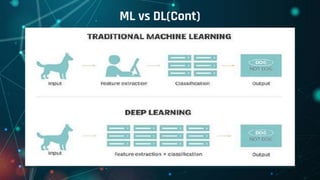
ML vs DL(Cont)
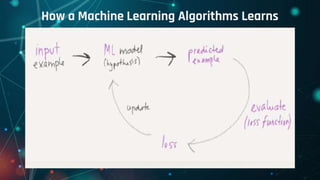
How a Machine Learning Algorithms Learns
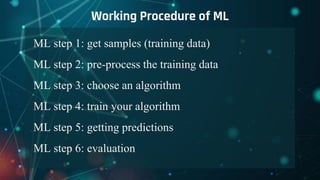
Working Procedure of ML
ML step 1: get samples (training data)
ML step 2: pre-process the training data
ML step 3: choose an algorithm
ML step 4: train your algorithm
ML step 5: getting predictions
ML step 6: evaluation
Model Evaluation
❖ Cross Validation
❖ Classification Metrics
- Confusion Matrix
- Accuracy
- Precision
- Recall
- Area Under Curve
- F Measures
Confusion Matrix
ML Case Studies
ML Case Studies
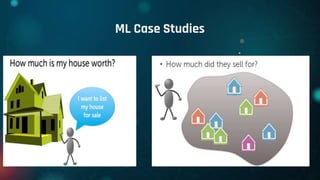
CASE STUDY 1: Predicting House Price
ML Case Studies
CASE STUDY 2: Sentiment Analysis
ML Case Studies
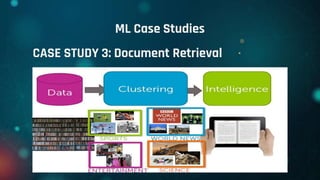
CASE STUDY 3: Document Retrieval
ML Case Studies
CASE STUDY 4: Product Recommendation
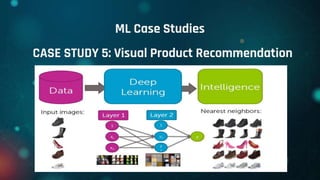
ML Case Studies
CASE STUDY 5: Visual Product Recommendation
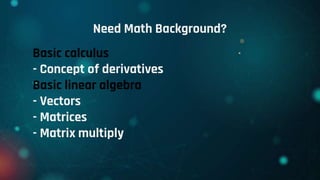
Need Math Background?
Basic calculus
- Concept of derivatives
Basic linear algebra
- Vectors
- Matrices
- Matrix multiply
Programming Experience
Programming Language:
- Python
ML/DL Tool Kits:
- Scikit-Learn
- Tensorflow
- PyTorch
- Keras
Where We do ML Code
Off Line Platform:
- Anaconda: https://www.anaconda.com/products/individual
- Pycharm: https://www.jetbrains.com/pycharm/
Online Platform:
- Google Colaboratory:
https://colab.research.google.com/notebooks/intro.ipynb
-Jupyter: https://jupyter.org/
Questions?

Road to machine learning

  • 1.
    Road To Machine Learning Md. MahfujurRahman, Lecturer, CSE, DIU
  • 3.
    CONTENTS ❏ What isMachine Learning? ❏ Machine Learning VS Traditional Programming ❏ Types of Machine learning ❏ Supervised Learning ❏ Unsupervised Learning ❏ ML VS DEEP Learning ❏ How a machine learning algorithm learns? ❏ Working Procedure of ML ❏ Confusion Matrix ❏ ML Performance Analysis ❏ ML Case Studies ❏ Need Math Background? ❏ Programming experience ❏ Where we do ML Code?
  • 4.
    What is MachineLearning? ❖ Show the computer some real world data and let it learn from it ❖ Machine Learning is the study of algorithms that improve their performance at some task with experience ❖ Machine learning is a field of computer science that gives computers the ability to learn without being explicitly programmed.
  • 5.
    Machine Learning vsTraditional Programming
  • 6.
    Types of MachineLearning ❖ Supervised learning – Given: training data + desired outputs (labels) ❖ Unsupervised learning – Given: training data (without desired outputs) ❖ Reinforcement learning – Rewards from sequence of actions
  • 7.
    Supervised Learning Algorithms Commonclassification algorithms include: ❖ Support vector machines (SVM) ❖ Neural networks ❖ Naïve Bayes classifier ❖ Decision trees ❖ Discriminant analysis ❖ Nearest neighbors (kNN) Common regression algorithms include: ❖ Linear regression ❖ Nonlinear regression ❖ Generalized linear models ❖ Decision trees ❖ Neural networks
  • 8.
    Unsupervised Algorithms ❖ K-meansclustering ❖ Principal Component Analysis (PCA) ❖ Gaussian Mixture Models (GMM) ❖ Self-organizing Maps (SOM) ❖ Hidden Markov Models (HMM)
  • 9.
  • 10.
    ML vs DL -When this problem is solved through machine learning and when deep learning
  • 11.
  • 12.
    How a MachineLearning Algorithms Learns
  • 13.
    Working Procedure ofML ML step 1: get samples (training data) ML step 2: pre-process the training data ML step 3: choose an algorithm ML step 4: train your algorithm ML step 5: getting predictions ML step 6: evaluation
  • 14.
    Model Evaluation ❖ CrossValidation ❖ Classification Metrics - Confusion Matrix - Accuracy - Precision - Recall - Area Under Curve - F Measures
  • 15.
  • 16.
  • 17.
    ML Case Studies CASESTUDY 1: Predicting House Price
  • 18.
    ML Case Studies CASESTUDY 2: Sentiment Analysis
  • 19.
    ML Case Studies CASESTUDY 3: Document Retrieval
  • 20.
    ML Case Studies CASESTUDY 4: Product Recommendation
  • 21.
    ML Case Studies CASESTUDY 5: Visual Product Recommendation
  • 22.
    Need Math Background? Basiccalculus - Concept of derivatives Basic linear algebra - Vectors - Matrices - Matrix multiply
  • 23.
    Programming Experience Programming Language: -Python ML/DL Tool Kits: - Scikit-Learn - Tensorflow - PyTorch - Keras
  • 24.
    Where We doML Code Off Line Platform: - Anaconda: https://www.anaconda.com/products/individual - Pycharm: https://www.jetbrains.com/pycharm/ Online Platform: - Google Colaboratory: https://colab.research.google.com/notebooks/intro.ipynb -Jupyter: https://jupyter.org/
  • 25.